
Click on this LINK for previous OurReviews2022
Click on this LINK for previous OurReviews2021
Click on this LINK for previous OurReviews2020
30/12/23 Mike writes –
Cold War
Book by Conor McPherson, Music by Elvis Costello, Based on the film by Paweł Pawlikowski, at the Almeida Theatre

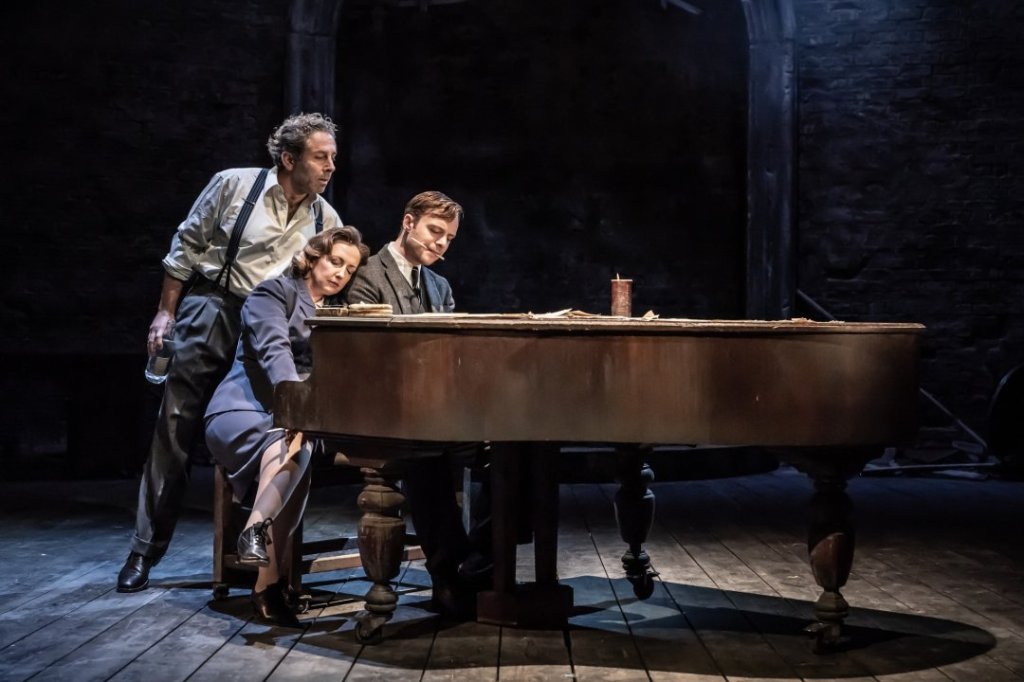
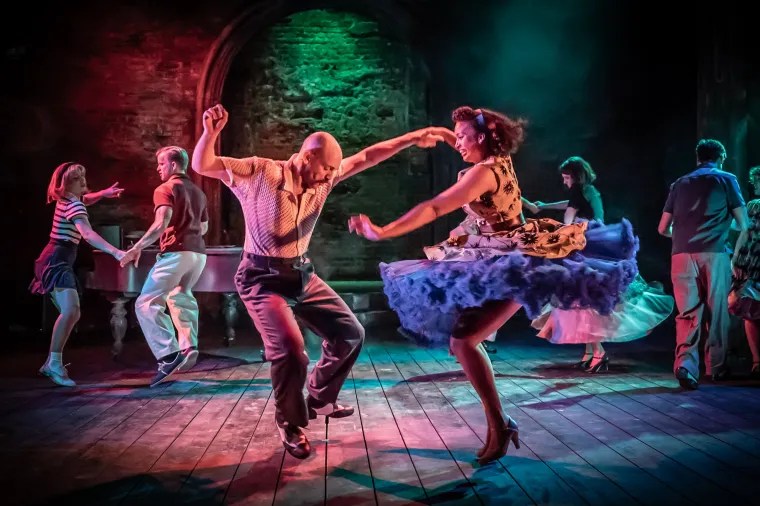
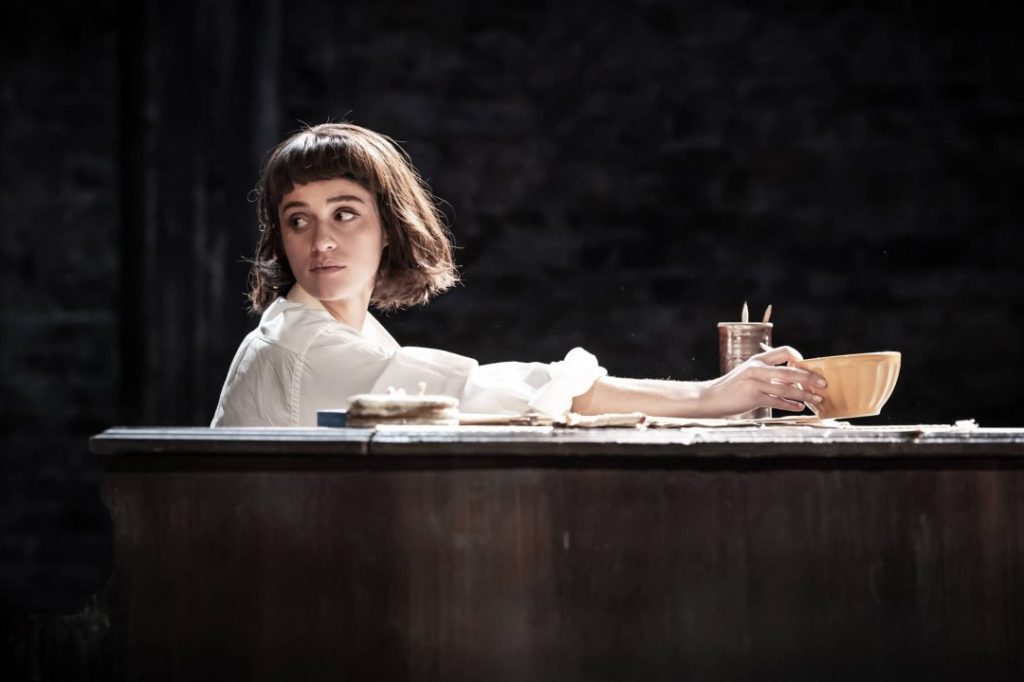
Photos: Marc Brenner
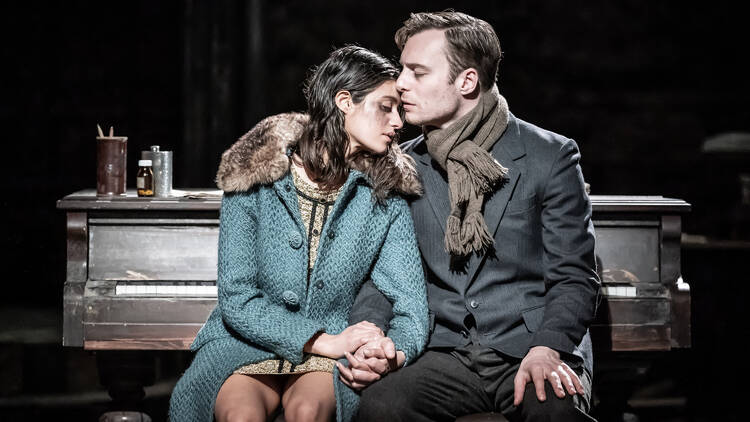
We admired the 2018 Polish film “Cold War” and this stage musical adaptation had high flying credentials – book by Conor McPherson, songs by Elvis Costello, and directed by Rupert Gould. We saw it just after Christmas so perhaps our spirits were too high for such a sad and retro love story. We remembered Conor McPherson’s heartbreaking ’Girl from the North Country’ which used Bob Dylan’s songs for a sad tale of folk scraping a living in reduced circumstances – this brought devastating results for the fictional characters as well as for the audience. More of the same, please.
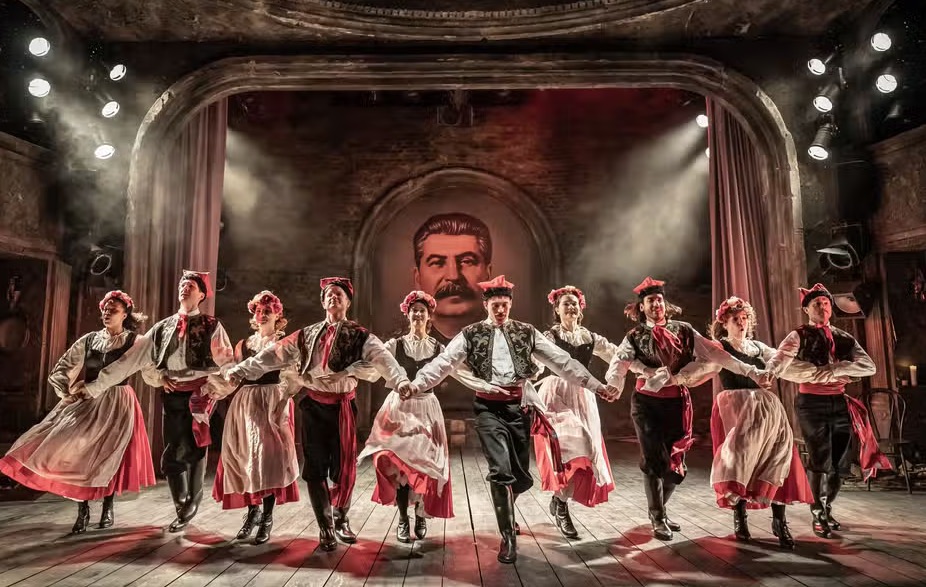
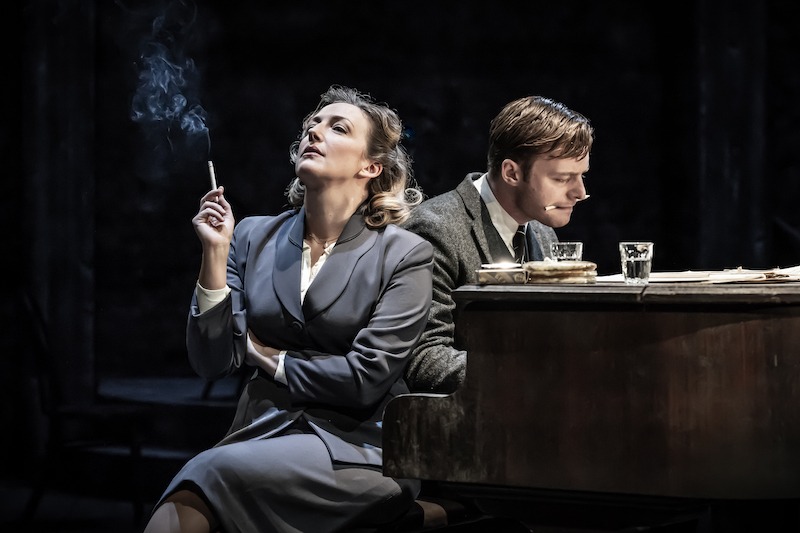
This was not to be. It began uncertainly with auditions for a folk music show which reminded me of those song’n’dance Folk Evenings (with embroidered waistcoats, frilly aprons and ribbons) that we are always offered on European Tours. A couple, ill-matched in character, meet in 1950s Poland – he plays the piano, she sings plaintive songs – they bond, they part, they meet again in different circumstances then part again. It’s the time of the Cold War in Europe: can borders be crossed (both geographical and temperamental) to ensure a resolution to this tale of love in a Cold War climate?
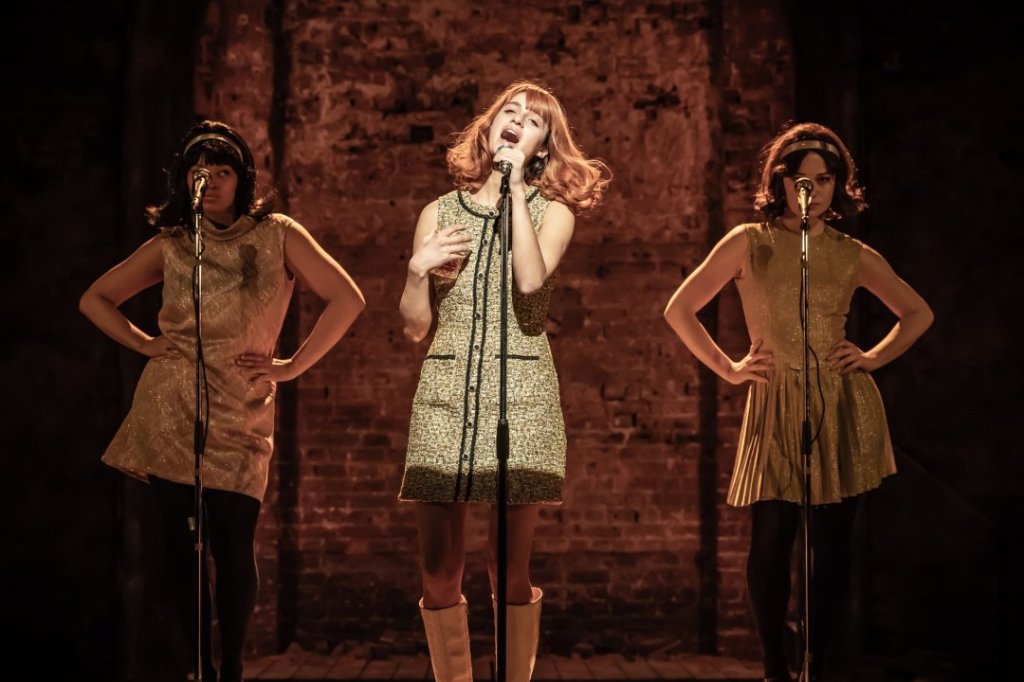
When Wiktor meets Zula they sort of click, but argue too and to me their relationship suggested antagonism more than magnetism. Zula remains in the East when Wiktor flees to the West. In both zones traditional songs are being rewritten either for communist ideals or commercial profit – oppression is political in East Europe but commercial in West Europe.
Of course musicals have historically taught us that love changes everything, but the love here never radiates any genuine emotion beyond the stage. The songs are just perfunctory pauses in the plot, and the occasional folk dance routine is strictly a temporary change to the forlorn tone. The musical numbers are directed at an unseen audience and we hear recorded applause, a killer of real applause, so there is no live audience response to the ‘entertainment’ until the interval and final curtain.
My reaction was at odds with the Islington audience who applauded with enthusiasm at the end, perhaps to show off their politics more than their pleasure. Certainly the cast did their best with the material – Luke Thallon had the measure of his role as Wiktor but his subdued portrayal would have been better suited to film than stage; Anya Chalotra’s Zula was unable to overcome her charmless script. Alex Young is wasted in a minor role. The other cast of more than a dozen fulfilled numerous roles with enthusiasm.
I feel I should praise all the effort by cast and company put into the staging but hold back on praise for the writing which really did not do justice to the original film. My rating will be an average for overall effort, and certainly less than the many 4 star reviews given by newspaper critics.
Our rating:★★½ / Group appeal: ★★★
16/12/23 Fredo writes –
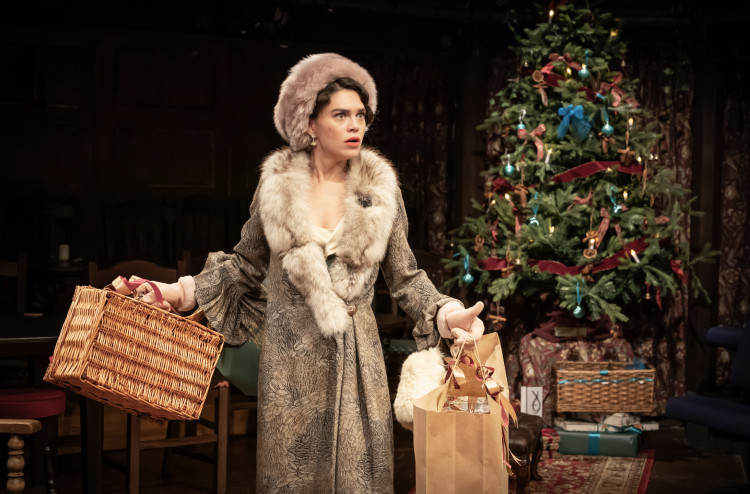
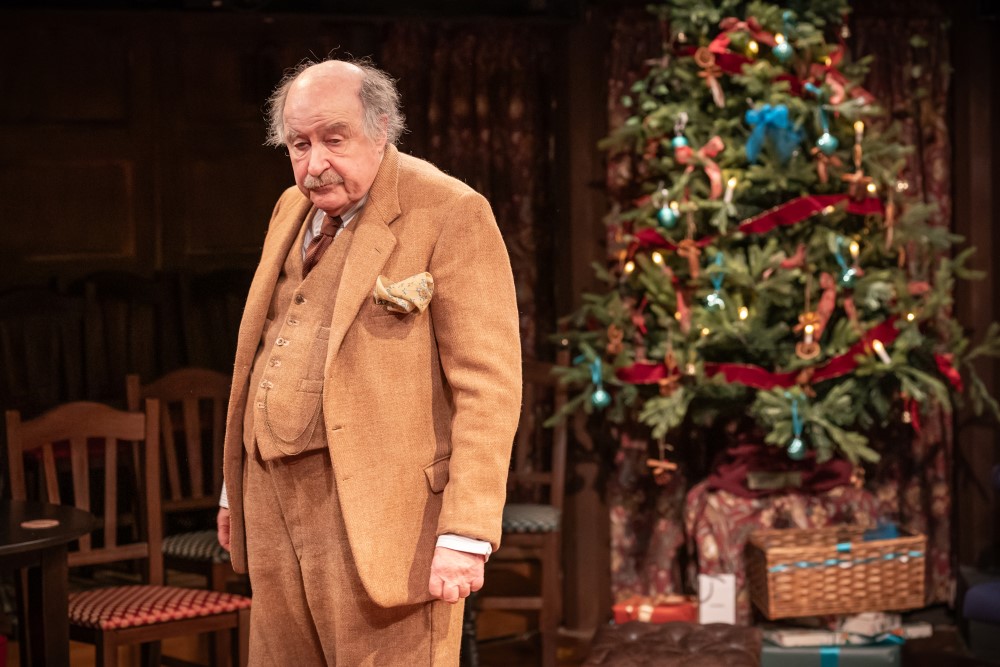
She Stoops to Conquer
by Oliver Goldsmith, at the Orange Tree Theatre
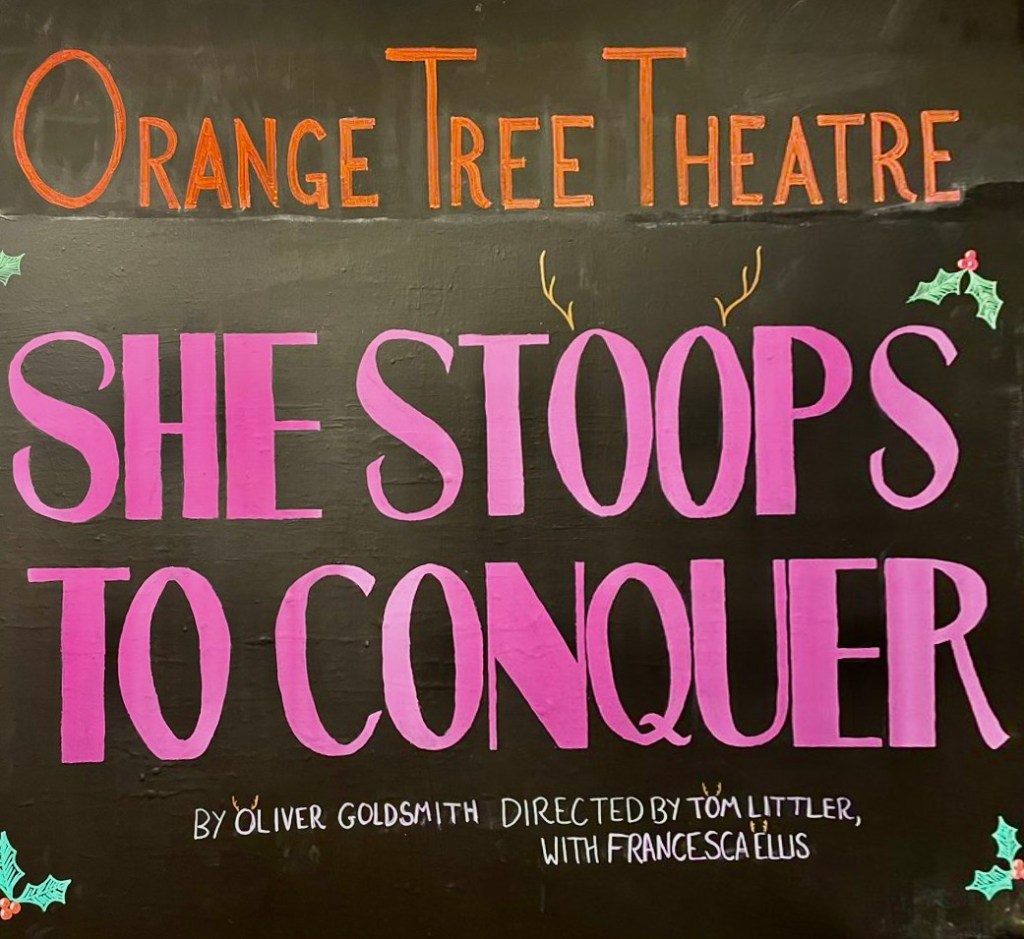
There are good reasons why Oliver Goldsmith’s comedy has remained popular since it was first seen in 1773. It has likeable characters, humorous situations and a happy ending – something for everyone, a comedy tonight! This latest incarnation on the Orange Tree’s tiny in-the-round acting space makes small gestures towards updating it to the 1930s, but there’s scarcely a hint of P G Wodehouse to the proceedings. Instead, the ‘mistakes of a night’ are played for all they’re worth by an expert cast.
Veteran David Horovitch is an old hand at this game, and we’re in safe hands there. Who would have predicted that Greta Scacchi, so often used as eye-candy in movies in the 70s and 80s, would develop into a comic character actress, gamely letting herself go to add to the fun? Or that rising star Tanya Reynolds, so intense in the downbeat A Mirror (at the Almeida) would revel in such a spirited performance?
For me, the acting honours go to Freddie Fox, expertly transforming from tongue-tied suitor to would-be seducer, and all the while demonstrating his own sheer enjoyment in performing. The play lights up when he’s on-stage, and in truth, it doesn’t flag even when he’s not there.
This play used to adorn the West End regularly with all-star casts. It’s reassuring to know that there are still actors with the skills to make it sing.
Our rating:★★★½ / Group appeal: ★★★
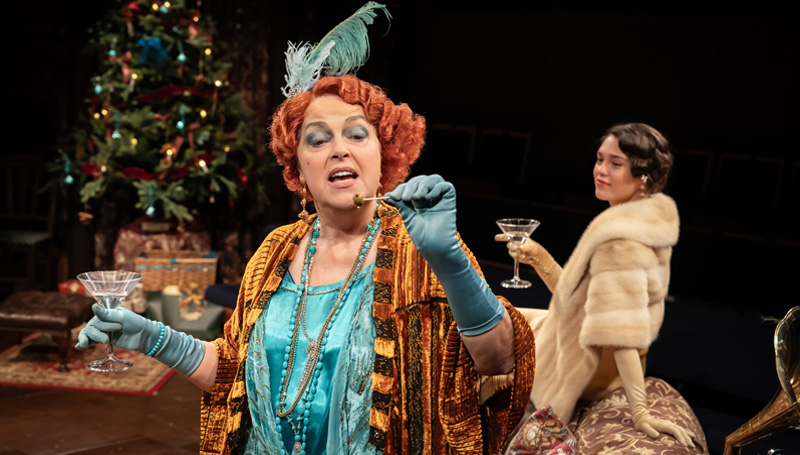
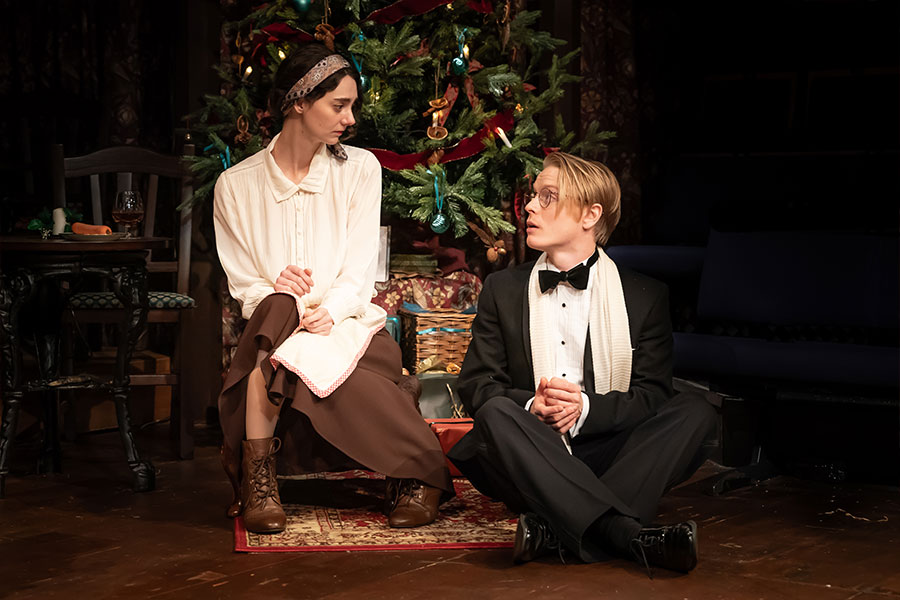
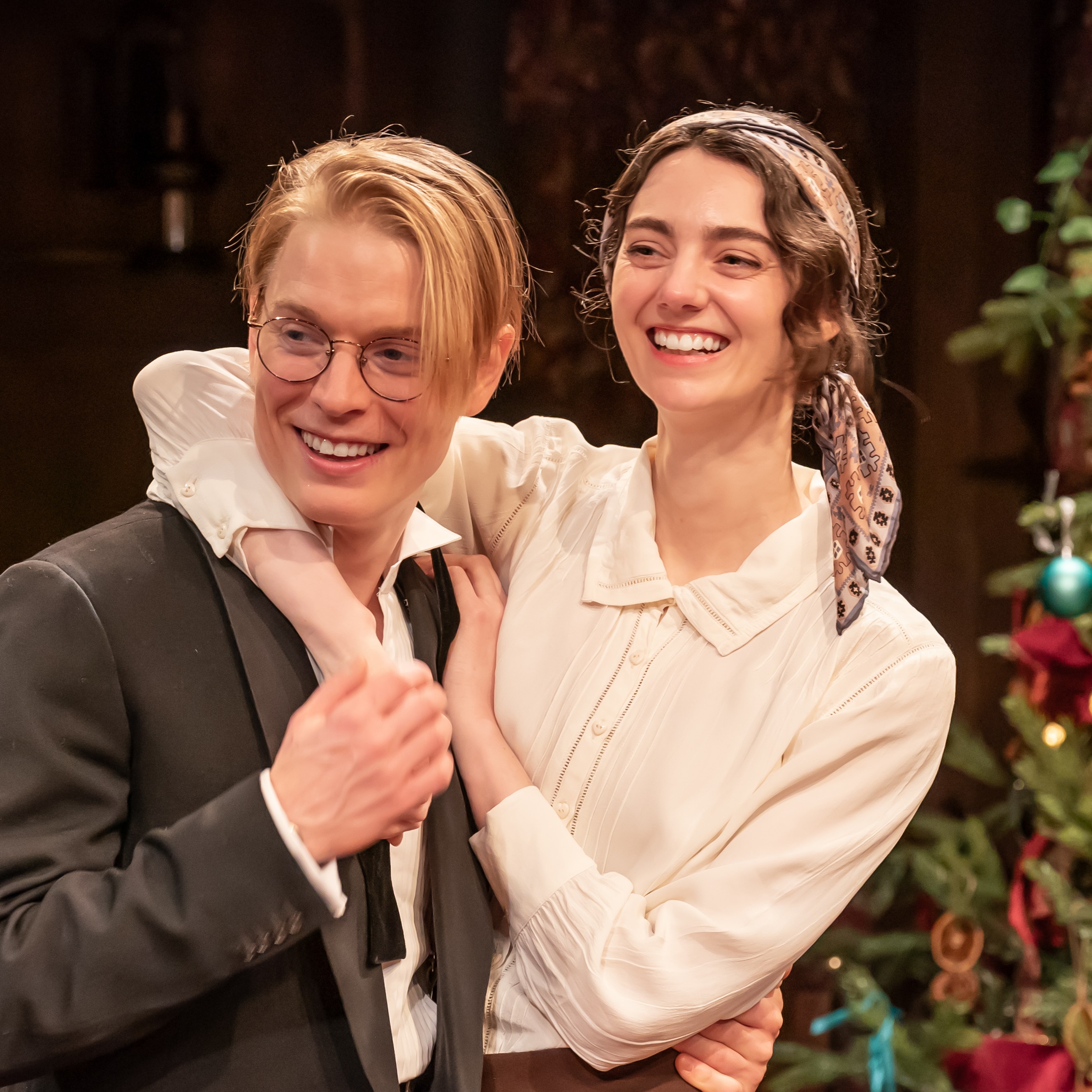
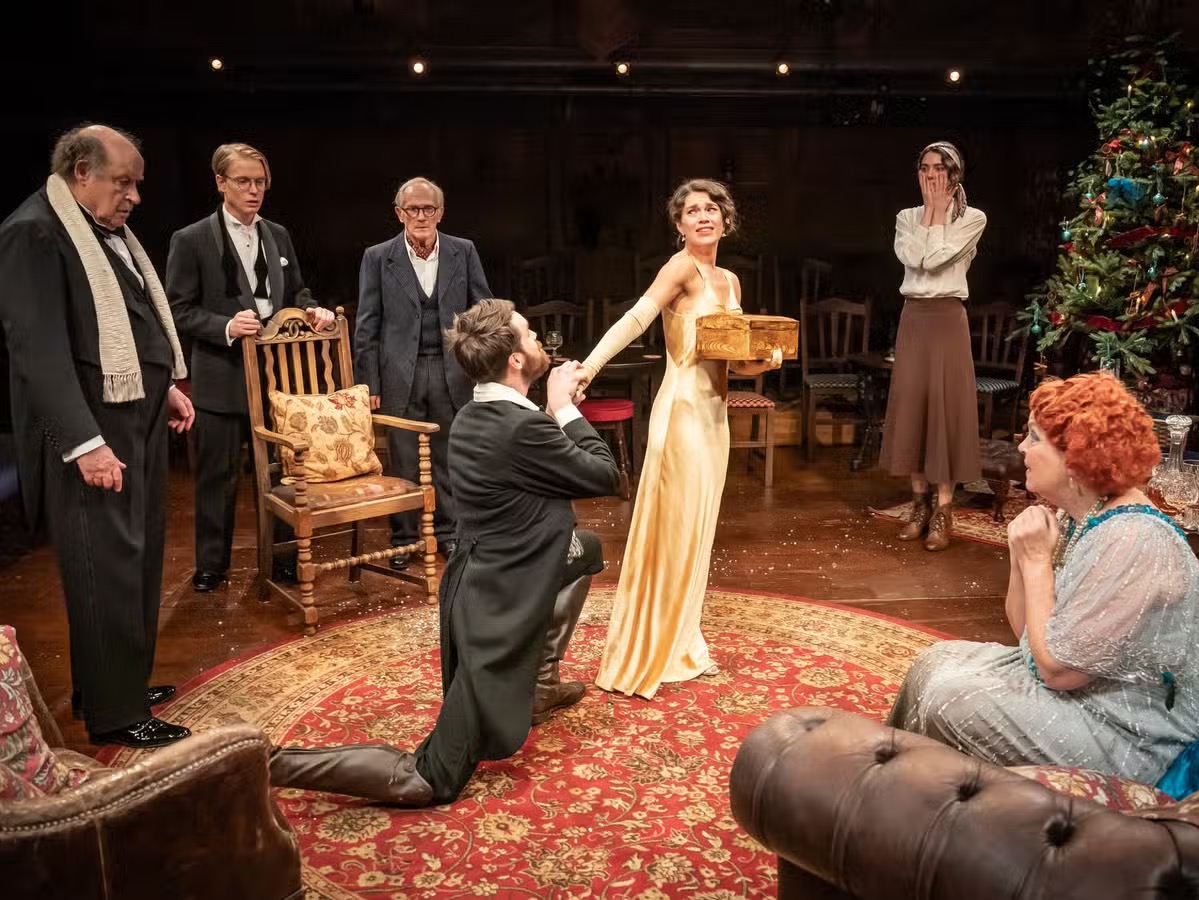
Photos: Marc Brenner
15/12/23 Mike writes –
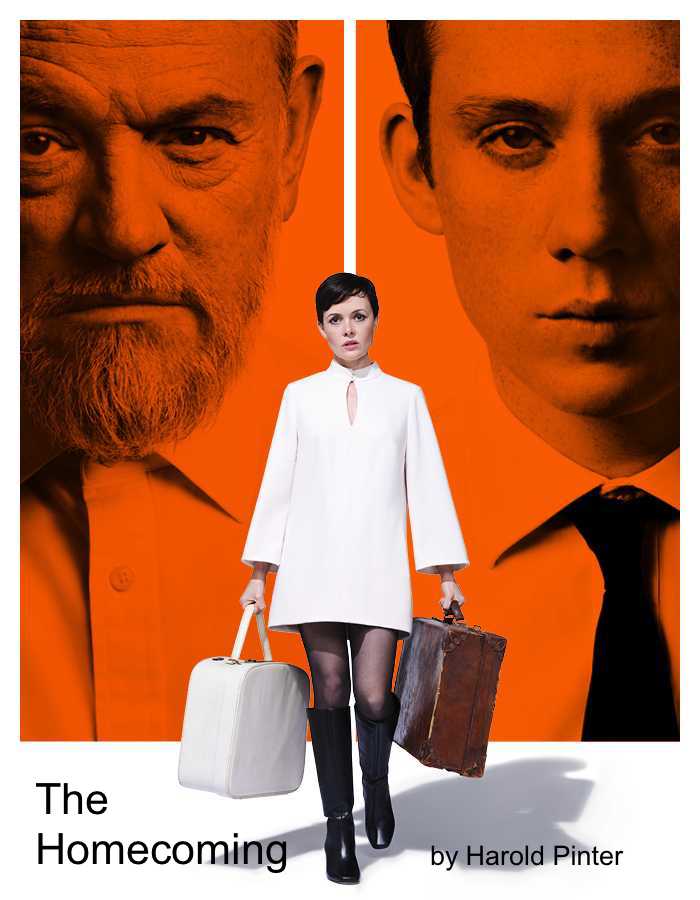
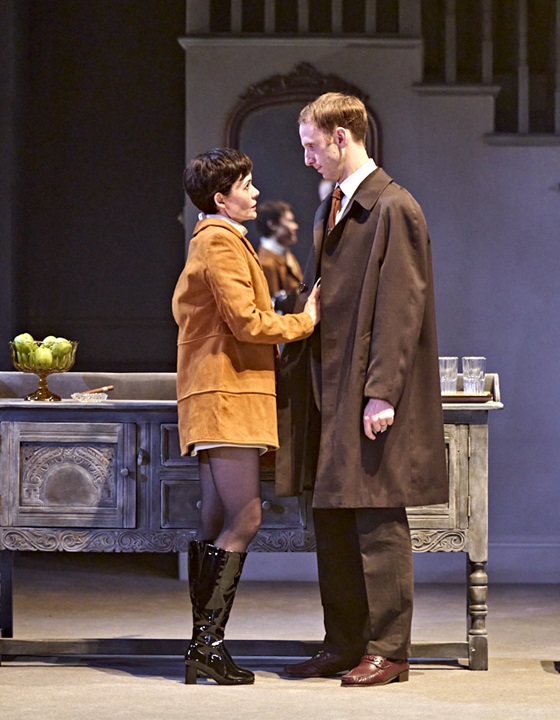
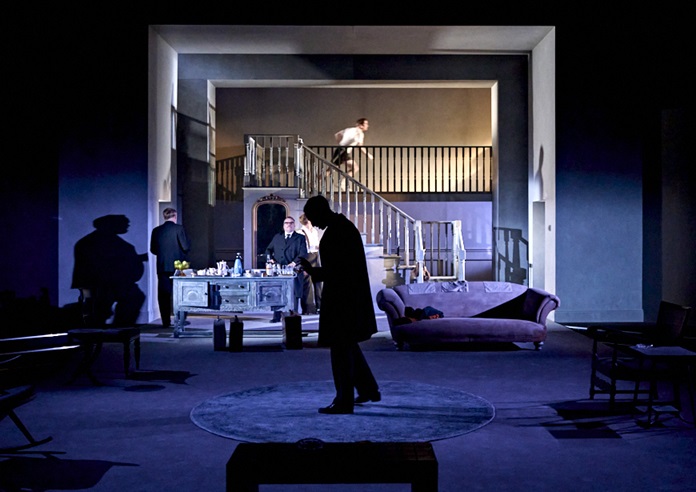
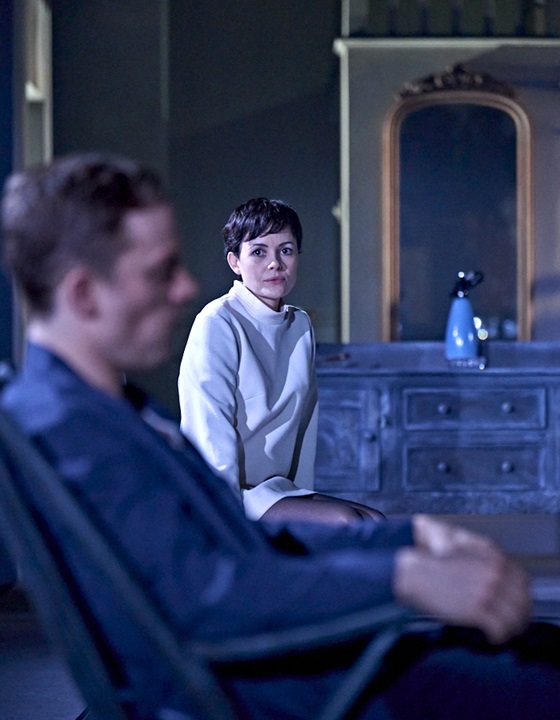
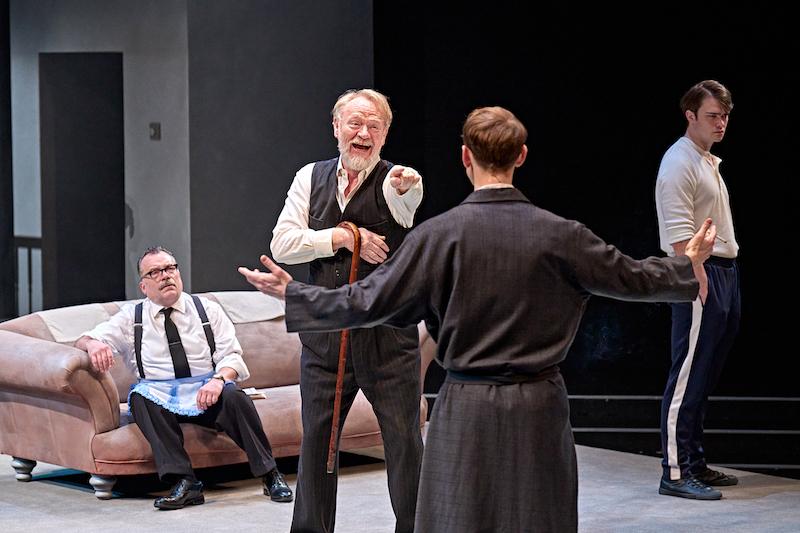
The Homecoming
by Harold Pinter, at the Young Vic Theatre
(View from our front row seats)
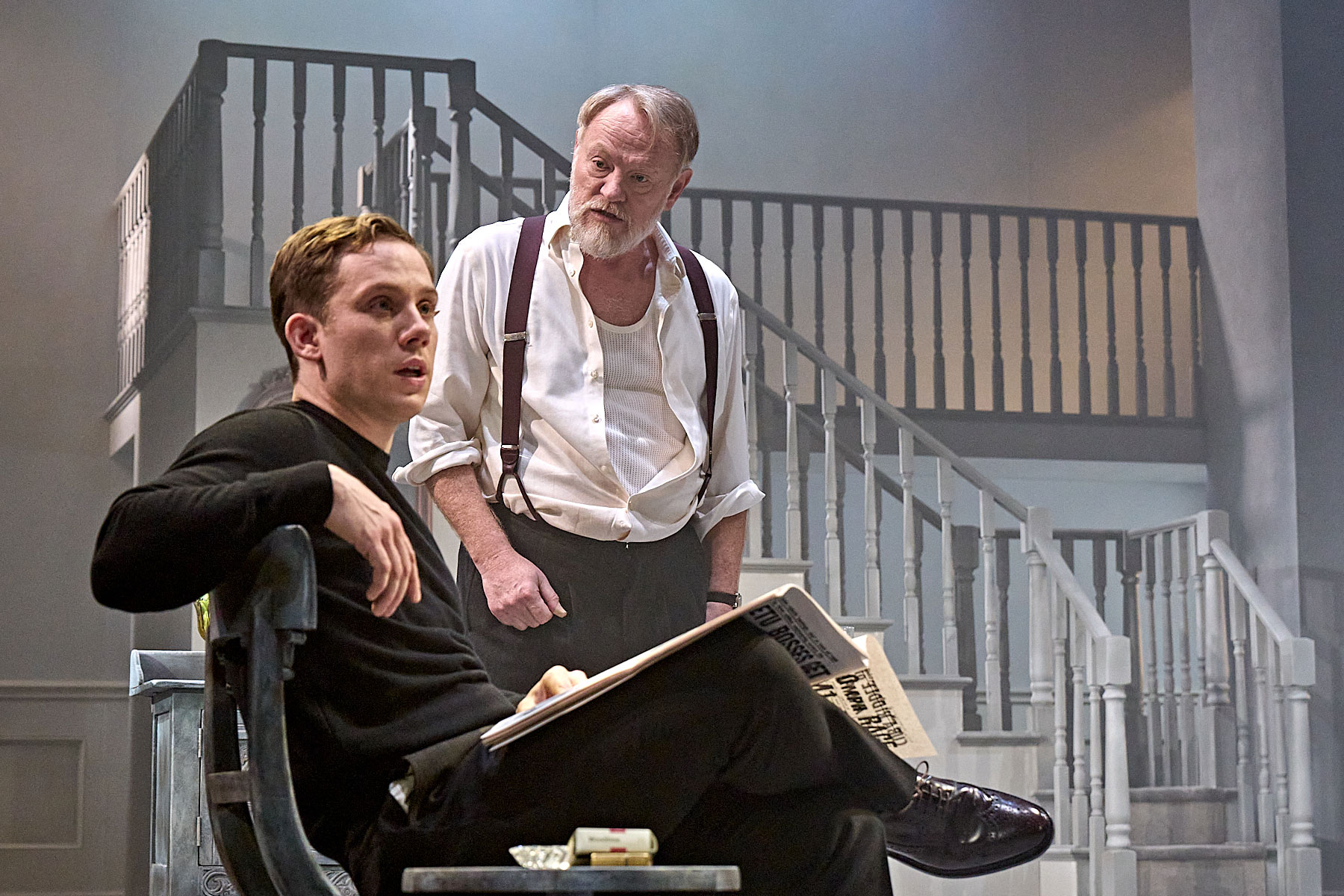
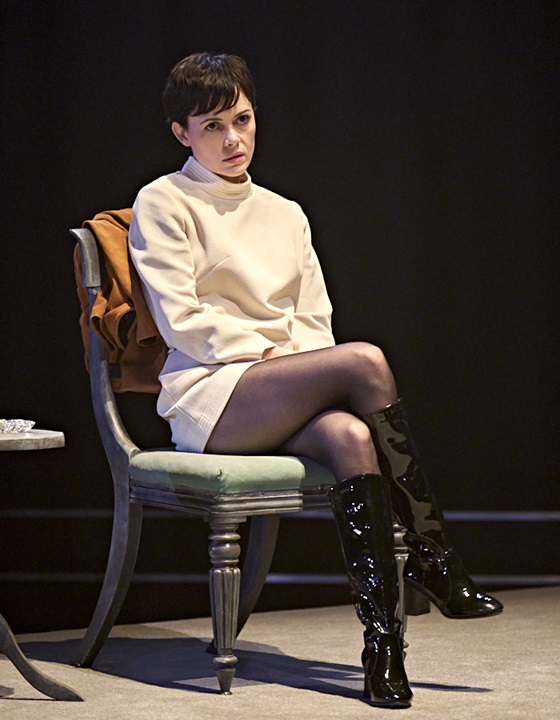
The question was asked this week (by Clive Davis of the Times, following his ★★ review) – Is The Homecoming a masterpiece, or is it showing its age? It’s a play with longevity, often reappearing in different interpretations, often dependent on its cast or director, much like Hamlet or Hedda Gabler, or revivals of Miller and Stoppard. And of course Pinter.
The Homecoming dates from 1965, certainly of its time but is it for all time, is it relevant out of its original context? I think the answer to Davis’s question is Both – its original qualities do not fade with age, you just view them from a different perspective. No play, once a classic of its time, should fall victim to the vagaries of subsequent political thinking.
You may remember this is the one where academic Teddy brings his demure wife Ruth back from America to meet his all male North London family household – father, uncle and two brothers – all aggressive, chauvinist, old-school monsters. By the end (Spoiler, but well known by now) Ruth becomes a whore for the household, but on her own very strict terms to ensnare the men. To some it’s a misogynist male fantasy, but to others it shows feminist power. Like or detest it for its characters and plot, it remains one to shock and linger in the memory, regularly bouncing back from history with various directors’ new ideas. For me it’s a play of importance and arguably a masterpiece because of the way it forever resonates with its audiences in so many different ways, faces up to our fears or fantasies, confronts our expectations, and reaches parts of our consciousness we may not want disturbed.
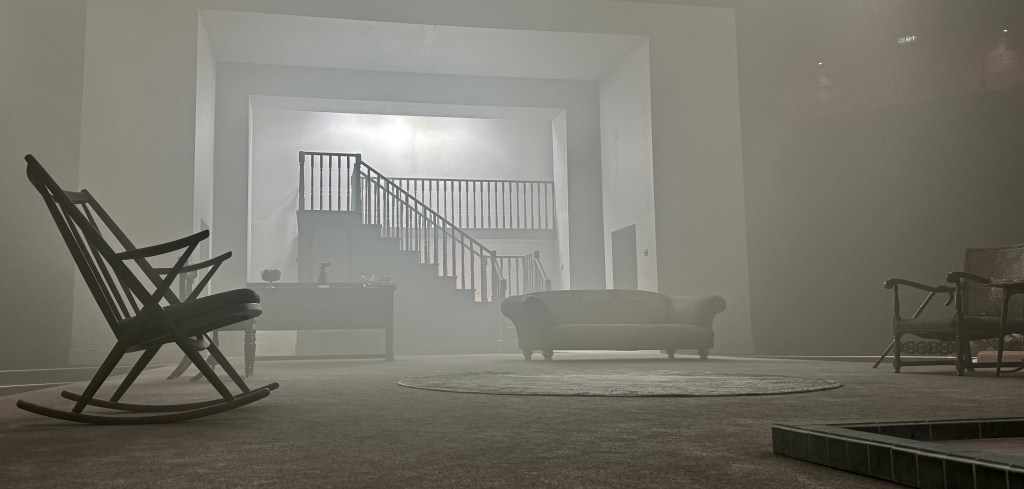
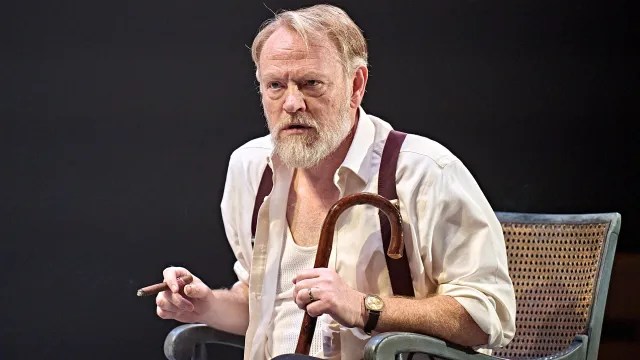
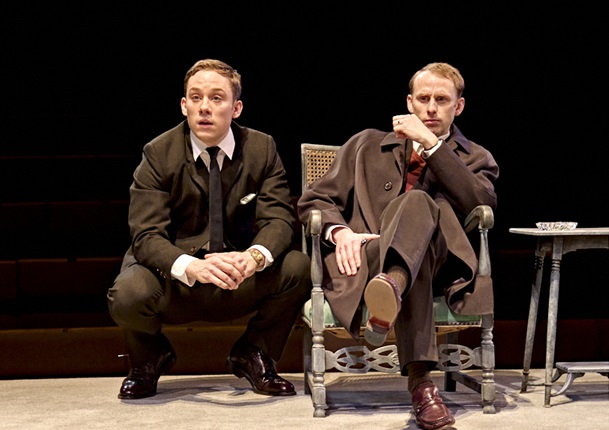
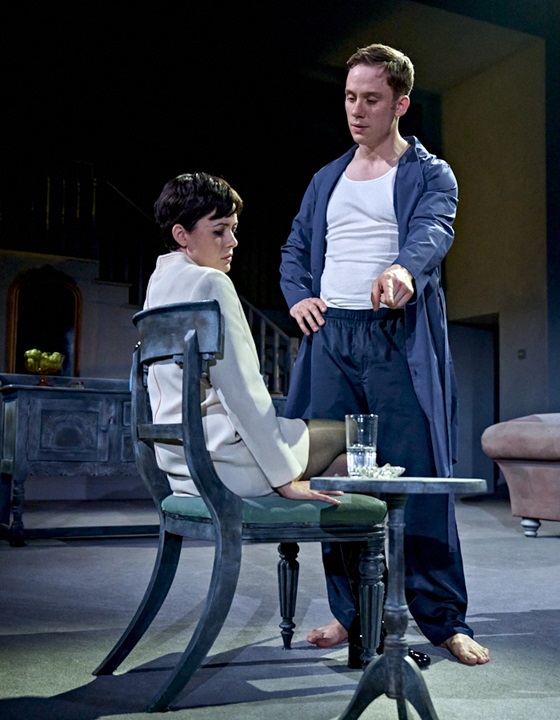
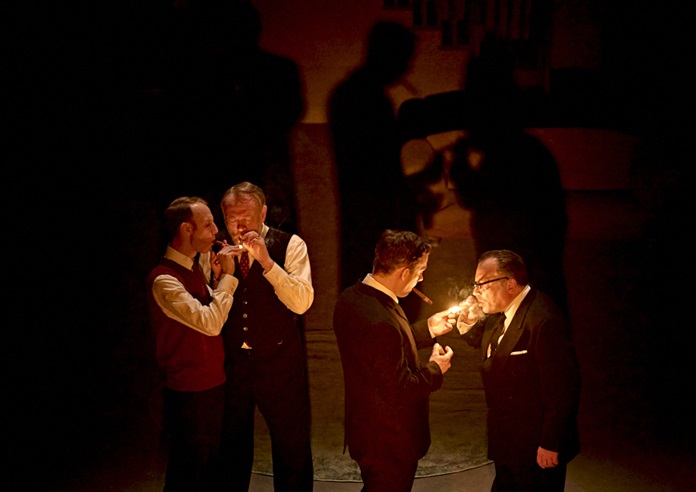
This time, director Matthew Dunster avoids any realistic style – the fifty shades of grey stage is filled with mist as thunderous percussive sounds greet us when we enter. The natty suits and the the Dansette playing Connie Frances are the only reference points to the otherwise timeless presentation. This seemed right, but I thought less appropriate was Ruth presented as a demure dolly-bird instead of a femme fatale. And the weak Teddy had nowhere to recoil from as he became the surplus reject.
Today’s audience found more to laugh at in the play than I remember, but was it humour or those other triggers of laughter – nervousness, embarrassment or surprise? I missed the signature Pinter tension and apprehension here, though sudden outbreaks of violence, isolated in a spotlight, were highly effective.
Jared Harris leads the cast as Max, the father (much bombast but to little affect), but most impressive is Joe Cole as the self-important son Lenny, pimping, prancing and pernickety, but a fuse waiting to be lit; a riveting performance. I felt that Lisa Diveny, as the wife Ruth, lacked the undercurrent of sexual tension necessary before a too sudden change into eager provider of requested sexual services. Nevertheless, two of the men collapse symbolically at her feet here, neutered. Fredo informs me the final tableau vivant is a Pietà pose, certainly an appropriate and thoughtful image on which to fade the lights.
It’s still a play to relish, but this presentation added little more than a modern flourish to the text. Interpretations may falter, but the play’s classic stature remains.
My rating:★★★½ / Group appeal: ★★
Photos: Manuel Harlan
14/12/23 Fredo writes –
Infinite Life
by Annie Baker, at he National: Dorfman Theatre
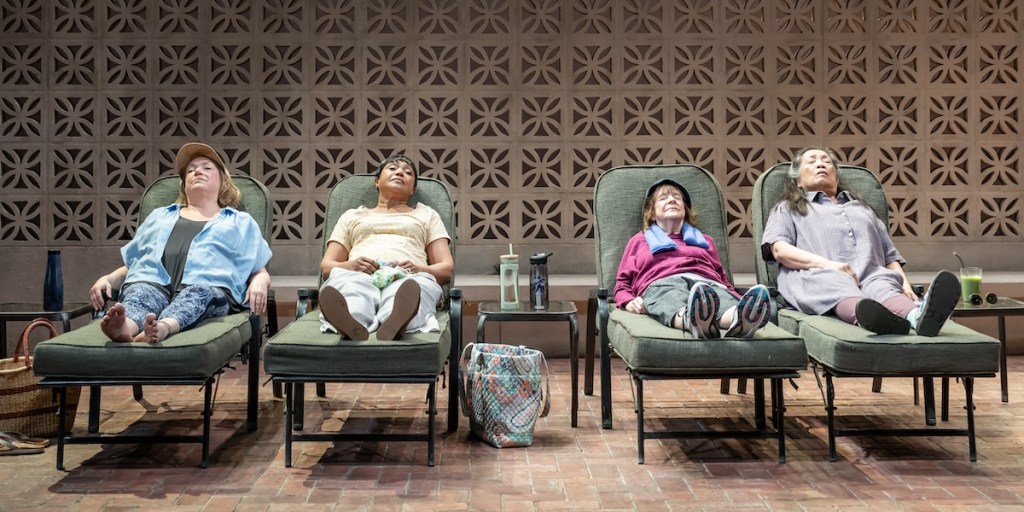
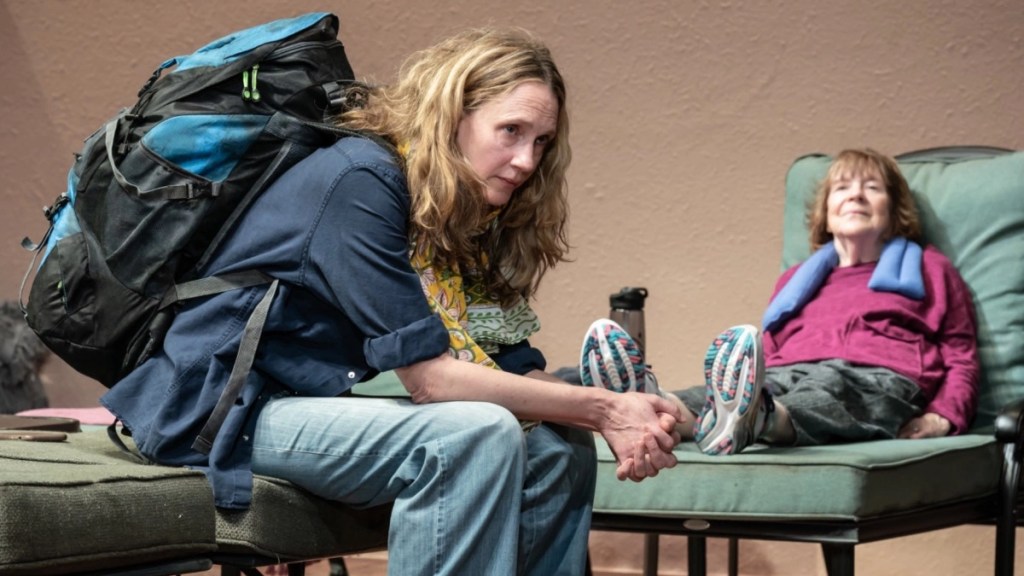
Photos: Ahron R Foster
Our rating: ★★★½
Group appeal: ★★
It’s wrong to say that Annie Baker’s plays are an acquired taste. You either like or loathe them straight away. And if you take to them, you’ll be absorbed by the small details that we notice because the plays happen in real time. When someone leaves the stage to fetch a drink, we wait for the off-stage kettle to boil. You’ll feel the response forming in the mind of one character as they absorb (slowly) the information they’ve just received. A tilt of the head can convey a seismic change of direction. In dramatic terms, this can seem excruciatingly slow, yet has a fascination and humour. But if you don’t like this deliberate approach, her plays can be like watching paint dry.
This is the fourth of her plays to be imported by the National Theatre. Previously, The Flick and John were enthusiastically received; The Antipodes, less so. This time, director James Macdonnald has brought over the entire New York cast, and it’s like hearing a chamber orchestra give a virtuoso performance.
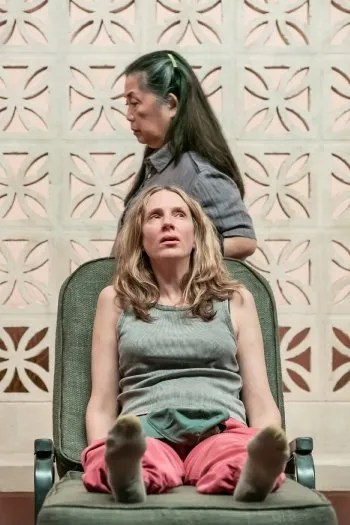
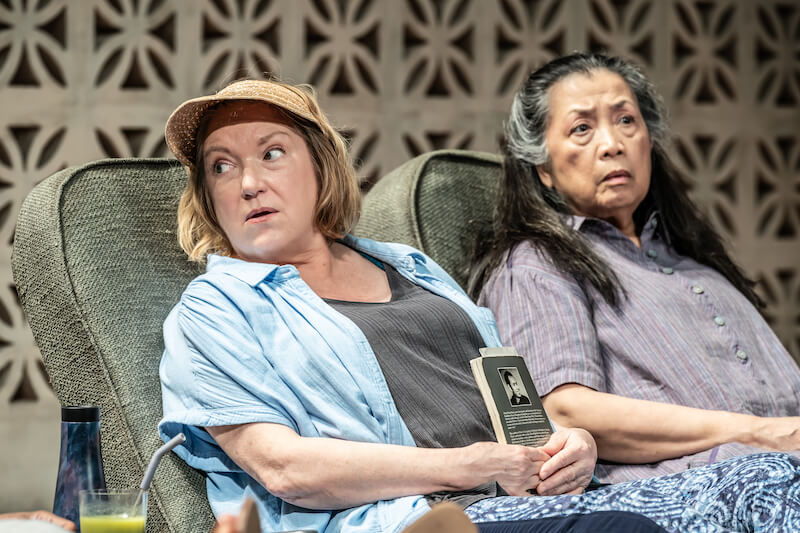
Sofie has come to a spa/clinic to relieve her chronic pain. She’s started a fast to rid her body of toxins, and as she lies on a lounger trying to concentrate on her book (Daniel Deronda by George Eliot), she gets into desultory conversation with four other patients. It’s Sofie’s first time, but they’re veterans, all at different stages of their fasting and all still wracked by unspecified and perhaps untreatable pain. They’re a Greek chorus on the tragedies of everyday life.
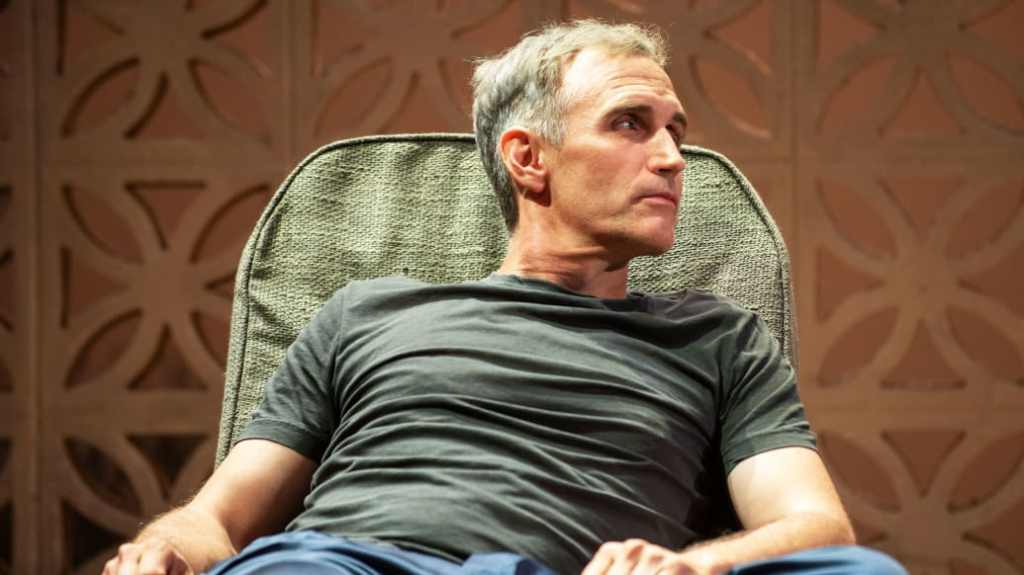
Is pain a metaphor for their lives? Nelson, the only man who appears, tells us that it is. In the play’s most controversial scene (walkouts were reported in New York) he and Sofie tell each other of their sickness and its manifestations. It’s a frank and brutal exchange, played to perfection by Christina Kirk and Pete Simpson. His condition is probably terminal, and hers incurable. Yet he seems to be a life force: his first appearance, walking shirtless before the women and creating an undeniable sexual frisson, is one of the play’s funniest moments. Later, he offers to have some form of comforting sex with Sofie, understanding that her complaint has rendered her incapable of a full sexual experience without unbearable pain. She declines: it would be a temporary consolation, and would resolve nothing for either of them.
Pain continues, life goes on. The final words go to one of the older women, played by the elfin Marylouise Burke. We’re in it together; we accept and endure.
15/11/23 Fredo writes –
The Time Traveller’s Wife
Book by Lauren Gunderson, Music and Lyrics by Joss Stone and Dave Stewart, at the Lyric Theatre
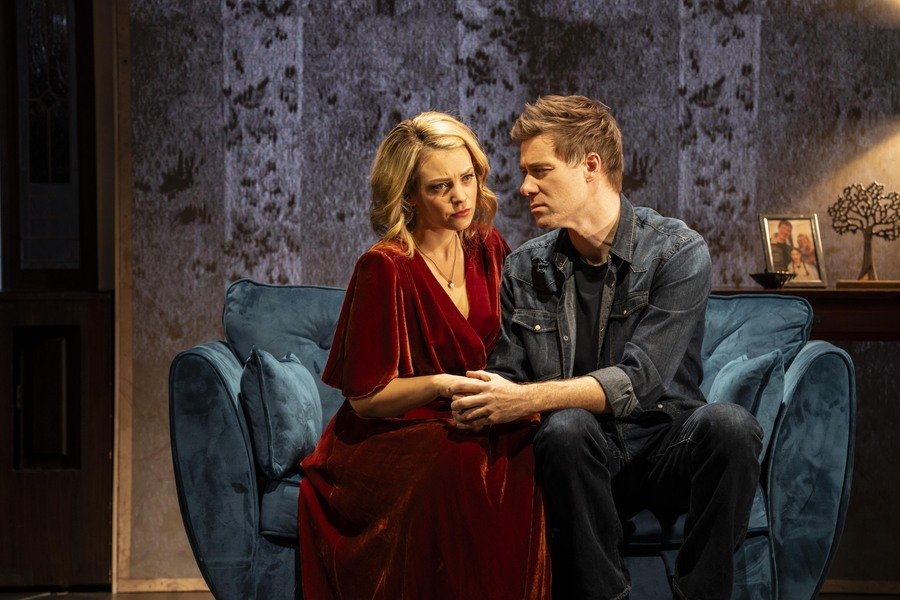
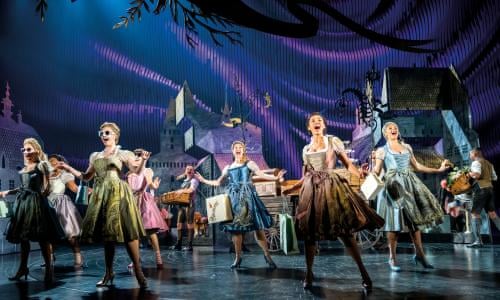
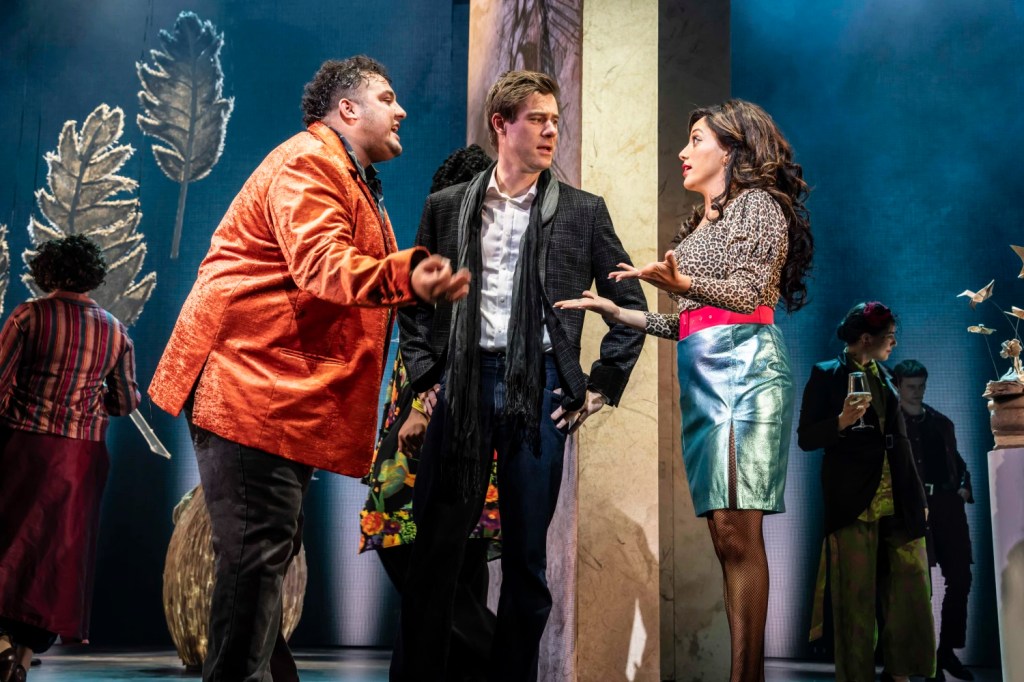
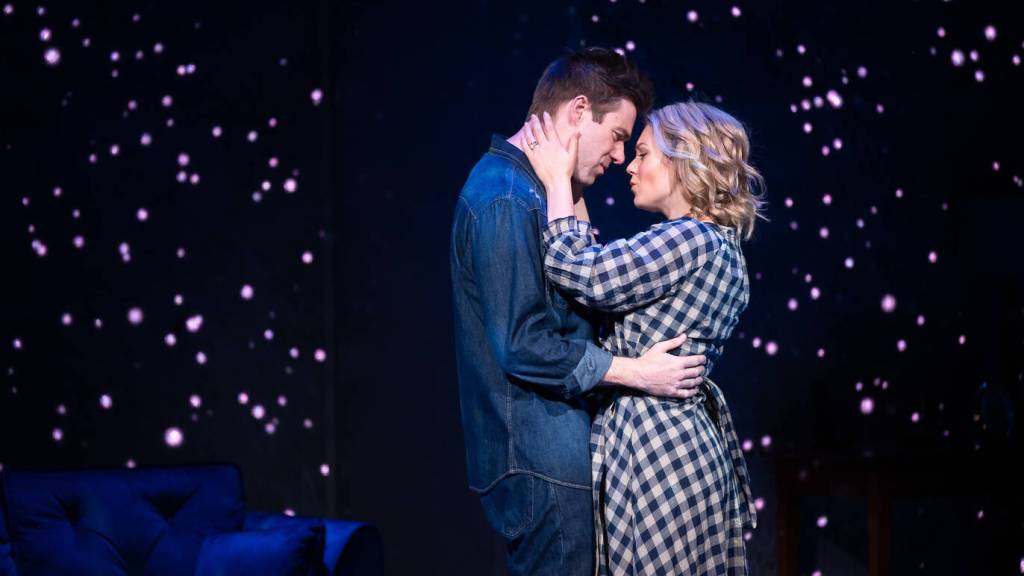
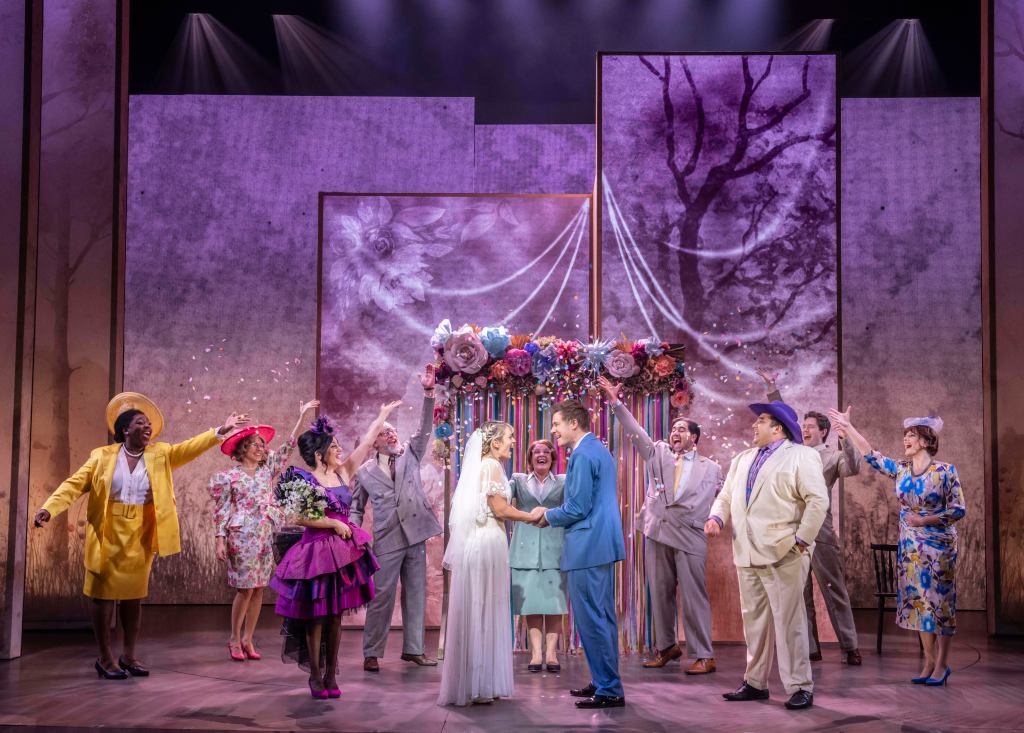
Photos by Johan Persson
I don’t like writing bad reviews, but there are times I have no choice. This is one of them. The show is dire.
Let me try to find a few redeeming features. Joanna Woodward sings strongly and has an appealing stage presence. David Hunter is less successful as the Time Traveller, and has to go through embarrassing contortions when he’s about to disappear into another time zone (then reappear naked until he grabs some clothing).
They’ve spent money on the special effects and the set, which is very high-tech with monolithic blocks and projections (though at various times the actors have to manhandle the furniture on to the revolve before it spins out of sight).
However, the story is confusing, and the plotting inconsistent, and I’d be flattering the writer if I describe the dialogue as banal.
(Mike interrupts – Both wife and husband age naturally but the Time Traveller can visit his wife’s ‘now’ from his past or future age. Confusing? I wish I’d gottit while watching the show but I guess most of the audience were fans of the book so didn’t need clarity. You can watch this adult man chatting up a young girl before she became his wife (!) or comforting her as an older man while she is a young woman. It’s supposed to be romantic but is just blandly sentimental. And would be a bit yucky if it wasn’t for Woodward’s appealing performance.)
The most egregious fault lies in the music and lyrics. Joss Stone and Dave Stewart (from The Eurythmics, for Heaven’s sake) both know something about writing songs, but their talent appears to have time-travelled to another dimension. There isn’t a memorable tune or an intelligent lyric in the entire score. I could go on, but I’m going to stop before I start enjoying myself.
Mike and I were guests of NIMAX Theatres, and perhaps we were at a disadvantage because we aren’t familiar with the best-selling novel by Audrey Niffenegger or the subsequent movie and television series. And the new genre of sci/fi-romcom has passed us by. The rest of the audience seemed to enjoy it.
Our rating: ★
Group appeal: It had form as a popular novel and movie, so possibly ★★★ though I had no enquiries about it.
13/11/23 Mike writes –
Roald Dahl’s The Witches
Book and Lyrics by Lucy Kirkwood, Music and Lyrics by Dave Malloy, at the National: Olivier Theatre (a Preview performance)
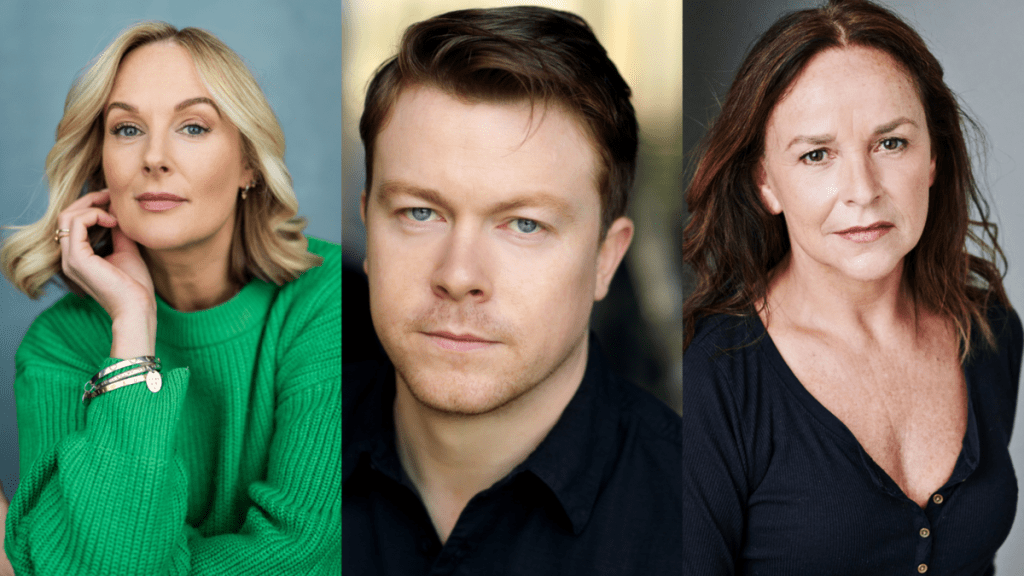
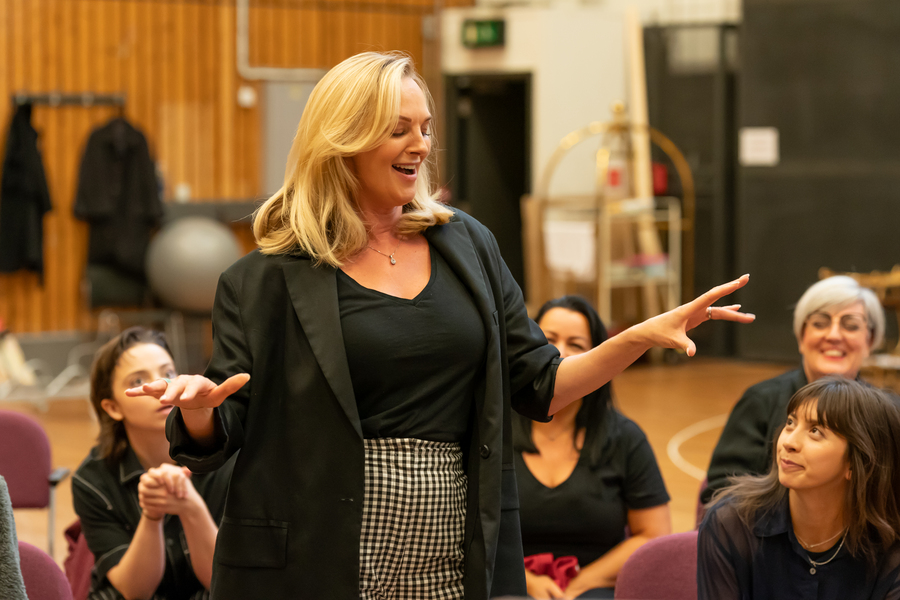
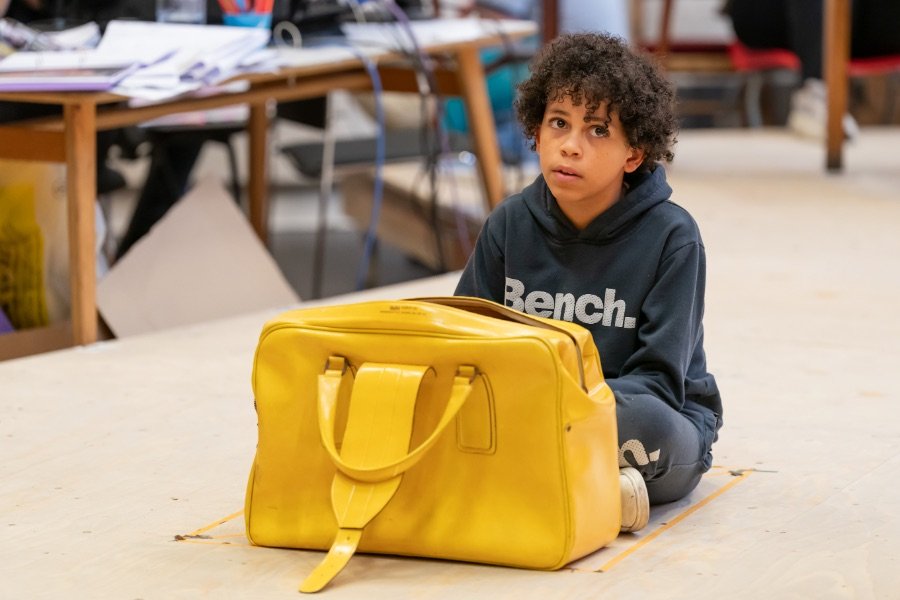
Rehearsal photos
Forget pointy hats and pointy noses, along with those Wicked green faces and all that ’toil and trouble’. The witches here are all down-home types, dressed by M&S and are probably members of the WI. But they like to squish children and have diabolical plans to turn kids into mice and then rid the world of them. Roald Dahl knew that kids like horrible stories and now his book has been given the full National Theatre spectacular musical treatment, no expense spared. And it’s wonderful, provided you are over 8 years old. And even over 80.
Katherine Kingsley rules the coven as the Grand High Witch, evil dressed to kill in the fashion sense, with voice at full throttle. She points a long finger at possible victims, including ones in the audience and at one point chastises the owner of a ringing mobile ordering them out of the theatre (but of course that might be a set-up).
Little Luke leads the kids in their fight-back, a huge heroic performance for one so young (maybe 10) and then there’s Bruno, a posh’un from private school who leads a song’n’dance number like an old Vaudeville pro, amazing. Helga helps out as head-girl of a large young ensemble. I wish I could mention all their names but of course three children are cast in each role for different performances.
The Grown-ups are lead by Daniel Rigby as Mr Stringer, put-upon proprietor of the hotel where the NSPCC are meeting to plan not the protection but the extermination of the children. But first the witches have to fix gruff Gran from Norway, played by Sally Ann Triplett, rough and tough on the outside but heart of gold. She has a heart condition but adopts Luke at the start when his parents are killed in a car crash. Yes, it has dark themes but still manages to remain Grimmly hilarious.
It’s huge fun which keeps the adults laughing continually while the kids, I suppose, alternate between cowering in fright and cheering on their peers. The big numbers are all a delight, mostly belters but with what I call ‘comfort lyrics’, wittily predictable rhymes which keep us smiling.
We attended an early preview performance and although all the cast were spot-on exuberant in their roles, some of the tricks and the tech ran less than smoothly. Act one was a joy but Act 2 still needed work and a trim to bring the show to a satisfying finale. By Press Night I’m sure all will be well, and then I would happily see it again and probably give it an extra star. A West End transfer is forecast.
At the end the kids are triumphant (no surprise) but, oddly, they are still mice – cue for all the audience kids to want mice for pets?
Our rating: ★★★★ / Group appeal: ★★★★
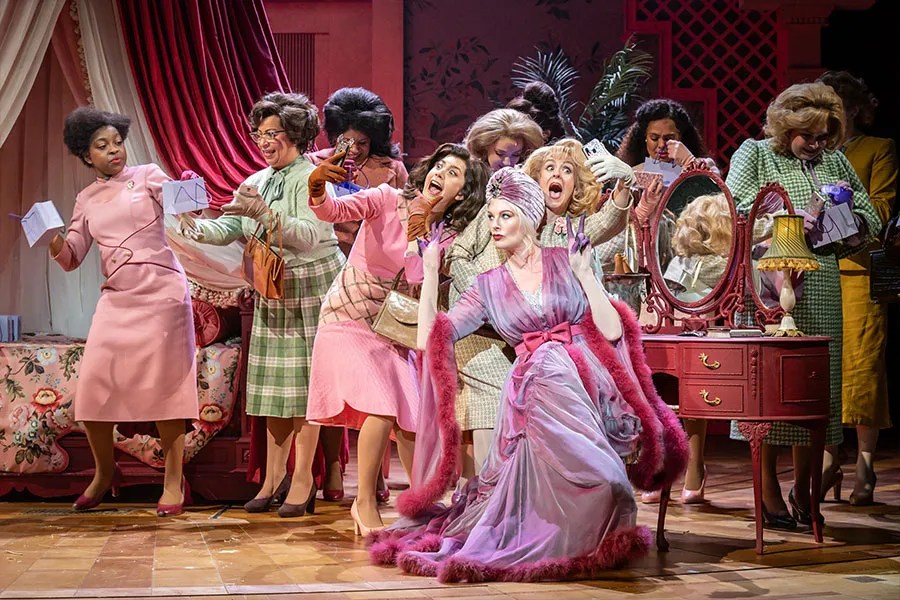
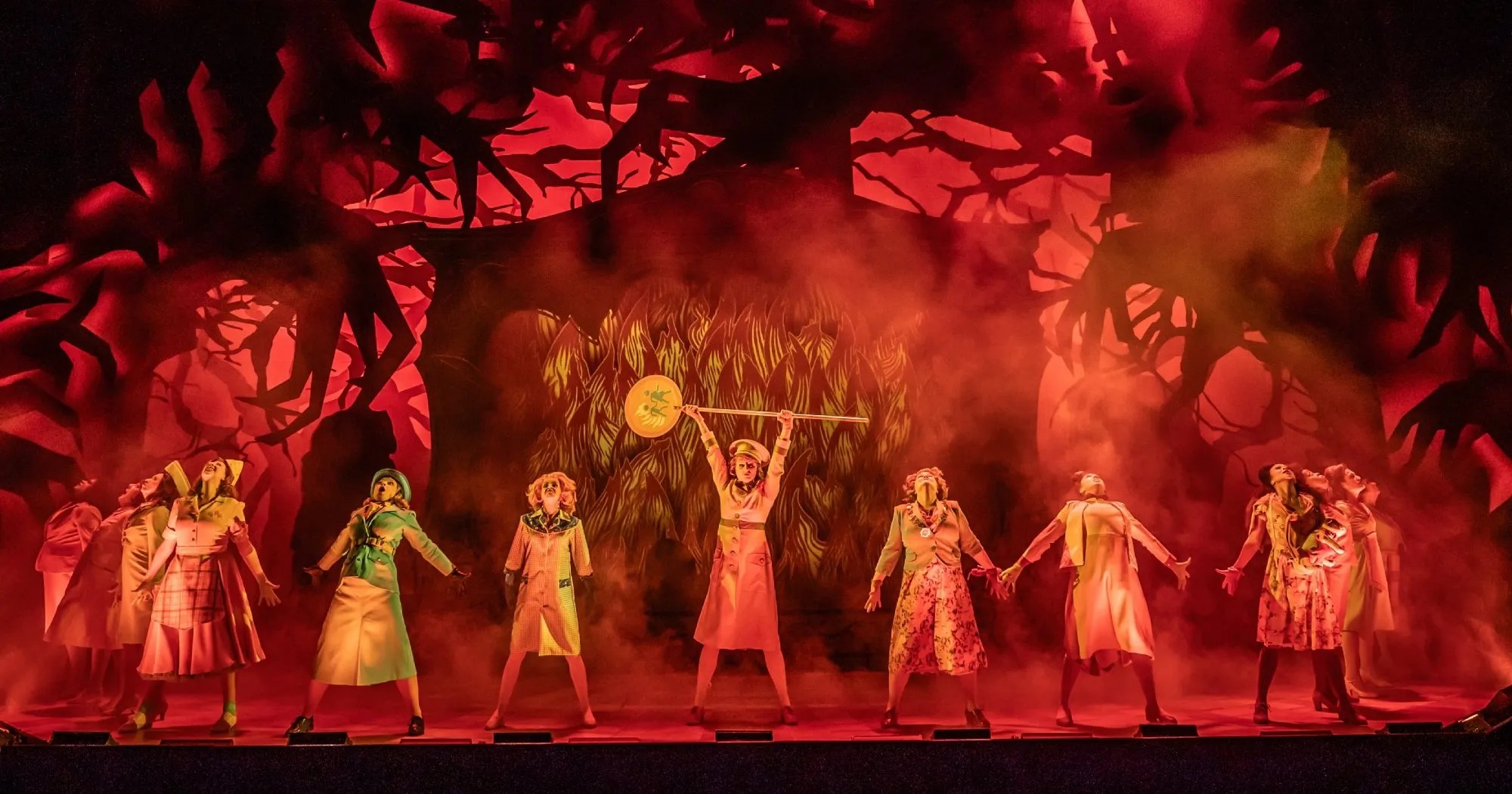
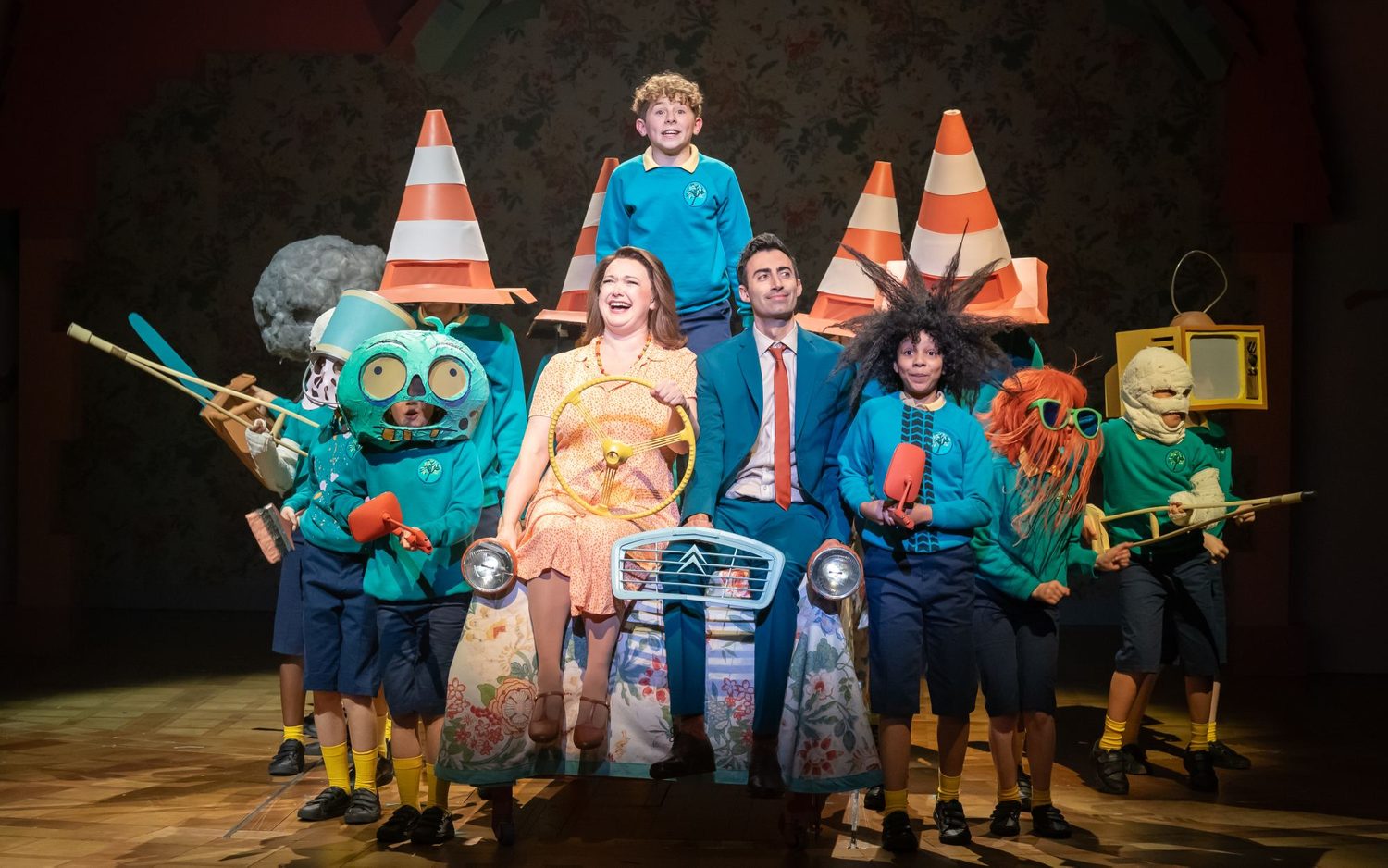
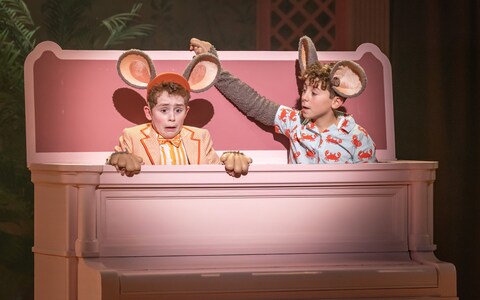
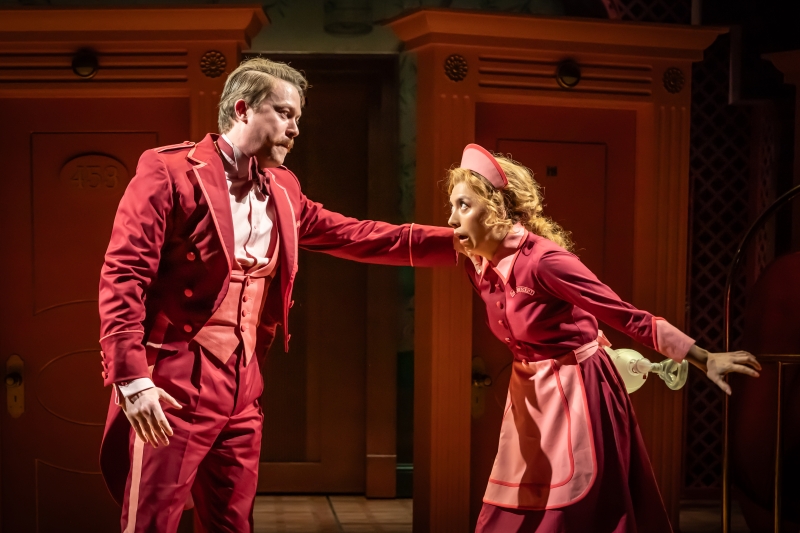
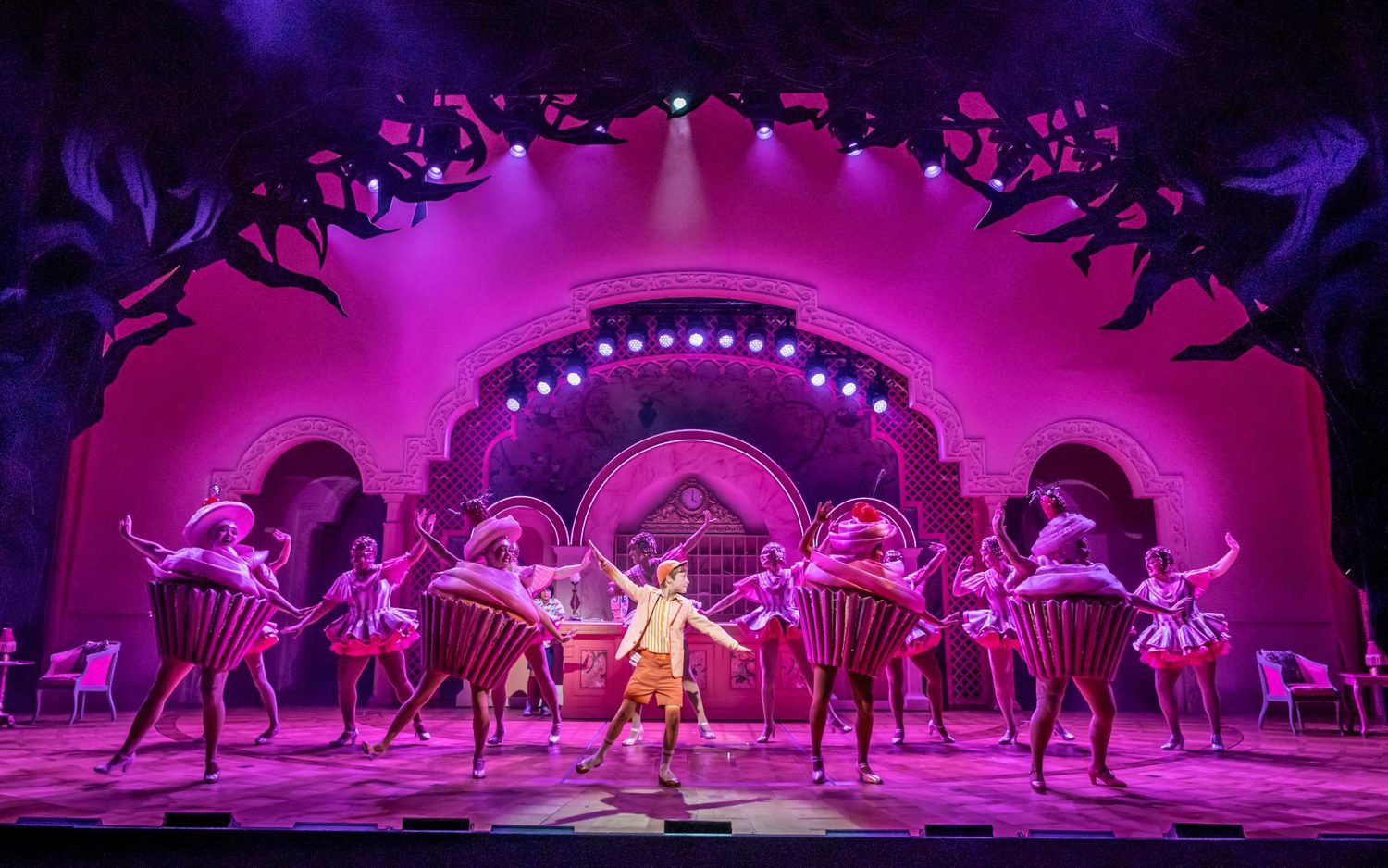
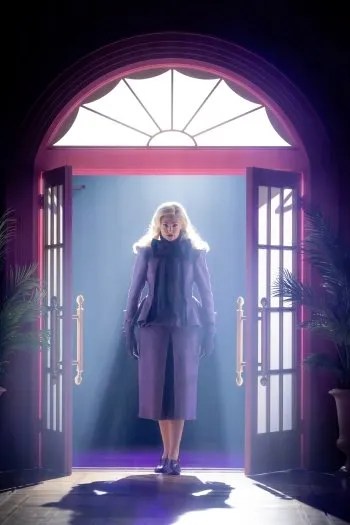
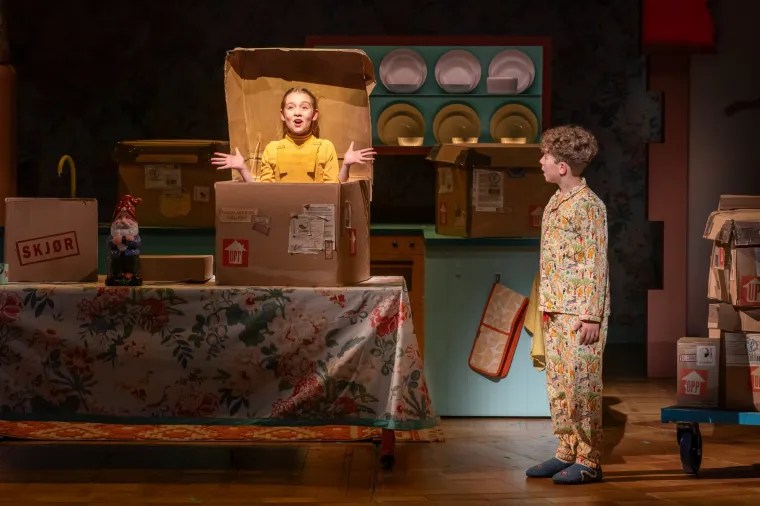
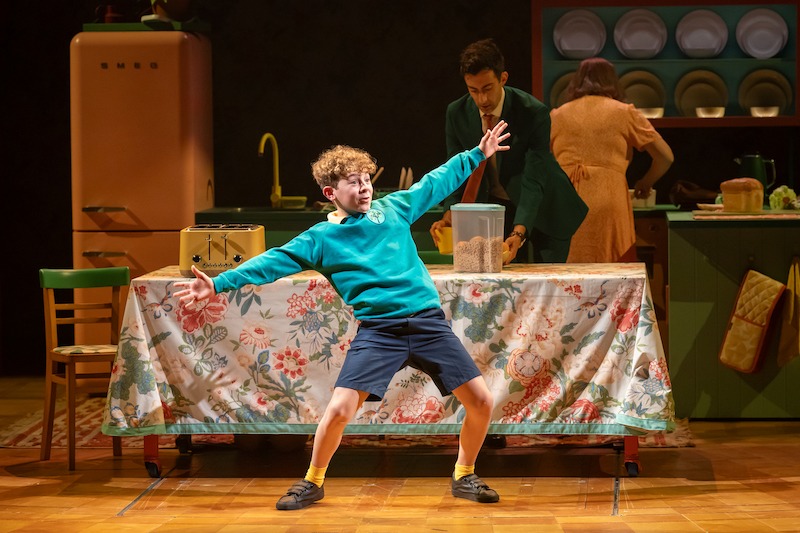
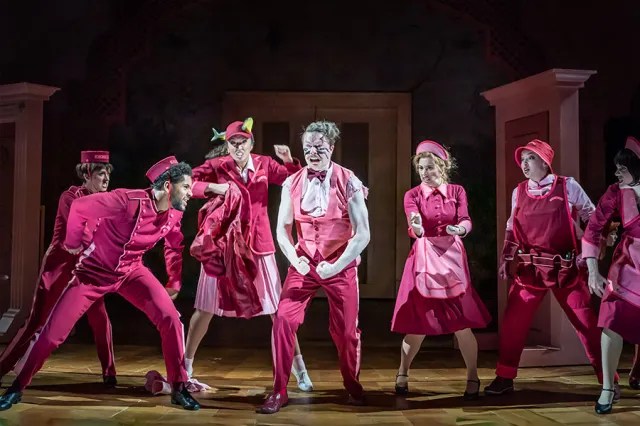
Photos: Marc Brenner
12/11/23 John R writes –
Coward and Friends
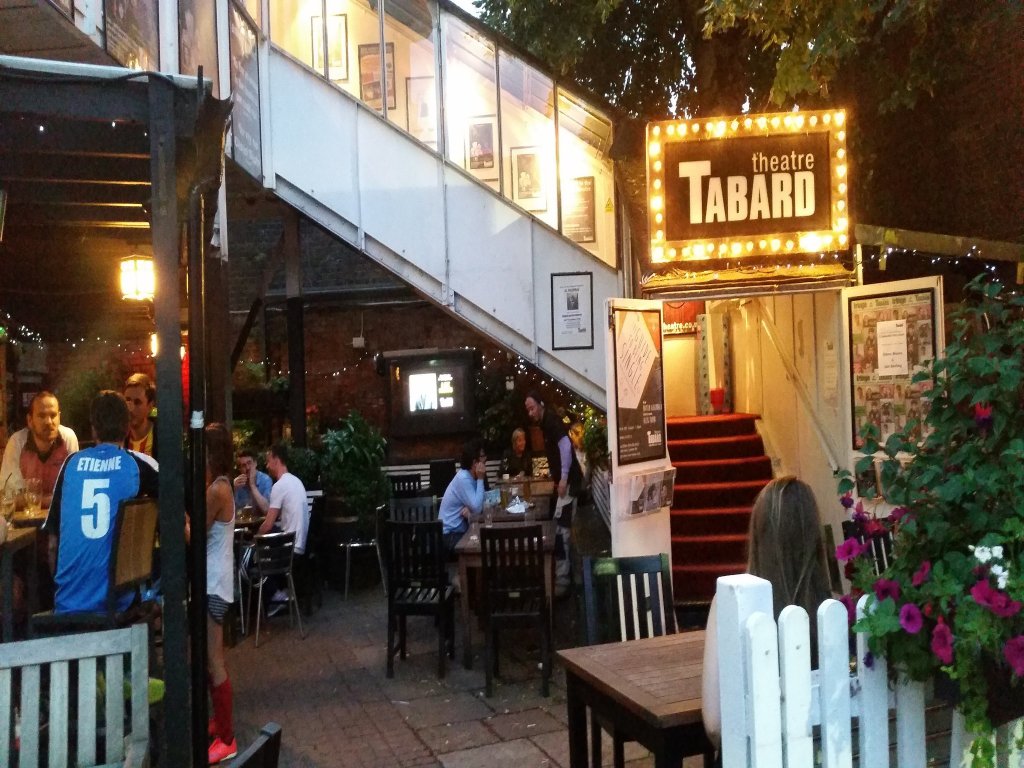
at the Tabard pub theatre, Chiswick
Janie Dee and
Stephan Bednarczyk
Our rating: ★★★
Goup appeal; ★★★
Everyone loves Janie Dee so it was a thrill to anticipate her show at my local pub theatre in Chiswick, which only seats about 90 people. It was a two-person show with the excellent pianist and raconteur Stefan Bednarczyk, who regularly appears at the Crazy Coqs and other London nightspots.
The first surprise was that neither performer used mics, so although in such a tiny space they were not needed for actual volume, the sound to me still needed a bit of a boost. Janie’s voice sounded a bit on the thin side, However we think she might have been battling a cold, plus possibly tired after slogging herself silly in Sondheim’s Old Friends in the West End.
She opened with the Marvellous Party number, which immediately went down well. Her comic timing was also to be admired in many other songs, as was Stefan’s in the more narrative pieces such as The Bar at the Piccolo Marina, The Bronxville Derby and Joan and Don’t put your Daughter on the Stage Mrs Worthington. He also provided some touching readings from Coward’s writings, covering his early stage training and experiences. It was a pity there was no sheet of A4 to identify the sources but it’s a venue with little funding.
Janie opened the second half, rather cheekily, with her current party piece, The Boy from….., referencing some brief accolade for Coward, made by Sondheim in one of his books. But nobody was complaining as it is rather a hoot! They also wittily performed the opening scene from Private Lives, with I’ll See You Again, which then segued into other songs. It did occur to me that perhaps Coward’s strongest talent was his lyric writing, which is delightfully wicked and yet often touching – London Pride for example. She did not sing two of my favourites, If Love Were All and Mad About the Boy.
It was still a most enjoyable afternoon despite a few reservations..
11/11/23 Fredo writes –
A View from the Bridge
by Arthur Miller, at the Rose Theatre, Kingston
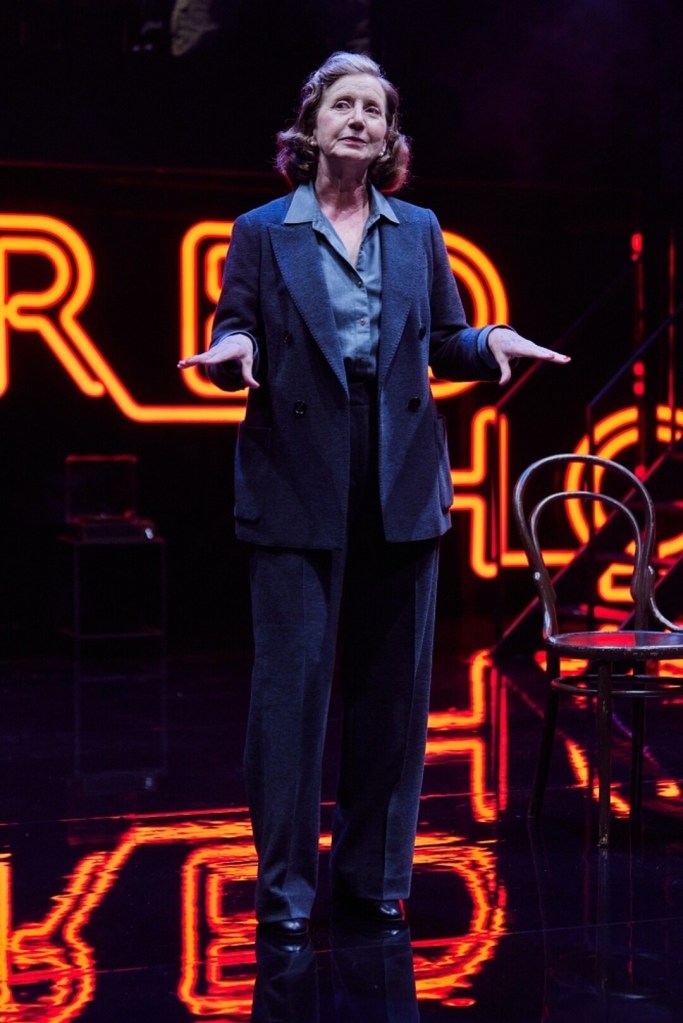
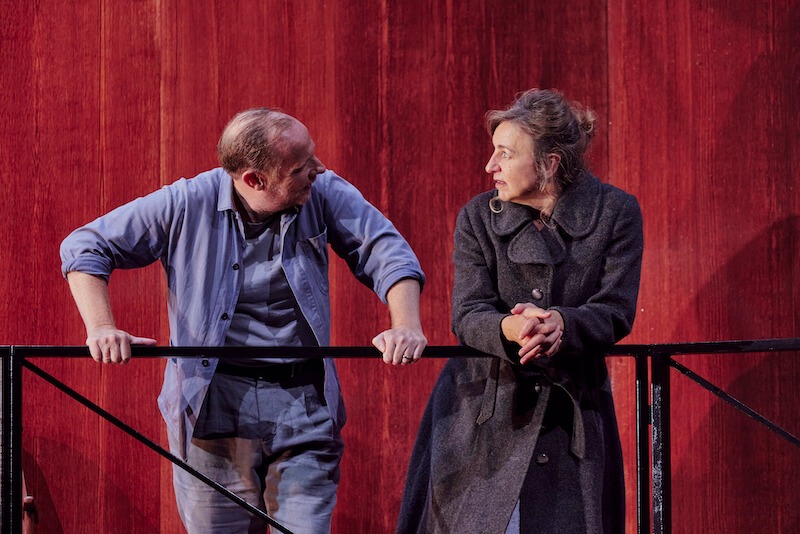
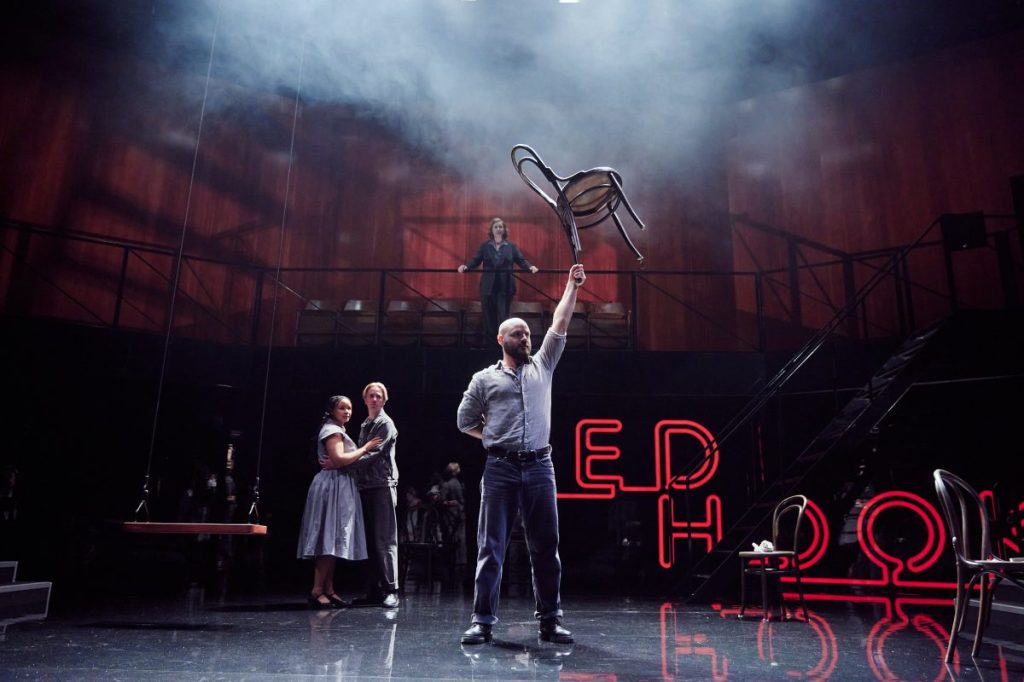
Photos: The Other Richard
Our rating: ★★★
Group appeal: ★★★
It could be just an ordinary situation: Eddie and his wife Beatrice argue about their adopted niece Catherine taking her first job. But we’ve been warned by the lawyer Mrs Alfieri that it won’t end well. The arrival in the Brooklyn home of Beatrice’s Sicilian cousins, Marco and Rodolfo, as illegal immigrants, upsets the fragile relationships within the cramped household.
Miller’s great play dates from 1955, and still seizes audiences in a longshore-man’s grip. Tension escalates throughout: at the end of the first act, there’s violence bubbling under the unspoken challenge to Eddie of Marco’s presence in his home. There’s more to come as Eddie brutally intervenes in the relationship between Catherine and Rodolfo, and the action moves inexorably to its tragic conclusion.
Johnathan Slinger, who impressed us in David Mamet’s Oleanna, showed Eddie’s suppressed rage and confused love for Catherine. His towering performance was matched by Kirsty Bushell’s Beatrice and her confusion as the events around her slip out of control. I thought that Rachelle Diedericks started too young as Catherine, but she became more convincing in the course of the play and, as Rodolfo, Luke Newberry was both endearing, and believable as a mild man whose presence would enrage Eddie.
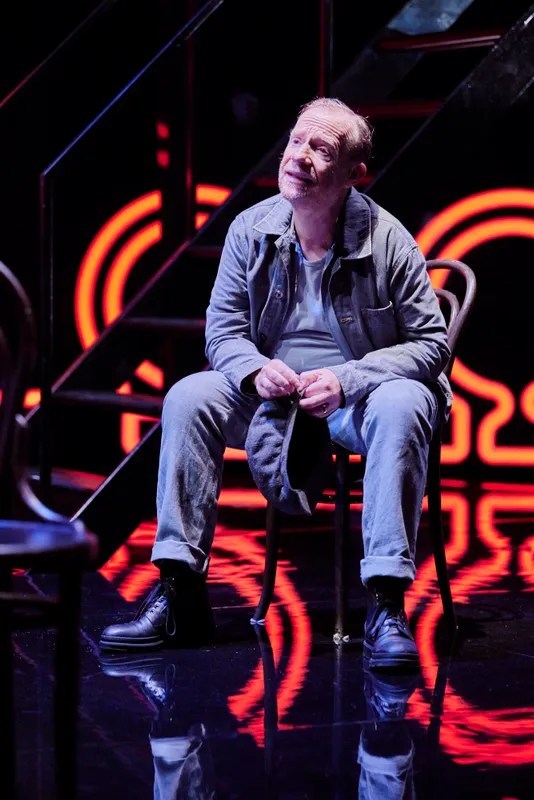
I’ve seen this play many times, and in some tremendous productions. The bar is high, and sadly this one wasn’t one of the best. The director Holly Race Roughan made some bizarre decisions: at crucial moments, one of the longshore-men becomes a ballet dancer; there’s a central swing on stage (in a home in Brooklyn?) and although we’re reminded several times that the apartment is on the ground floor, the actors have to descend a staircase from what is supposed to be street level. A chair placed front-stage intruded on the difficult sightlines in this theatre. And the floor reflecting a neon RED HOOK sign does not assist the intimate scenes.
I have no quarrel with cross gender-casting (well, not always) but casting a woman in the role of the lawyer Alfieri was a mistake. First of all, it seemed unlikely that a man like Eddie would seek advice from a woman. And good actress though we know her to be, Nancy Crane didn’t convey the poetry of Alfieri’s narration; in particular, her voice was too light to give the necessary resonance to the epitaph at the play’s end.
Nevertheless, this drama has devastating impact. Eddie Carbone, the appropriately named burnt-out man, stands with Miller’s other self-deluded heroes Willy Loman in Death of a Saleman and Joe Keller in All My Sons. Arthur Miller is the laureate of the overlooked, and raises the tragedies of ordinary people to epic proportions. Despite the flaws in this production, I still felt elevated by it.
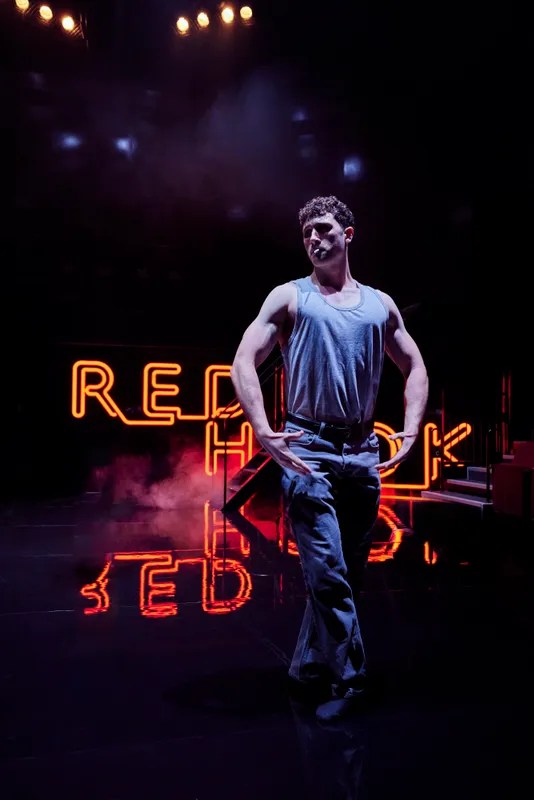
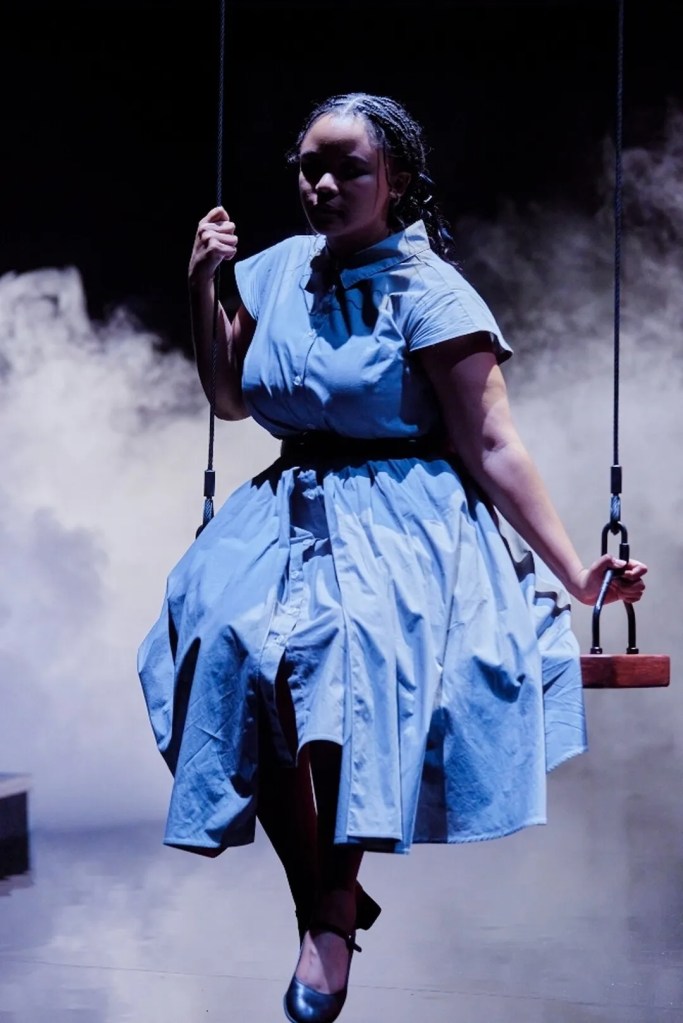
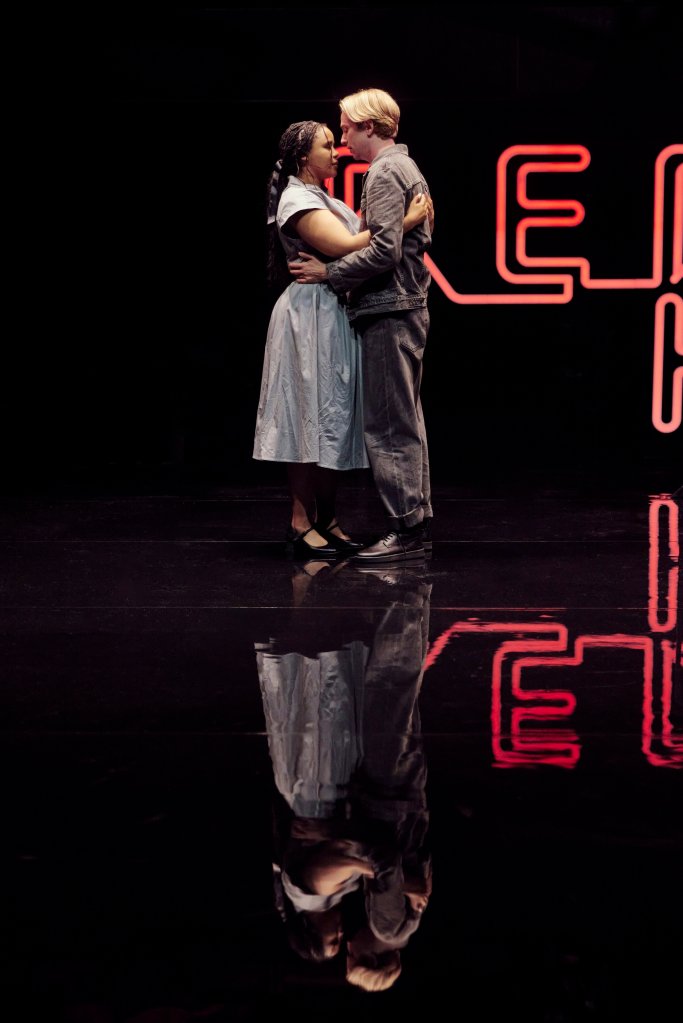
07/11/23 Fredo writes –
Portia Coughlan
by Marina Carr, at the Almeida Theatre
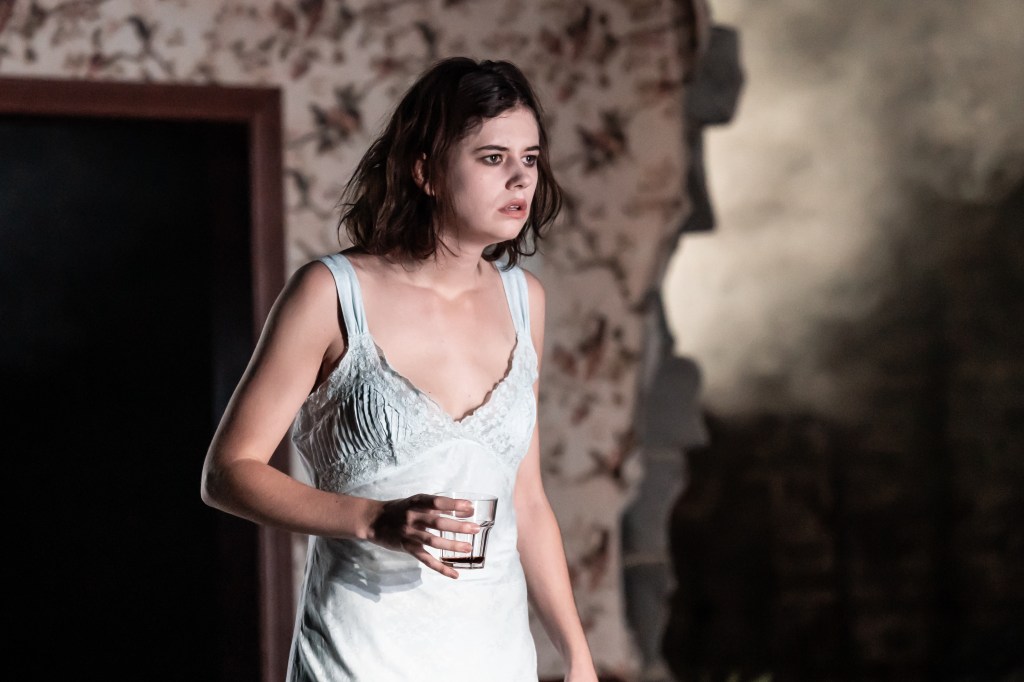
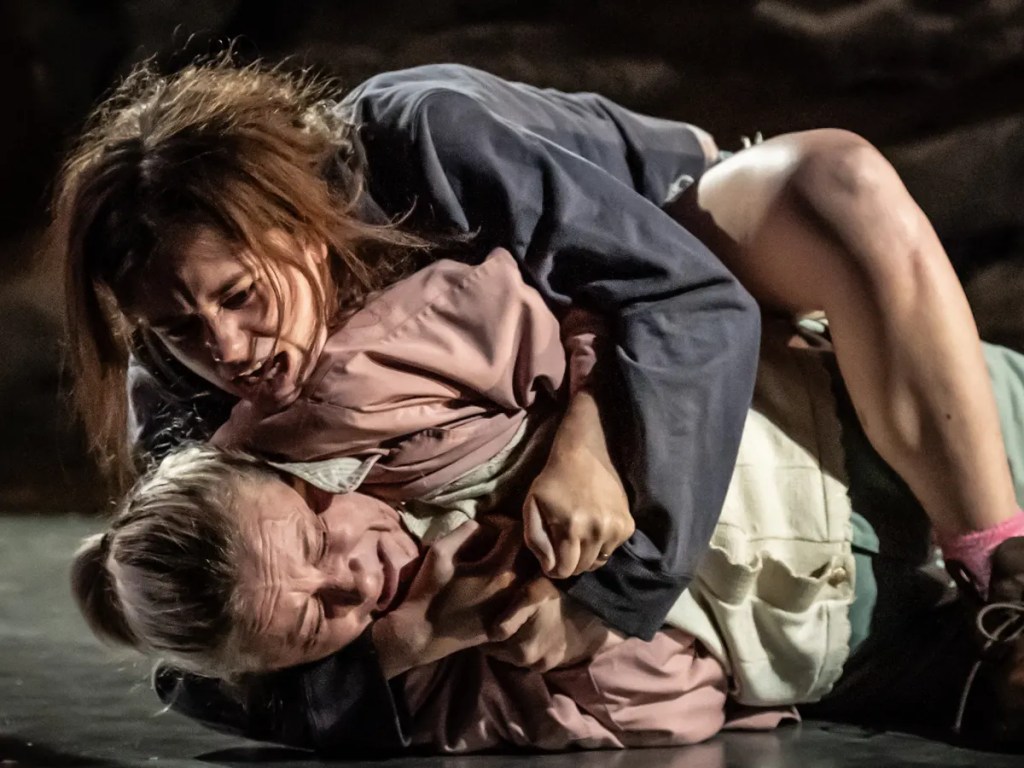
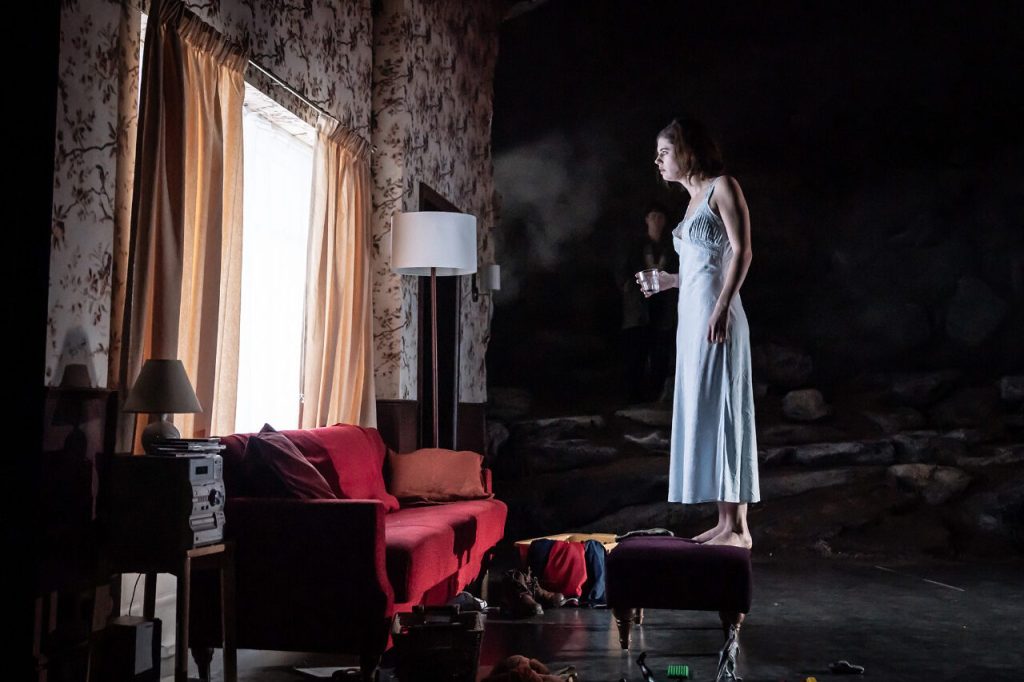
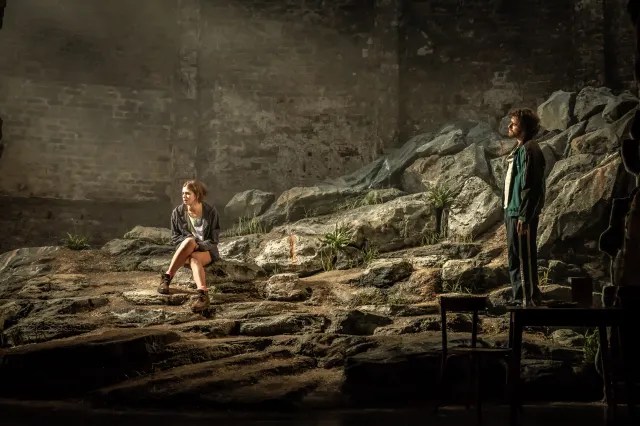
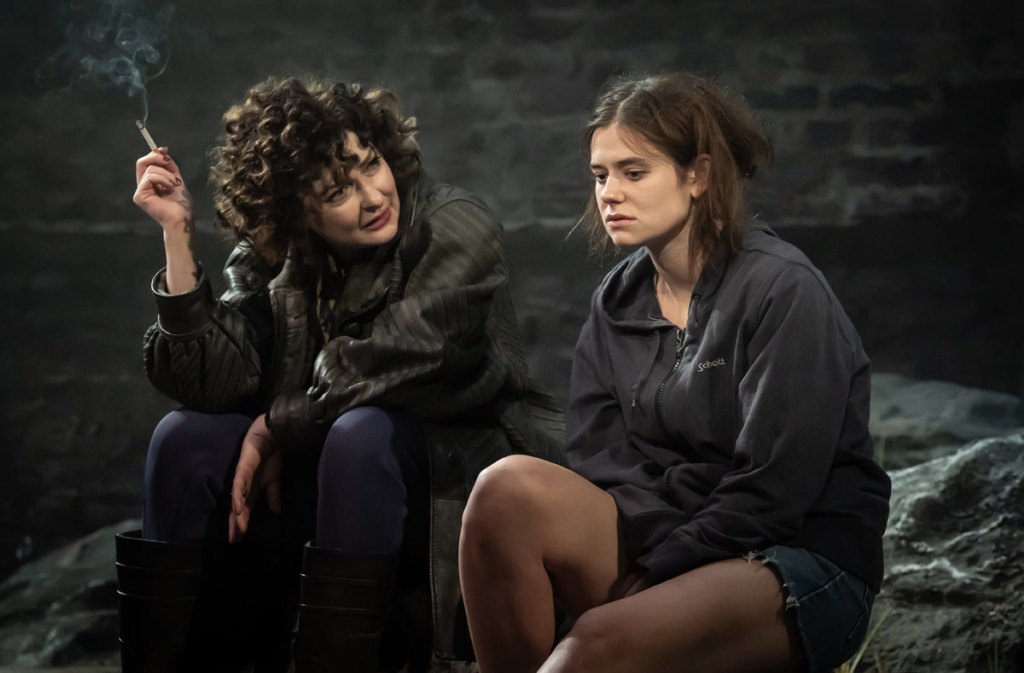
It’s 10 o’clock on the morning of Portia’s 30th birthday. She’s pouring herself a drink, and it’s not her first. It’s not a celebration either, as it’s the 15th anniversary of the death of her twin brother. “It’s not easy being married to Portia Coughlan,” commented her creator Marina Carr, and it’s not much easier being in the audience either. “I’m traumatised. We’re all traumatised,” commented one woman to an attendant as we left the theatre.
There’s little evidence of the Celtic Tiger in this deprived rural community in Ireland in 1996, though Portia’s unfortunate husband is the wealthiest man in town. Portia herself embodies discontent and despair like Hedda Gabler, but with more appetite for destruction . All her family are relentlessly at each others’ throats, as they claw over old arguments and resentments (Sorcha Cusack and Mairead McKinley give lessons in venom-spitting with every line they utter). Hints of incest twist through the generations, and it’s clearly heading for a tragic end.
Do we care? Surprisingly, my interest was held throughout. Marina Carr has a gift for writing dialogue that segues easily from invective to lyrical (methinks she studied J M Synge at some point) and she spikes the diatribes with shafts of dark humour. At the end of the first act, we are suddenly propelled to the end of the play, and the second act covers the events that lead to the devastating climax. This didn’t work for me, and I suspect some authorial/director revision may have taken place. The songs by Maimuna Memon were beautiful, and beautifully sung by Archee Aitch Wylie, but seemed to work against the grain of the play.
Rising star Alison Oliver rises to the challenge of this merciless Portia; she brings much-needed warmth and sympathy in her performance. Even in the extraordinary scene when she lashes out at her inoffensive husband, revealing her loathing, she still makes us understand the depth of Portia’s anguish. She was rightly acclaimed by the audience, and seemed unsure about taking a solo bow. She had certainly earned the applause.
Our rating: ★★★½ / Group appeal: ★★
Photos: Marc Brenner
05/11/23 Mike writes –
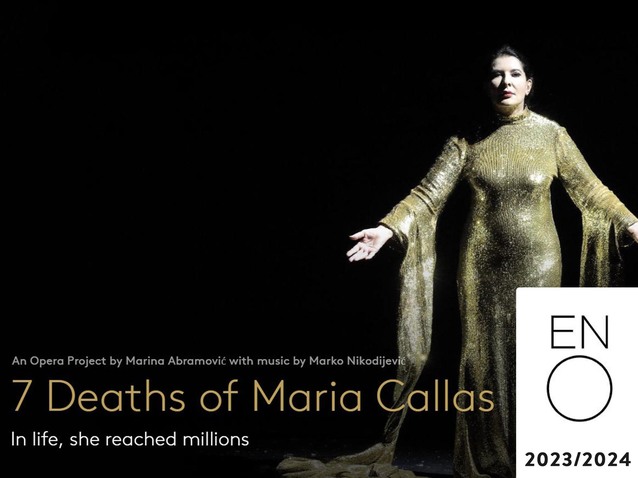
7 Deaths of Maria Callas
an opera project by Marina Abramović , at the London Coliseum (Dress rehearsal)

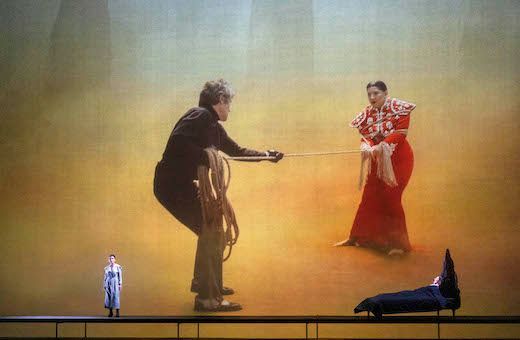
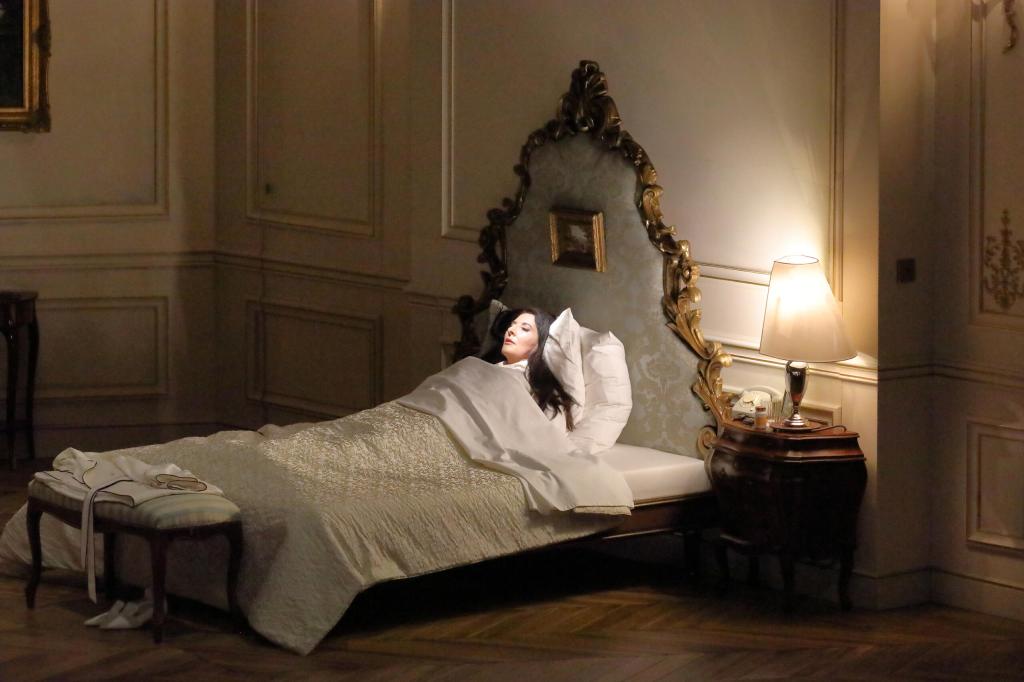
Photos: : Tristram Kenton
Something rather amazing and uncharacteristic is happening at the Coliseum. And that is just what it is – a happening, not quite an opera and not quite an installation, but ‘an opera project’ . It comes from the performance artist Marina Abramović who currently also has an exhibition of her works at the Royal Academy – video, sculpture, installation, and re-enactment. But for now she is installed on stage herself for 6 performances in this tribute to Maria Callas.
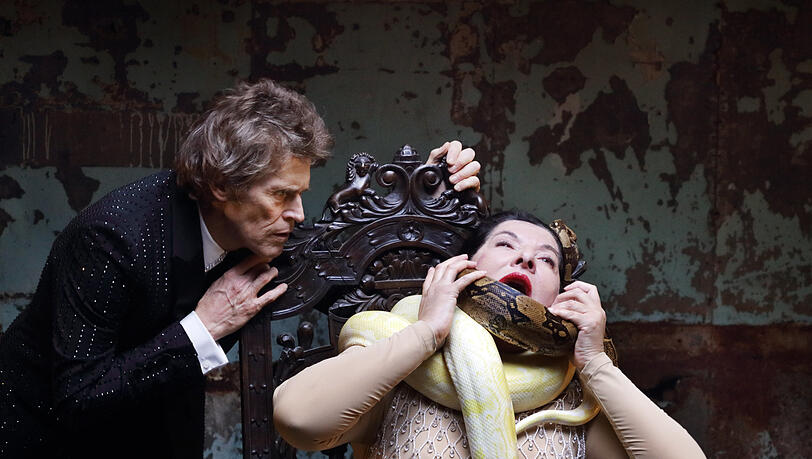
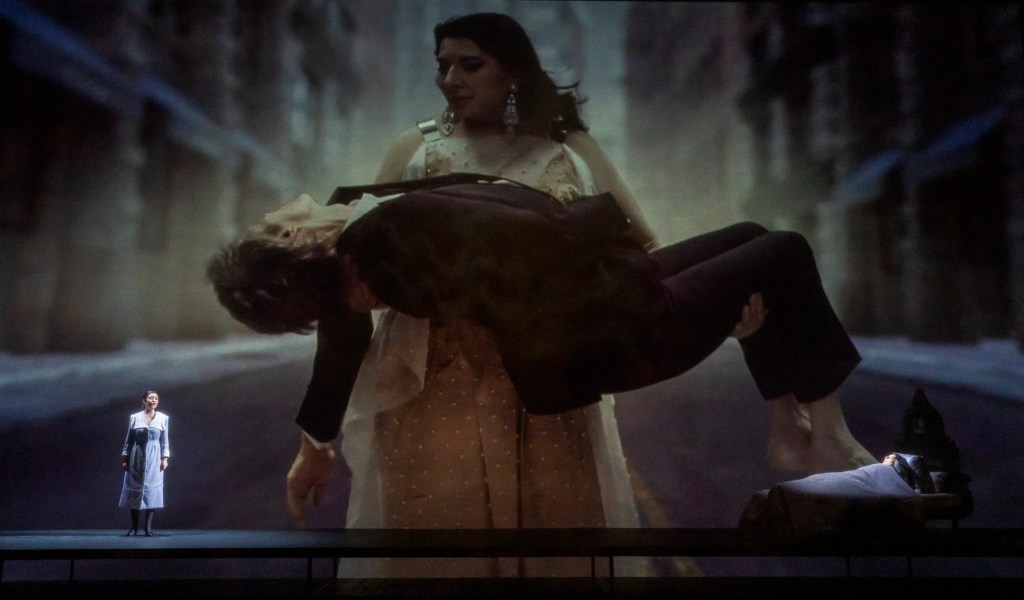
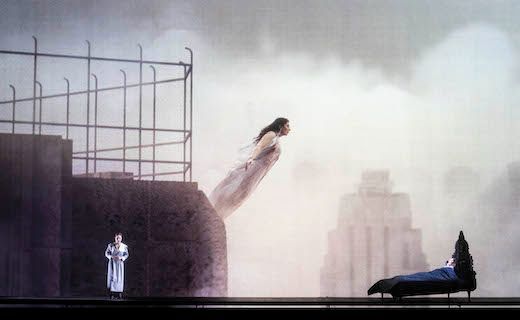
Marina plays Maria, looking very like her (though a little fuller-figured) and is on-stage almost throughout…playing dead. She lies in bed in a spotlight while seven deaths that Maria performed in her operas are re-enacted on film; the surreal sequences are performed in fantastical fashion by Marina and Willem Defoe on a vast screen behind her bed. A voice-over intones interpretations of each death, a jump from a skyscraper representing Tosca and strangulation by a snake referencing Othello, etc.
However, this is an opera project so the voice of Callas is acknowledged by live performances of 7 of her most famous operatic arias – the two operas mentioned previously plus Madama Butterfly, Carmen, Lucia di Lammermoor, La Traviata and Norma. Move over Maria, while 7 singers do her more than fair homage in impressive and very moving performances sung direct to the audience with a full orchestral accompaniment. They all deserve a mention – Sarah Tynan, Elbenita Kajtazi, Nadine Benjamin, Eri Nakamura, Aigul Akhmetshina, Karah Son and Sophie Bevan.
I’m a sucker for a ‘coup de théatre’ and, just when something special is needed to finish this rather sombre and serious contemplation of death, comes a complete change in presentation. It’s the perfect theatrical scene to put to rest a diva, a career, a legend, and of course this unique happening. Finally Marina appears centre stage as Callas, in a signature gold and glistening evening dress, to showcase a recording of the diva’s voice singing Casta Diva from Norma.
The whole event is surprisingly emotional, the arias are gloriously performed, and the concept is intriguing, involving and highly collectible for anyone with any interest in Maria Callas. Or, new to me, in Marina Abramović.
I have to confess that I was far more impressed than Fredo who found Ms Abramovic’s contributions a bit pretentious but enjoyed the singing and the orchestra. I loved ‘the project’ and admired it for its originality and for the high quality of its presentation and performance.
Our rating: ★★★★ / Group appeal: ★★
20/10/23 Mike writes –
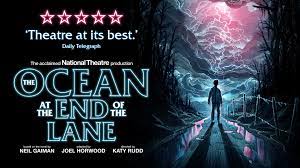
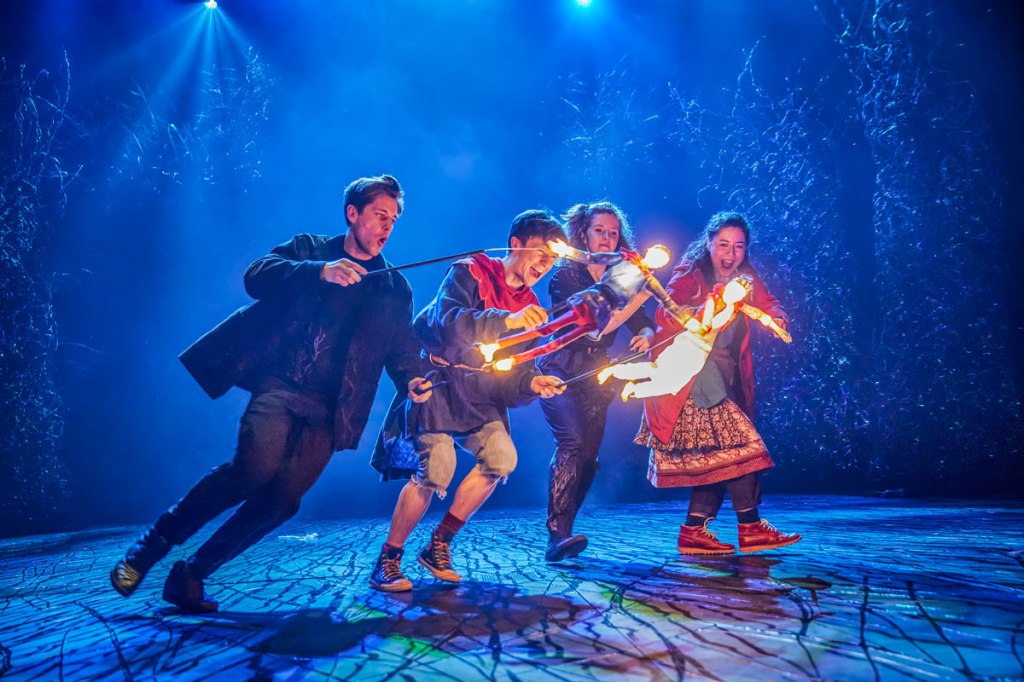
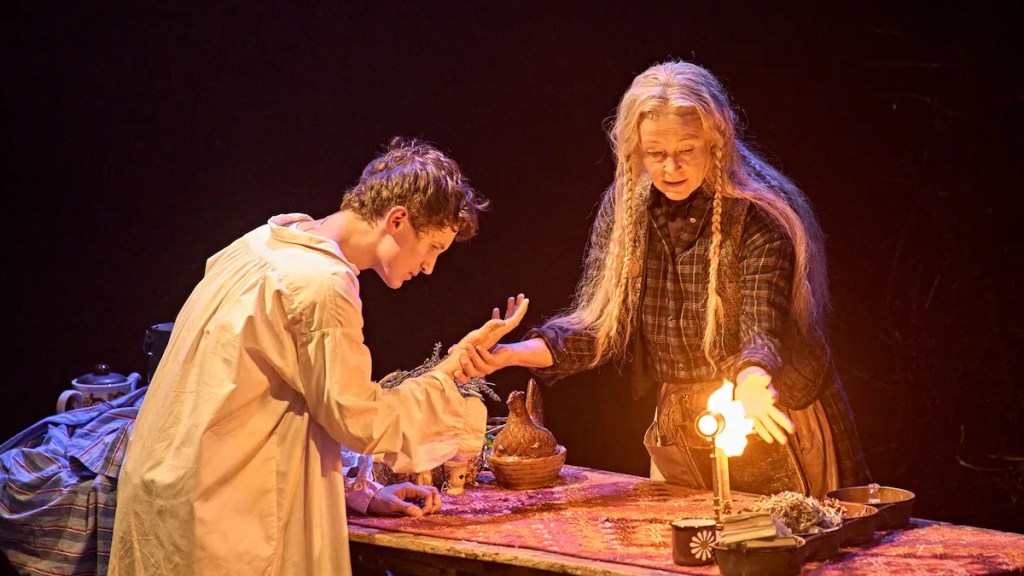
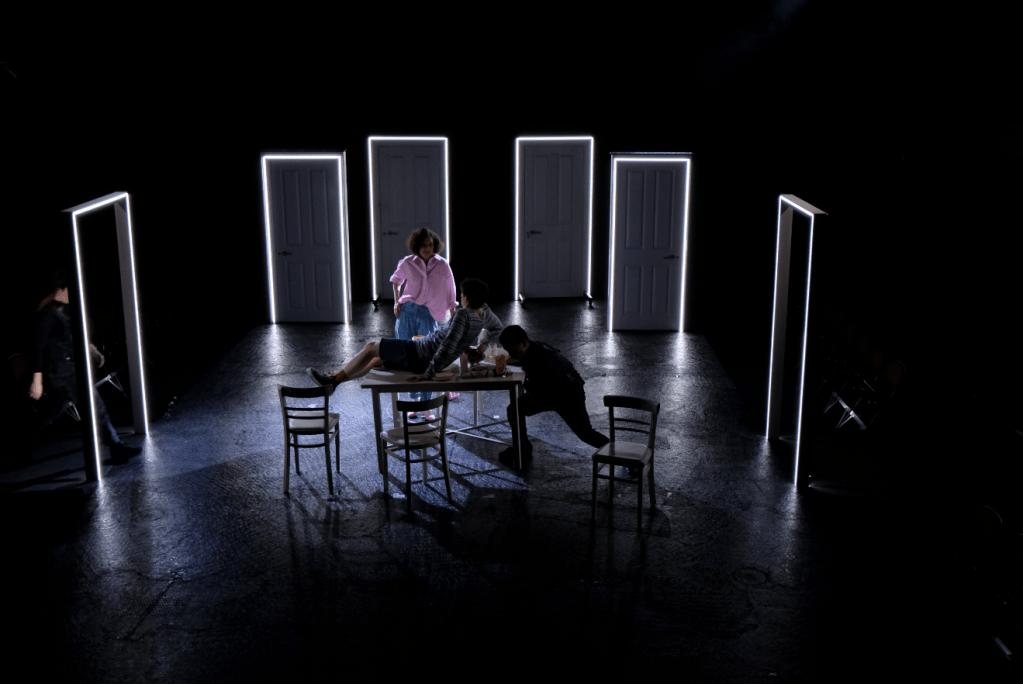
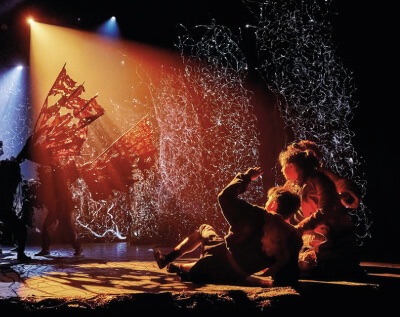
The Ocean at the End of the Lane
by Joel Horwood, from the novel by Neil Gaiman, at the Noel Coward Theatre
Photos: Manuel Harlan
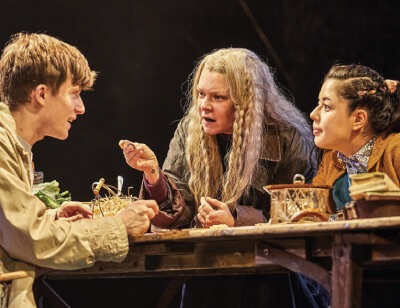
I must show my hand here – we were invited down the Lane by DelMack and I have an aversion to Fantasy Fiction. The ocean at the end of this lane is a pond on a farm, fantasised into a world of monsters with an aggressive agenda, and a ‘make it up as you go along’ story to keep kids enthralled. There was a lack of kids in the audience but many youngish adults seemed keen to go along for the ride. And, I must admit, a very theatrical ride it was too.
There’s another term to set my teeth on edge – Magical Realism. The plot is in that realm, and is based on a 2013 book in which a Man returns to his childhood home to rekindle memories of (cliché warning) a nasty stepmother with uncanny abilities to send him into panics of persecution. There was a girlfriend and her know-all granny on hand back then, with magical abilities to fight evil spirits, create safe spaces in fairy rings, explain the supernatural…and all before nipping off to Australia (don’t ask).
Forget trying to follow the fantastical plot – your effort would be wasted. The writing references Narnia, the Hobbit, Peter Pan, Harry Potter, etc etc, to give itself a validating edge, but it’s the theatrics which grab at our attention. War Horse, Pi, and other puppetry exercises set the style of presentation – we soon forget to notice the balletic manipulators and succumb to the bombardment by soundscape, movement and dramatic lighting, which create monstrous diversions and terrors.
But I have to warn you, there’s a wearisome amount of explanatory verbiage which drags the plot along at a very slow pace. The novelty of the presentation wore off during Act 1 so by Act 2 the tedium was beyond my comprehension and patience.
On the plus side (yes, there is a plus side) the effects were created slickly with imagination, and surprisingly with no resort to fashionable projections. Daniel Cornish lead the cast energetically as Boy, and it was good to find Charlie Brooks (forever an EastEnders’ bad girl) as stepmother Ursula. She was used amusingly in an illusion, disappearing through multiple doors and reappearing impossibly on another part of the stage. That was a highlight for me, along with the appearance of a shape-changing demon. Most of the rest was a snooze fest.
Incredibly, this production has received many 4 and 5 ★ reviews from critics more easily impressed than me.
Our rating: ★★ / Group appeal: ★★★
12/10/23 Kathie writes –
It’s Headed Straight Towards Us
by Adrian Edmondson and Nigel Planer, at the Park Theatre

Photos: Pamela Raith
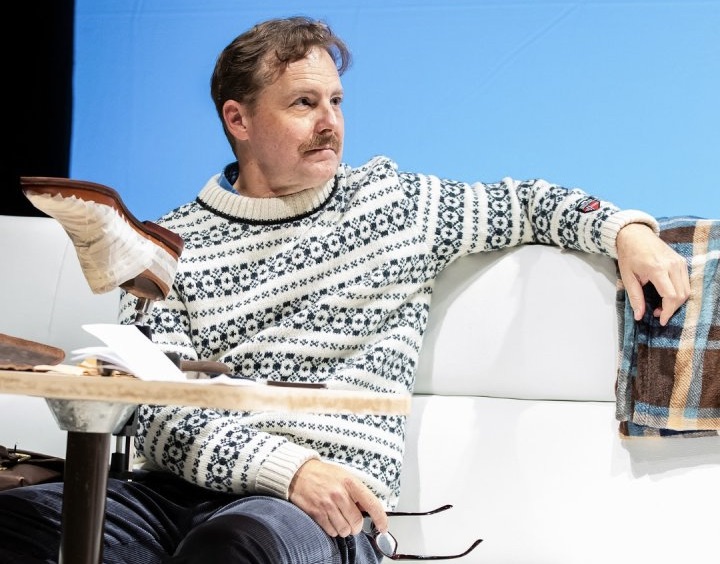
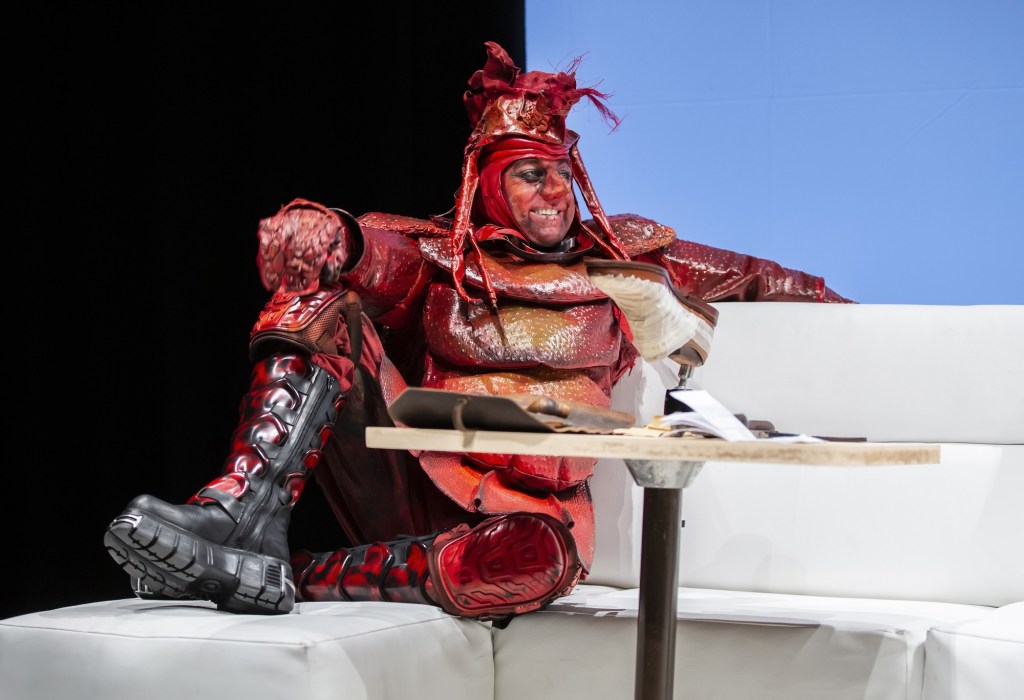
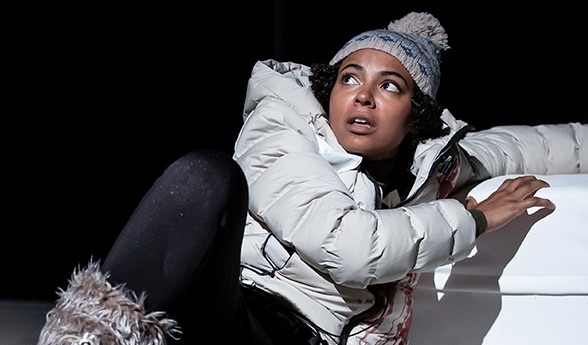
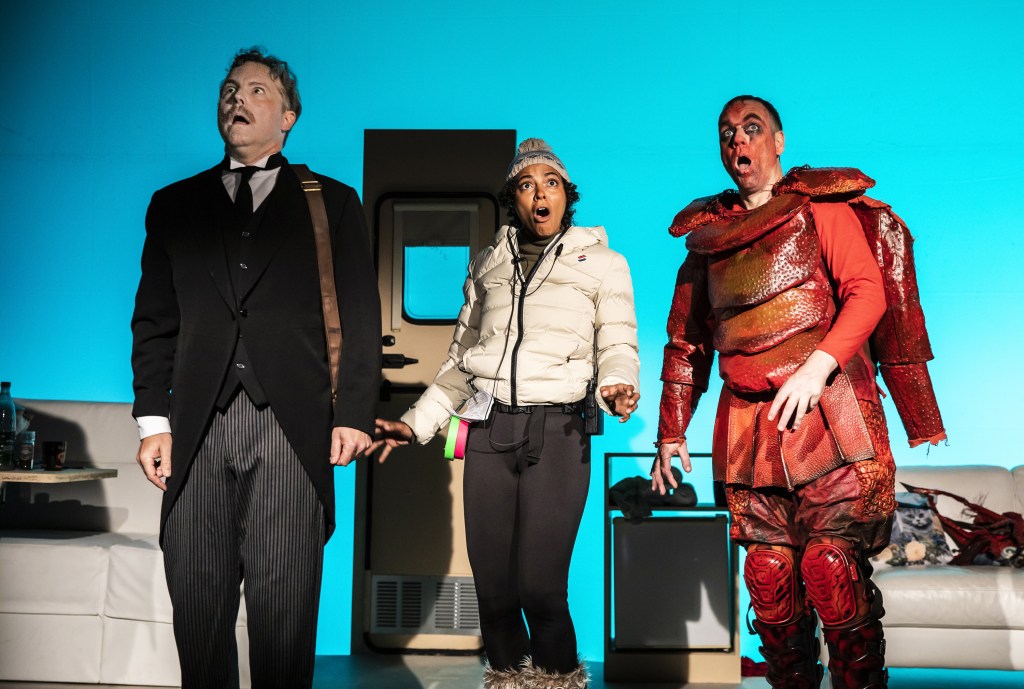
Written by Adrian Edmondson and Nigel Planer, there was, inevitably, a comic element to this play, but it had a broader remit. The setting is a trailer being used by an actor on a film set, being shot on the Gígjökull Glacier in Iceland, which sits on a volcano. The film is Vulcan 7, with a monster/sci-fi theme, and the latest in a series, all of which have a character played by Hugh Delavois (Samuel West). For this film, the actor Gary Savage (Rufus Hound) is joining the cast to play an ‘Angry Thermidon’. Hugh and Gary have known each other since drama school and have had, we soon find out, a turbulent history. The final member of the cast is Leela Vitoli (Nenda Neururer) who is the Production Runner with the challenging task of getting things to happen, and dealing with the fragile egos of these particular actors occupies much of her time and energy.
The comparison between the careers of our 2 fictional actors is revealed through a litany of parts they had in plays or films (all ones known to regular theatre/film-goers), with frequent mention of other real-life actors (Daniel Day-Lewis is often referenced enviously!) . While Gary is now reduced to playing a heavily costumed monster, with just one word to deliver, he has had the more illustrious career which has gradually dwindled through his drinking and inappropriate behaviour. Hugh has had a steadier but less prominent past and despite their apparent antipathy they both have their inner demons which emerge more fully when external events shake things up. The bit of the snowy glacier, upon which their trailer sits, is calved off from the rest through some volcanic/earthquake activity and their safety is uncertain. What will become of them all as natural forces threaten?
In Samuel West and Rufus Hound we were assured of good performances and Nenda Neururer held her own. The rapid-fire delivery of the text and frequent physical stunts kept the pace at just less than frantic, and we were certainly entertained, not least by the sense of an insider’s view of the world of acting. The stage had been mounted so as to shake and shudder with the earth tremors which was very well done, especially for such a small theatre space.
Our rating: ★★★
plus another ★ for the special effects.
Group appeal: ★★★
05/10/23 Fredo writes –
Shooting Hedda Gabler
by Nina Segal after Henrik Ibsen, at the Rose Theatre, Kingston

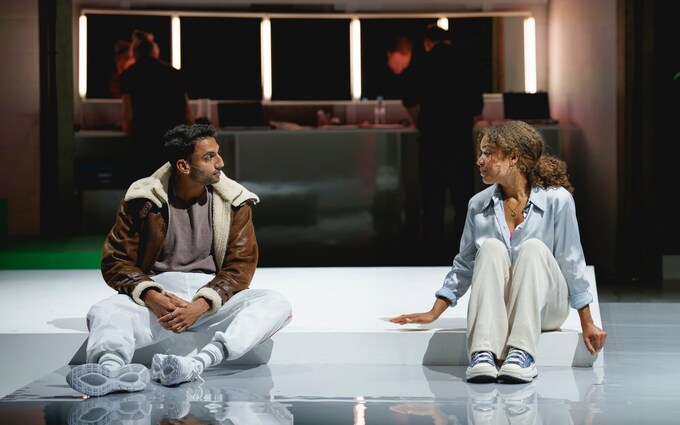
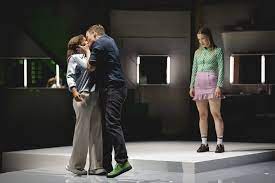
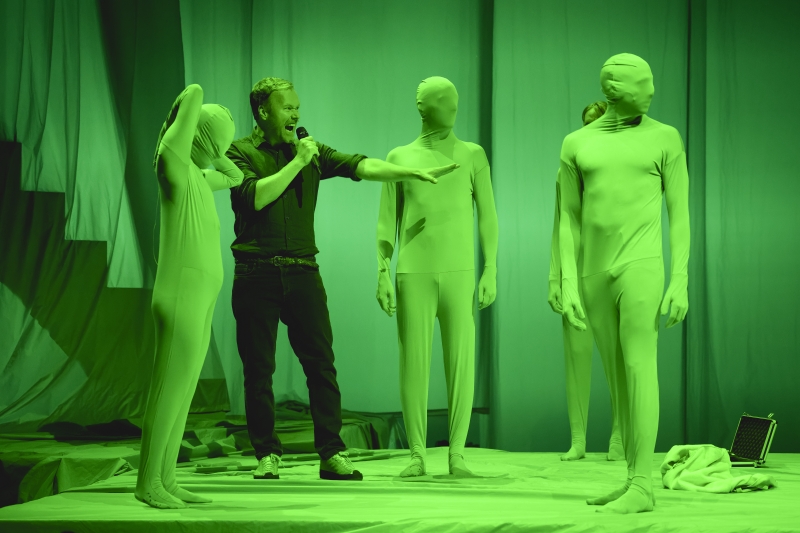
Photos: Andy Paradise
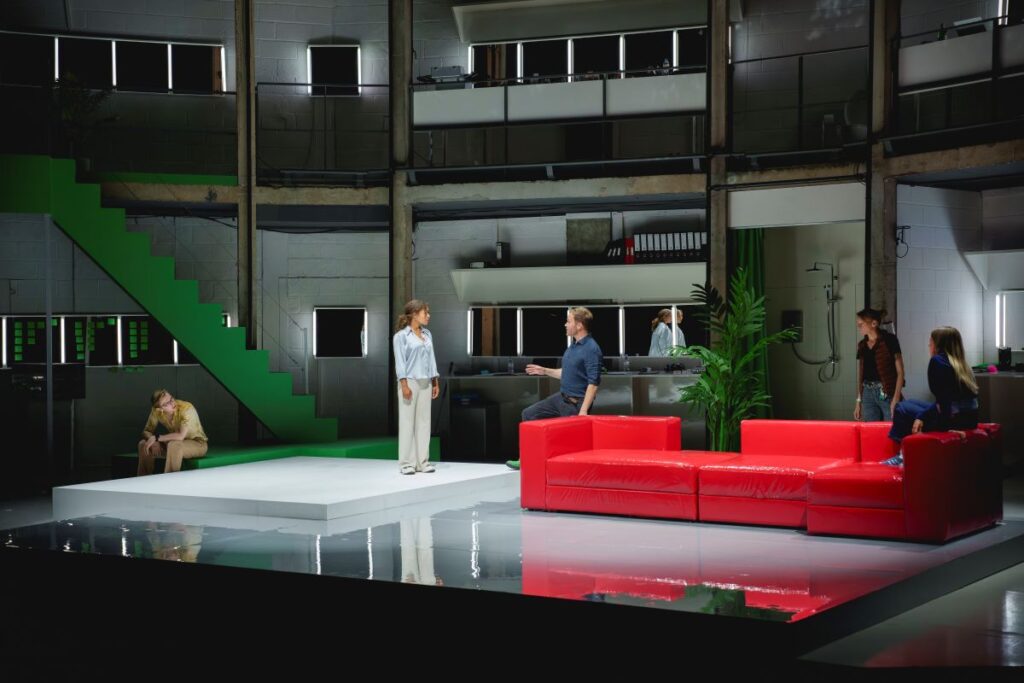
They rolled out the red carpet at the Rose Theatre, not for us but for the world premiere performance of their co-production with Norway’s Ibsen Theatre. This new play daringly references Ibsen’s masterpiece, and the playful title indicates that we’ll have to put our fingers in our ears before it ends.
An unnamed American screen star – let’s call her ‘Hedda’ – arrives in Oslo to film Hedda Gabler. Her career is on the slide, there are rumours of drink and drugs (though she insists she’s clean and sober) and her agent won’t pick up her calls. Her life is a mess: there’s been a recent scandal in the gossip columns, gleefully mentioned by her co-star Jorgen (Joshua James). Later, a message to her lover telling him that she is pregnant gets the response, “Don’t contact me again.”
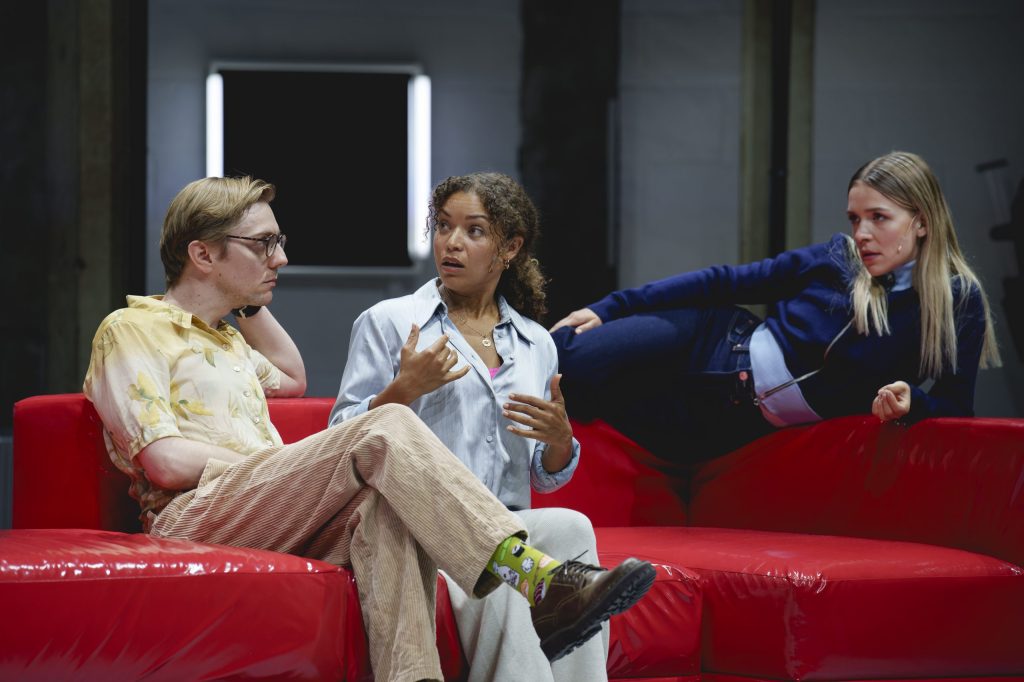
‘Hedda’s’ initial unease increases as shooting starts. The film director Henrik (Norwegian actor Christian Rubeck in commanding form) is a bully and possible sexual predator – and he’s cast her former lover (played by Avi Nash) as Hedda’s former lover. There’s no film script, and a hostile co-star (Matilda Bailes) is also the on-set therapist and intimacy co-ordinator, a reference to current performance obsessions. The sympathetic assistant director (Anna Andresen) offers support but she too is cowed by Henrik.
Antonia Thomas anchors the play with her vivid depiction of ‘Hedda’s’ discomfort which mounts as the play progresses. She charts ‘Hedda’s’ isolation and disorientation as the plot of the play and its characters get closer to the events in Ibsen’s drama. It doesn’t end well.
There is some humour in the early scenes, but neither playwright Nina Segal nor director Jeff James find a consistent tone as the play unfolds. James has to wrestle with the huge and largely inhospitable space of the Rose stage. I could detect the influence of Dutch director Ivo von Hove (and not in a good way) in his positioning of key scenes in isolated areas of the vast space. And he diluted the impact of the play’s final scenes by having the actors appear in “green screen” attire.
Segal creates a problem for herself in cleaving so closely to Ibsen, and always inviting inevitable comparisons. As a riff on Hedda Gabler, it doesn’t really work. And yet that is the play’s purpose. Those unfamiliar with Ibsen’s play will be disadvantaged.
The interest of the play lives in the tension between the actress and the director, and it was at its best when Antonia Thomas and Christian Rubeck could flex their muscles. In fact, all the actors seized their opportunities, though I felt that the gifted Joshua James was seriously under-used. Nevertheless, his mother, West End star Lia Williams, looked proud and radiant in the foyer after the show.
Our rating: ★★★ / Group appeal: ★★★
29/09/23 Mike writes
Mrs Doubtfire
Book by John O’Farrell and Karey Kirkpatrick and music and lyrics by Tony Award-winning duo Wayne Kirkpatrick and Karey Kirkpatrick, at the Shaftesbury Theatre.
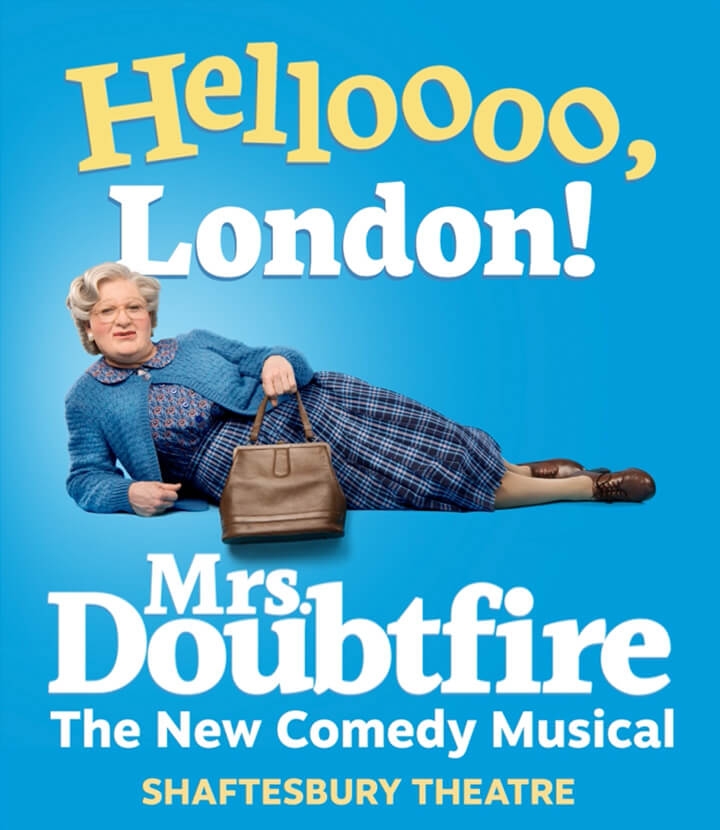
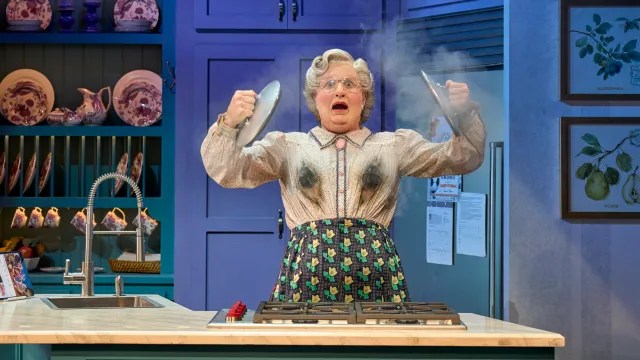
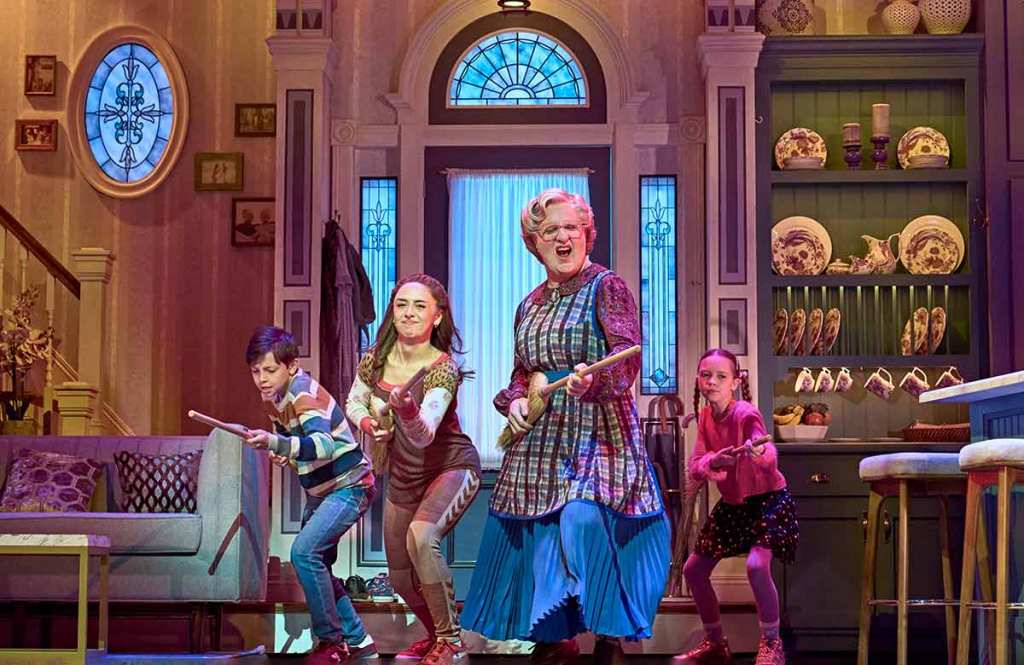
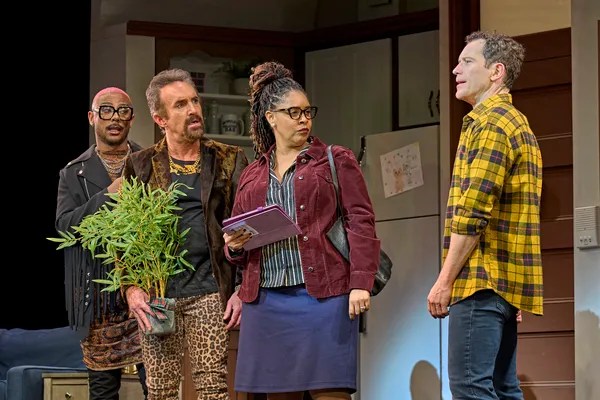
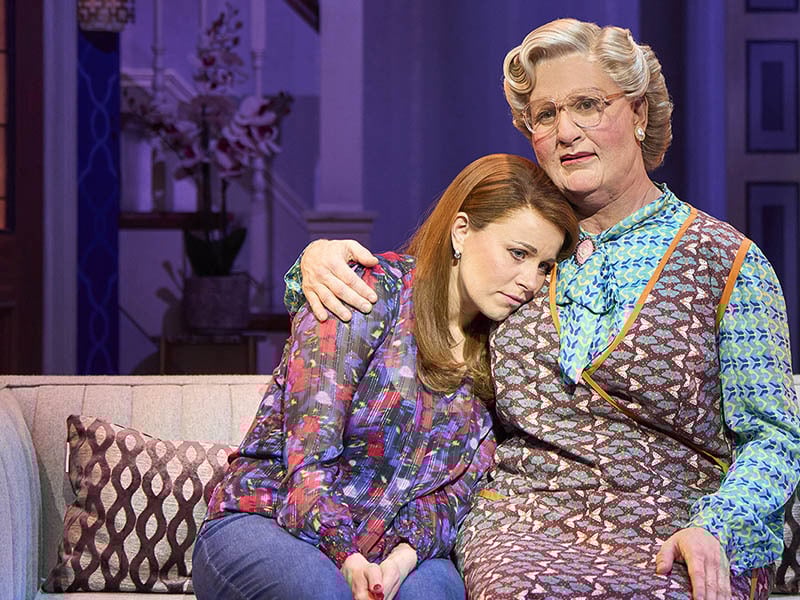
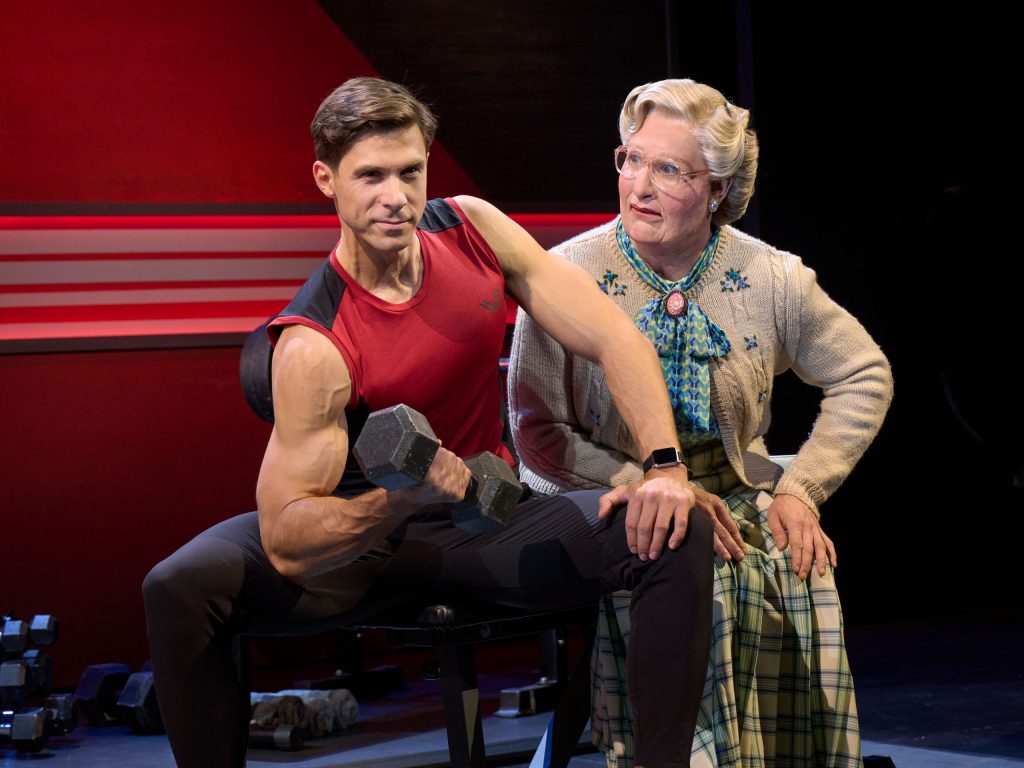
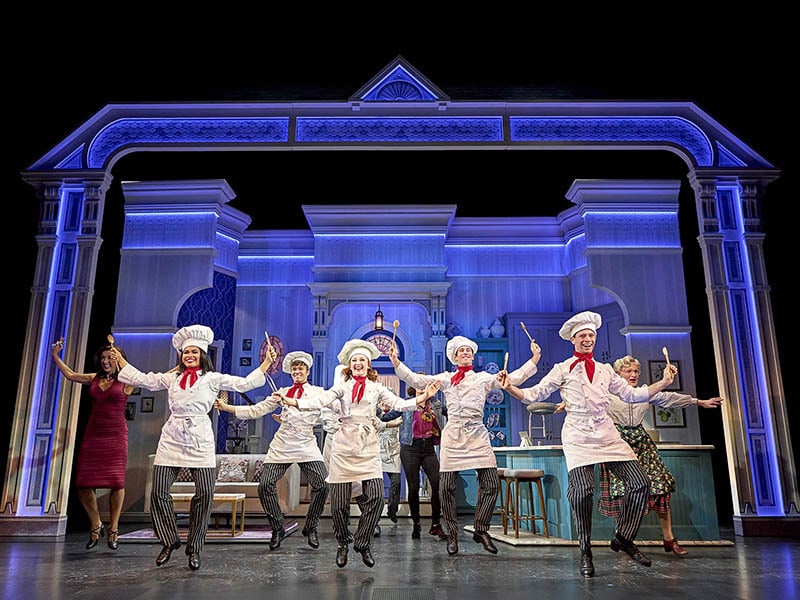

Gabriel Vick / Mrs Doubtfire
She was Madame Doubtfire, a book for children back in 1983, then Robin Williams played her as Mrs Doubtfire in the 1993 movie. Now she has come to the West End stage via Broadway in a slick new comedy-musical, very American and very much aimed at those who may remember the film.
Frankly, we had little interest in seeing the show, until we were invited by our friends at DelMack so went along to see exactly who this Mrs Doubtfire is. No cast names had been mentioned, just a picture of Mrs D on the posters, so what we really wanted to know was who plays the lead that the producers don’t want to publicise, unrecognisable as the lady herself in the ads, disguised by fat-suit and prosthetic mask. Only last month Fredo wrote about shows without stars, sold on their title alone, like Les Mis, Moulin Rouge and Phantom. Now we have seen the show, we want to shout about Gabriel Vick, the unknown star who transforms himself into this Scottish down-to-earth children’s Nanny.
He is just amazing, a likeable presence on stage whose performance and personality carry the show. He is a good-looking old-pro at both musicals and plays (Once, Avenue Q, Cabaret, La Cage Aux Folles, The Tempest, Murder in the Cathedral…) but he has never made it to star billing. He still hasn’t, but he certainly should!
He plays a fun Dad, an out-of-work entertainer, who loves his kids but cannot keep a job. He’s up against a practical and professional Mum – she divorces him and advertises for a Nanny to look after the kids. You can guess the rest. The show settles into a cross between Mary Poppins and Tootsie, with Kramer v Kramer thickening the plot. Of course everyone learns lessons about family ties, responsibility, deception, and naturally love, all mixed together with lively humour. There’s even a song called As Long As There Is Love.
It’s a handsome production with familiar character types and smart sets. But it’s Gabriel Vick who holds it all together, has us rooting for him, and manages on-stage quick-changes from Dad to Nanny in seconds, while disappearing through one door to reappear through another. Part of the entertainment here is seeing him change or we just may not believe it’s the same person.
Part panto and part standard musical fare with some cringe-making humourous moments, it gains class by its production values and well-chosen casting. The audience seemed older than for the currently popular juke-box musicals, with a few families bringing young children – they were all amused and entertained, but it was Vick who brought everyone to their feet at the curtain call. Deservedly so.
Our rating: ★★★★ / Group appeal: ★★★★
26/09/23 Kathie writes –
Orlando furioso
Musica di Antonio Vivaldi, libretto di Grazio Braccioli, at the Teatro Malibran, Venice.

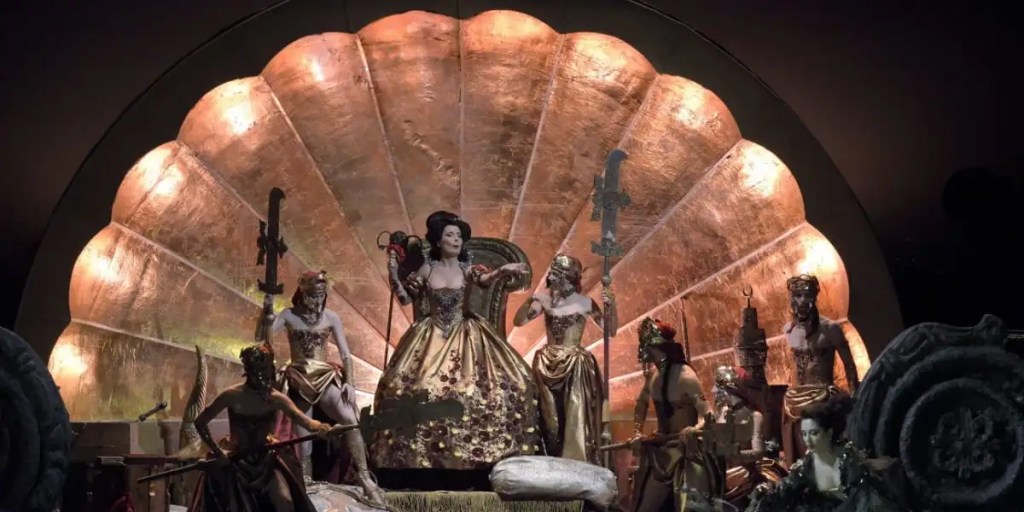
Today, if Vivaldi is mentioned it is The Four Seasons, plus a concerto or two, that readily come to mind and yet there are 50 operas that have been identified as being by him, of which only 20 survive and from those just 16 in a complete form. Seldom performed, the chance to see Orlando Furioso while in Venice for Mike’s 80th birthday celebration was an opportunity not to be missed.
First performed in Venice in 1727, the libretto was based on the 1516 epic poem Orlando Furioso by Ludovico Ariosto which had earlier roots in other poems. The story of Orlando, a knight-errant and supposedly a nephew of Charlemagne, was used on other occasions by Vivaldi and also by Handel, who wrote 3 operas based upon this heroic tale.
The orchestra and chorus of La Fenice were joined by a fairly small cast where the male and female roles were somewhat blurred by having females playing most of the male roles, possibly in lieu of the castrati of the day. The complete opera comes in at 4 hours but here we had the 3-hour version, performed in Italian, of course, with Italian surtitles. It’s fair to say that we were not always entirely clear about the storyline!
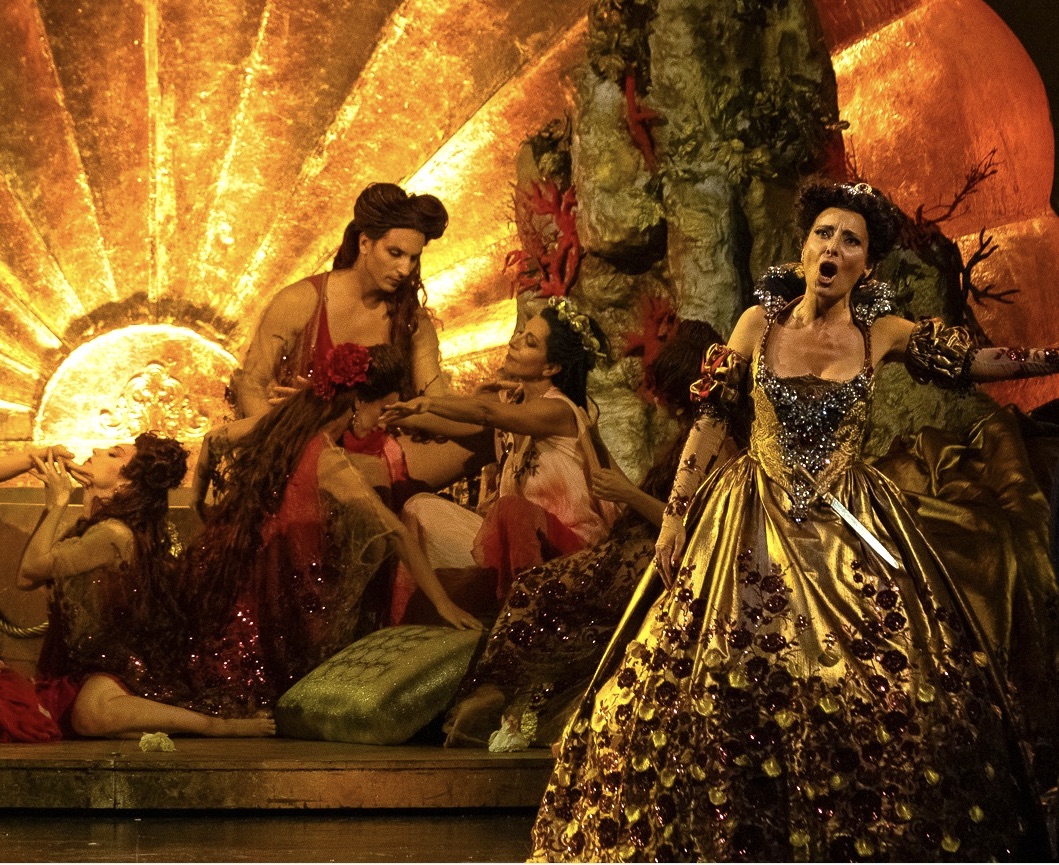
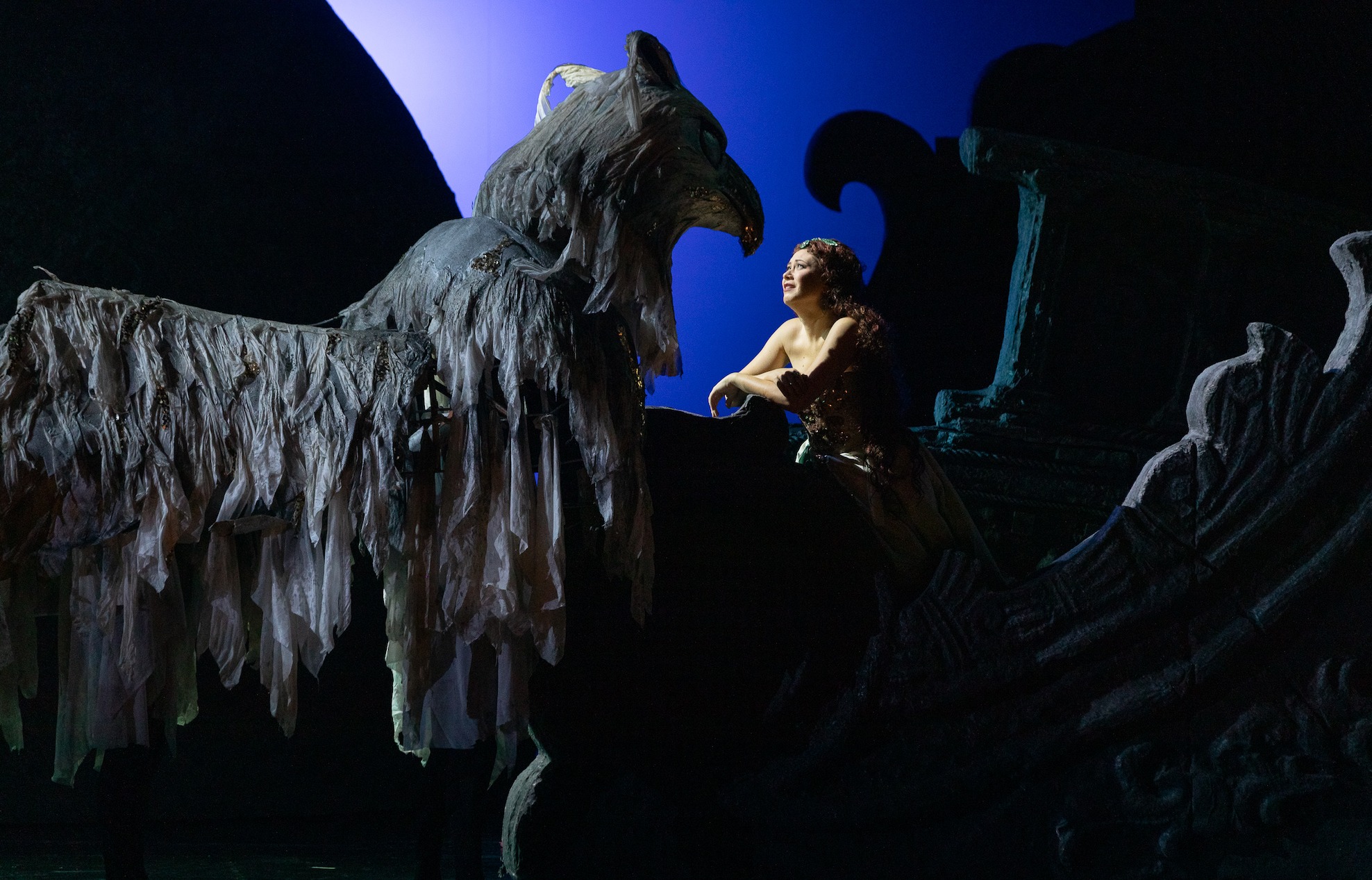
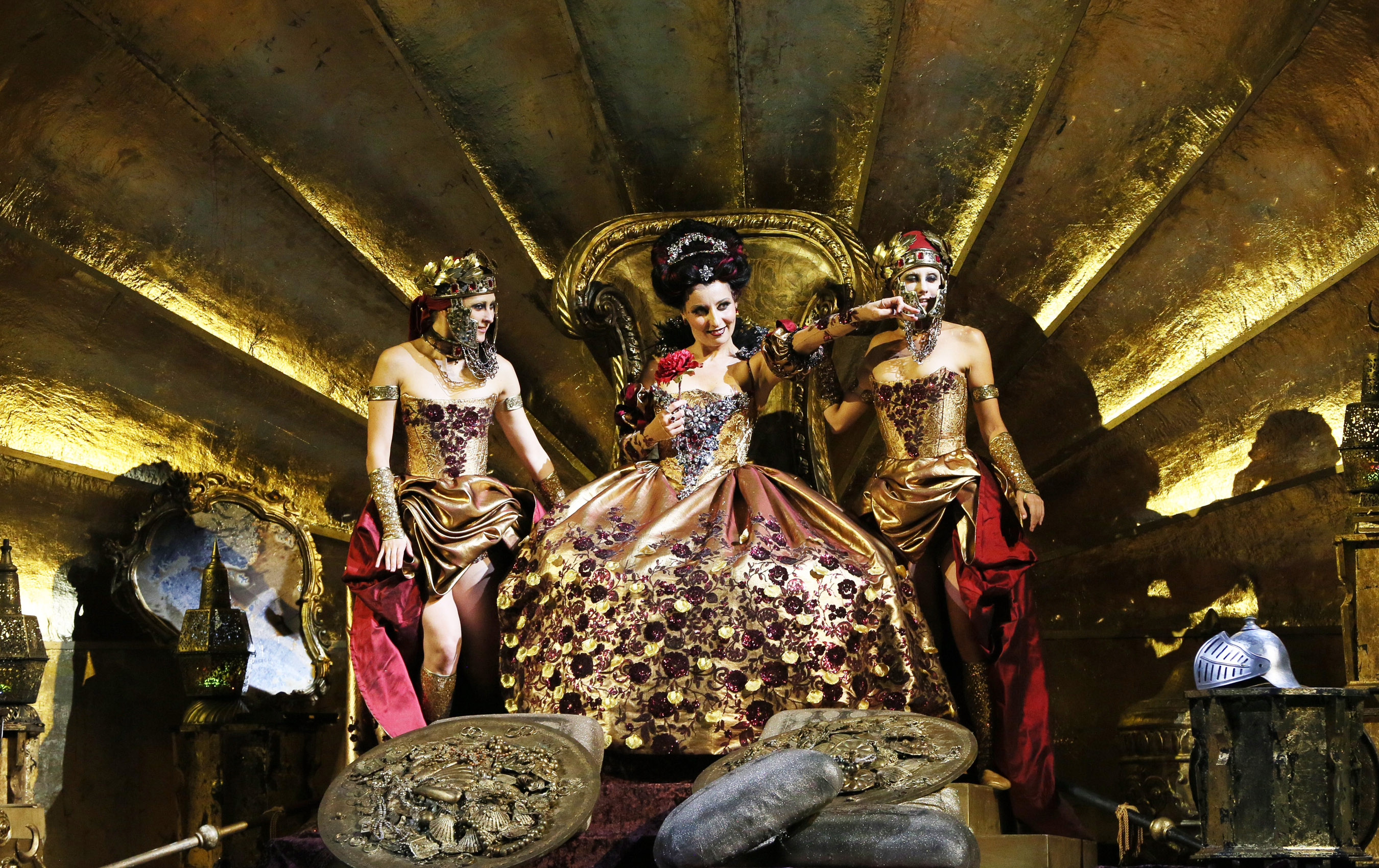
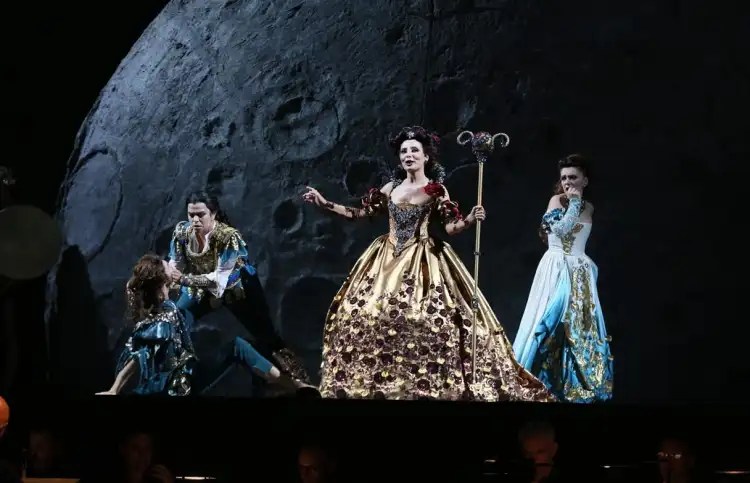
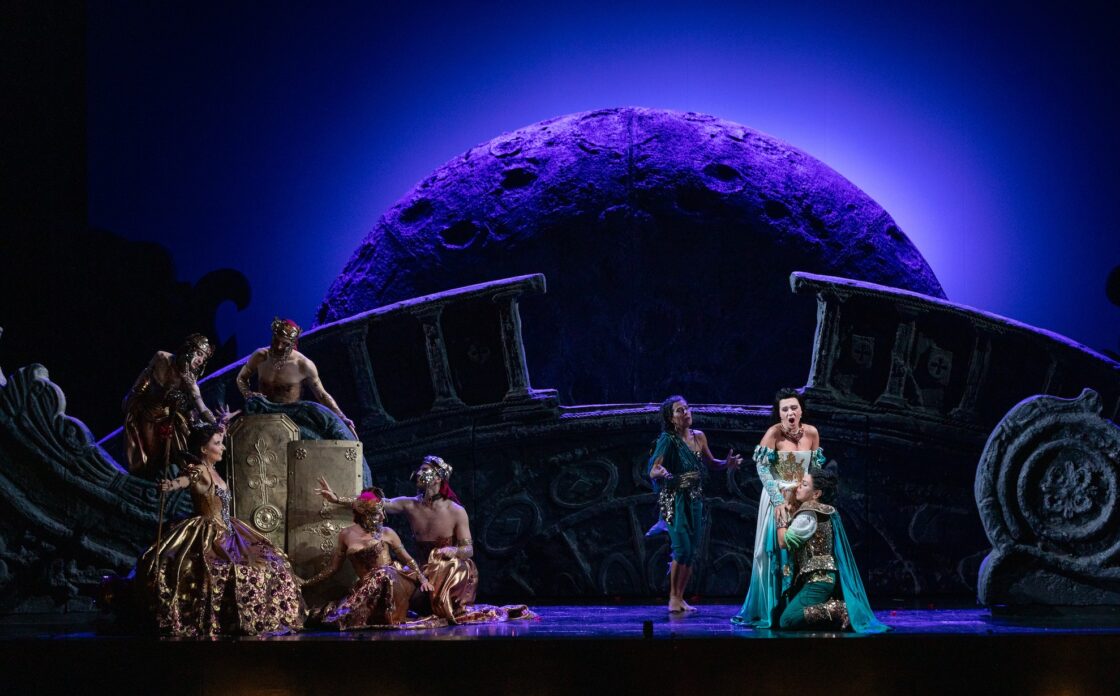
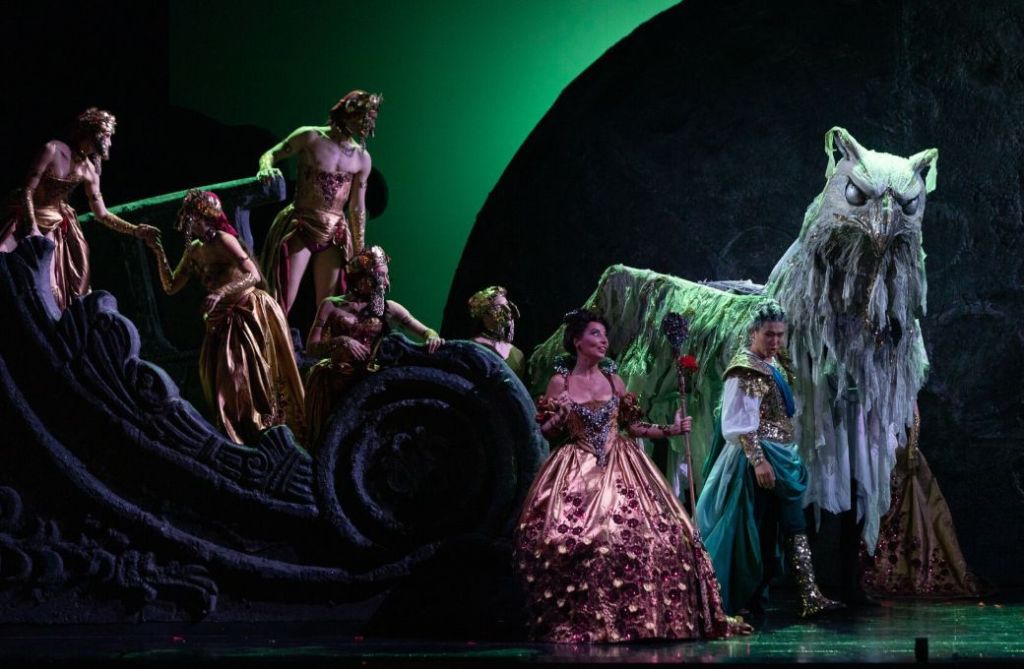
The plot sees us on the island of the enchantress Alcina. Her magical powers come from the ashes of Merlin (a surprise to us that he popped up here) and she is trying to stop Orlando from interfering in a match between Angelica and Medoro. Orlando is in love with Angelica. Other characters include Ruggiero who arrives on a flying horse (though in this version it was a creature with a beak) who is on team Orlando but who is seduced by Alcina. Bradamante, the beloved of Ruggiero, is not happy. Orlando eventually destroys Alcina’s powers and some sort of reconciliation is achieved.
The music, musicianship and vocal dexterity cannot be faulted. Where we were disappointed was in the staging and the continuity. It had a clumsiness to it which reduced the experience to less than it might have been.
Our ratings:
For the chance to have seen it: ★★★★
In the execution: ★★
Mike adds: Opera seats are always expensive so we bought tickets for the Gallery, far from ideal. The theatre lacks atmosphere, lots of cream paint, and the sightlines are poor. The gallery was not full (we couldn’t see the size of the audience below) so several people changed their seats to get a better view. We did too, and eventually settled with a clear but very distant view of the stage. The acoustics were excellent, both orchestra and voices, but this meant stage movements were loud too, footsteps accentuated. And from our high view, we could see stagehands moving props and bending to try to hide themselves. Too many distractions! For many €uros more, from a better seat, we may have enjoyed it more.
09/09/23 Mike writes –
A Mirror
by Sam Holcroft, at the Almeida Theatre

Photos: Marc Brenner
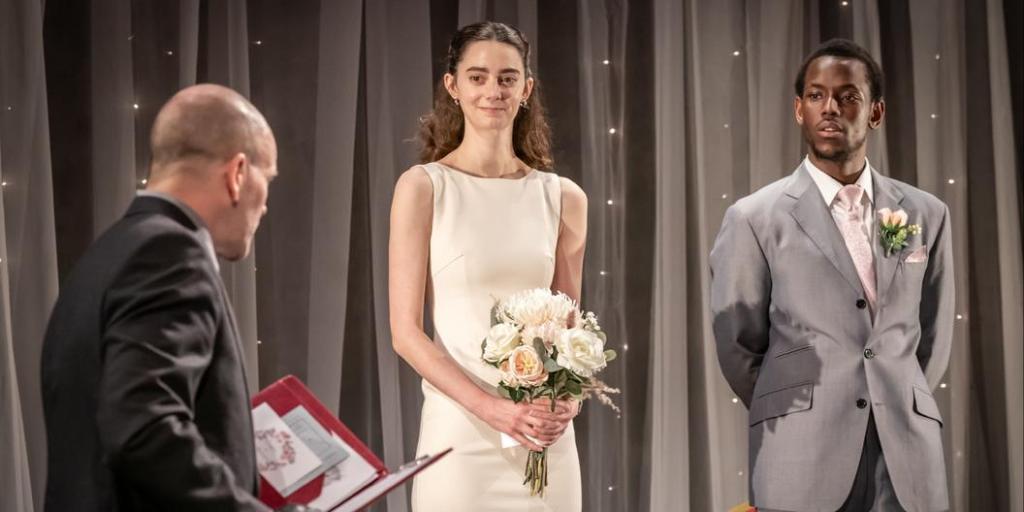
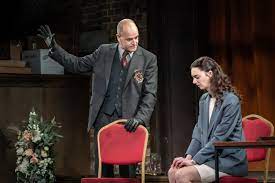
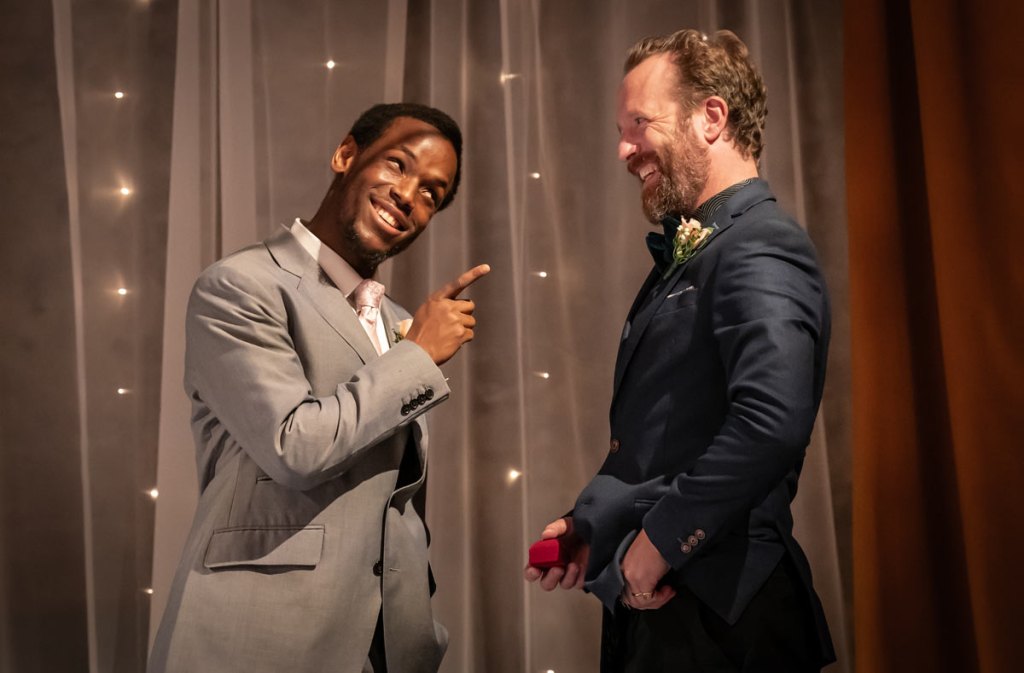
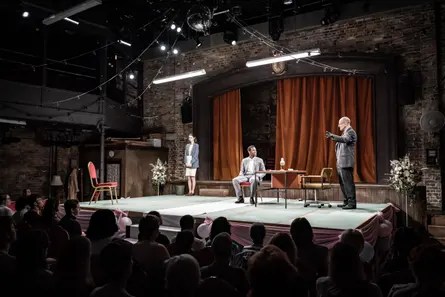
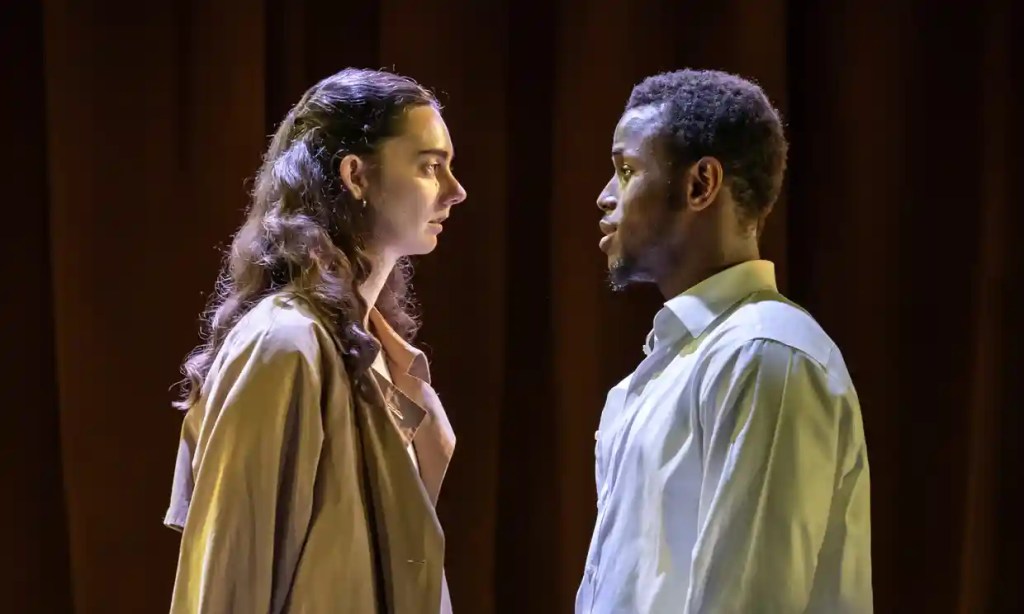
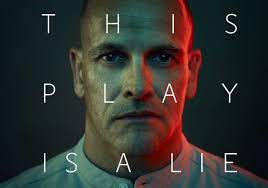
Sam Holcroft reportedly brought the idea for this play back from her holiday jaunt to North Korea. I hope she had a better time than she gives us. It begins well. We are guests at a wedding ceremony in a dictatorial state where culture is repressively controlled. But the wedding is bogus, a front for performing a play that would otherwise be banned. This forbidden play is all about censoring a play because it is based on unacceptable overheard verbatim conversation, so the playwright (the bogus wedding’s husband) writes another based on his confrontation with the culture minister. At this point you may not be following me, but the talented cast bring it off in an entertaining way, wheels turning within wheels.
But half way through, this merry whirl comes off its own wheels. We get embroiled in yet another play about a wartime incident and, even with an interruption when this bogus event is stopped by security police and we have to pretend to be wedding guests again, I never returned to caring what is really happening.
I tried to imagine the despicable Nadine Dorries controlling our own cultural efforts when she was a minister for culture, but the more the playwright tried to create relevance (mirroring real life, you might say) the more my hold on events slipped away.
With each cast member ‘being’ at least one person who is pretending to be another, the actors deserve praise for entertaining us as well as they do. There was much amusement in the play’s first half (two hours, no interval) but as a more serious theme surfaced, fascism v. cultural freedom, the complications became wearisome.
But there were pleasures. The Almeida had been transformed into a convincing marriage registry office with flowers, a podium, curtains, wedding seating, and we all entered into the spirit of the enterprise. Jonny Lee Miller was the bogus registrar/culture minister manipulating our deception, and Tanya Reynolds managed her nervous but ultimately assertive character appealingly. Micheal Ward and Geoffrey Streatfield were the two contrasting playwrights.
At the end, and here’s a Spoiler Alert, we are all arrested for watching such a subversive event. If only that had been so. However, it whetted my appetite for a holiday in North Korea, however briefly, but of course no chance of the play being performed there. The Almeida pulled out the stops to give it a chance (The Guardian, of course, and many other papers were impressed) so I hope some had a better time than we did. Maybe the cheers were for the politics rather than the play.
Our rating: ★★★ / Group appeal: ★★
25/08/23 Mike writes –
The Third Man
A Musical Thriller, Book by Christopher Hampton, Lyrics by Don Black, Music by George Fenton, at the Menier Chocolate Factory.
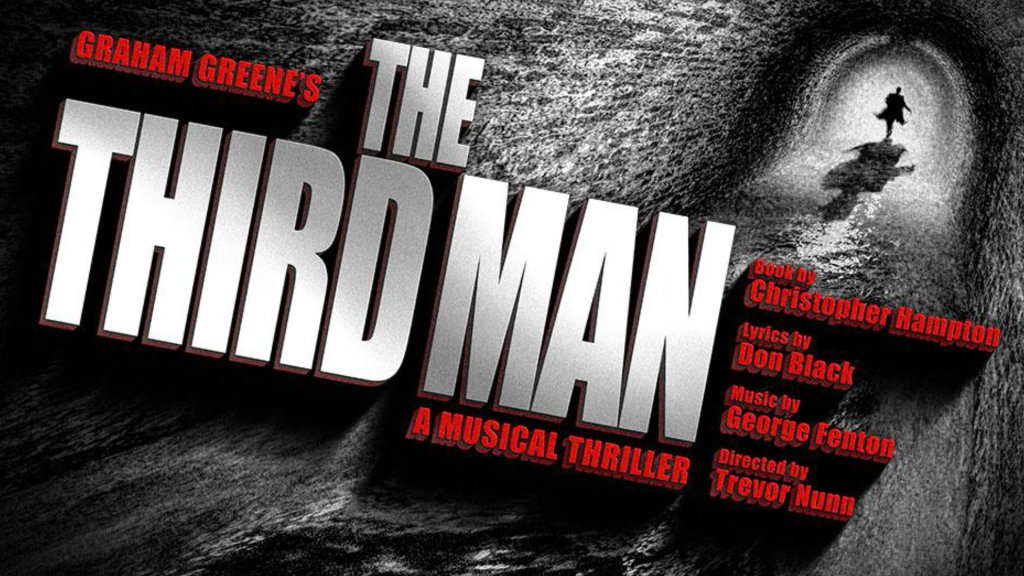
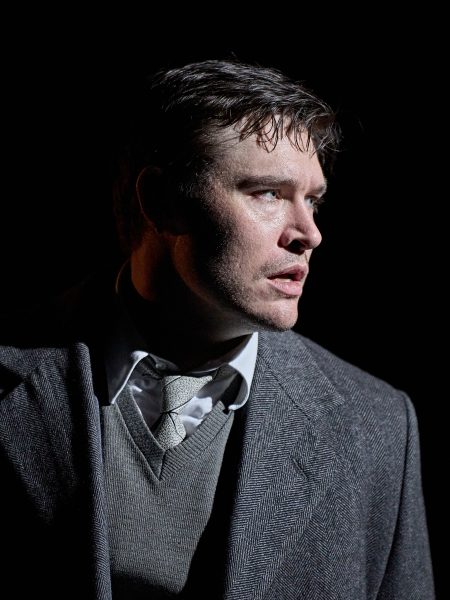
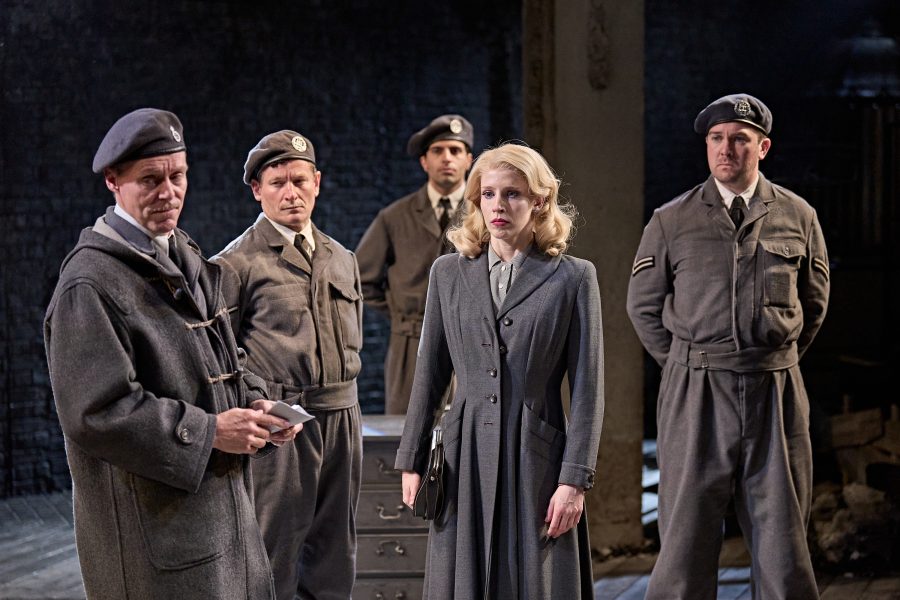
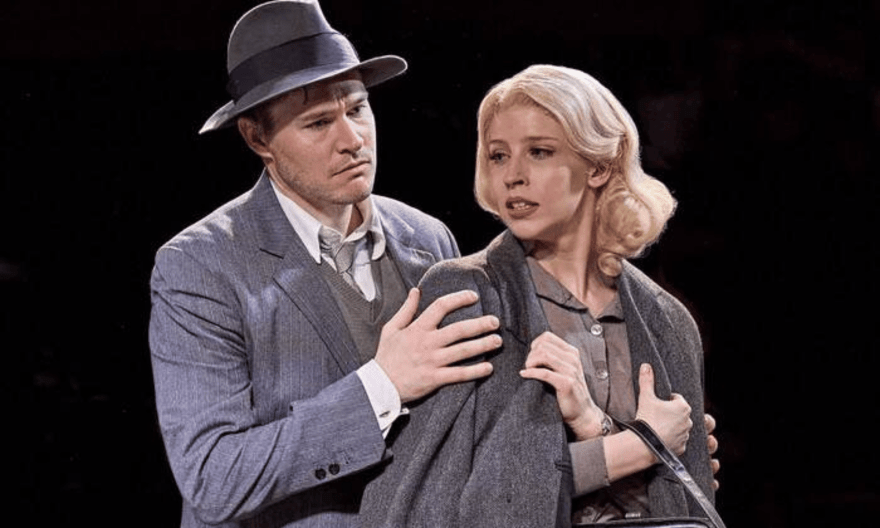
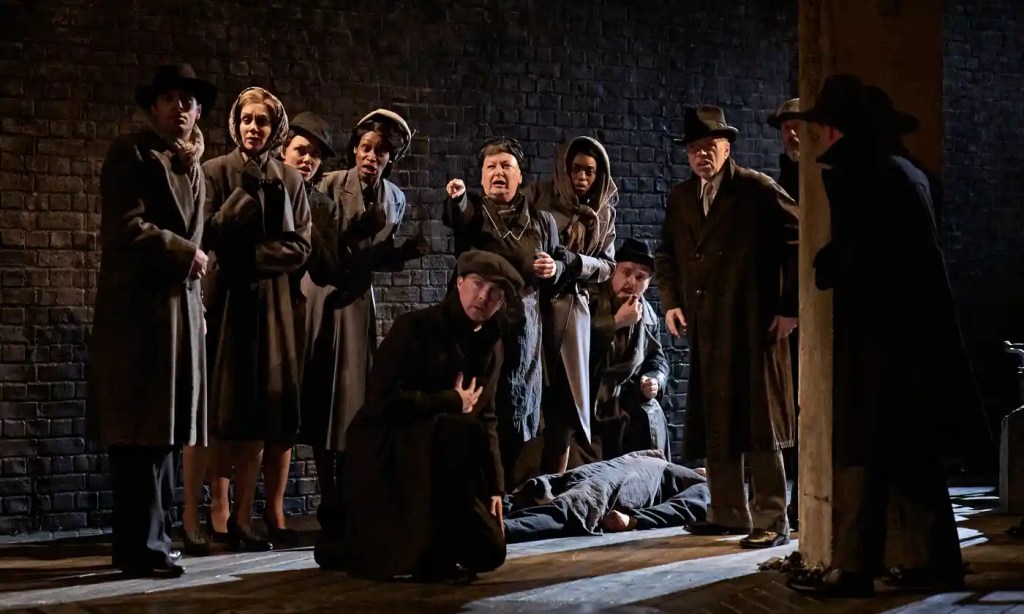
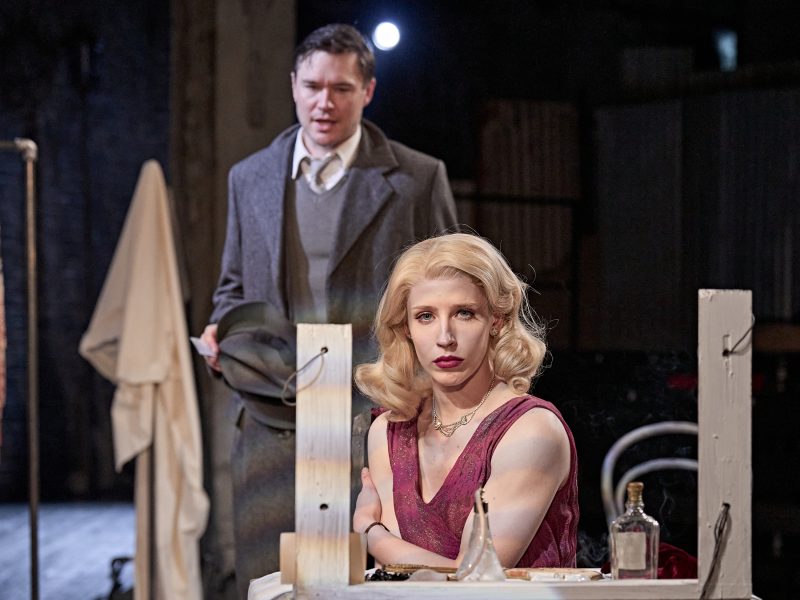
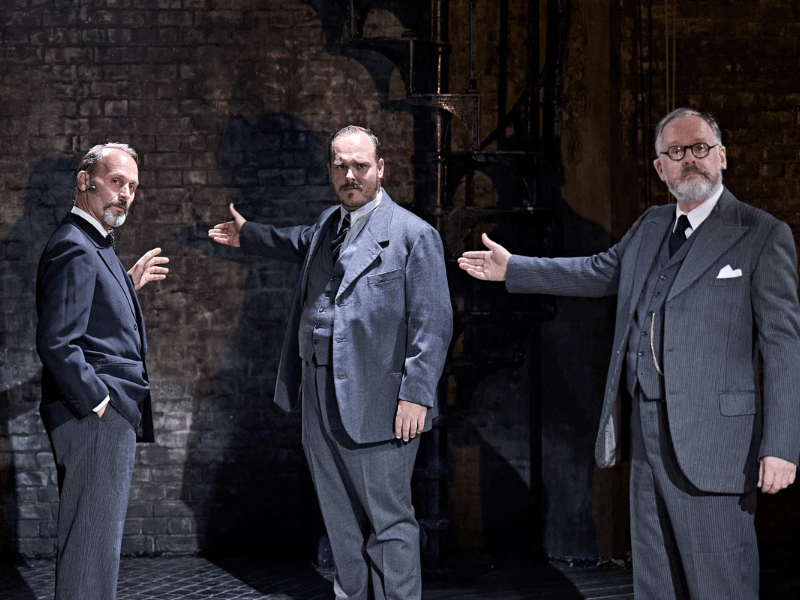
Harry has history, at least in the minds of my generation. That Harry Lime theme on zither has wormed its way into our subconscious, and we remember Orson Wells filling the screen as the illusive Harry himself. There were also Joseph Cotton, Alida Valli and Trevor Howard – classic movie, classic cast. I can still see that ferris wheel too. Then of course there’s Graham Greene’s novel. All this may be a selling point for the musical, but also a reputation to live up to. It’s brave to try.
The musical makers also have reputations. It was Don Black & Christopher Hampton (Book and Lyrics), Trevor Nunn as Director, and Jason Carr as Orchestrator who lured us to the Menier, as well as the theatre’s adventurous reputation for producing musicals. Did it earn a reputation of it’s own? Certainly it did with our next-generation-down companions who, not knowing the original film or book, thought it “absolutely marvellous”. They then bought the DVD.
For us it still looked like a ‘work in progress’, sparsely produced and hampered by being gloomily set mostly in dark alleys and the sewers, with grey always being the dominant colour – appropriately ’film noir’, I suppose. However, it did have a cast of 19 and an orchestra of 9, so that’s where the budget went. I commented before the show that we mustn’t expect tap-dancing, but a brief cabaret scene was included that was no competition for Cabaret.
With the audience on three sides, there was still plenty of space for moving the cast around, rushing hither and thither, and grouping threateningly. The songs, more scene-stoppers than scene-setters, were….oh, I can’t remember any, and they are not listed in the programme. The music just occasionally hinted at that Harry Lime theme tune. The ferris wheel did make an appearance, as just a swinging platform (disappointing), and the chase through the sewers down a spiral ladder (unused!) hardly got one’s pulse racing (again disappointing).
On the plus side was Sam Underwood in the lead role of Holly Martins. He pulled the show together with an energetic and commanding performance, hardly ever off stage, the perfect gumshoe. Simon Bailey as Harry Lime appears late in the show but adds a stylish presence. Natalie Dunn as Anna Schmitt was not well cast, lacking the charisma for a romantic interest – when she spat in Holly’s face at the end it was more of a relief than a shock.
But there was enough of interest in the story and atmosphere to hold attention, enough bones on which to flesh out a better show, enough hope for a success after a make-over. Harry may well live again.
Our rating: ★★★ / Group appeal: ★★★½
Photos: Manuel Harlan
15/08/23 Kathie writes –
Spiral
by Abigail Hood, at the Jermyn Street Theatre
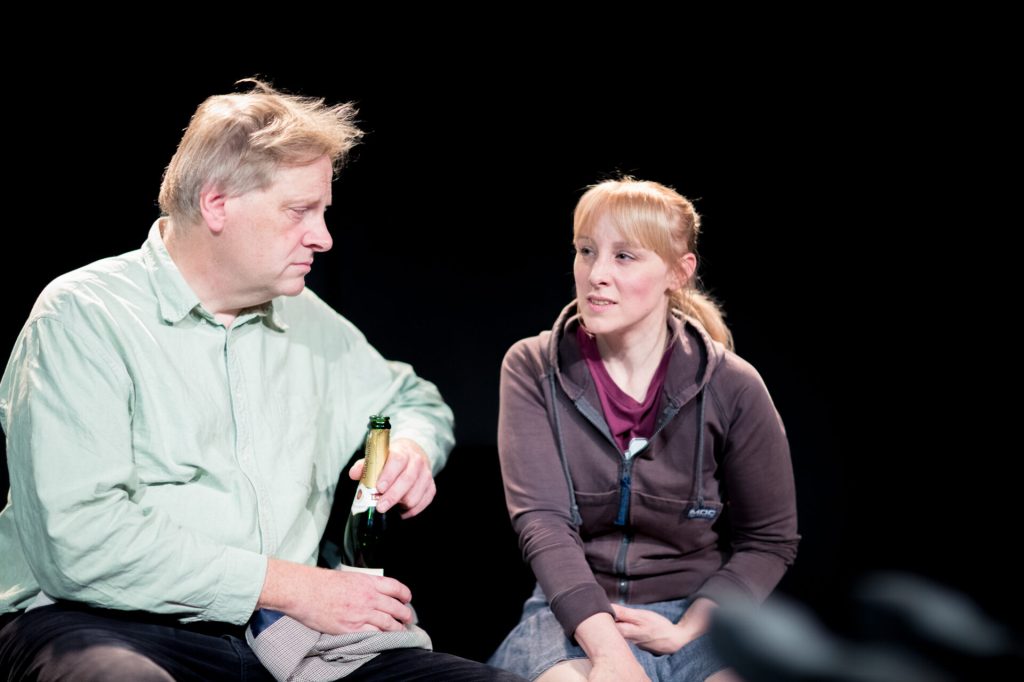
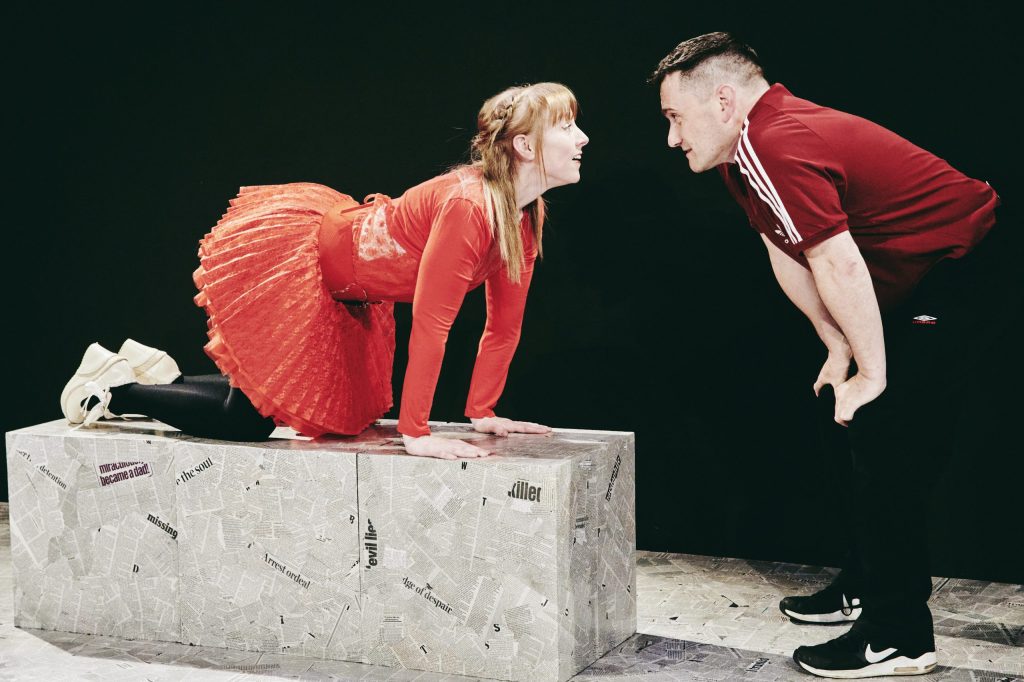
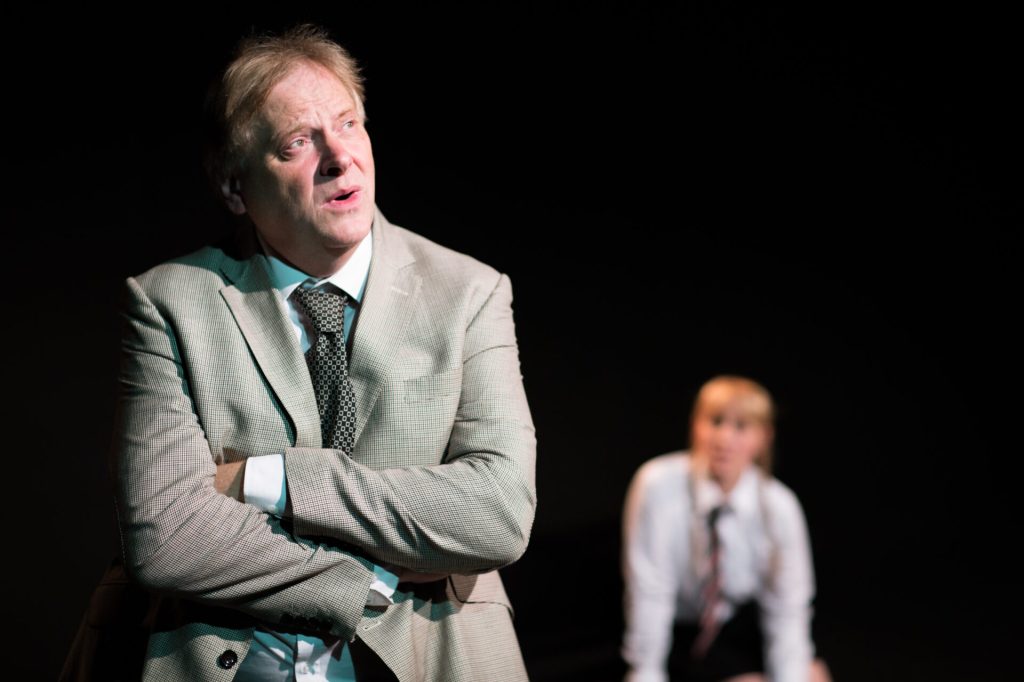
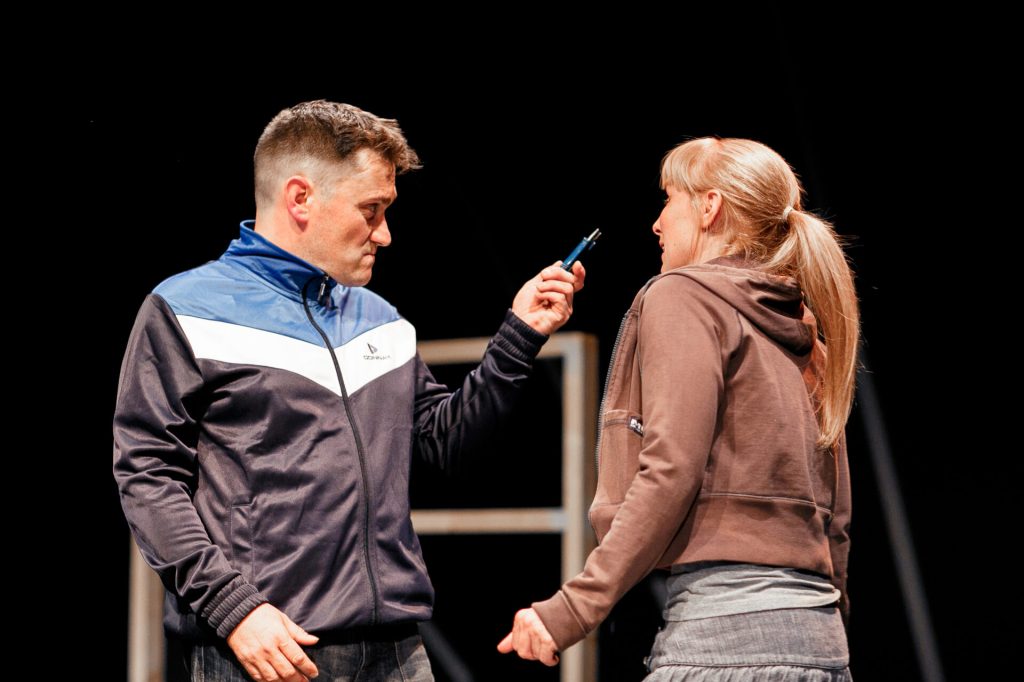
A play first performed at the Park Theatre in 2018 returns to the stage in the very compact Jermyn Street Theatre. The cast of 4 comprises husband and wife, Tom and Gill, plus Mark and Leah who are in a relationship which, we soon learn, is not a healthy one.
Tom & Gill, both school teachers, have a 15 year old daughter, Sophie, who has disappeared after having been dropped off by Tom to go to her school. A few months later Tom meets up with Leah who he has hired to look, talk and behave like his missing daughter. Tom’s association with Leah is discovered by his wife and Mark, who acts as Leah’s handler for this and other role-playing jobs, assumes she has sex with her clients which leads him to abuse her, verbally, physically and sexually. It is clear that this happens frequently.
After comforting one of his pupils Tom is told she has accused him of touching her inappropriately which then opens him up to questions about his relationship with his daughter and his role in her disappearance. He has continued to see Leah, out of friendship and concern he tries to assure his wife, but both she and Mark question his motives and life is looking very bleak for everyone, except Mark who deserves no sympathy.
There are further twists and turns and we, the audience, are left wondering until the end what sort of man Tom is and how much we can trust what he says. Whilst not every situation is resolved there is a conclusion of a sort which provides some satisfaction.
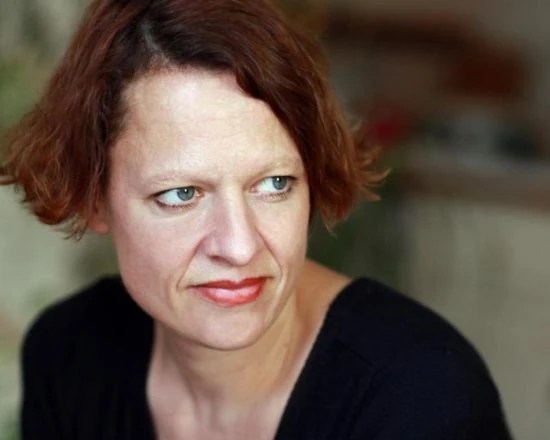
The play was written by Abigail Hood (Leah) and directed by Kevin Tomlinson (Mark). They were joined by Jasper Jacob (Tom) and Rebecca Crankshaw (Gill) and this small cast made a mighty impact in the tiny space dealing with challenging issues where the emotions and underlying tensions were all too exposed. Not always comfortable to watch but certainly worth seeing.
Our rating: ★★★★ / Group appeal: ★★
11/08/23 Mike writes –
The Effect
by Lucy Prebble at the National: Lyttelton Theatre
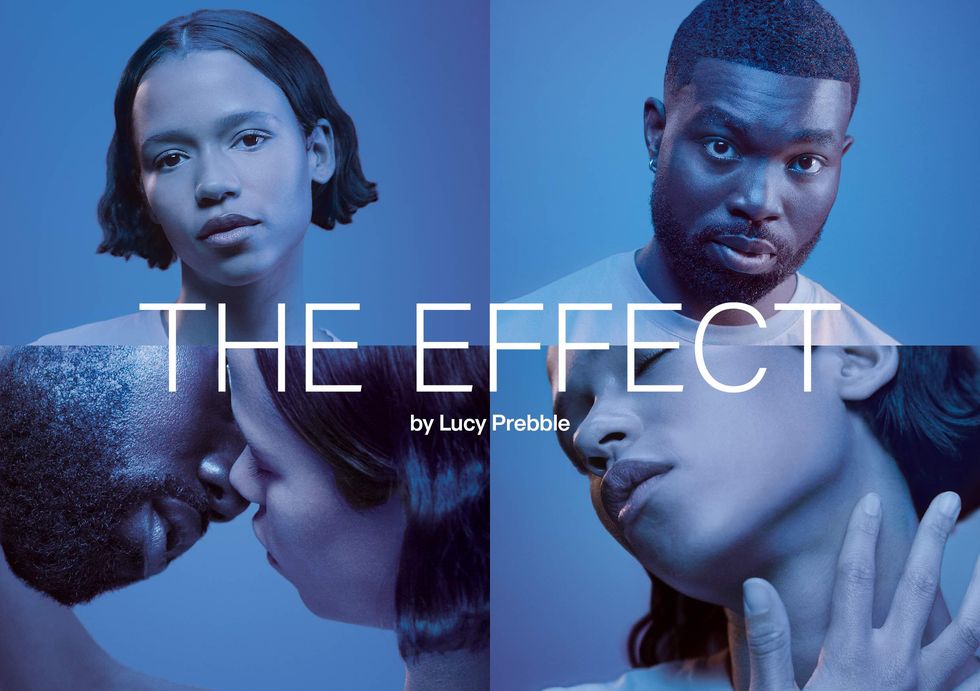
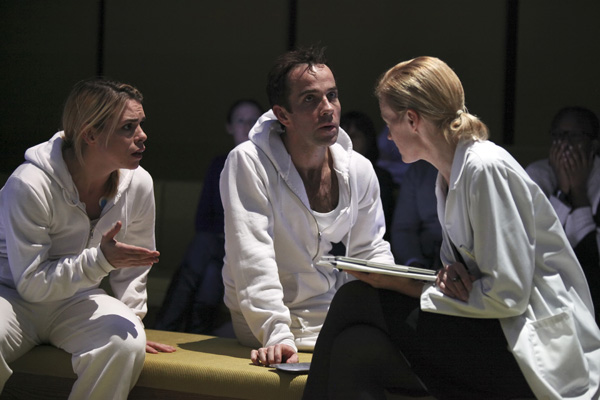
Sometimes presentation is all. Director Jamie Lloyd finds himself at the National Theatre with all its resources at his disposal so he goes big and bold with The Effect. We saw this play back in 2012 with Billie Piper and Jonjo O’Neill at the Cottesloe. It now returns, installed in a reconfigured Lyttelton with an all-black cast, revised and updated for a new decade. It now has a traverse stage brought forward into the front Stalls with seating raised up to the front of the Circle and another bank of seating in the old stage area. The stage is lit dramatically from all sides with its floor lit from beneath in changing geometric shapes. The cast of just four up their game to suit this forensic focus. I wondered just how much it all cost and, more essentially, whether it was worth it.
We paid only £20 to sit in the back row of the stage seating, but there were many top price empty seats and it was our lucky day to be moved forward into the vacant seats. We were grateful as, despite the big staging, this is an intimate drama with emotions in the spotlight.
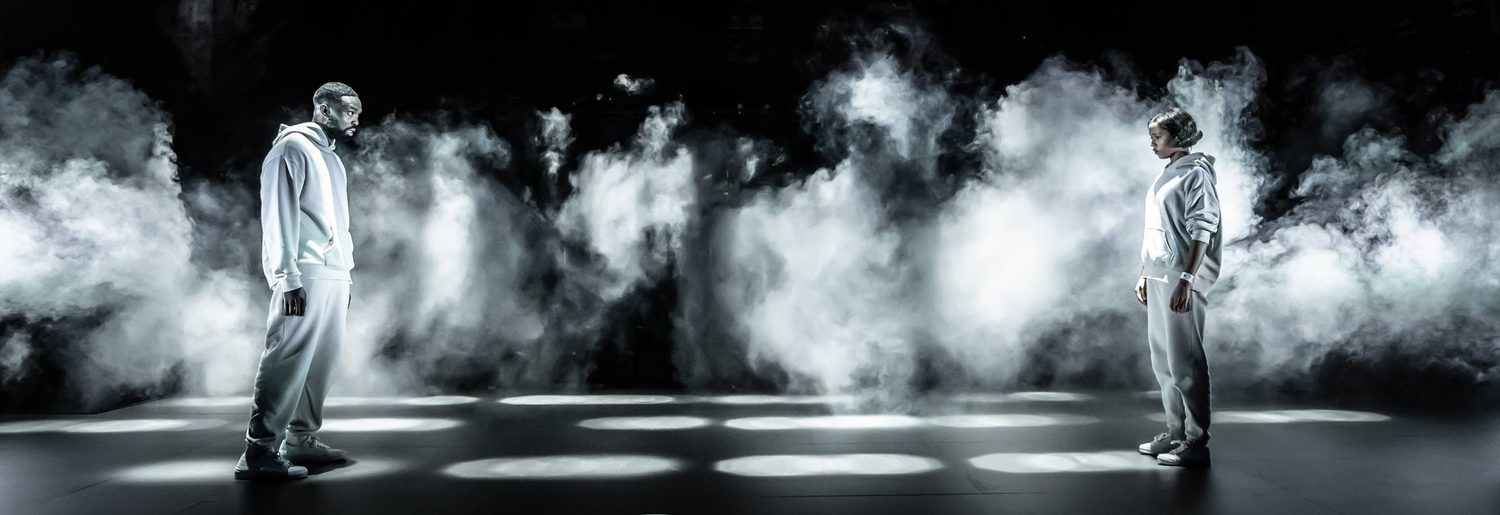

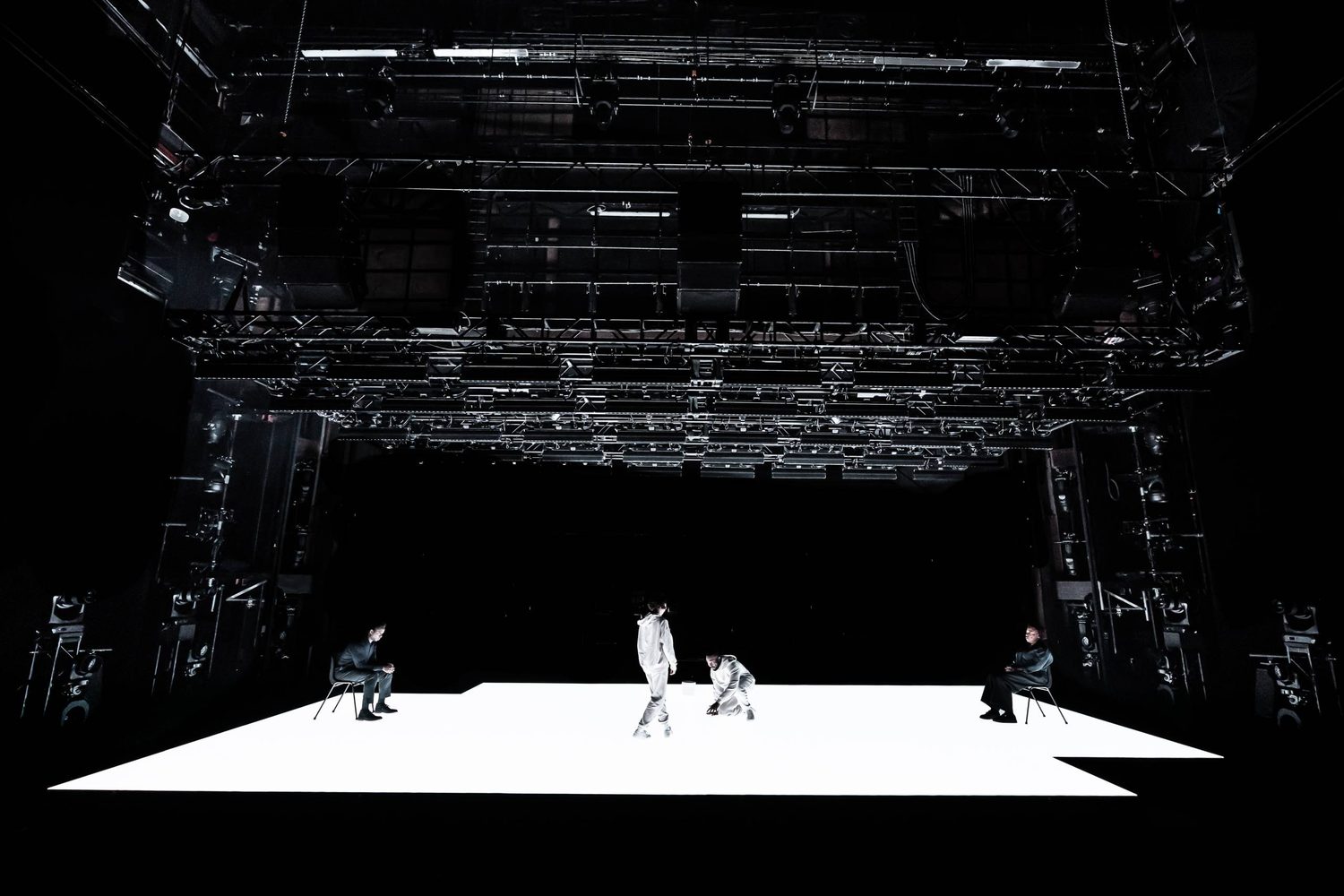
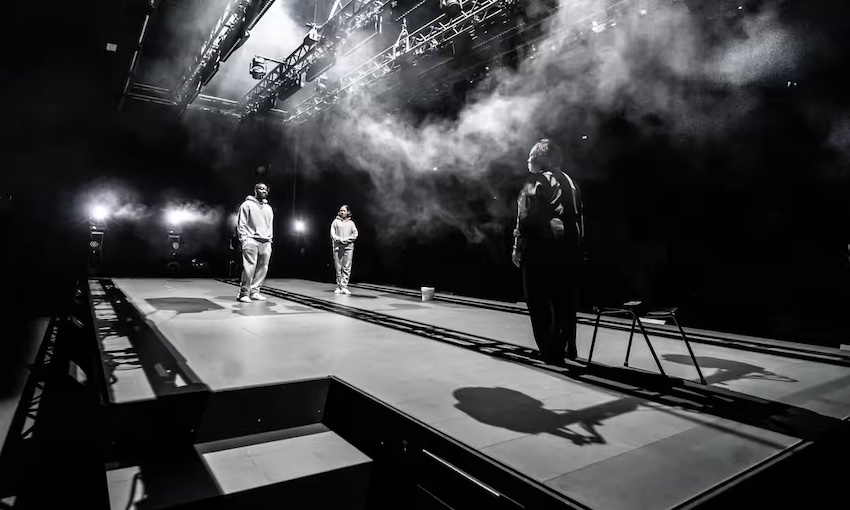
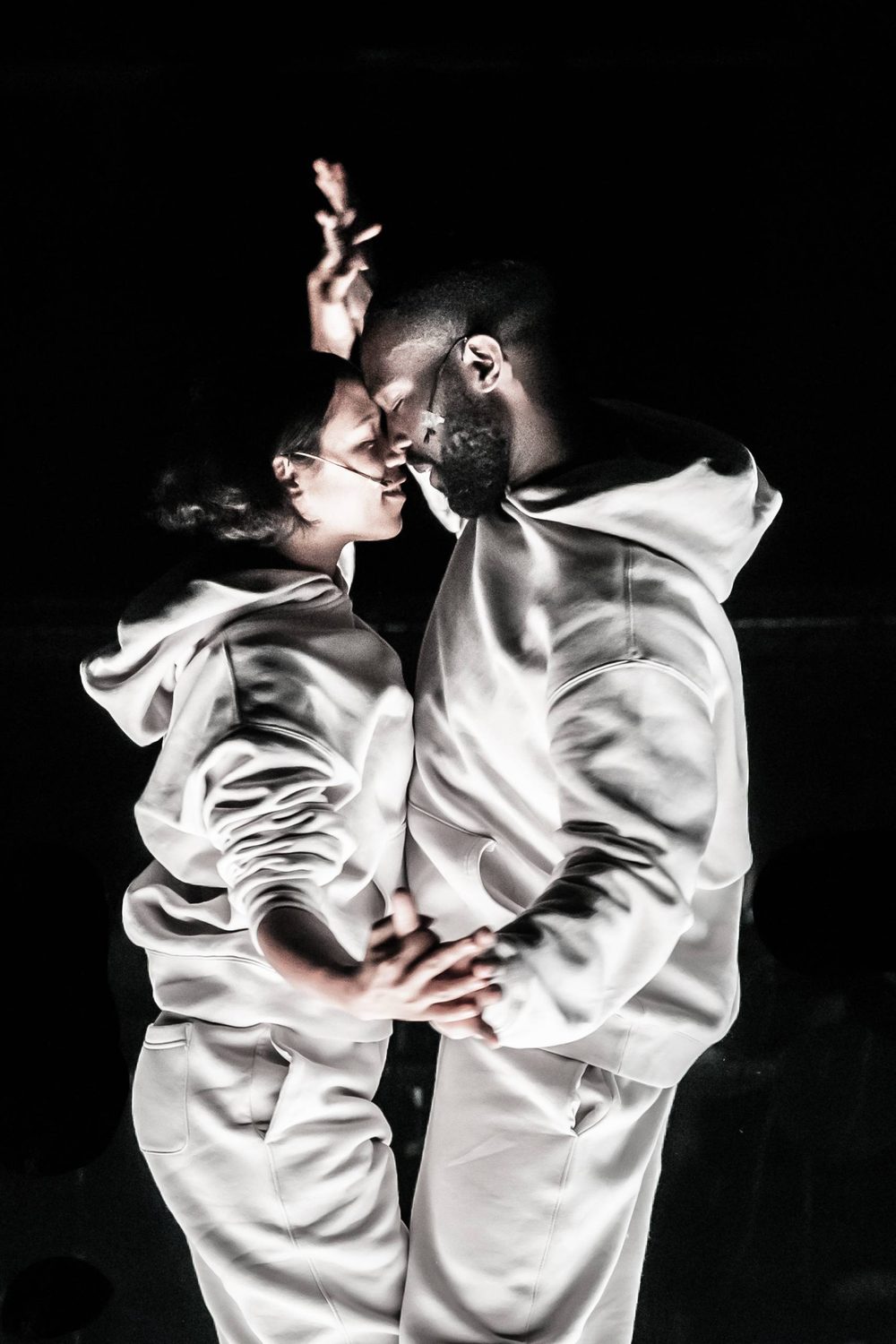

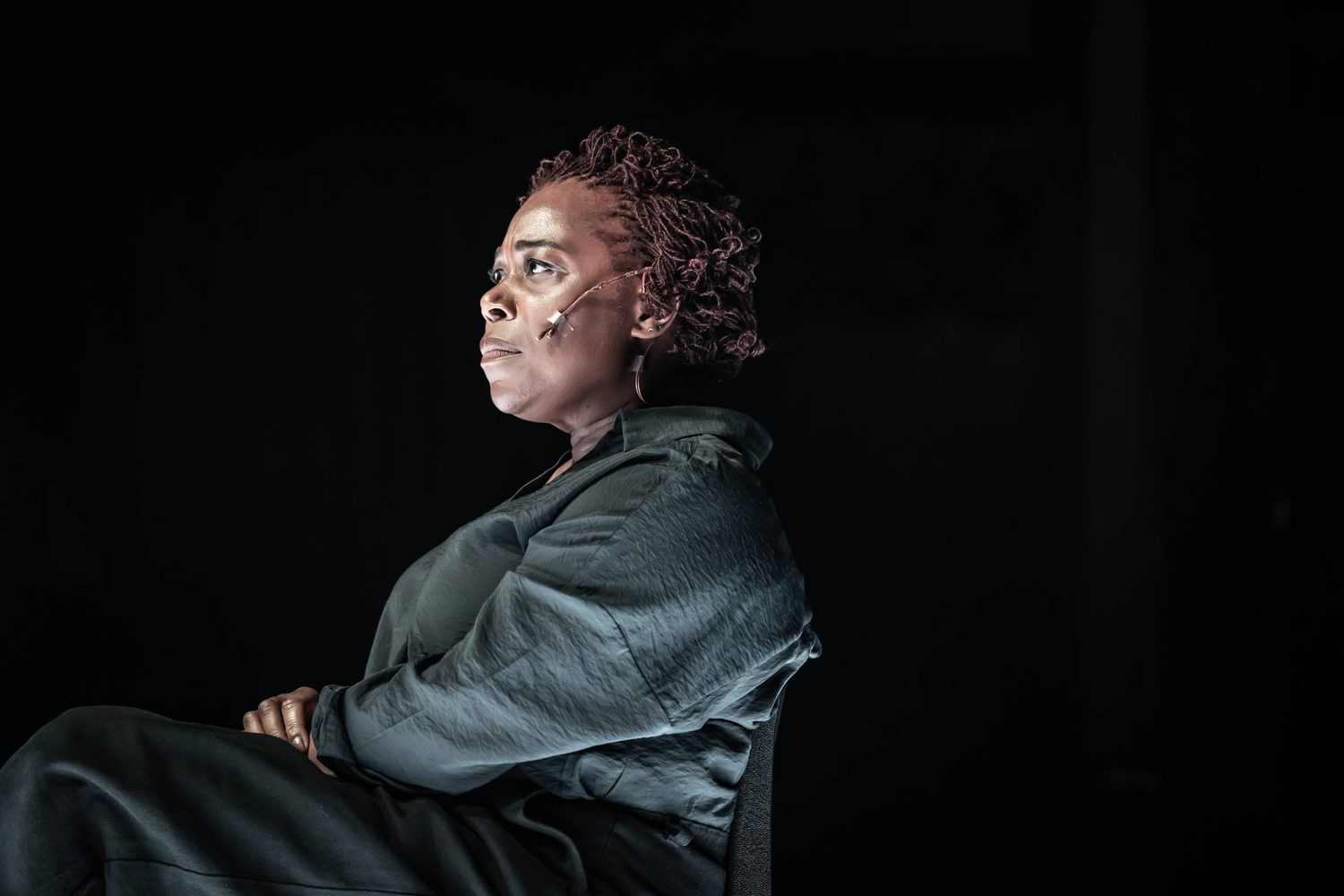
(Click on photos to enlarge)
The two younger characters are partaking in an antidepressant drugs trial, observed by two clinicians. One is asked if she feels sad. Or depressed? Is there a difference? As the doses increase, feelings become more acute and the friendship between Tristan (Paapa Essiedu) and Connie (Taylor Russell) becomes more combative as they realise they are falling in love. But is it real, or just the result of the increasing drug doses? Are any mental health issues being inflamed or surpressed, and whose feelings are real feelings? Does it make a difference if one of them is being given only a placebo? And are the observers (Michele Austin and Kobna Holdbrook-Smith), confrontationally placed, being objective or just reacting according to their own previous emotional history?
This is all very involving for the audience, reacting with some laughter and some concerned shock of recognition, especially as the tone becomes more intense. We are led down thoughtful paths. And of course the ethics of human drug testing is always there for us to consider.
But (and that But was never far from my mind) I did wonder if all this was as deep as it liked to think it was. I was reminded perhaps of the movies Love Potion (a horror flick from 1987) or Love Potion No.9 (a song and a romcom from the 1990s) or any variation on that genre. And of course the songs about love are numerous and timeless – Love Changes Everything, Love Makes the World Go Round, etc etc etc. Lucie Prebble’s play approaches the subject from a different angle but does it dig deeper and raise different concerns?
The performers themselves, battling it out in the ring, probably answered that question with an emphatic Yes. I was not so sure. The four actors were impressive – committed, persuasive and natural. That OTT staging, so simple and yet so affecting, added considerably to our positive response and to the audience’s standing ovation for the wrung-out actors at the end. If I remember rightly, it was more powerful now than it was back then. We certainly had our £20’s worth sitting in £89 seats!
Our rating: ★ ★ ★★ / Group appeal: ★ ★ ★ ½
Photos: Marc Brenner (2023) & Alastair Muir (2012)
08/08/23 Fredo writes –
Tom Kitt: Reflections
A cabaret performance at The Crazy Coqs
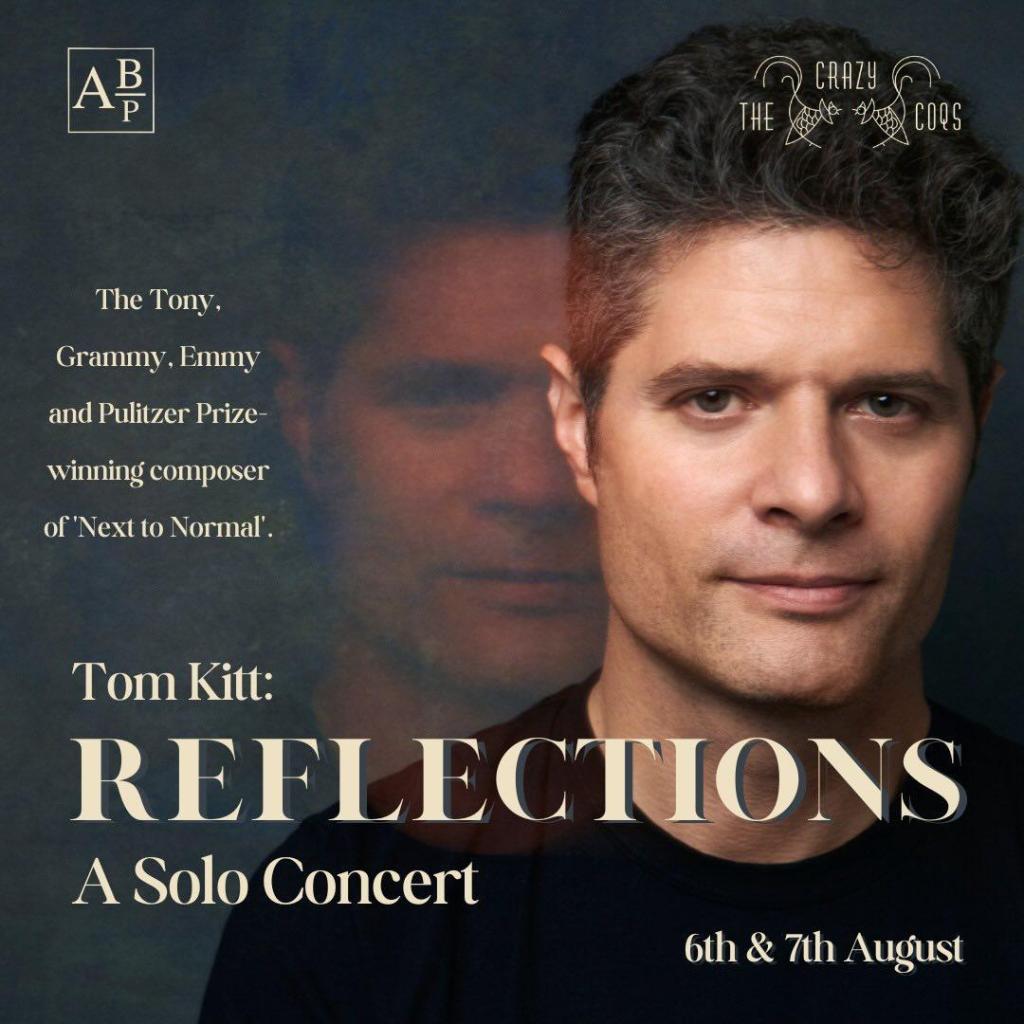
Composer, pianist and singer Tom Kitt is almost famous in this country (and by the way, that’s the title of one of his shows). Although his work has been presented 9 or 10 times on Broadway, and won many awards and prizes, he’s had little exposure over here. That is about to change: he has written the additional music for The SpongeBob Musical, currently showing at the South Bank Centre, and has just completed a short cabaret season at Crazy Coqs. Most significantly, his most successful musical, next to normal, starts previews at the Donmar on 14 August.
The personable and handsome Mr Kitt gave us a preview of some of the songs from this show, but first he treated us to a sample of tunes from several of his other successes and near-misses. These include Almost Famous, Flying Over Sunset, Freaky Friday and If/Then (one could identify recurring themes of mother/child relationships and alternative realities and, talking about himself, he often mentioned his wife and family). It’s always difficult to judge how a song works in a show when you hear it out of context, but Tom played and sang with passion and commitment. (Here’s a LINK to Lost in New York City from Almost Famous.)
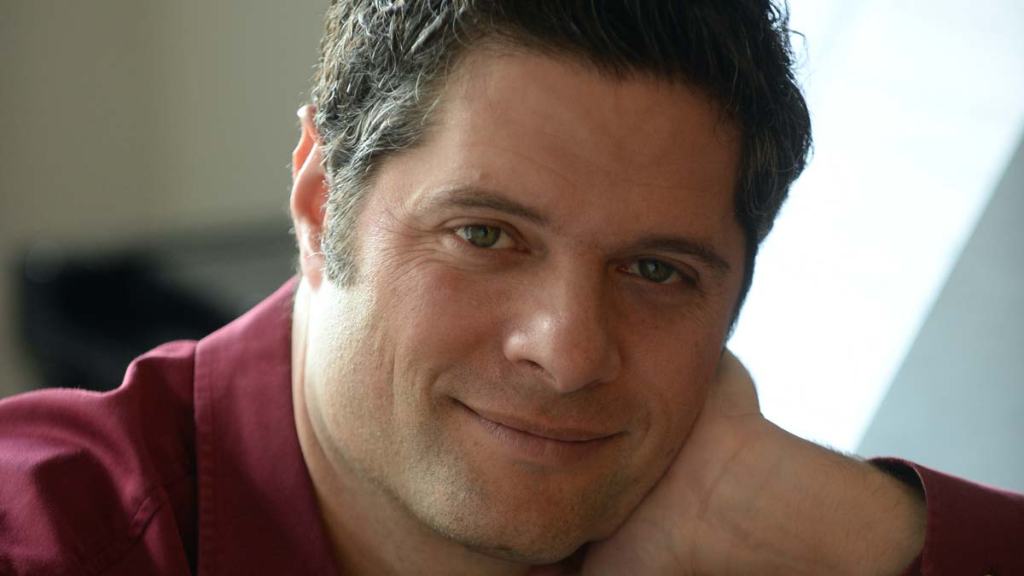

He has a good voice, but when he introduced West End star Kerry Ellis to sing a song from If/Then, the performance ignited. Kerry inhabited the song, and made us realise that it was part of a drama, not just another number. This happened again, in the section of the performance devoted to next to normal. Tom had brought along members of the Donmar cast, and the performances by Caissie Levy, Jack Wolfe and Eleanor Worthington-Cox were electrifying.

Caissie Levy is a respected performer on Broadway, having appeared in Les Miserables and Wicked, and in London in Ghost. She had previously worked with Michael Longhurst in Caroline, or Change on Broadway. It will be a memorable experience to hear her sing the emotional I Miss the Mountains from next to normal on the Donmar stage.
(Here’s a LINK.)
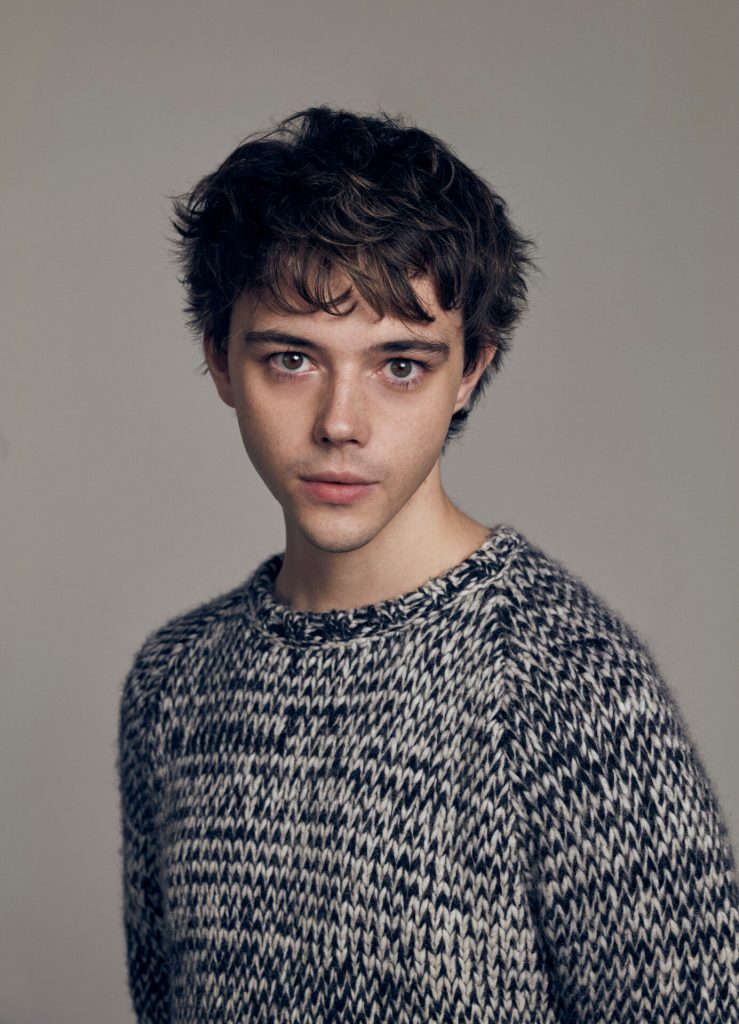
Michael, the Artistic Director of the Donmar, had told us that he was moved to tears by Jack Wolfe’s audition. This young man is a remarkable performer presenting a youthful fragility (he’s 27) and has clearly mastered the songs he has to sing.
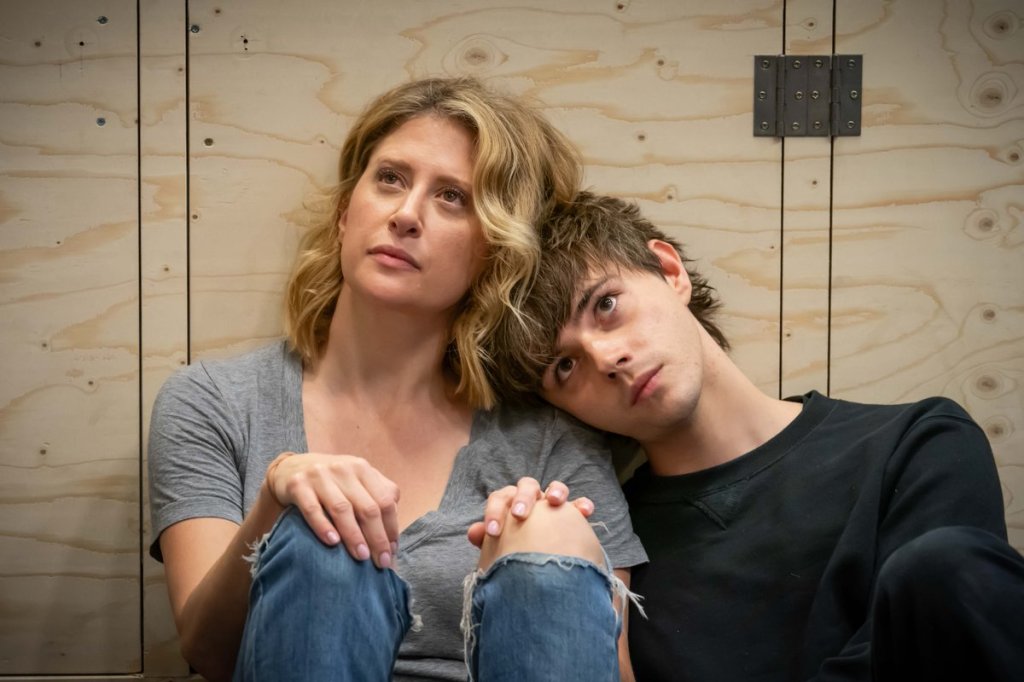

Another star is about to be born in the person of Eleanor Worthington-Cox. She has a lovely voice too (and the tiniest waist I’ve ever seen!). A trigger warning: the duet between Caissie and Eleanor near the end of the show will have you fumbling for your Kleenex; come prepared.
(Here’s a LINK.)
The run of next to normal is sold out at the Donmar – I know because people near us were searching for tickets on their phones. If you haven’t booked, let me know and I’ll add you to the waiting-list for our visit on 29 August.
These performers were rightly applauded, but it was Tom Kitt’s evening. He’s having a London moment. Almost famous? He will be soon!
Our rating: ★ ★ ★★ / Group appeal: ★ ★ ★ ★
08/07/23 Mike writes –
Song from Far Away
by Simon Stephens and Mark Eitzel, at Hampstead Theatre
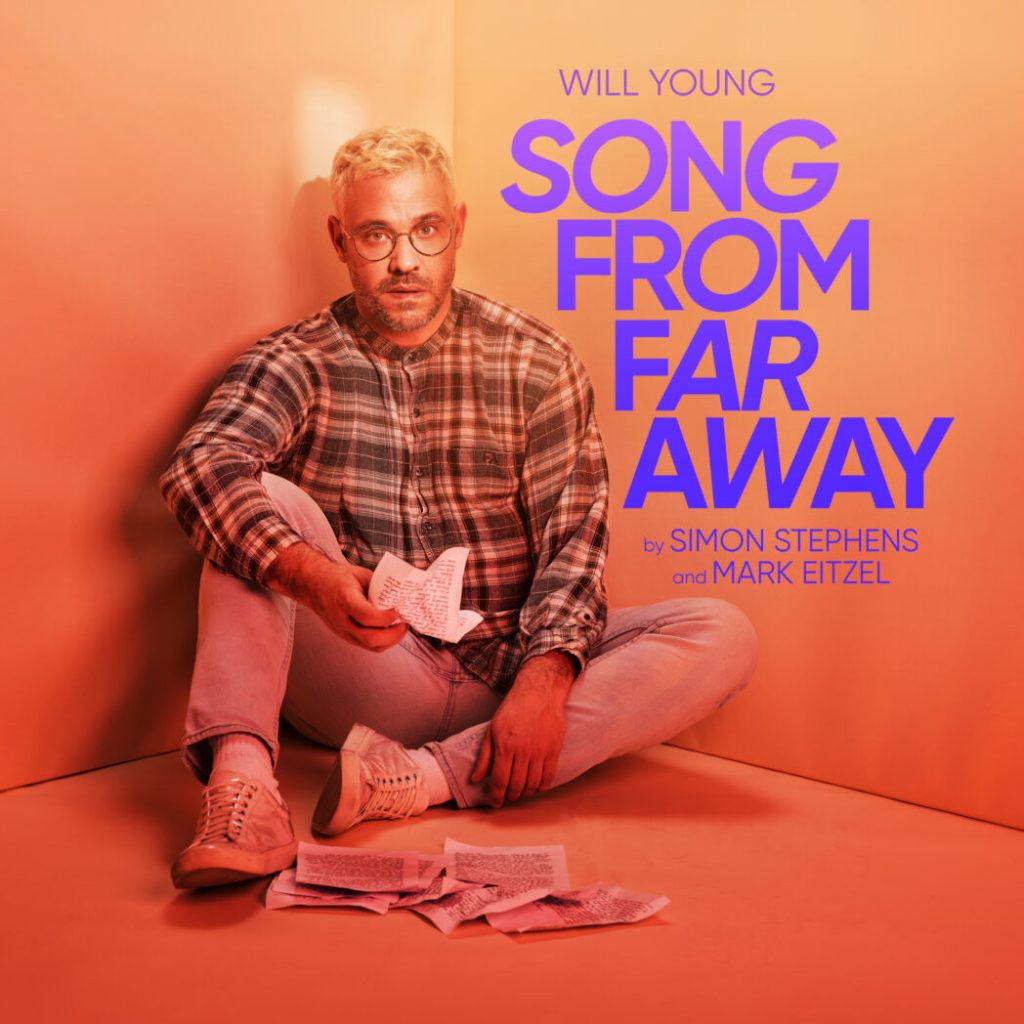
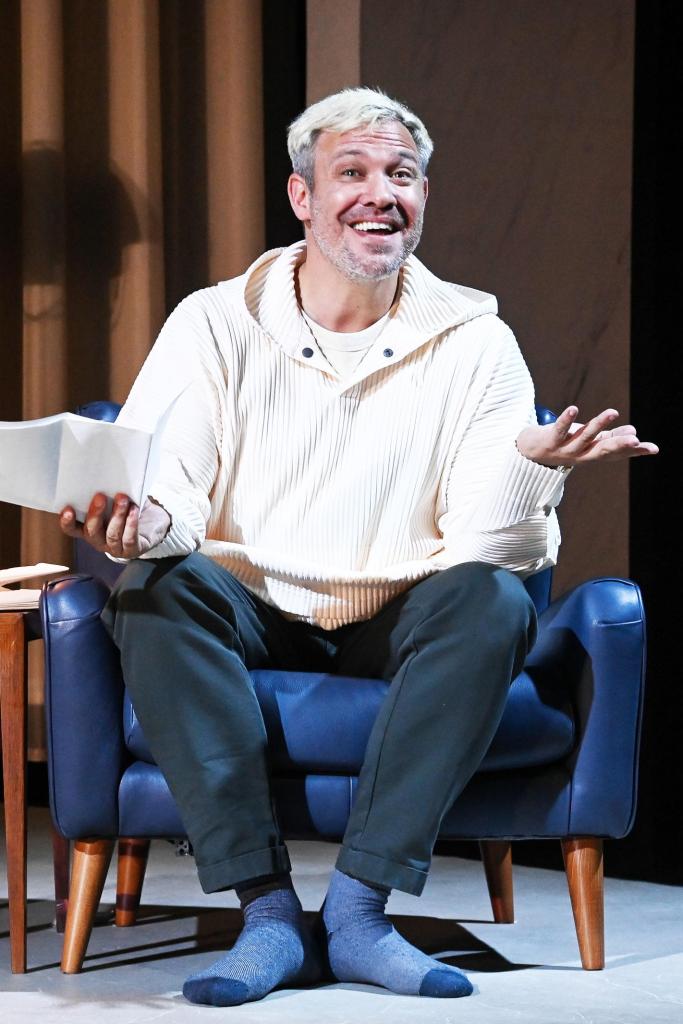
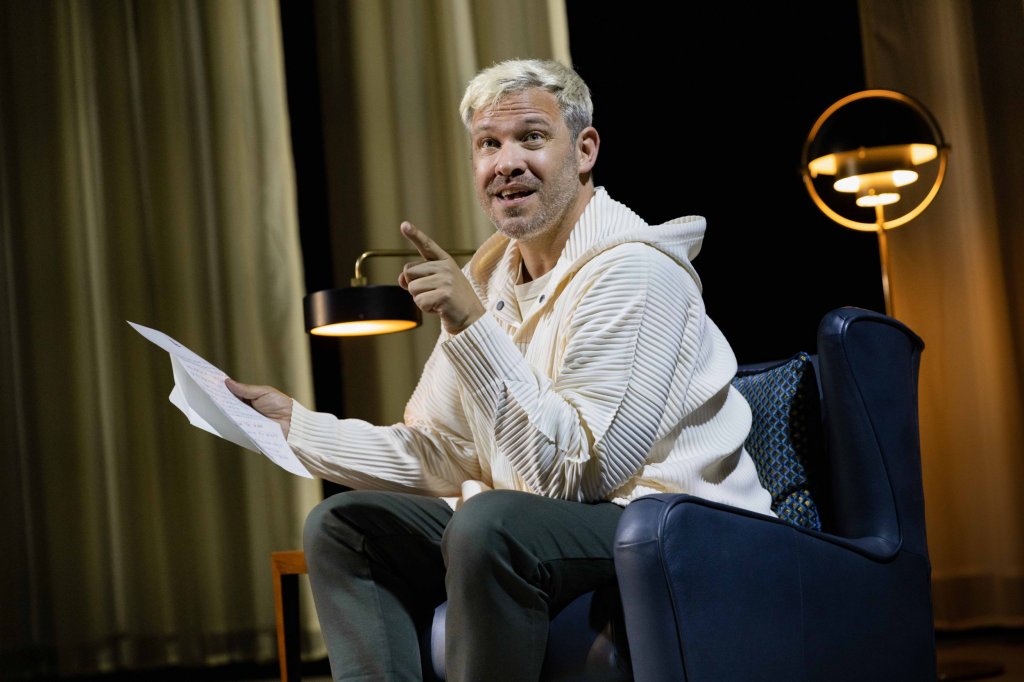
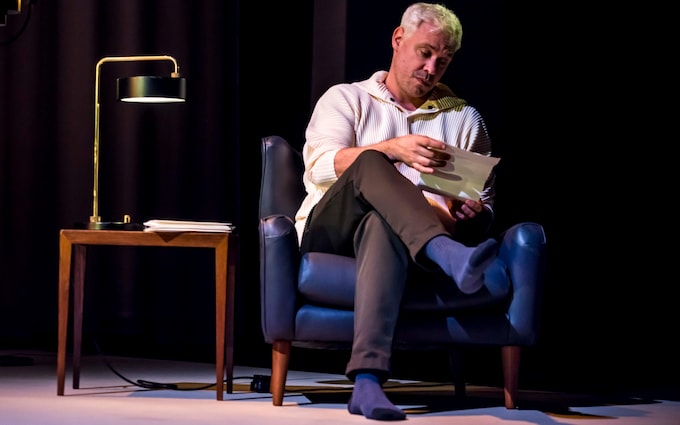
What’s it about? Willem is called back from New York to the family home in Amsterdam where his brother has died. He mulls over his circumstances, his grief, the differences between his and his brother’s life, and what the future may hold.
What does it have going for it? Will Young giving a monologue written by Simon Stephens, author of The Curious Incident of the Dog in the Nighttime. It has one song too, by Mark Eitzel.
Did we enjoy it? Will Young was our draw although we are not fans, we just wanted to see if he could do it after mysteriously withdrawing from Strictly a few years back. He is older now, white-blond and paunchy yet still with a youthful manner. The part of a camp and gay New Yorker suited him and his performance impressed. He brought life and understanding to the script (his own brother died three years ago) talking easily to his audience in a relaxed manner, bringing as much restrained emotion as the part required.
But he could not overcome the bland predictability that the writing gave him – letter reading, family differences, a hotel one-night-stand, his regrets – I wanted more grit, more feeling, to keep me interested (and awake). His softly soothing voice hardly reached the rear Stalls, but when, at last, the monologue segued into song it became more obvious why Young was perfect casting, a perfect voice still. But he should have been given more to offer us.
Hampstead had generously provided curtains, a couch, a coffee table (a little reminiscent of a Parkie talk-show set) and oddly a ceiling which went up and down expensively without reason. Willem’s hair matched the decor, even his baggy designer hoodie was colour coordinated with the furnishings, so all was of a piece and I rather wished something could have broken the spell. Just a little drama would have helped, maybe spilled red wine on the oatmeal carpet.
Our rating: ★ ★ ★ Group appeal: ★ ★ ★
07/07/23 Fredo writes –
Dear England
A new play by James Graham, at the National: Olivier Theatre
HE SHOOTS! HE SCORES! I’m talking about James Graham here. And Joseph Fiennes too. Full disclosure: I’ve never been to a football match in my life. And I can’t foresee a future where I’ll be on the terraces, cheering my team. Even so, I was hooked on Dear England from the opening moment when Gareth Southgate lines up to take that fateful penalty – and misses. James Graham’s thrilling play fast-forwards to Southgate taking over the management of the England team, and the subsequent progress through to the Qatari World Cup. It’s a turbulent period, as Southgate reshapes the team and introduces new tactics. There’s resistance from both team and management, there are failures, and in the end there is pride not in victory but in achievement.
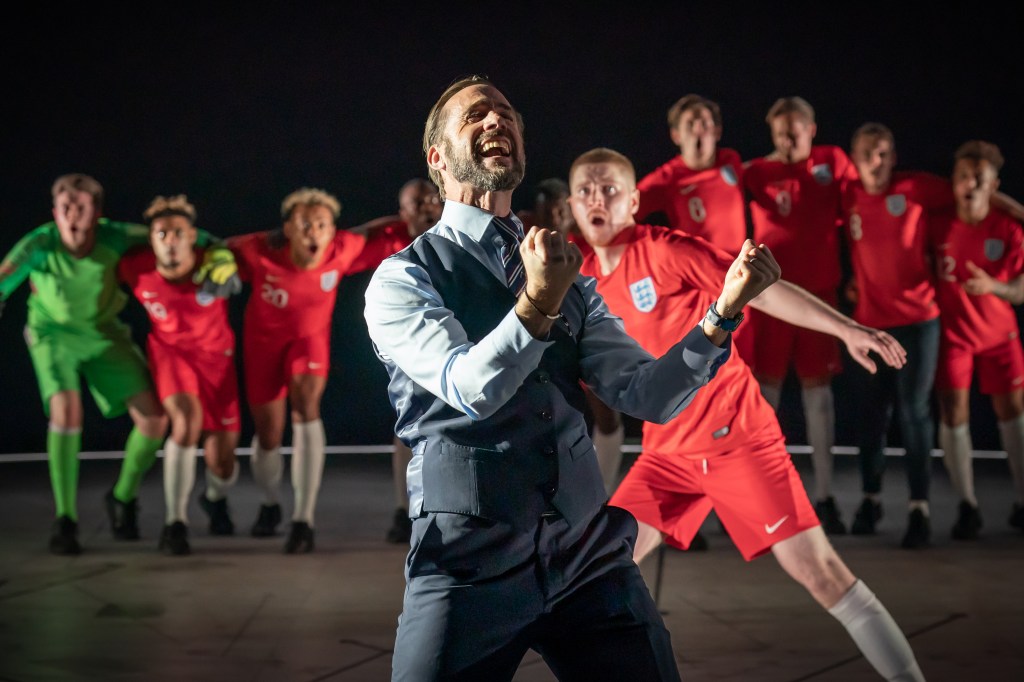
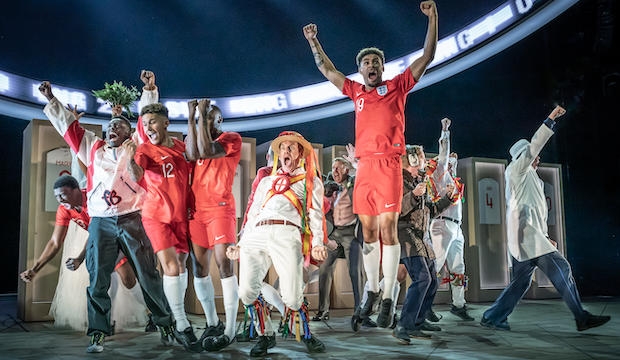
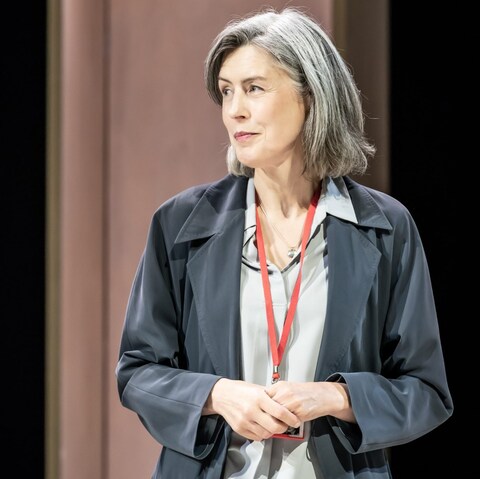
It’s a spectacular show, anchored by the performance of Joseph Fiennes as Southgate. First of all, he looks more like Gareth Southgate than he looks like Joseph Fiennes, and he has the same soft yet slightly high-pitched voice plus the body language. In a week where we had already witnessed Will Keen’s eerily life-like performance of Putin in Patriots, this was another performance that seemed to capture the essence of the man. This too went beyond mere impersonation; Fiennes portrayed a man making reparation for a past failure, while embodying a sense of fair play and decency. His scenes with sports psychologist Pippa Grange (Gina McKee, in typically intelligent, sensitive mode) add nuance to a narrative that might seem testosterone-heavy.
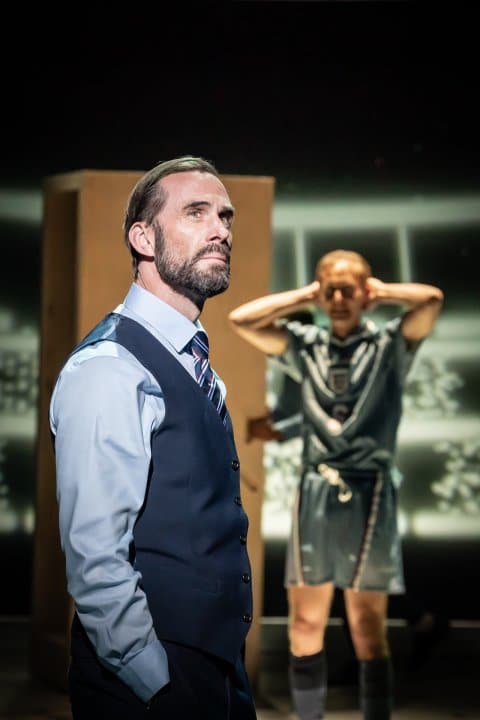
Graham links the England’s team success with a sense of national pride. Without overstating his case, he shows how the country’s self-image is represented by its sporting heroes. It’s an epic play, and Graham and director Rupert Goold exercise firm control over the many tones of voice employed to tell the story. Southgate is diffident and refreshingly free of bombast – and there’s plenty of that from John Hodgkinson, Paul Thornley and Sean Gilder as assorted managers and trainers. Meanwhile, the action is punctuated by commentary from Gary Lineker (who else?) in one of a series of caricatures (that includes Sven-Goran Erikson, Boris Johnson, Wayne Rooney, Alex Scott and Theresa May) supplied by Gunnar Cauthery and Crystal Condie in a sweeping overview of a period of transition.

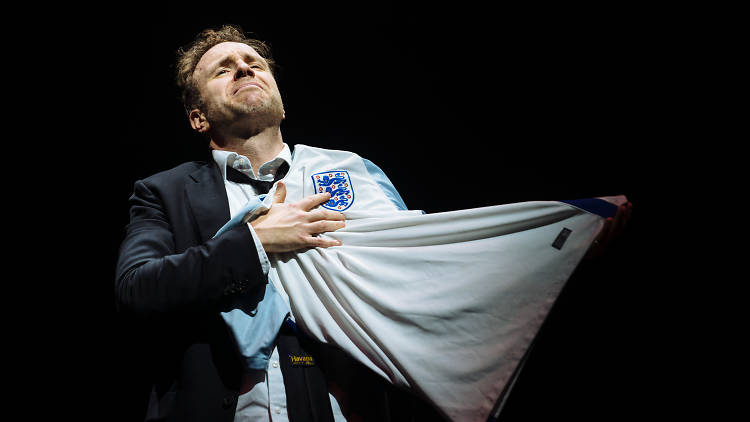
The well-known players are all portrayed, and with good humour. I’m inclined to think they are probably more intelligent than they’re shown in the changing room here, but the scenes of the beautiful game are beautifully choreographed, excitingly staged, and the penalty shoot-outs are edge-of-the-seat stuff.
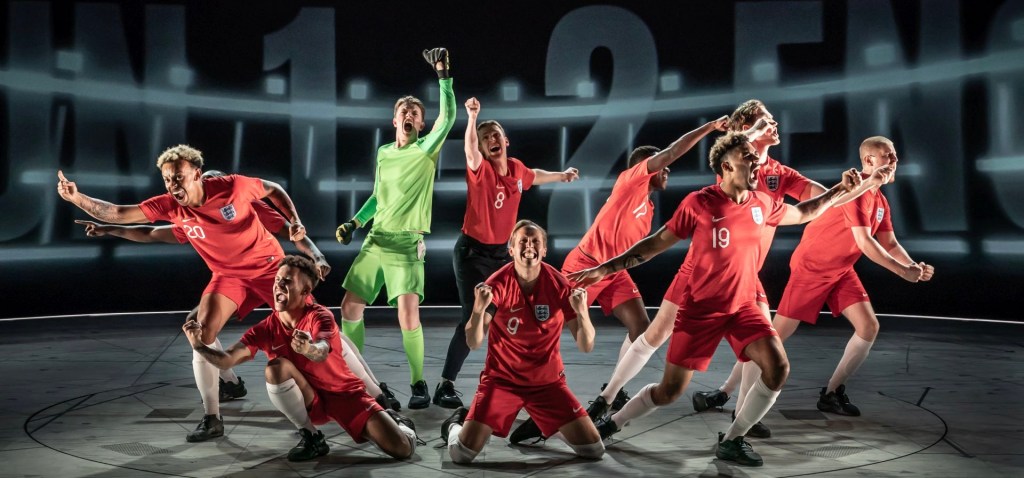
Photos: Marc Brenner
At the interval, I was prepared to award 5 stars to this production. However, there was still a lot of story to tell, and Act 2 was overcrowded with incident, as is the recent history of the England team. Towards the end, it started to feel like a long evening, and that we’d gone into injury time. Nevertheless, it’s still a great play, brilliantly conceived and realised by both James Graham and Rupert Goold. By the time we reached Sweet Caroline, I was ready to join in. Good times never felt so good!
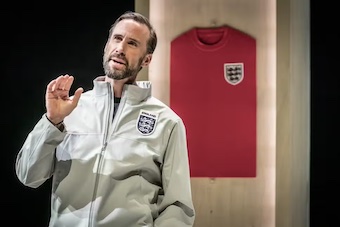
Our Rating: ★ ★ ★ ★
Group Appeal: ★ ★ ★ ★
Yes, it’s coming home! Most performances are Sold Out this season but it’s bound to be revived in time for the World Cup next year, and we’ll do a group visit.
<Joseph Fiennes / Gareth Southgate>

24/06/23 Jennifer writes –
The Curious Case of Benjamin Button
Book & Lyrics by Jethro Compton, Music & Lyrics by Darren Clark, and movement direction by Chi-San Howard, at the Southwark Playhouse: Elephant
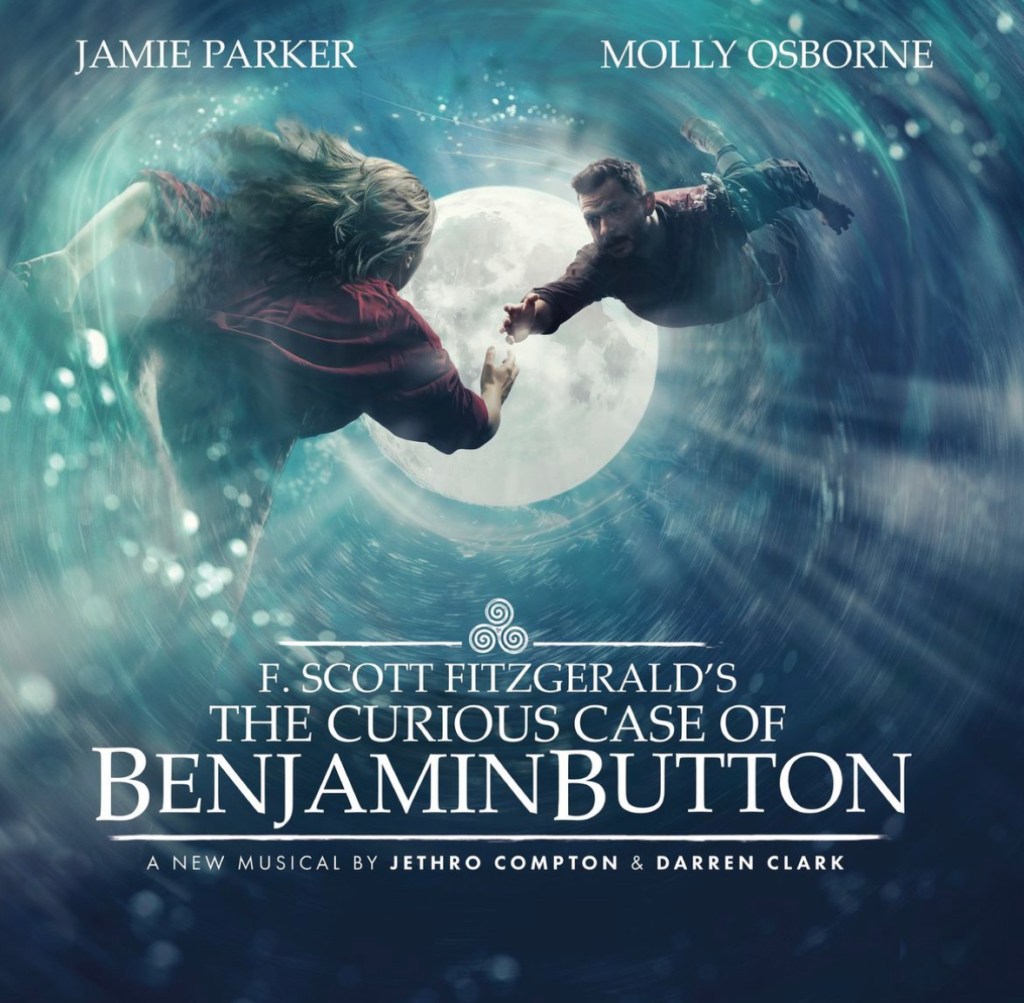
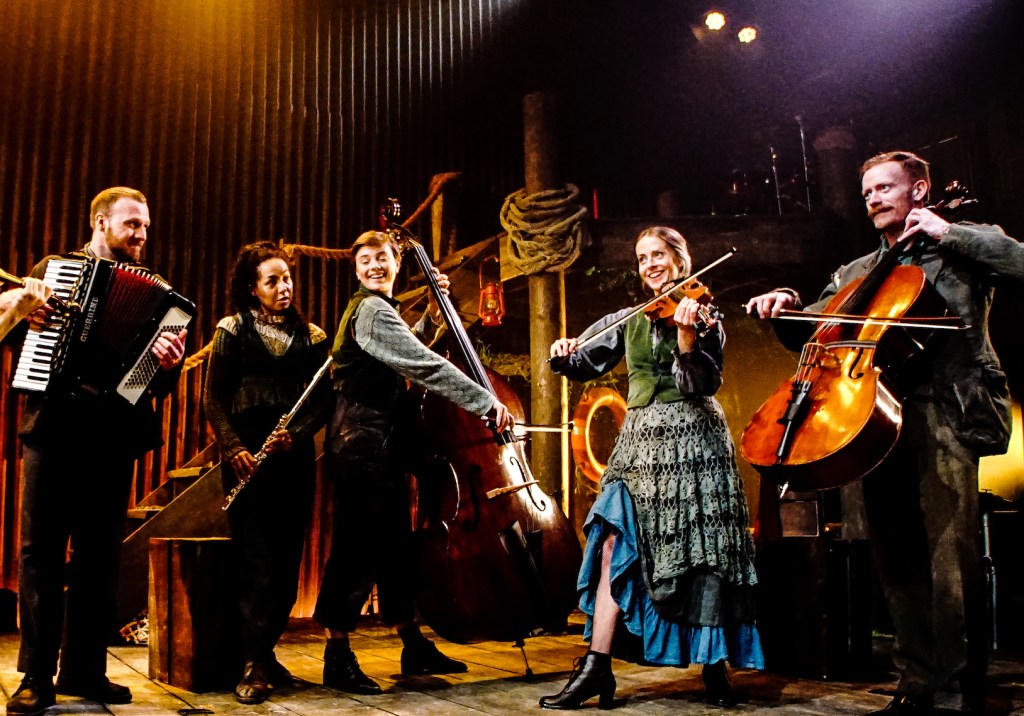
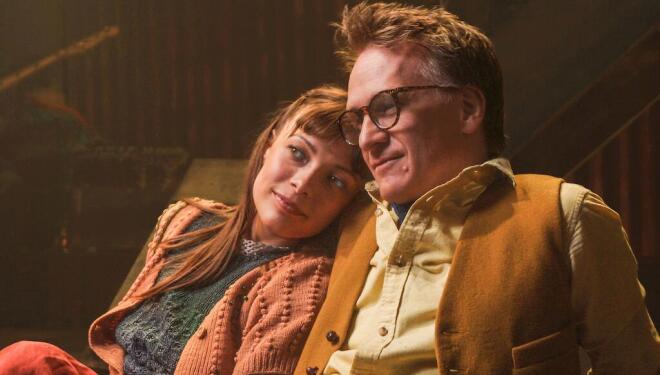
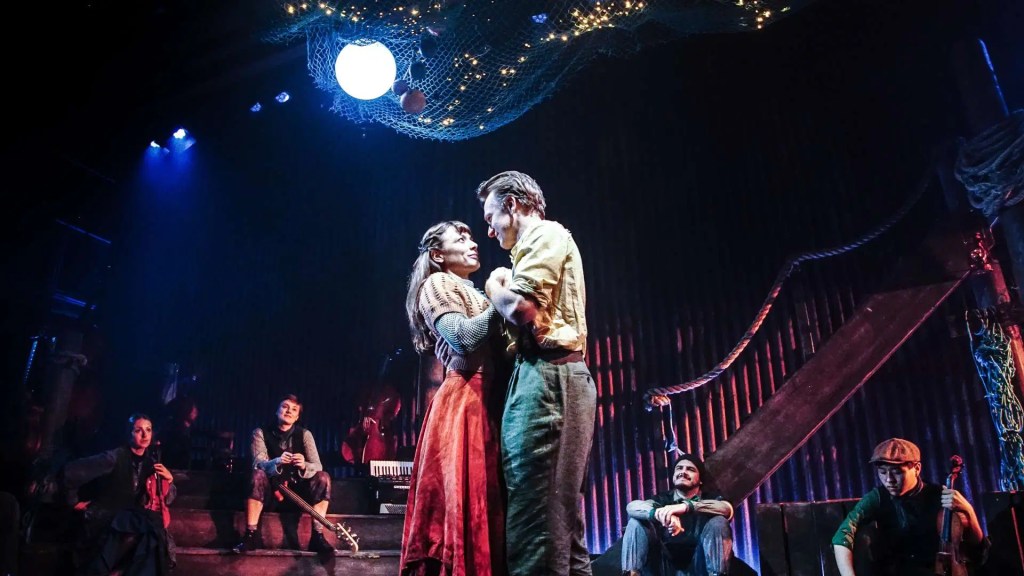
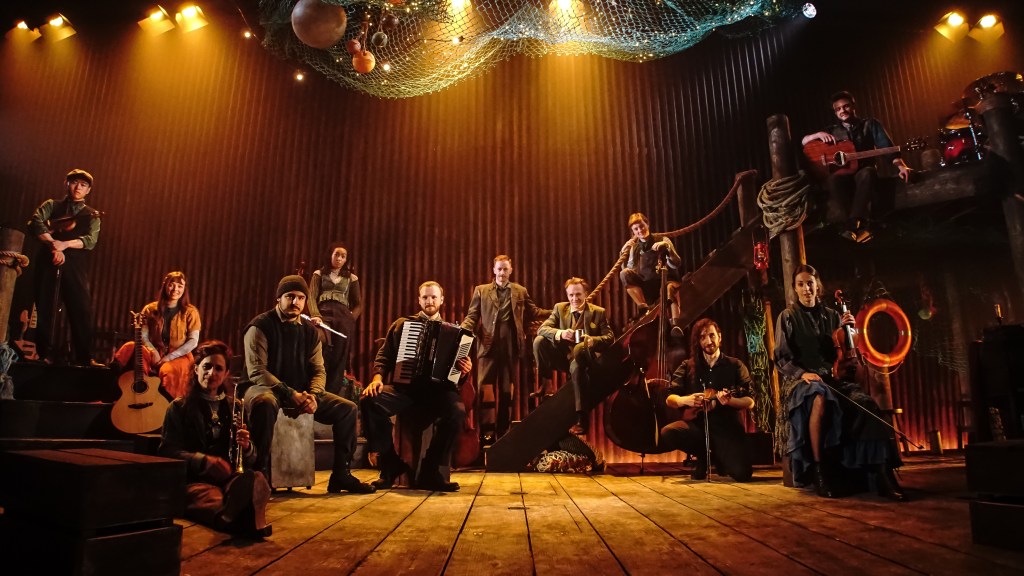
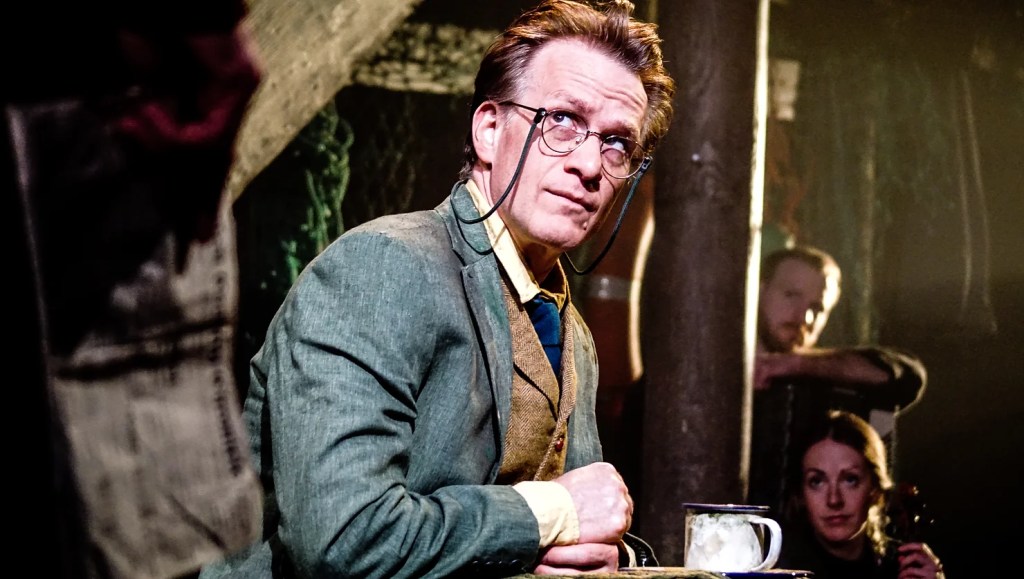
TCCoBB is based on a short story by F Scott Fitzgerald and was filmed to muted reviews some years ago with Brad Pitt as Benjamin, the man who’s born aged 70 and lives his life in reverse. In this re-imagined production, the action has been re-located to a seaside town in Cornwall in the 20th century by Jethro Compton, the Cornish born director. This folk musical version first appeared at Southwark Playhouse back in 2019 but is now revived and recast at the new venue Southwark Playhouse: Elephant.
Jamie Parker makes a welcome return to the stage as Benjamin after starring in Harry Potter and the Cursed Child in London and on Broadway. Jamie’s considerable charm, acting and singing skills are deployed to good effect throughout as he goes from playing the recently born old man to a gangly teenager, while singing and playing instruments in between. At this point, it’s probably a good idea to set aside logical and practical objections to this fantastical fable and allow yourself to be carried along for the ride. And what a ride it is.
Jamie is ably supported by a top notch cast of multi talented musicians and actors who also sing the Cornish folk tunes (better than you’d think!), play multiple instruments and characters while dancing jigs and reels and deftly moving a few props to create convincing scene changes.
As Benjamin takes faltering steps into the wider world, he experiences all the fates can throw at him: sadness, love, loss, prejudice, friendship and the hardship of war. We eventually see him happily settled with his wife and family although, as the clock ticks on, “time and tide wait for no man”, we know somehow (this is a Fitzgerald story after all) that this happiness cannot last, and yet more travails await….
The ending, when we’re told rather than shown, thankfully, that Benjamin is now a babe in arms, is bittersweet. I can’t have been the only audience member with something in my eye at this point. So, what is the moral of this modern day fable? Seize the day, remain optimistic, trust in fate and, when you find true love, hang on to it for all it’s worth.
Our rating: ★ ★ ★ ★ Group appeal: ★ ★ ★ ★
20/06/23 Mike writes –
The Pillowman
by Martin McDonagh, at the Duke of York’s Theatre (A preview)
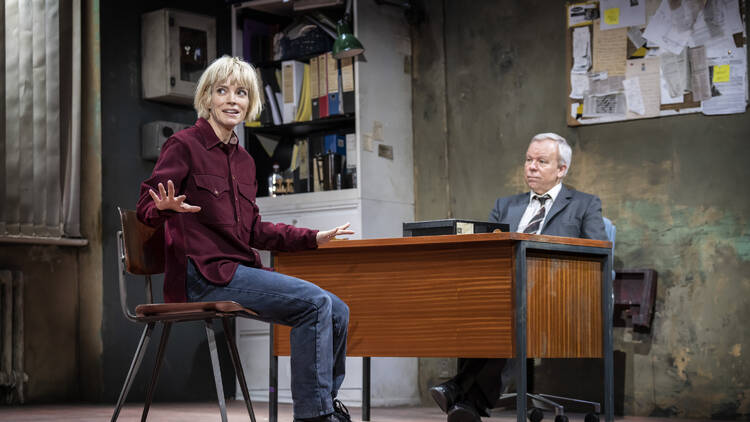
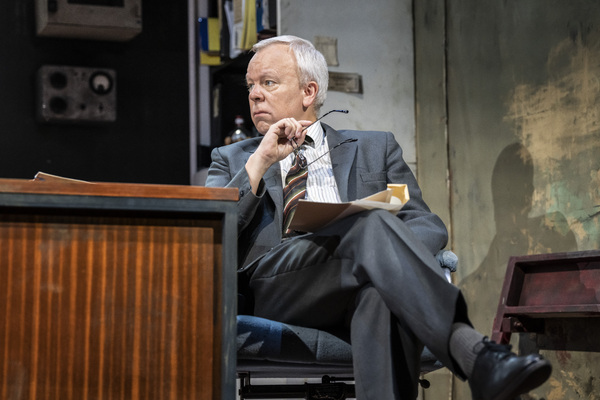
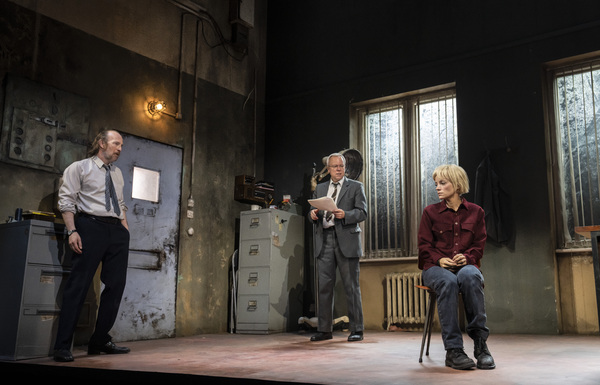
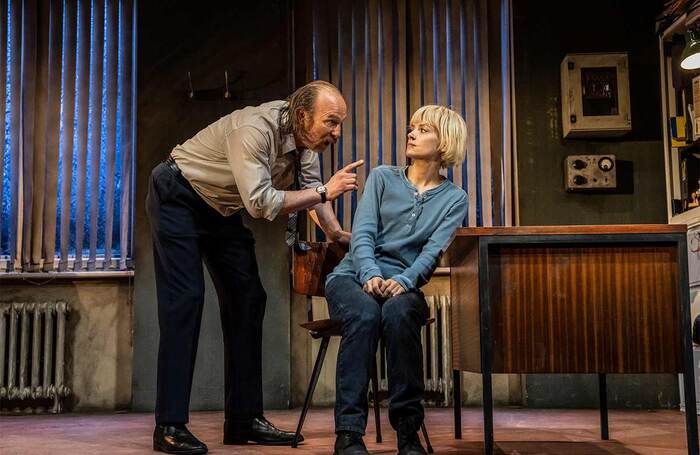
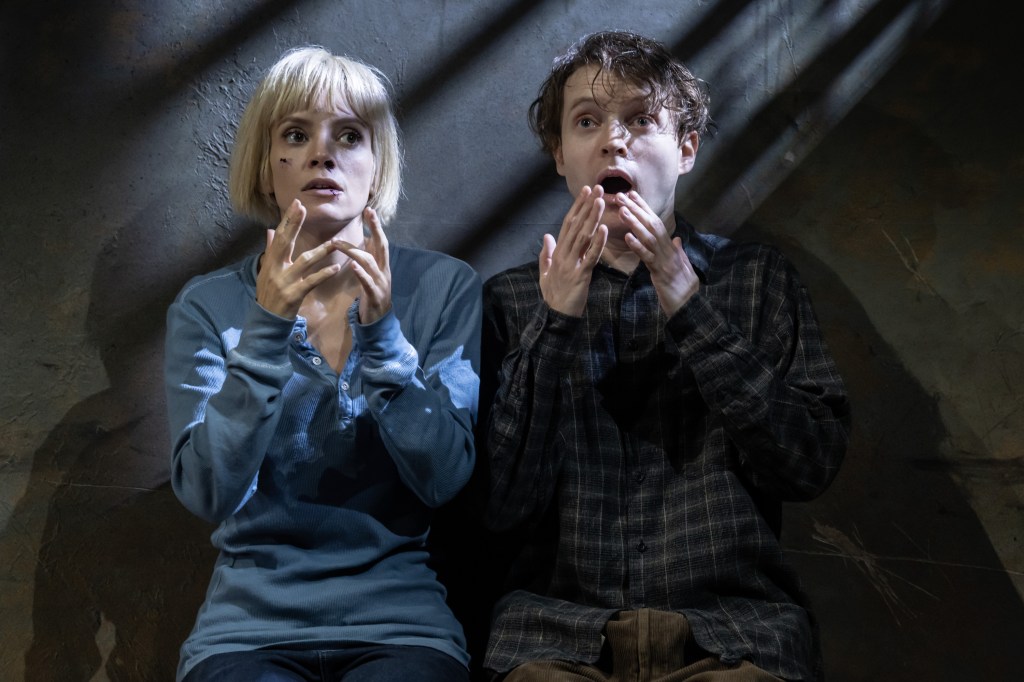
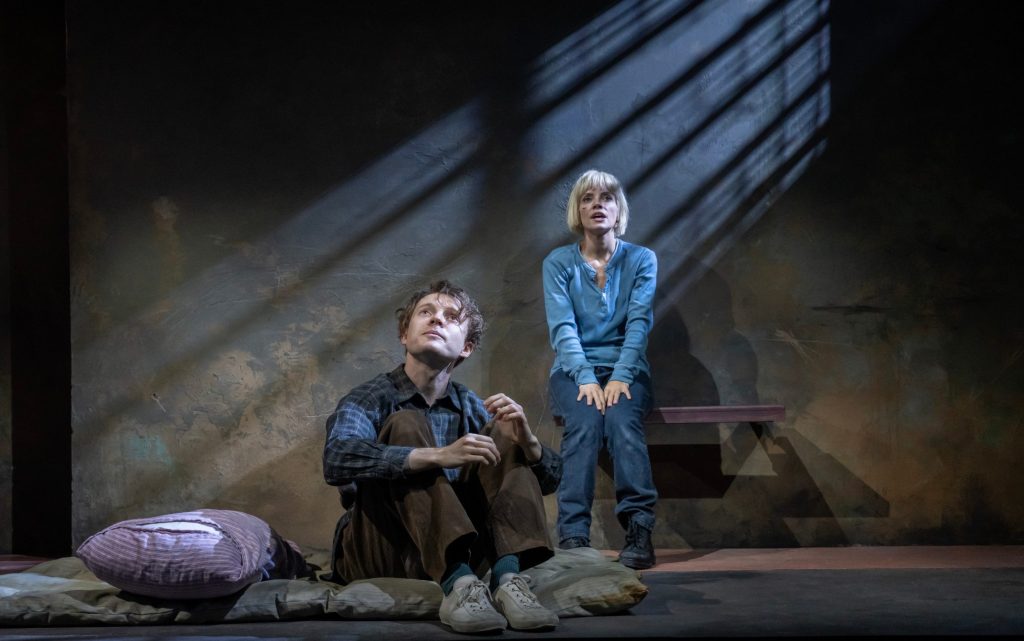
Photos: Johan Persson
There’s something nasty happening at the Duke of York’s. Last time it happened was at the National in 2003 and, if I remember rightly, was much liked by the critics. “One of the greatest plays of the last 25 years.” Every Martin McDonagh play is both humorous and gruesome with underlying elements of human frailty and resolve – take his most recent lauded film, The Banshees of Innisheran, as an example. But remembering this play from way back, it startled with its black humour and violence, enough to be disliked by some. Fredo decided not to attend this revival, but I wanted to see how it fared twenty years on in a rather different social climate.
Katurian is a writer of children’s darkly comic fairy-tales, (more about than for them) played originally by David Tennant, but now gender swapped for Lily Allen to lead. She is being interrogated in a police state by two (funny) cops, one good (Steve Pemberton) and one very very bad (Paul Kaye). They are investigating several real murders of children which copy the deaths in her tales. She wants her legacy to endure even if she does not. It’s a whodunnit essentially – was it the writer or perhaps her retarded brother Michal (Matthew Tennyson)? Or is the playwright just telling tales within tales to lure us into a chamber of horrors?
There is violence (against a woman this time, because of the gender swap), extended verbal aggression, and the enactment of weird and jokey tales following a Grimm path. In one tale, a little girl who thinks she is Jesus is crucified by her parents, just to please her. Grim it is, with screams of offstage torture but, in much the same way that audiences loved the excessive pain of A Little Life, the abuse related here has an appeal which treads a careful line between shock and laughter. Beneath the surface we can look for explorations of fascism, fantasy and adult fears of feral children. And we can enjoy theatrical thrills along the way. For my preview matinée the theatre was full, and I did wonder whether in 2023 we have become too insensitive to nastiness. Or is it just the star casting that sells seats?
Lily Allen has a huge wordy role to play, a summit to climb but not yet reached, the words delivered but the effect muted, so let’s hope her efforts will give better rewards as the run progresses. Pemberton and Kaye are reliably on form but Matthew Tennyson hooks our attention best with a performance mixing innocent charm with pure evil.
I would have preferred a shorter visit to this nightmare world of contrasting tones and prolonged repetitive interrogation. Perhaps David Tennant (or even Colin Farrell) is the one who could get away with McDonagh’s excesses and make us grateful for visiting places we really don’t want to go. Is it still a play for our times? More so, if we go by the audience reaction.
My rating: ★★★ Group appeal: ★★
08/06/23 Mike writes –
4000 Miles
by Amy Herzog, at the Chichester Festival Theatre

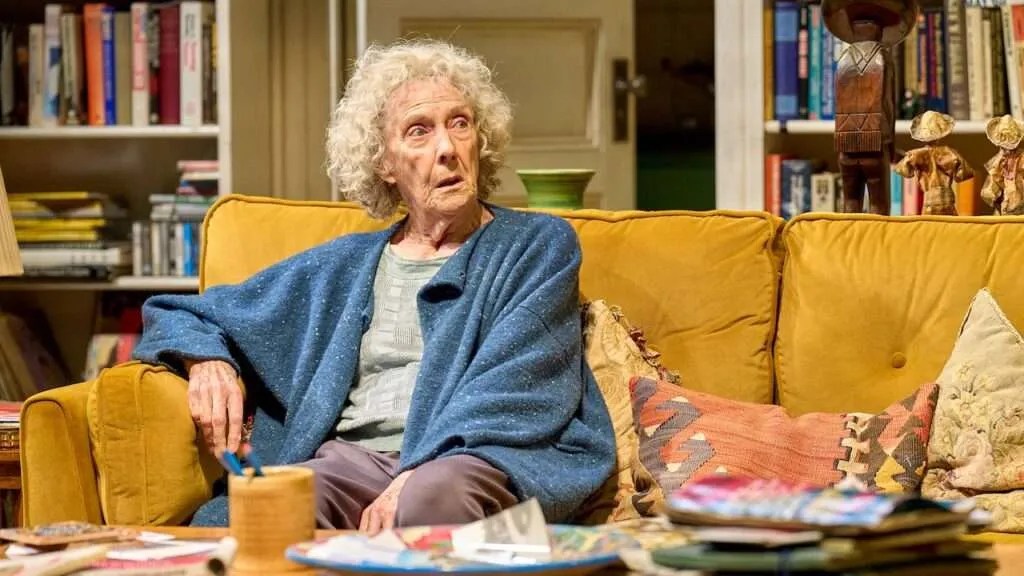
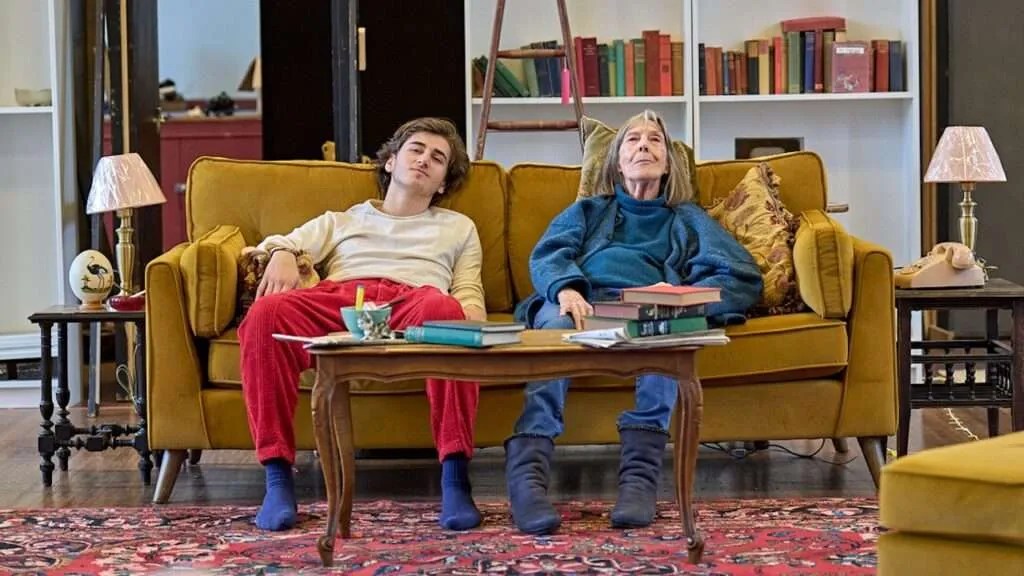
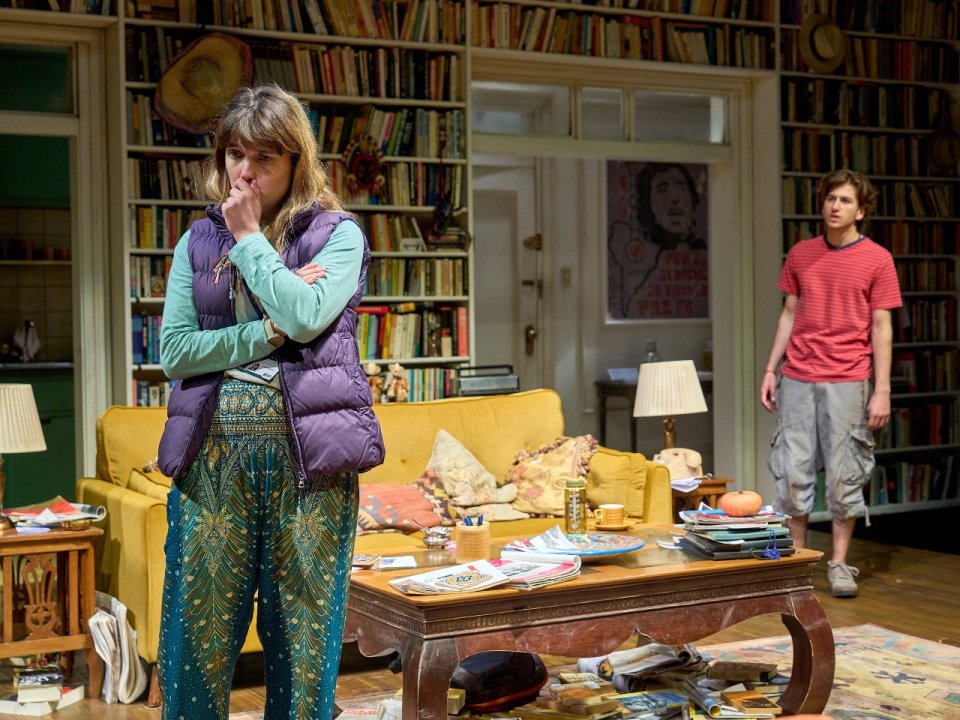
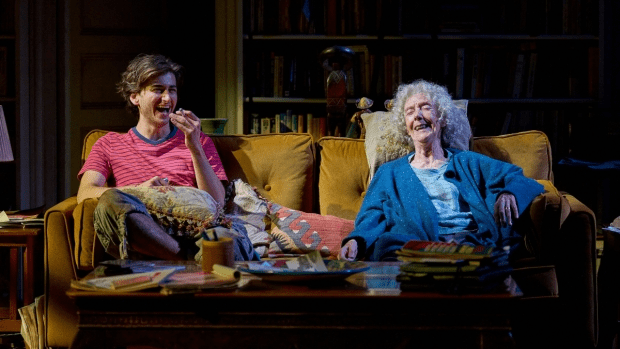
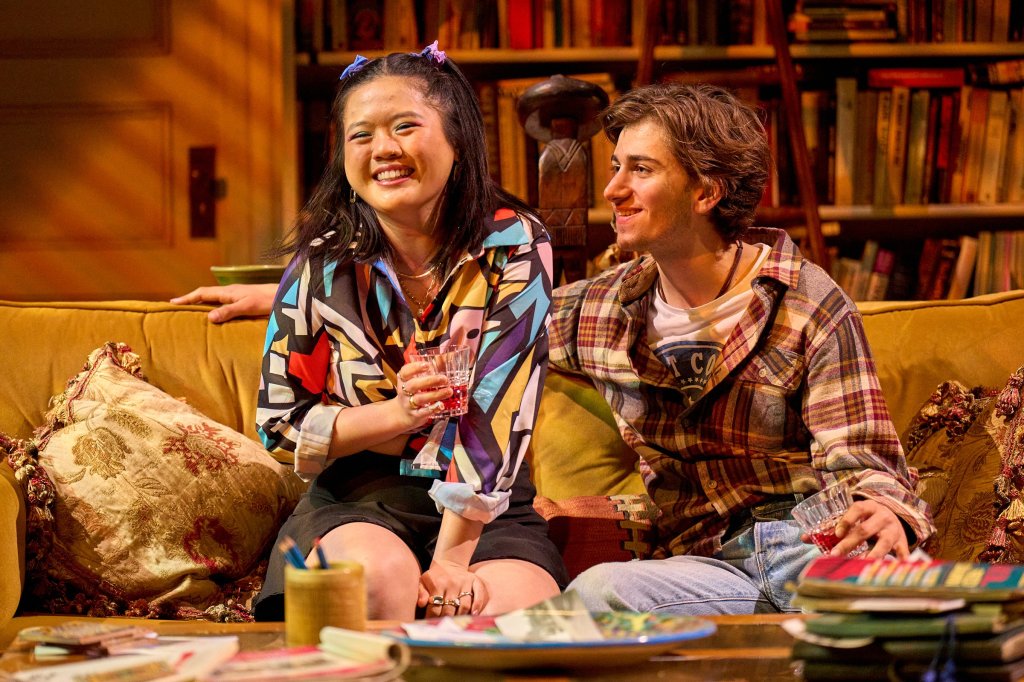
Leo has biked 4000 miles from California across country to visit his grandma in New York. He arrives with worries hiding behind his cheerful demeanour, keen to help out 90 year old Vera. Or is he really escaping into a safer space where she can help him?
We travelled not-so-far to Chichester to see Eileen Atkins in this play, cancelled at the Old Vic a couple of years ago by lockdown closures. The other big name, Timothée Chalamet has been replaced by Sebastian Croft who proves himself a good substitute to hold his own against Atkins who was on top irascible form. But was it worth both his and our journeys?
There are some plays which go down well Off Broadway, playing as comfort, for audiences demanding little except an ambiance they know and characters they recognise, no stretch, no worries to take home. A big name is an extra helping of familiarity. But such plays don’t always travel well to the UK, their comfort factors seeming of another place. From Chichester I doubt it will move on, though in NY with the right star it may attract an audience as here.
The big name is in place. We, and the senior Chichester matinee audience, were certainly not disappointed by Atkins who would be treasured as anyone’s granny – outspoken, cynical, caring and unquestioning. Leo and Vera spar amusingly, and scene by scene the reasons for that long bike ride come to the surface. But we wait in vane for some drama to bite, for some surprise to stir our emotion. The tone of the piece never reaches beyond bland, never further than a sketchy first-draft peppered with one-liners.
There’s an attractively furnished set, a lot of family gossip, phone-calls, two visitors…..and far too many blackouts for plumping cushions and showing time passing.
At the end Leo leaves, granny lives on. Do we care? Not a lot.
Our rating: ★★★
Group appeal: ★★★★
07/06/23 Fredo writes –
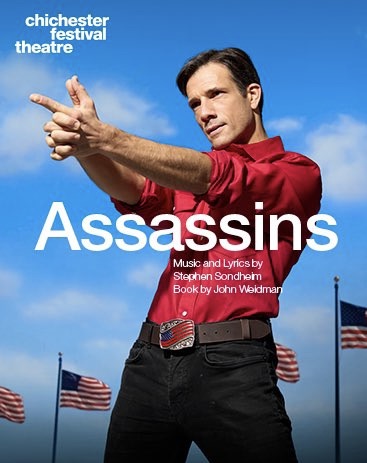
Assassins
Music and Lyrics by Stephen Sondheim, Book by John Weidman, at the Chichester Festival Theatre

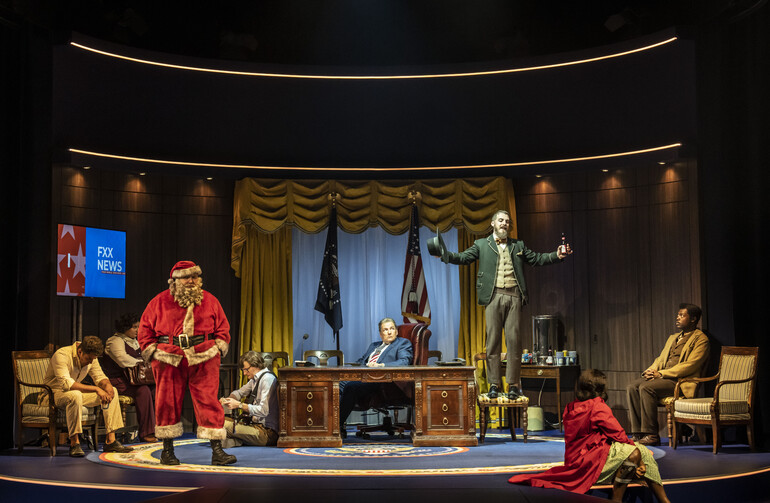
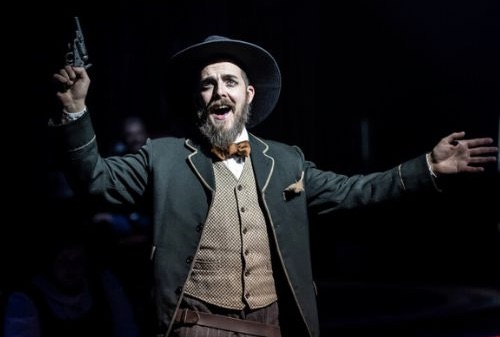
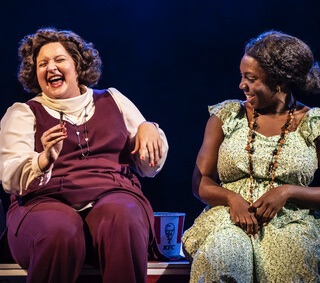
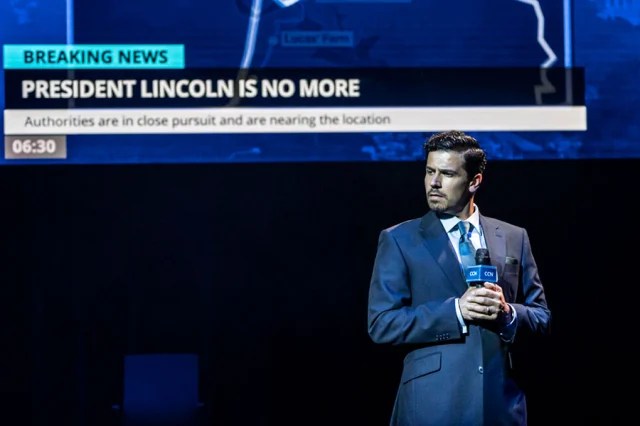
Our rating: ★★★★★
Group appeal: ★★★★
It helps to be a Sondheim fan!
Assassins – they’re the other side of the American dream: the disenchanted, the dispossessed, the ones who feel they’ve missed their chances to enjoy life, liberty and the pursuit of happiness. All they have to do is move their little finger to change the world. All they have to do is shoot to kill a President, become assassins, and find their permanent place in history.
It’s a difficult subject for a musical, tracing nine individuals across eight assassination attempts in a century (successful or otherwise) . It has to balance its tone between humour and horror; it has to tempt us to engage with its assassins then recoil from them. Yet Stephen Sondheim and John Weidman somehow find an appropriate idiom to present a vaudeville that places their stories together, blending song and script seamlessly, to construct a mosaic of their discontent.
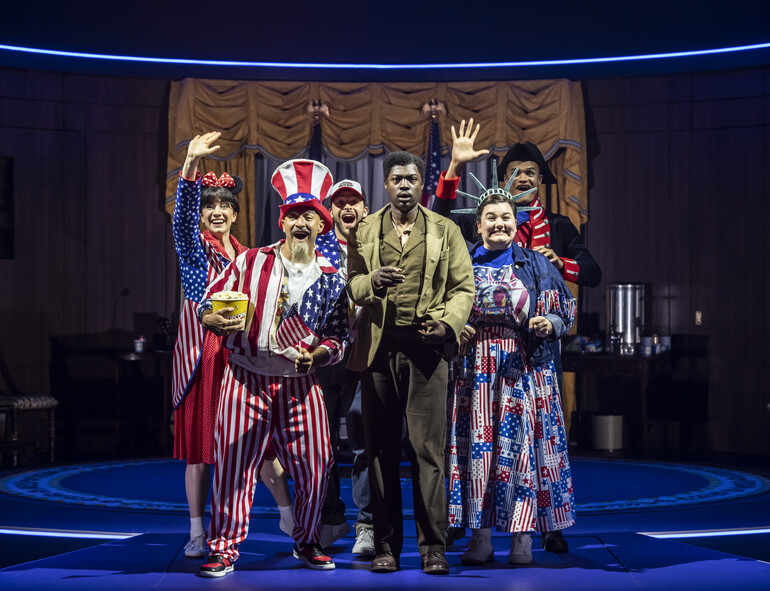
Director Polly Findlay also finds an idiom for her spectacular production. We’re no longer in the usual fairground where the sinister Proprietor hands out guns to the assassins. It’s a political convention with bells and whistles, and cheerleaders encouraging a Mexican wave from the audience. And it’s a Presidential contender (Peter Forbes) who hands out the weapons to the prospective assassins seated among us. Any resemblance to a recent president is purely intentional ! The Proprietor is now a trio of storytellers, appropriately presenters from tv’s FXX News channel.
It’s usual to say that the show contains dark humour. In fact, some of the humour is simply hilarious, such as when Sarah-Jane Moore (Amy Booth-Steel) and ‘Squeaky’ Fromme (Carly Mercedes Dyer), would-be lover of Charles Manson, have a stand-off over Moore bringing her son and her dog to their attempted assassination of Gerald Ford (1975). However, the triumph of the show is the successful juxtaposition of these scenes with the more chilling moments, such as the electric-chair execution of Giuseppe Zangara (Luke Brady) who tried to kill Franklin D. Roosevelt (1933) but killed the mayor instead; and the killing of President John F. Kennedy (1963) by Lee Harvey Oswald (Samuel Thomas) shown in newsreel footage.
(Note: These scenes caused outrage in the local Chichester press. Phil Hewitt of the Sussex Express called the show “a horrid misjudgement from all concerned”, totally missing the point, and misjudging the show himself!).
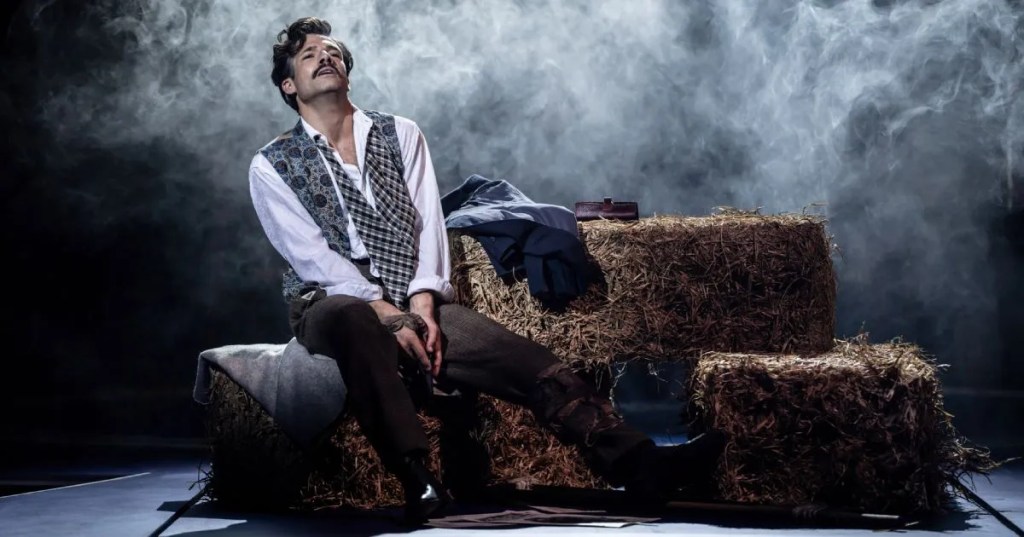
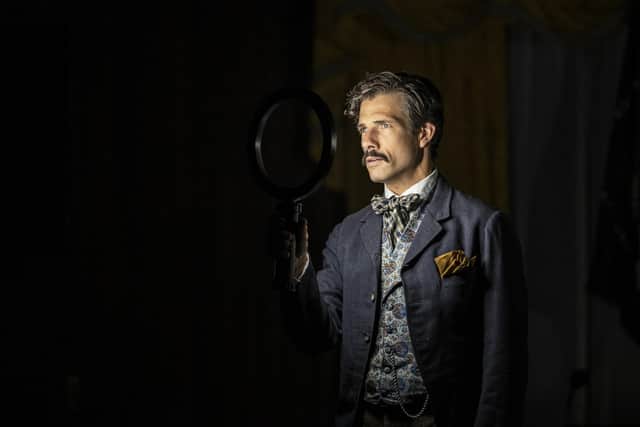
There’s pressure on the cast to hit the right note (in every sense) and they work miracles in navigating the switchback changes of style and mood. Sondheim even composes his songs to reflect the style of music for each historical period. It’s a show where ‘everybody’s got the right to some sunshine’ of recognition, but they’re a uniformly excellent cast. Just to name two who hit the highest heights: Harry Hepple straddles the line between charming eccentricity and downright dementedness as Charles Guiteau – he had delusions of becoming ambassador to France but he shot President Garfield (1881) instead, and dances to the gallows; and Danny Mac reveals a saturnine side to his charming persona as John Wilkes Booth, a stage actor who assassinated President Abraham Lincoln (1865)- “Some say it was your voice had gone, Some say it was booze, They say you killed a country, John, because of bad reviews”.
John Hinckley (Jack Shaloo) wanted to impress Jodie Foster by shooting President Ronald Reagan, which he did, six times, without killing him. And then there was Samuel Byck (Nick Holder), a grubby Santa Claus figure dictating a tape to Leonard Bernstein. He wants to crash a plane into the White House and harangues the audience front row with his violent fantasy. It’s funny until it becomes disturbingly real.
I’ve seen this show in vastly different productions several times now, and there are two moments that have always brought tears to my eyes. The first is a brief dialogue scene between the activist Emma Goldman and Leon Czolgosz, the assassin of President William McKinley (1901), played by Sam Oladeinde. It’s short, and unadorned with flowery words, but John Weidman conveys the sense of social struggle underpinning the characters’ actions. The other scene is near the end, when all future and past assassins gang up to persuade Lee Harvey Oswald to join their infamous group. We’re almost on their side; their history of discontent is overwhelming – then the famous shot rings out from the Texas School Book Depository. Suddenly, the bystanders who have previously amused us with recounting How I Saved Roosevelt assemble with a heartbreaking rendition of Something Just Broke, demonstrating that Oswald has killed President Kennedy, but together the assassins have killed their American dream as well.
At the end, the assassins line up to confront the audience. In this production, they’re revealed in the Oval Office they have trashed – a vivid visual reminder of the attack on the Capitol Building by Trump supporters. They advance towards us, reminding us that everybody’s got the right to their dreams. They raise their guns for one last time. They’re aiming them at us.
It’s a work of genius reinvented in an inspired production. Congratulations to Chichester for presenting it on such an epic scale, and so brilliantly.
6/05/23 Kathie writes –
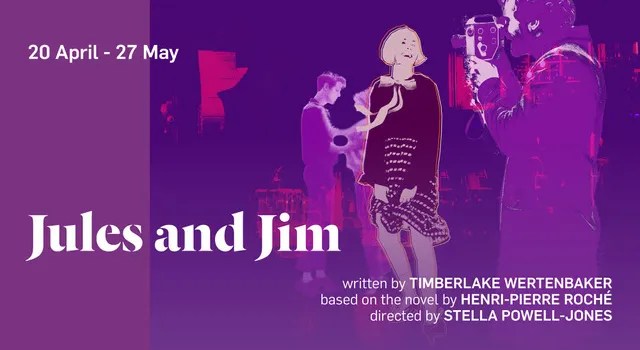
Jules and Jim
by Timberlake Wertenbaker, based on the autobiographical novel by Henri-Pierre Roché, at the Jermyn Street Theatre
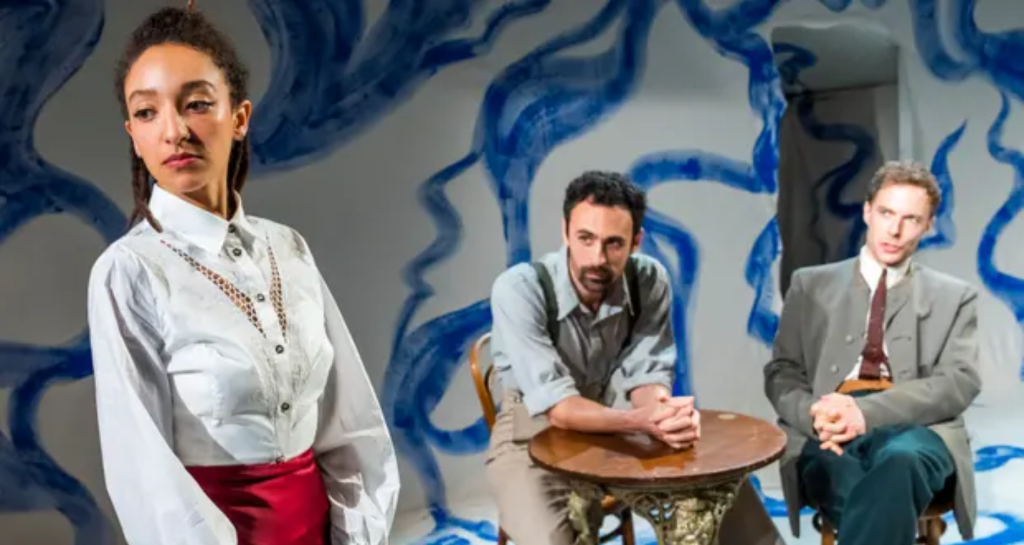
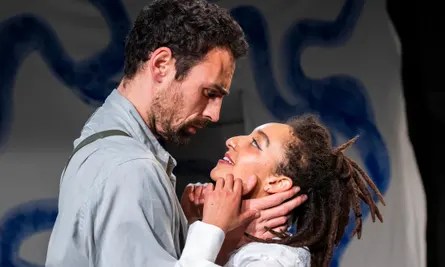
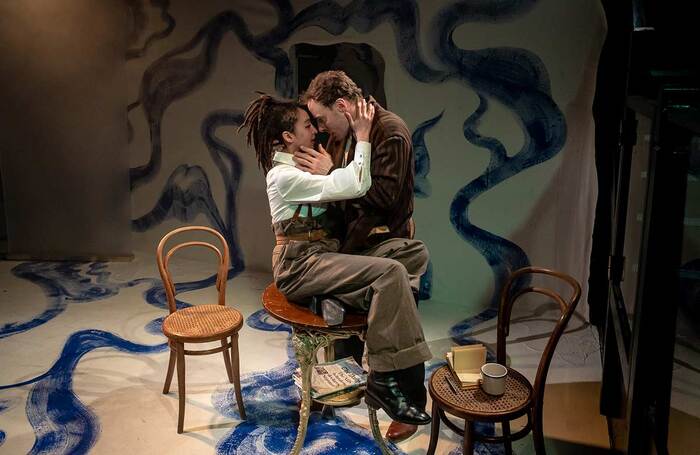
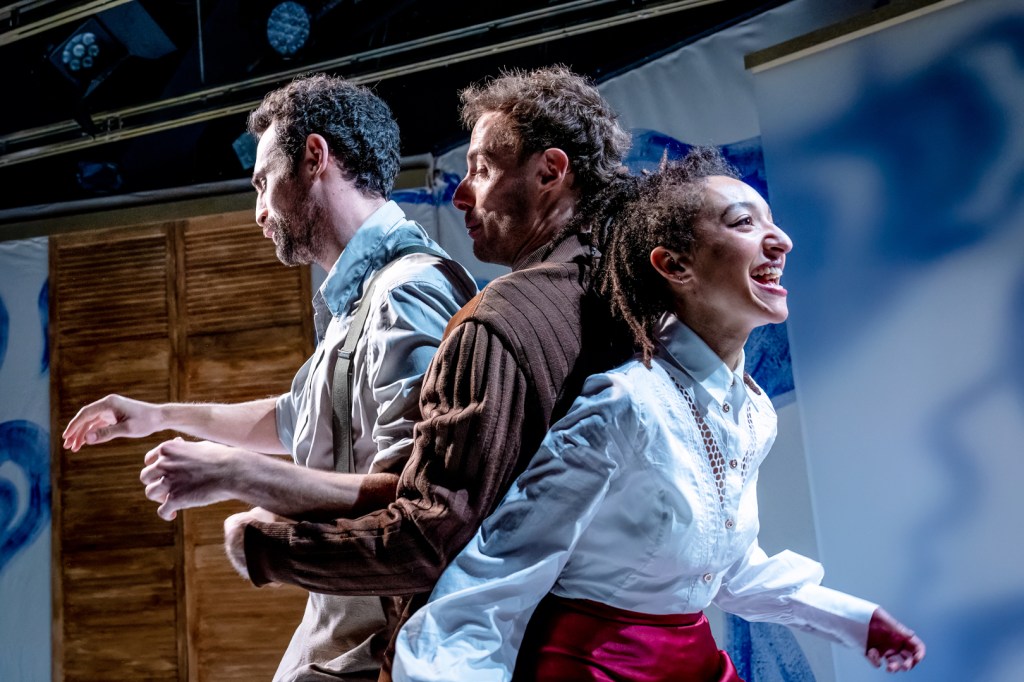
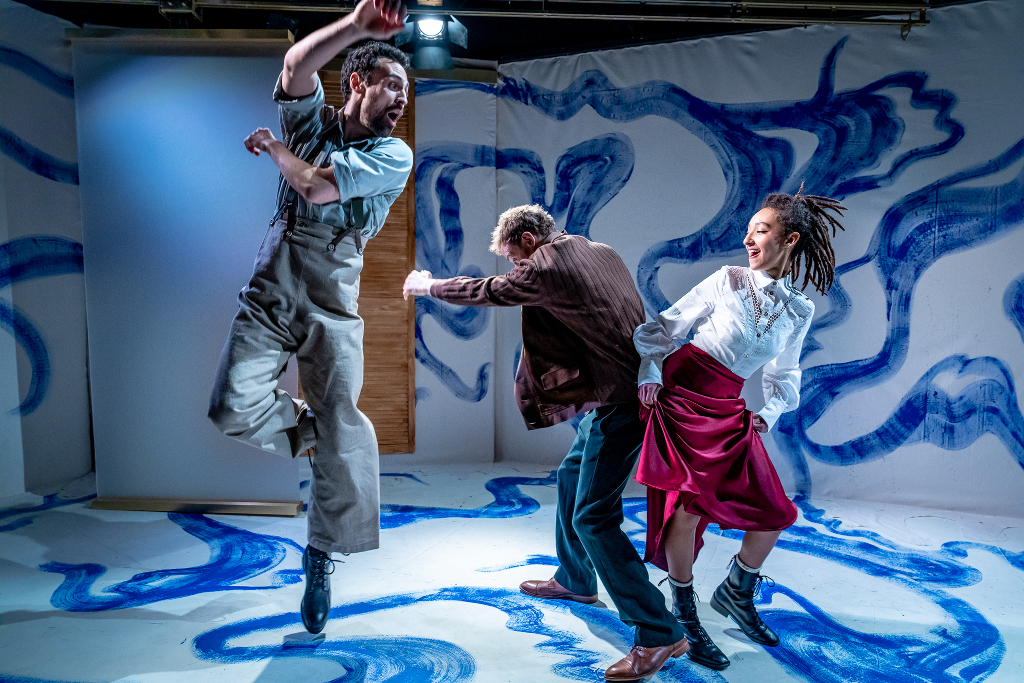
I wasn’t familiar with the Truffaut 1962 film based on the book and in the 87-seat Jermyn Street Theatre this version was a more contained affair. Our cast of 3 presented themselves and their story using a mix of narrative to the audience interspersed with key scenes acted out. The set was sympathetically designed and used just a table and chairs, a couple of screens and a clever water feature.
We meet Jules (Austrian/writer) and Jim (French/translator) in Paris at the start of their friendship, pre-WW1, and a close and deep friendship is forged. In character they are quite different with Jim, extrovert and successful in attracting female company, the opposite of Jules, who is focussed on his writing, to the exclusion of anything else at times.
On a trip to Greece they come across a statue of a goddess. They are both entranced by her smile and imagine what it would be like to meet a woman with that smile.
Back in Paris they meet Kath (German) and, yes, she has ‘the smile’. Kath lives life by her rules, pushing and testing limits and boundaries with relish. She marries Jules, they move to Germany and war breaks out with Jules and Jim on opposite sides. When they meet, post-war, their reunion is poignant, both relieved that their wartime service in different arenas meant they couldn’t kill the other.
Kath now leads them both a merry dance, with other men mentioned at times, and we arrive at an almost inevitable conclusion.
This 90-minute distillation of their story was executed well and each actor was convincing in their roles. The element that didn’t work so well, and is so essential to the plot, was the belief in the chemistry between them that could generate so much passion.
Our rating: ★★★
Group appeal: ★★
Mike adds – Jules et Jim (the film)
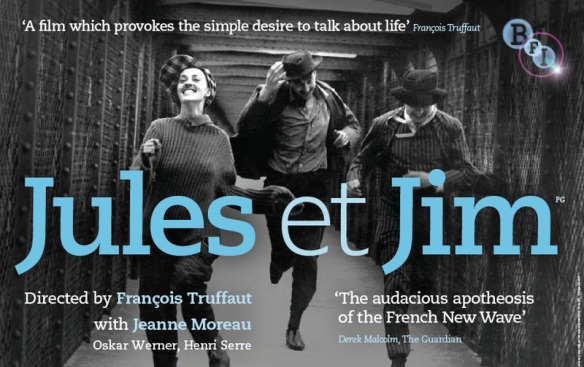
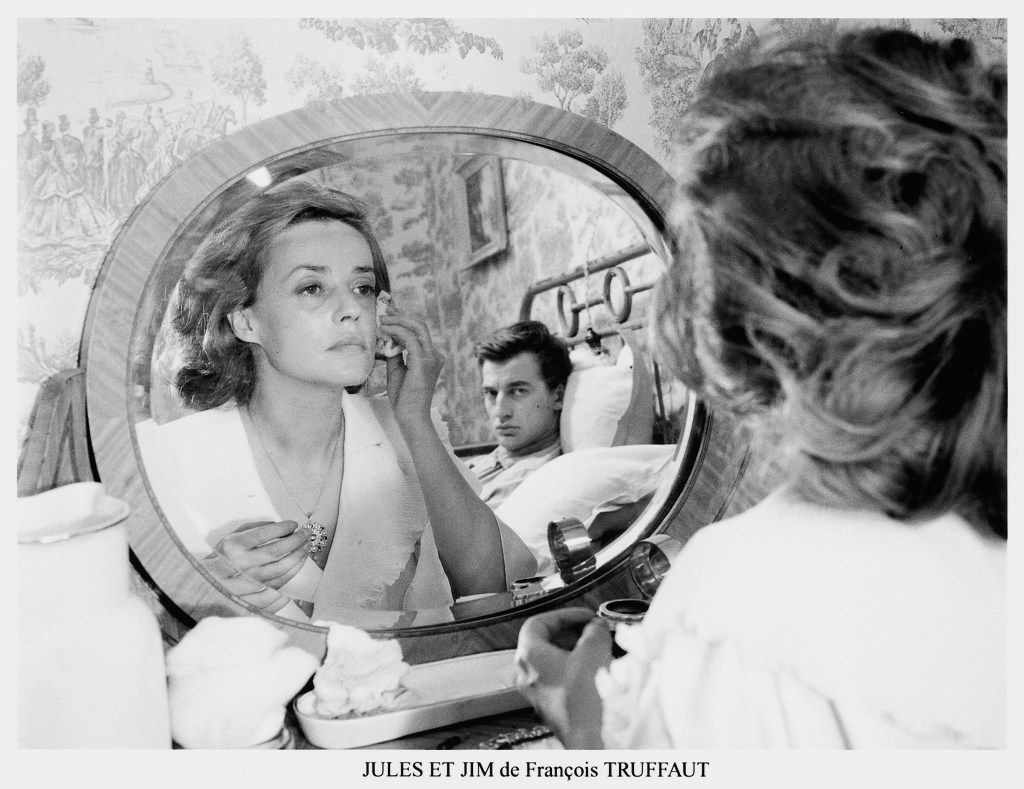
I still have memories of Jules et Jim, the classic film dating from 1962 when François Truffaut (a founder of French Cinema’s La Nouvelle Vague) turned this bohemian novel into a quintessential milestone in French Cinema. It was so visual, so unstructured, so Truffaut and so French – I could not imagine it confined to any stage. But of course I had to see the play.
Coincidently, I found I had made notes on the film, almost 60 years ago to the day I was now seeing Jules and Jim again, this time in a theatre. Back then I called it “a film of great charm and fascination”; “the photography of sunlit woods, misty dawns, etc. is often very beautiful”; “the erratically edited film almost runs away with itself”; “Jeanne Moreau is at her most lively”. Ah, Jeanne Moreau, the doyenne of French Cinema, thought to be at her most luminescent in those avant-garde New Wave films.
As a comparison, after seeing the play, I decided to watch the film again on tv. In 1962 its setting during WW1 made it a period piece and now the film itself is a period piece very much of its time, a seldom seen treasure of those New Wave years. It’s still charming, but irritating too in its persistent bohemian quirkiness, it’s arty intellect out of step with today’s antibourgeois obsessions. It relies heavily on a voice-over commentary, perhaps taken directly from the novel, while the narrative is illustrated more than dramatised on screen. The characters jump moral and social barriers for their playful lifestyle, and today Kath at the centre of this ‘entitled’ trio would now be tagged with a patronising ‘syndrome’. I certainly remained “emotionally detached” from them, now as I did back then when first viewed. But it remains a joyfully indulgent fairy tale.
Jules et Jim, both novel and film, remain classics of their time, but now on stage as Jules and Jim and Kath they lose much of their charm and originality, and an earnest silliness takes over in a rather English way. It amuses, but why did Timberlake Wertenbaker bother when the classic originals still exist? I agree with Kathie’s rating and hope this new play may encourage some to seek out those originals. The book remains in print as well as the film (widescreen, monochrome) being available on Amazon Prime/BFI Home Cinema.
10/05/23 Fredo writes –
Dancing at Lughnasa
by Brian Friel, at the National: Olivier Theatre
Michael, the narrator now an adult, steps forward and sets the scene: it’s 1936, and he’s a child living with his mother and aunts outside Ballybeg in Co Donegal. My eyes filled with tears; no, it wasn’t nostalgia, it’s the carefully chosen words delivered with tenderness by Tom Vaughan-Lawlor at the opening of Dancing at Lughnasa by Brian Friel.
Could this be Friel’s greatest play? It seems like a small domestic drama, even spread across the vast expanse of the Olivier stage, but as the story unfolds in Josie Rourke’s detailed production, the lives of the Mundy sisters reveal the personal tragedies in each of their lives.
It’s surely no accident that a writer so attuned to language as Friel chose the name “Mundy”. It makes us think of “mundane” and that is how they appear at first glance, as they carry out their domestic chores – ironing, knitting, baking bread, unpacking the shopping, worrying about their brother Father Jack, a priest who has been recalled from the missions. There’s a missing person: Gerry Evans, the father of Michael, Christina’s love-child. And there’s another character – the unreliable new radio, Marconi, which suddenly erupts with music (never news) at key points in the action.
With a masterly sleight of hand, Friel draws us into their world, where Catholic values co-exist with a suppressed form of paganism: rumours abound about rituals taking place in the back hills to celebrate the August festival of Lughnasa. Father Jack, who had gone native during his 25 years in a leper colony in Uganda, evokes the ceremony associated with the festivals in that country, and we see how close the civilisation of Ballybeg is to this primitivism.
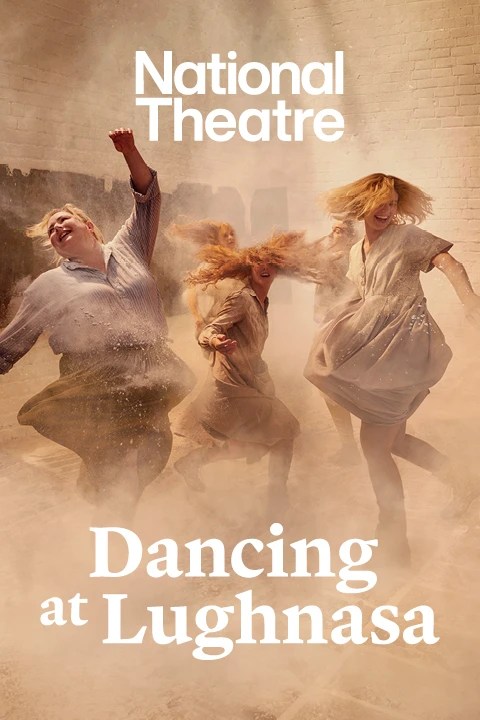
This explodes in the play’s most famous scene, when Marconi comes to life with an exuberant Irish jig. The sisters can’t contain their suppressed emotions, and they release their feelings in individual ways. Extrovert Maggie stomps out her steps, demure Agnes trips through her dance lightly, Christina sacrilegiously pulls on her brother’s surplice and cavorts, and Rose skips childishly around. Even Kate, initially scandalised by this bacchanal, is eventually overcome, but leaves the cottage to dance privately her own variation of a traditional reel.
And then it’s over: unreliable Marconi cuts out, and the sisters are brought down to earth. For a moment, their euphoria makes them plan to attend the Lughnasa dance, but Kate puts a stop to that pipe-dream; women of their age would be a laughing-stock in that setting. Tensions rise to the surface when Agnes declares that Kate treats them all like unpaid servants.
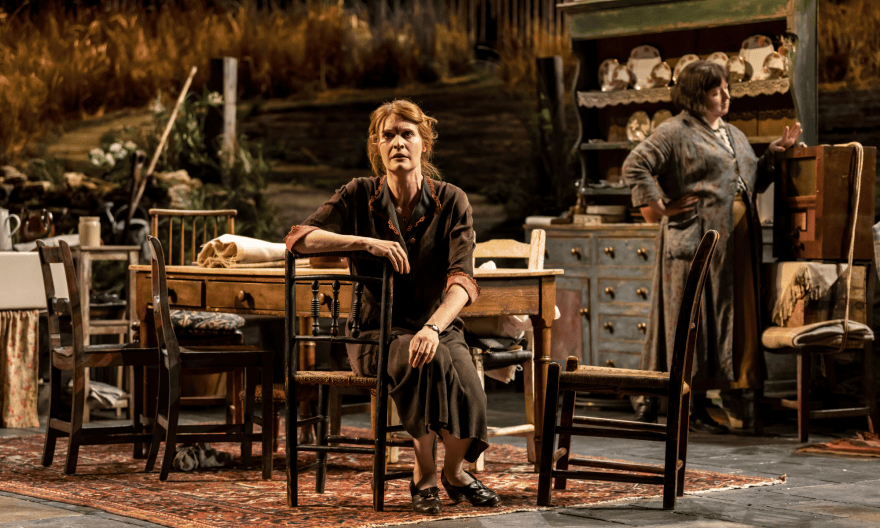
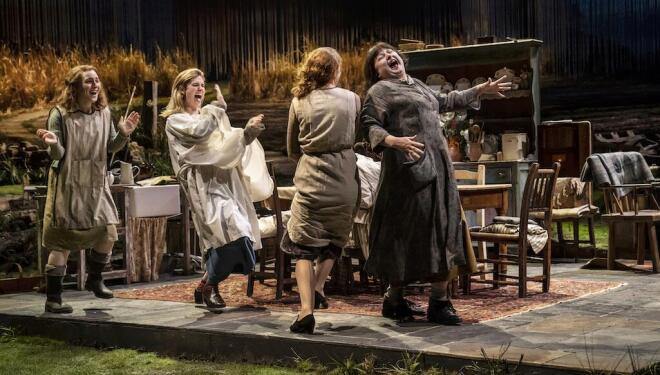
We witness their excitement at the visit of the unreliable Gerry, who has become a strictly ballroom dance instructor in Dublin and once again sweeps Christina briefly off her feet. We feel Maggie’s anger when she hears that Gerry has promised Michael a bicycle, for she knows the bike will never arrive, and that Gerry will disappoint his son just as casually as he seduced and betrayed her sister. It’s a play of broken dreams.
Their fragile way of life is coming to a close. In a stroke of breath-taking theatricality, Friel interrupts the action in the middle of the second Act: Michael steps forward again to tell us what becomes of every character in the play – and we haven’t reached the end yet. We still have to see the return of Gerry, now headed for the Spanish Civil war but still taking time to sweep a lovelorn Agnes in his arms for a dance while Chris, the mother of his child, watches dismally from the cottage window. We still have to watch Kate’s gradual acceptance that Fr Jack will never celebrate Mass again. We still have more tears to shed.
I admit that this play explores many emotions and experiences that are familiar to me. (Am I the only surviving person who can recognise Kate’s dismissal of “the book by Annie M P Smithson – The Marriage of Nurse Harding”? Yes, I read it when I was very young; I thought it was the Irish Gone With the Wind!) However, my feelings were shared by an appreciative full house at the Olivier, and by friends who have seen and enjoyed it.
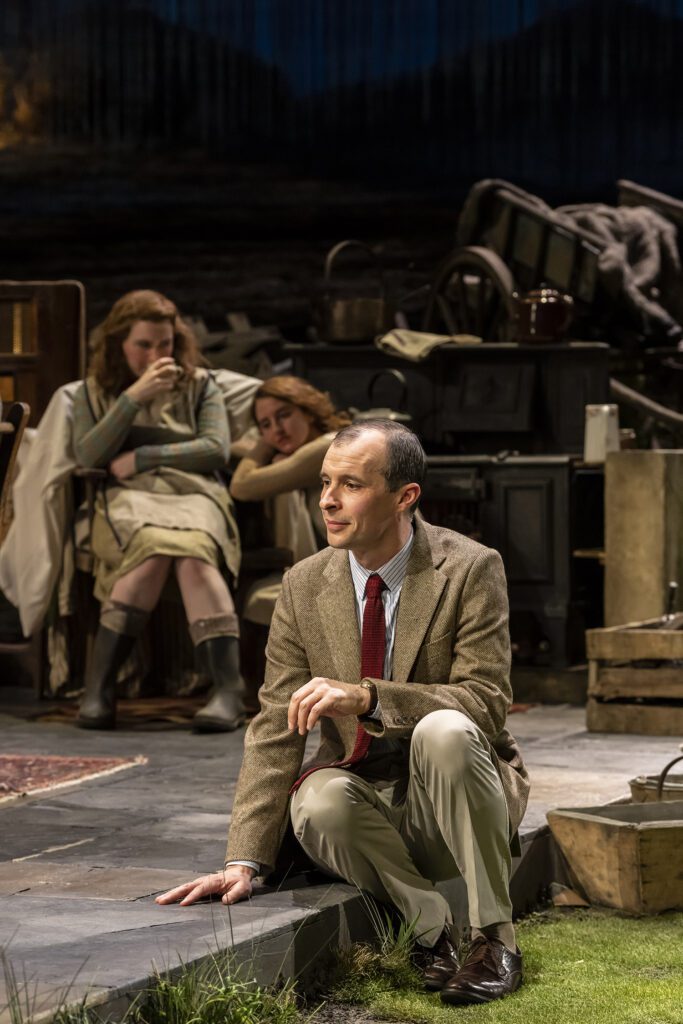
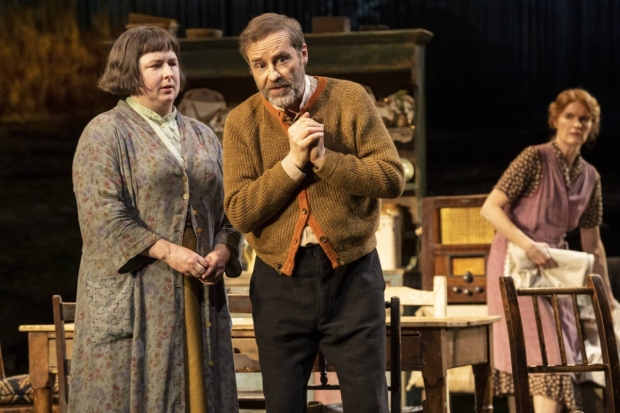
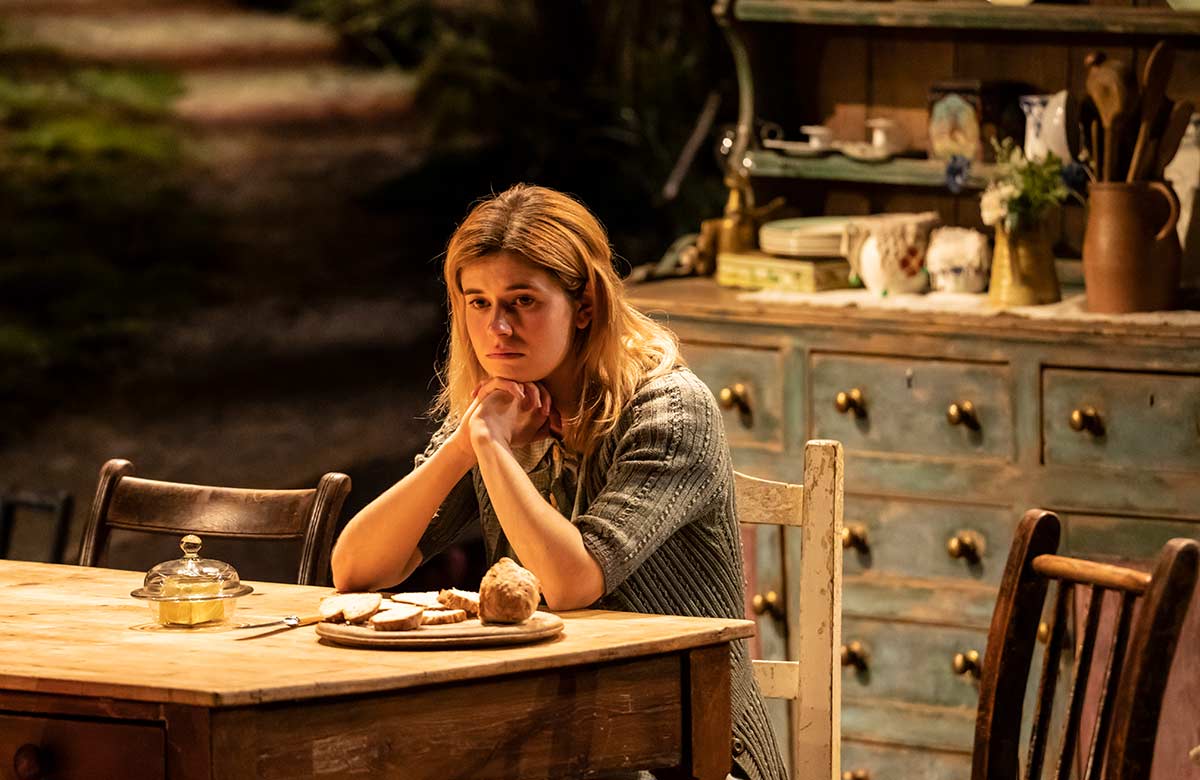
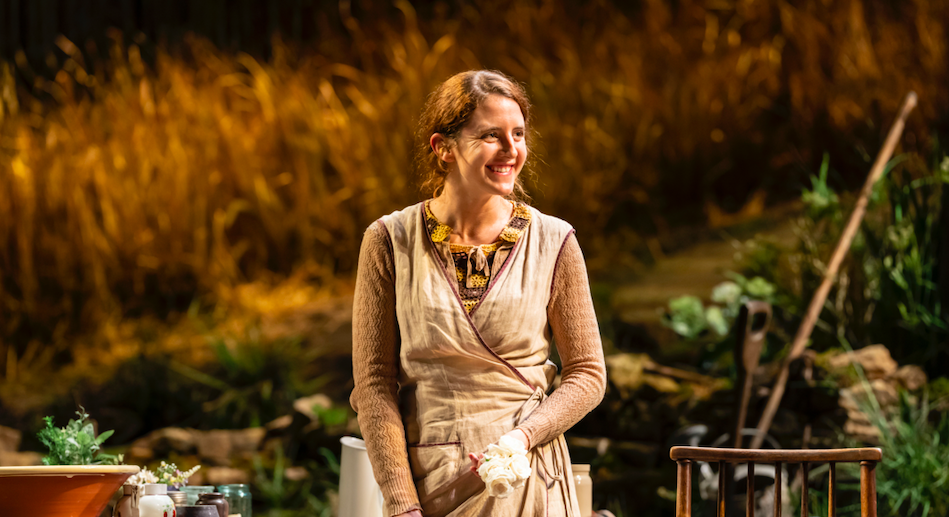
(Production photos: Johan Persson)
But for all its gentleness and nostalgia, there’s a hard core there. Friel eschews sentimentality. His agenda is to explore the slender line between religion and paganism, between tradition and modernisation, between memory and reality and the hostages that they take.
It was an absolute joy to listen to Friel’s command of language. This is the writer who, in Faith Healer has one character comment on another’s confident use of the word “chicanery”. He has a love and awareness of words, and uses them with pinpoint accuracy.
The actors in the play are accurate as well. Justine Mitchell gives her best-ever performance, and both Siobhan McSweeney and Ardal O’Hanlon rein in their comic instincts to bring their characters to vivid life. Tom Riley resists the temptation to make Gerry just a lovable rogue. He’s half aware that he’s destined to fail at everything, and of the damage he causes to others along the way. If it sounds as though the sisters Louisa Harland, Alison Oliver and Bláithín Mac Gabhann are also-rans, far from it: they enhance every scene they appear in. And at the end, Tom Vaughan-Lawlor reduced me to tears again with a winding-down epitaph of love and regret. And I wasn’t the only tearful one.
Our rating: ★★★★★ / Group Appeal: ★★★★
13/05/23 Cecilia writes –
Innocence
Opera at the Royal Opera House, score by Kaija Saariaho (b.1952), libretto by Sofi Oksanen, directed by Simon Stone. (I saw it on 20 April 2023)
Blue
Opera at the London Coliseum, score by Jeanine Tesori (b.1961), libretto by Tazewell Thompson, directed by Tinuke Craig. [I saw it on 4 May 2023)
Preface – Aside from debuting in the U.K. at more or less the same time, both are works by respected women composers, both have remarkable libretti and both examine contemporary sources of social and personal tragedy. Both make a strong impact – but by means that could hardly be more different.
What are they about?
Blue’s deceptively simple story – the libretto pulls no punches – is about the birth and death – by shooting – of a black boy in today’s America.
Innocence explores the continuing impact of a school shooting in Finland.
Oksanen’s Innocence libretto tells us that, 10 years after a mass shooting at an international school in Finland, a wedding breakfast is in progress. Survivors and ghosts of victims recount their memories and their continuing traumas. The new bride (Lilian Faharani) does not know that her husband Tuomas (Markus Nykänen) is the brother of the shooter. Tuomas confesses his own part in the planning of the attack, but asserts that he went home before the killing began……
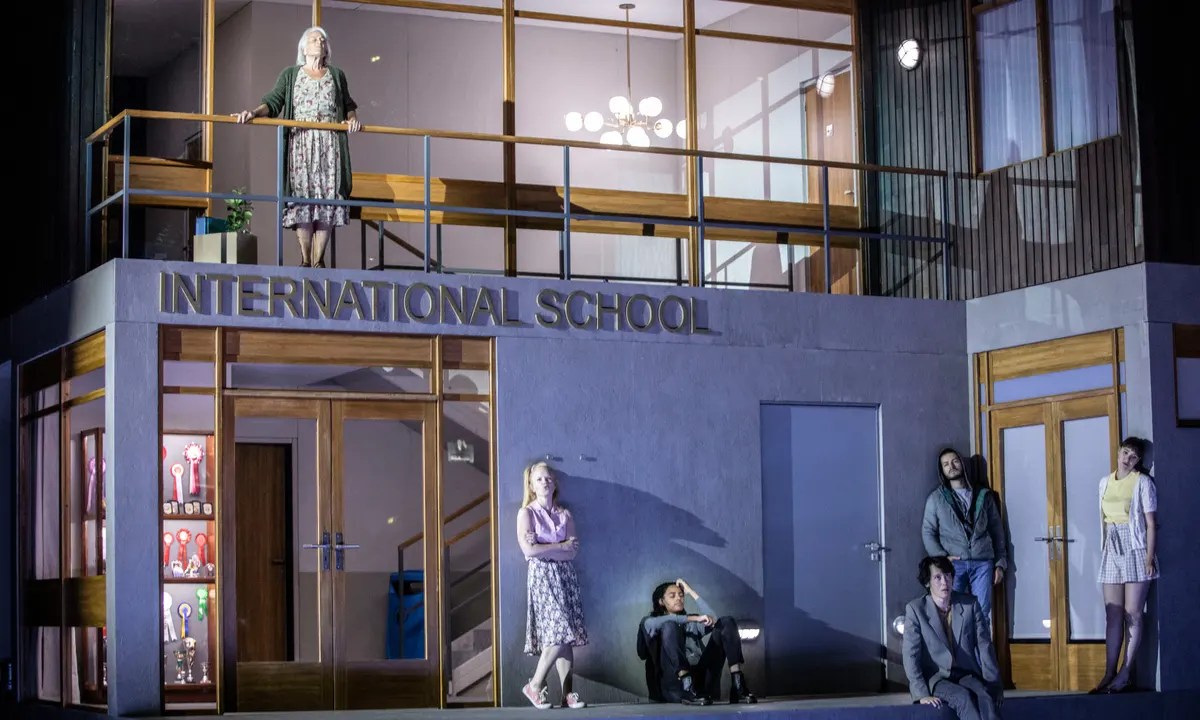
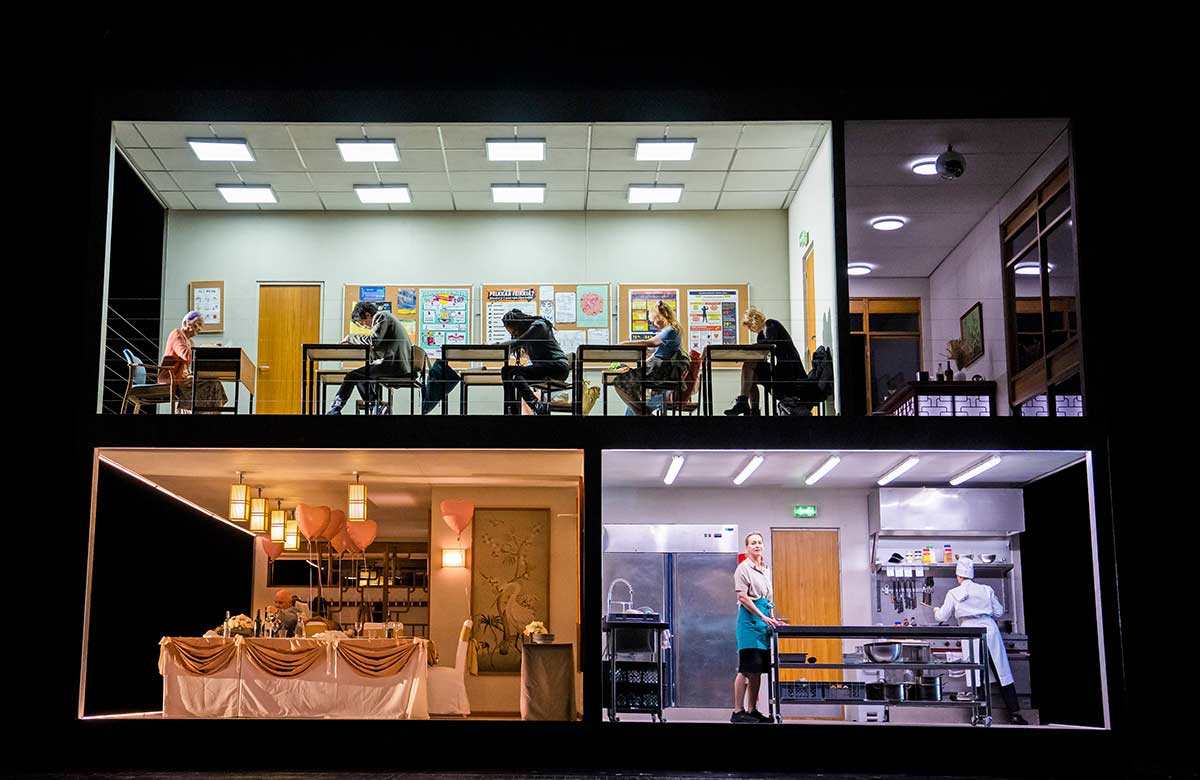
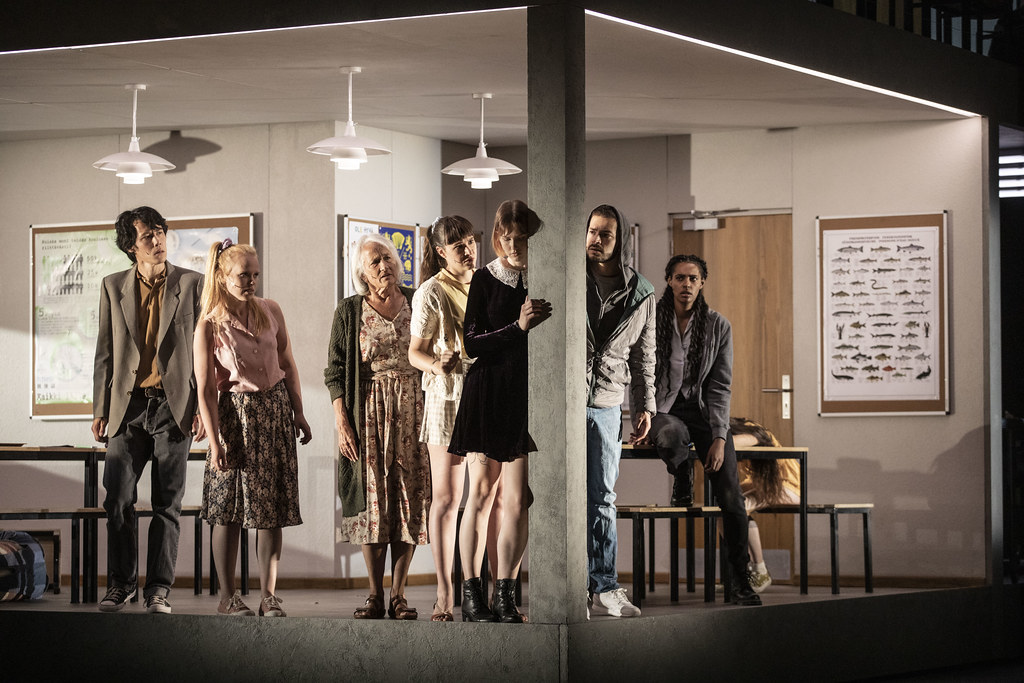
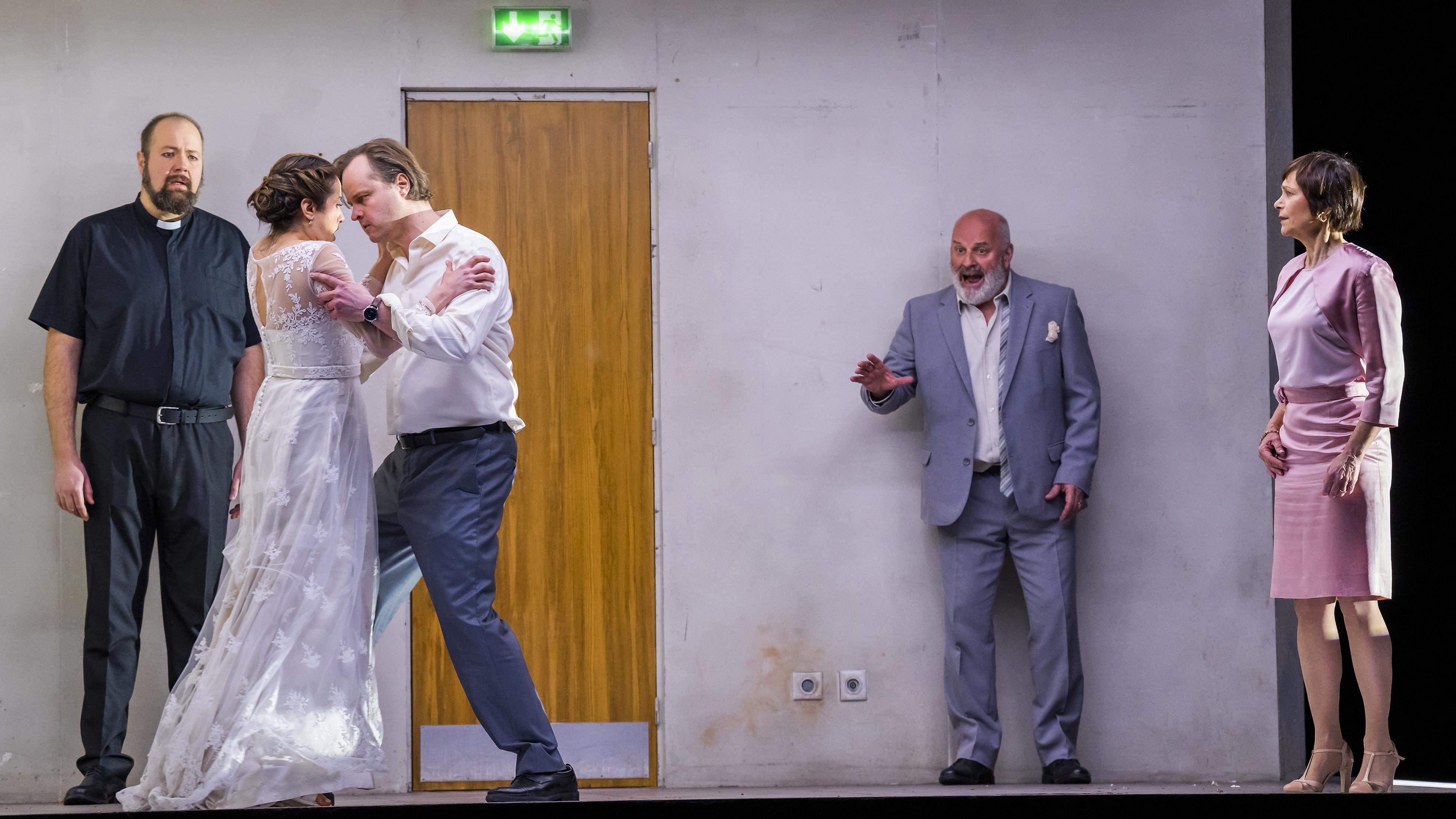
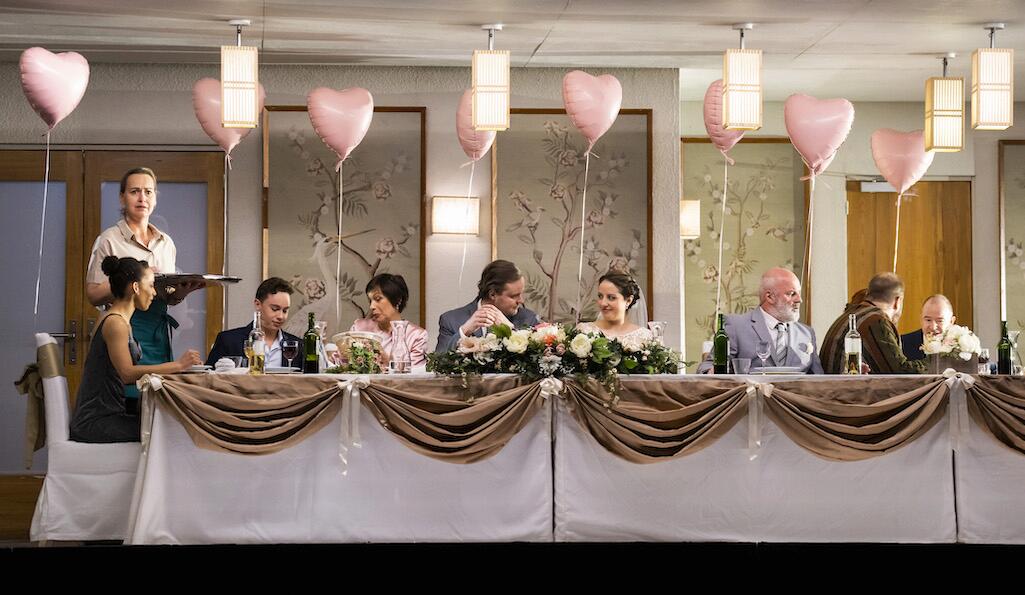
Innocence (Photos: Tristram Kenton)
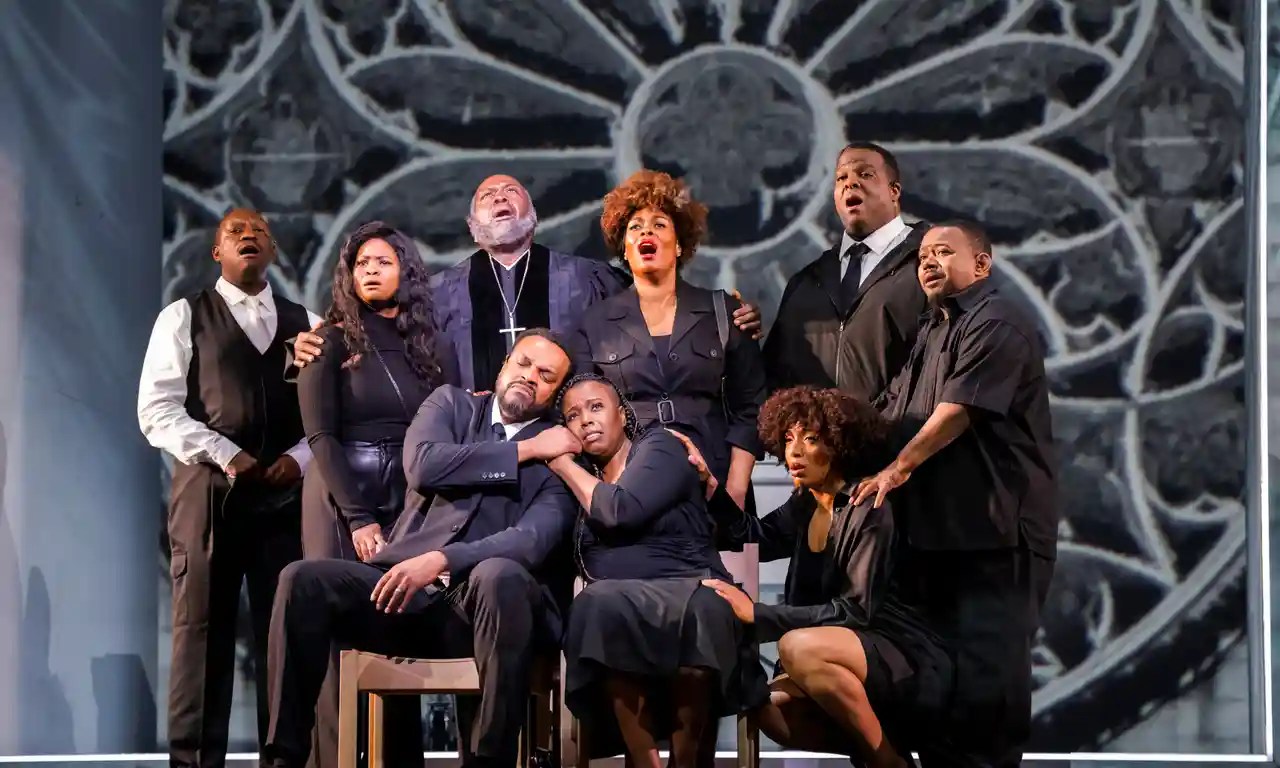
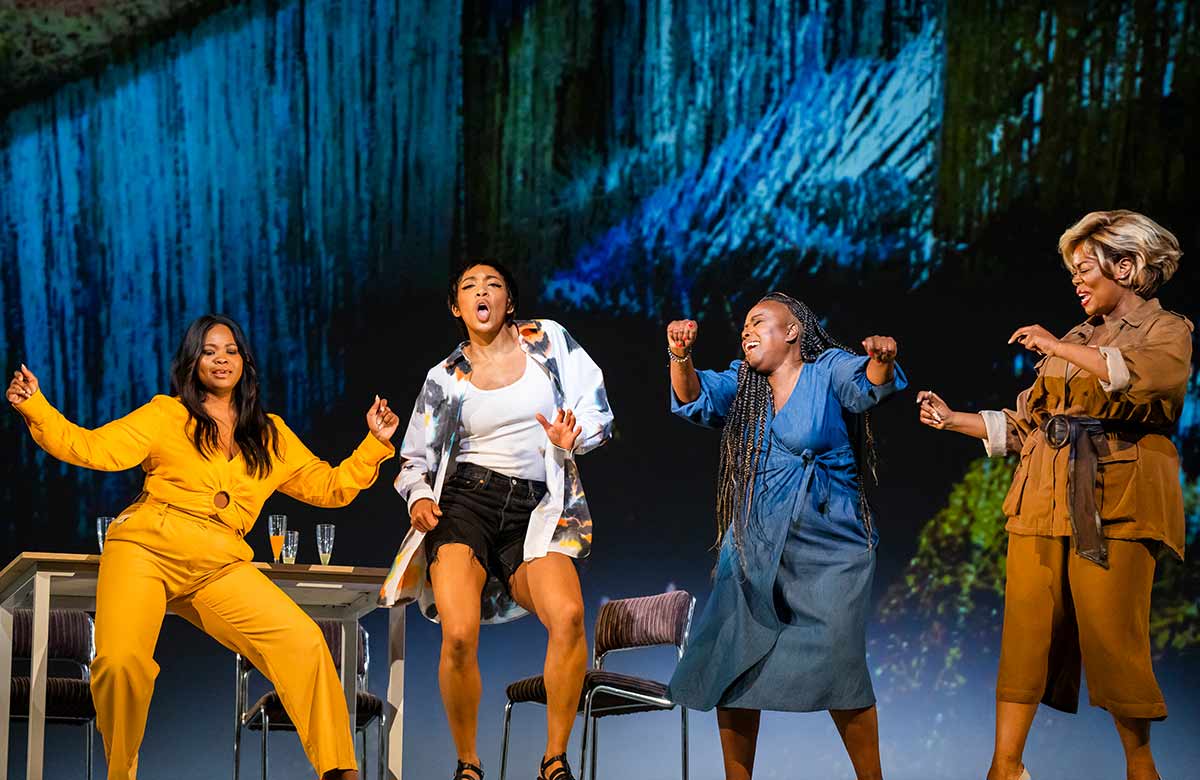
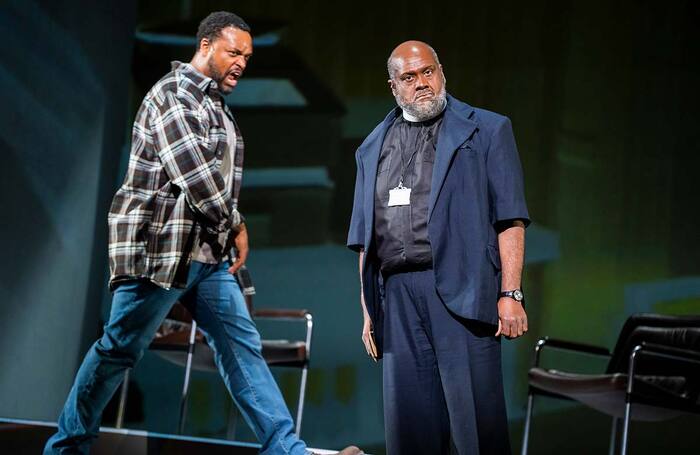
Blue (Photos: Zoe Martin)
In Blue, The Mother proudly announces to The Girlfriends that she’s expecting a son with her policeman husband (in his “blue”uniform). Double shock reactions – a policeman? A boy? – a black boy in America? – what a future…. The Father’s male friends cheer the prospect of a boy, but predict hard times ahead for their friend. Sure enough, The Son, in his teens, becomes a full-blown Harlem street rebel, and doubly contemptuous of “a black in blue” who is protecting effectively only whites. Inevitably, on a demo, The Son is shot and killed – by a “blue”. The Father’s impulse for revenge is neutralised by The Reverend and the funeral follows…..
What have they got going for them?
Both productions include several of the originating cast members. Both productions warrant high marks for their stage settings.
Innocence’s revolving set of rooms on two levels very effectively conveys the passage of time and place. For all its concluding revelatory drama and the sight of bleeding bodies in the school, it is essentially a meditation on the horrible event and its ramifications, not a narrative of it. At ENO for Blue, a combination of a tight tilting-box acting-space is combined with video to convey intimate narrative in the seething streets of New York.
Saariaho’s Innocence score – wonderfully rich in orchestration and sensitively realised under conductor Susanna Mälkki – offers a mood that is sometimes tense and anguished, sometimes brooding. The music doesn’t “set the words” in a conventional sense (I am open to expert correction on that point) or sonically describe the action. The words are important – several languages are used – thank goodness for surtitles.
Tesori’s lush score for Blue does by contrast directly underline and enhance what’s sung on stage in dramatic fashion, providing some spectacular opportunities for wonderful solo and ensemble singing. Whatever the more conventional character of much of act 1, reflective perhaps of the composer’s background in musicals, act 2 demonstrates that classical and black traditions in American music carry great emotional charge. Under the baton of Matthew Kofi Waldron, the resilient ENO orchestra truly delivered the goods.
Blue’s structure is that of a Greek tragedy – the build-up to the fatal moment which occurs off-stage, followed by the grief and anger. Here too of course, a woman (Nadine Benjamin) is bereft, but the closer focus is on The Father (Kenneth Kellogg), broken by fate. Much of act 1 is used to establish the joy and pride of the parents in the birth of their boy, arguably a little OTT and not without jokes. But these preliminaries make the intensity and high passions of act 2 all the more devastating.
Both works are impressive musically.
Did we enjoy them?
You might reasonably think that a school shooting and the death of a young man at the hands of the police are grisly subjects, so hideous and heartbreaking as to be avoided. But heartbreak and death and betrayal are the essence of many operas over the centuries. In many instances they are cathartic and I felt that both Blue and Innocence were just that. So “enjoyment” in this case encompasses an obligation to ponder what these gruesome contemporary phenomena, almost daily events in the USA, can mean over time for survivors and for their communities. Innocence is not a transcription of “media coverage” and Blue’s agonising scene between The Reverend (Ronald Samm) and The Father pulls us into a virtual wrestling match of values and intense feelings.
Critics have sometimes complained about the absence of “character development” and engagement in Saariaho’s work (ENO staged her L’Amour de loin in 2009). But in Innocence we can hardly fail to feel for Stela, for Tereza, for her young daughter, for the schoolteacher, for Tuomas’ parents, even though they too concealed the family’s secret, and even for Tuomas too. Beyond these principals, the group of ghosts and survivors slowly draw us into their experiences.
The potency of this work and its polished ensemble clearly struck the unusually young and diverse audience on the night I was present if the prolonged plaudits were any measure.
The characters in Blue may be unnamed and thus “universal” but they emerged as rounded and convincing individuals, a tribute to the singers’ fantastic vocal assurance and commitment and to the skill of the composer. The principals were all striking, not least Zwakele Tshabalala whose seizure of role of The Boy was phenomenal, vocally and dramatically. The extended trio of The Girlfriends in the aftermath of the obsequies was utterly gripping, as strong as Wagner’s Norns. As with Innocence, the audience for Blue was diverse and enthusiastic, according it a well-deserved standing ovation.
There are great contrasts between the two compelling works – the one in-your-face, with its insistent Black Lives Matter message, the other more subtle and insinuating but just as moving. I hope that the crabby apparatchiks of the Arts Council took a few hours away from the ledgers to experience these remarkable creations.
My rating: Equal ★★★★ each.
A contempory opera-loving group may agree.
18/04/23 Mike writes
Blue
An opera in two acts with music by Jeanine Tesori and libretto by Tazewell Thompson, at the London Coliseum. This was a Dress Rehearsal
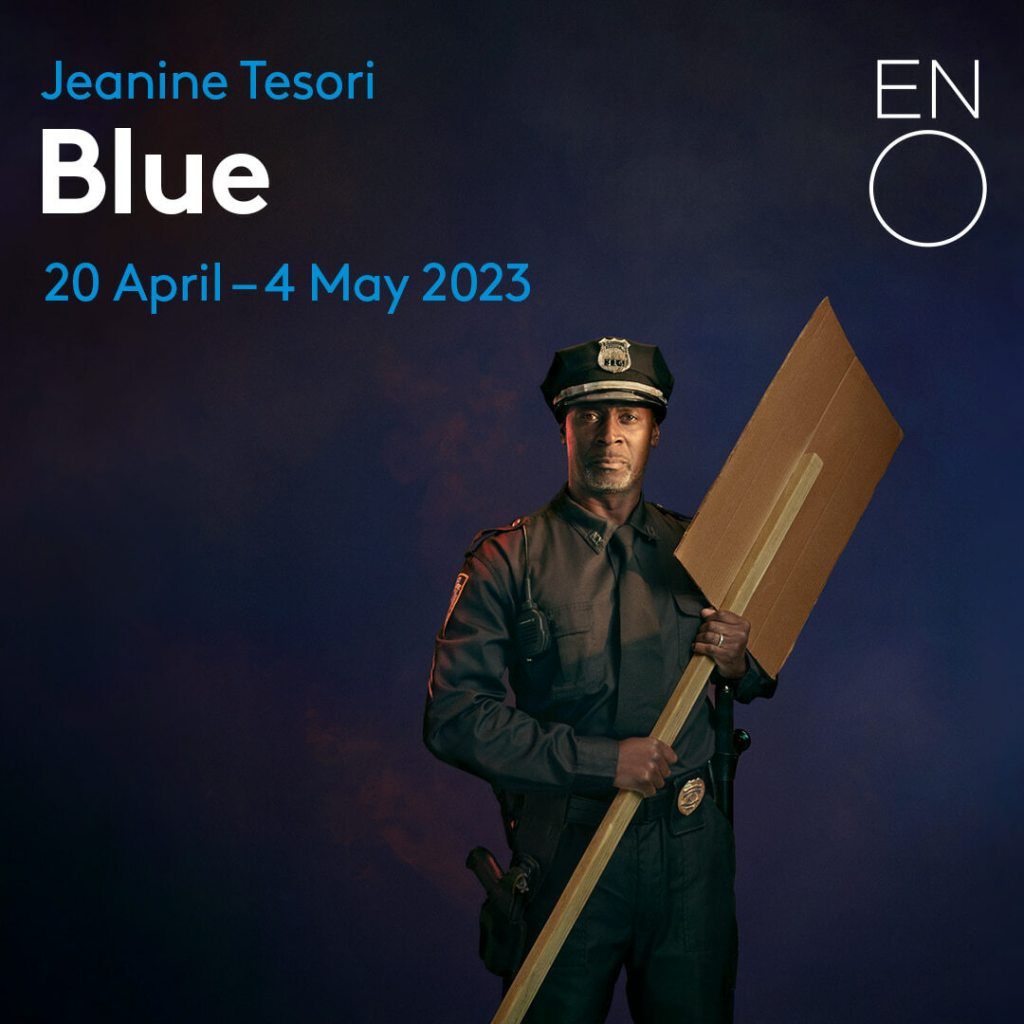
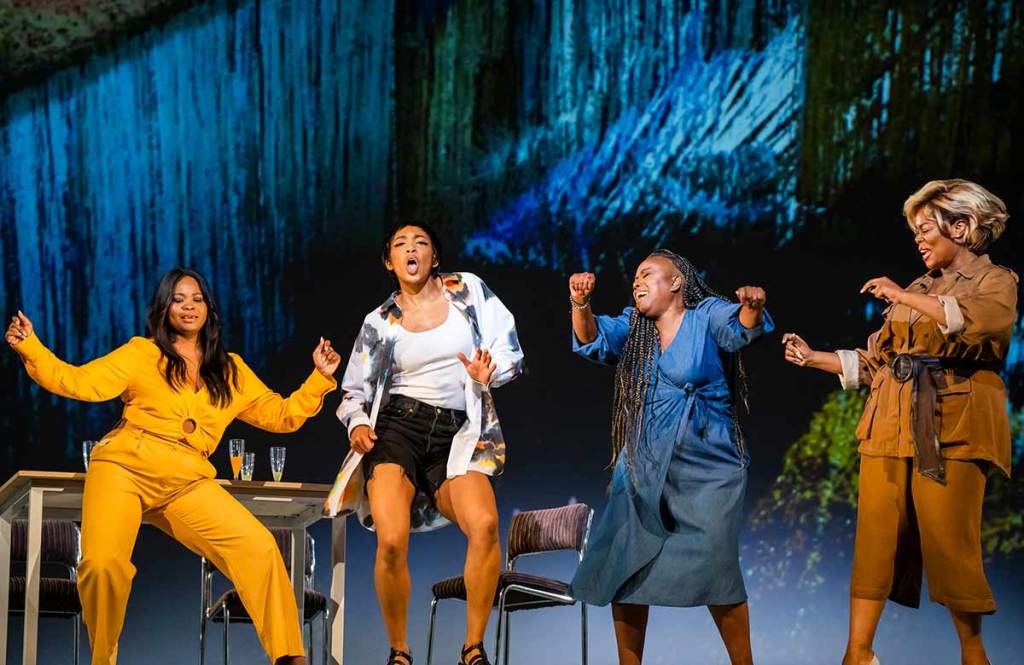
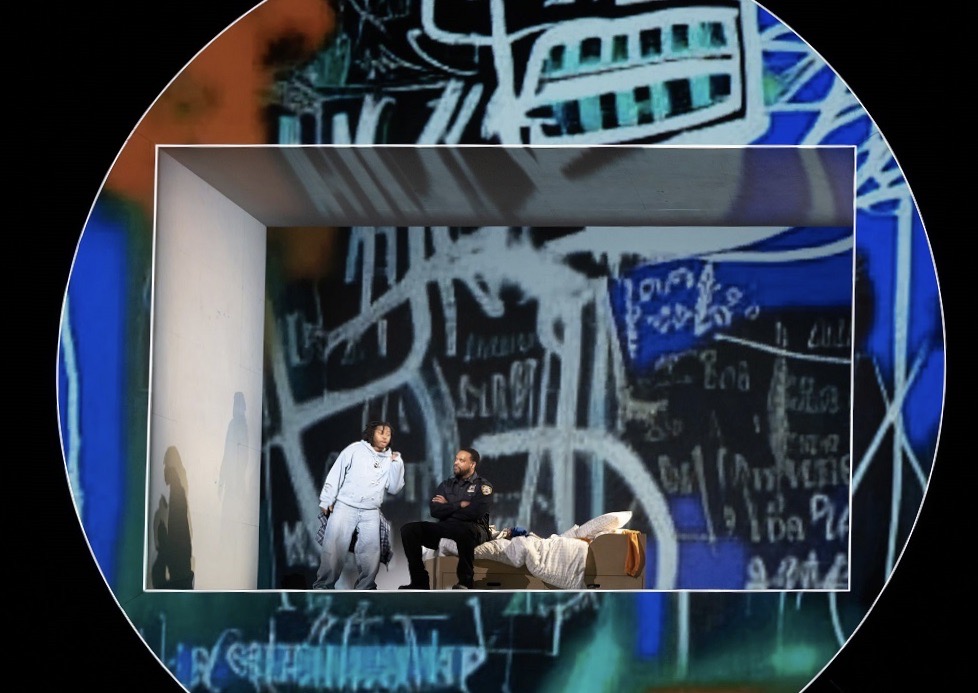
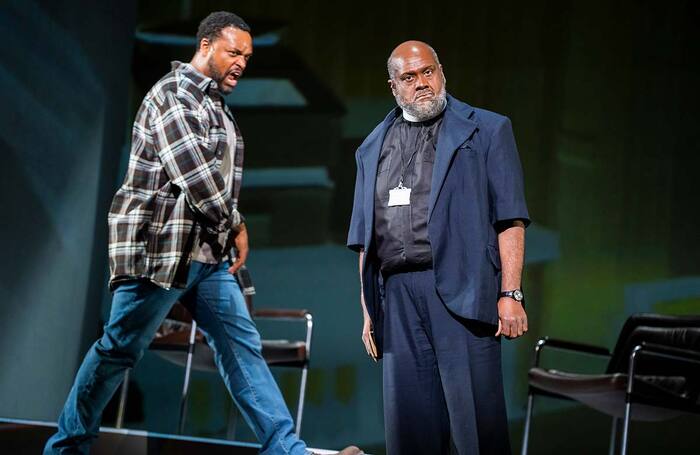
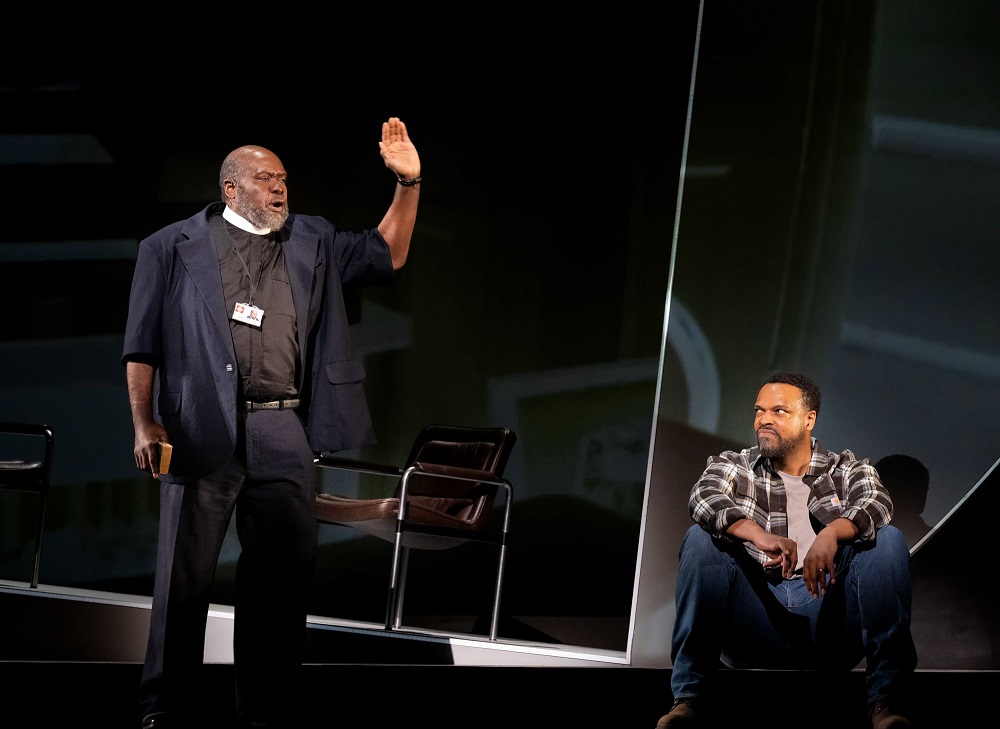
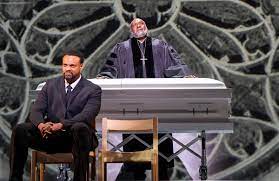
What did it have going for it?: A new production from English National Opera is always worth a look, and this is a new opera too, dating from only 2019 when it premiered at the Glimmerglass Festival in the US. Jeanine Tesori is an award-winning composer better known for her work on musicals than opera, and wrote the music for contrasting shows including Caroline or Change, Fun House, Shrek the Musical and Thoroughly Modern Millie.
What’s it about?: The Mother (Nadine Benjamine)is about to have her first child and is breaking the news to her Girlfriends. They are worried about a boy child being brought into this world by an African American family when The Father (Kenneth Kellogg) is a cop (no, “a law enforcement officer” he insists). The son becomes a talented but rebellious teenager and (a SPOILER is coming but read on) by the opening of Act 2 has been shot dead by a white policeman. The topicality sets up the situation, the anticipation focuses its importance, and grief is the heart of the tale.
Did we enjoy it?: From Millie to Caroline, you can see the increasing interest of the ‘black lives’ subject in Ms Tesori’s work, and here her music and Thompson’s libretto bring strong emotion to today’s newspaper headlines. She makes the story accessible, direct, all too understandable, and increasingly powerful. I feared the tragedy could become sentimental and preachy but it didn’t. I was completely hooked by the family’s situation (the birth, the love, the community, the difficulties, and then the devastation); the sadness overwhelms them and us.
From Ms Tesori’s background in musicals and general theatre work, I wondered if just this second opera would fit into an Opera House repertoire or still be a sung-through musical. It fits! With its surging orchestral sounds and emotional voices filling the Coliseum, even in this small-scale production, it becomes a magnificent addition to the regular opera programme rather than another of their occasional musicals. I wonder if opera buffs will agree – it is telling that the rehearsal audience packed the house for the earlier Rhinegold, and The Dead City was respectfully attended, but here the audience was shamefully sparse.
The black cast are all magnificent, in passionate voice (even at this dress rehearsal when they can ‘hold back’ if they wish) and a big Thankyou to ENO for casting so appropriately, which does not always happen. The production is perfect, and I haven’t been able to make that comment at the Coliseum often. Each small scene is set in a central box within a framing circle of light, overlaid with hovering camera views of Harlem. The characters are formally placed, three Girlfriends balancing three Policemen, then The Mother and The Father with just The Son and The Reverend completing the cast. It could be any and every family; its honesty and simplicity touches us personally.
I hope I’m not making Blue sound depressing. No, it’s hard-hitting but life-affirming too with a coda that gives us time to wipe tears before spreading the news – the Coli has a must-see.
Our rating: ★★★★★ / Group appeal: ★★★★
31/03/23 Mike writes –
Further than the Furthest Thing
by Zinnie Harris, at the Young Vic theatre.
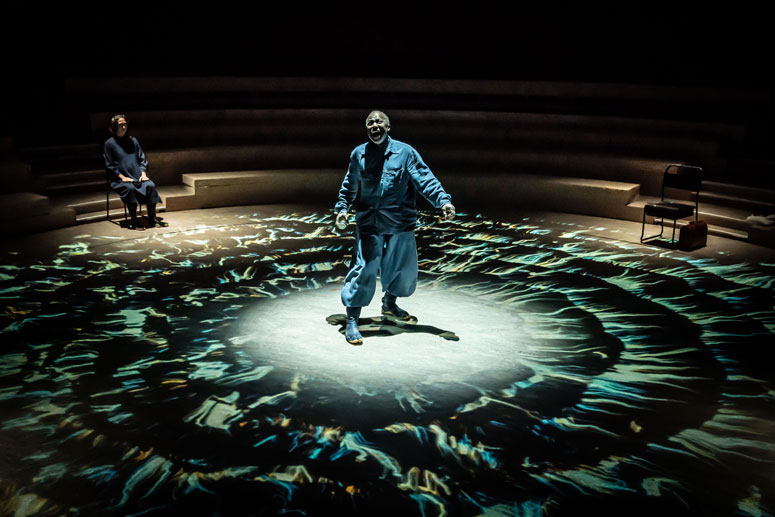
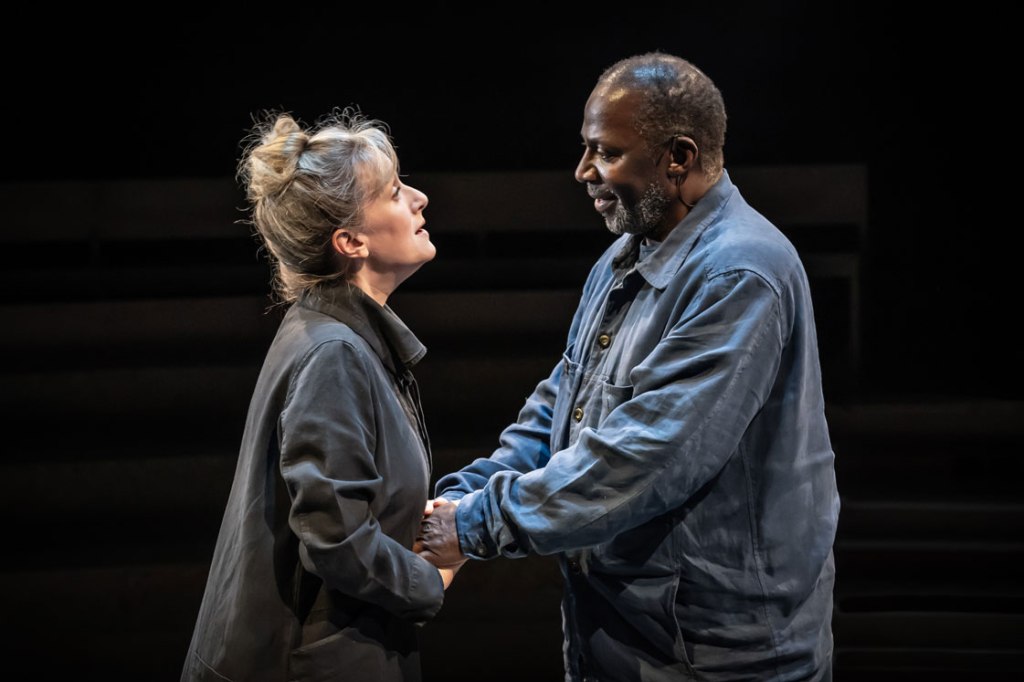
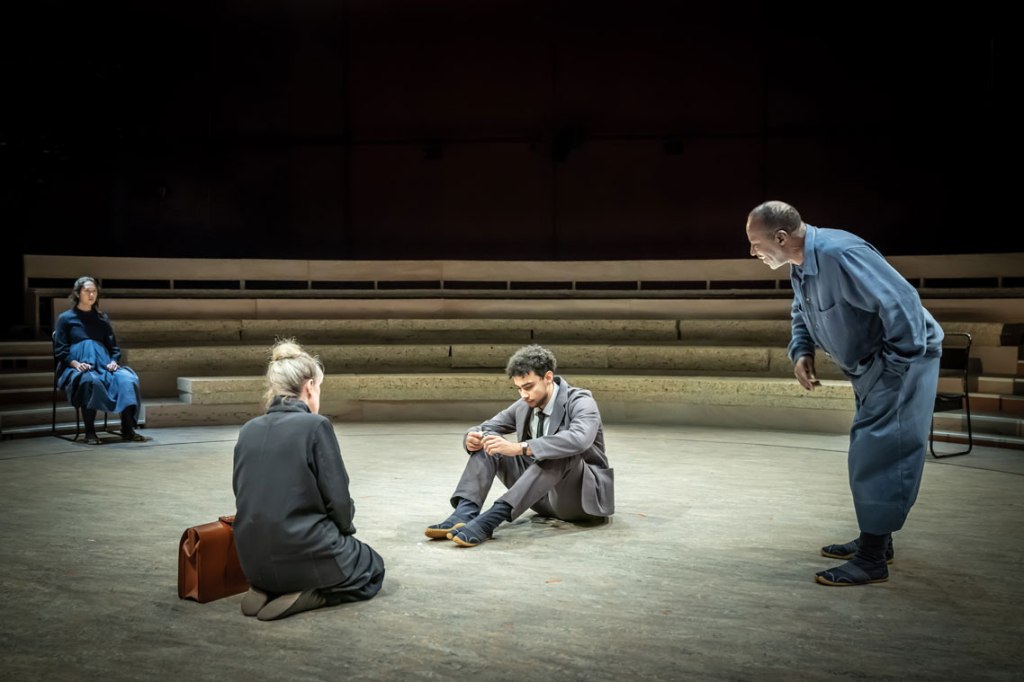
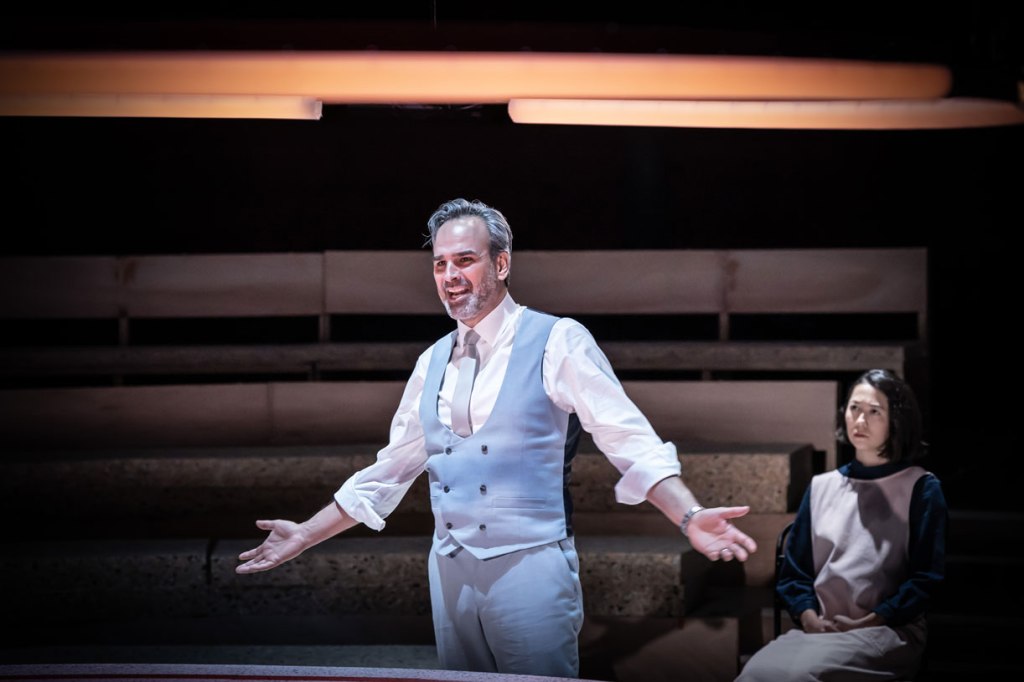
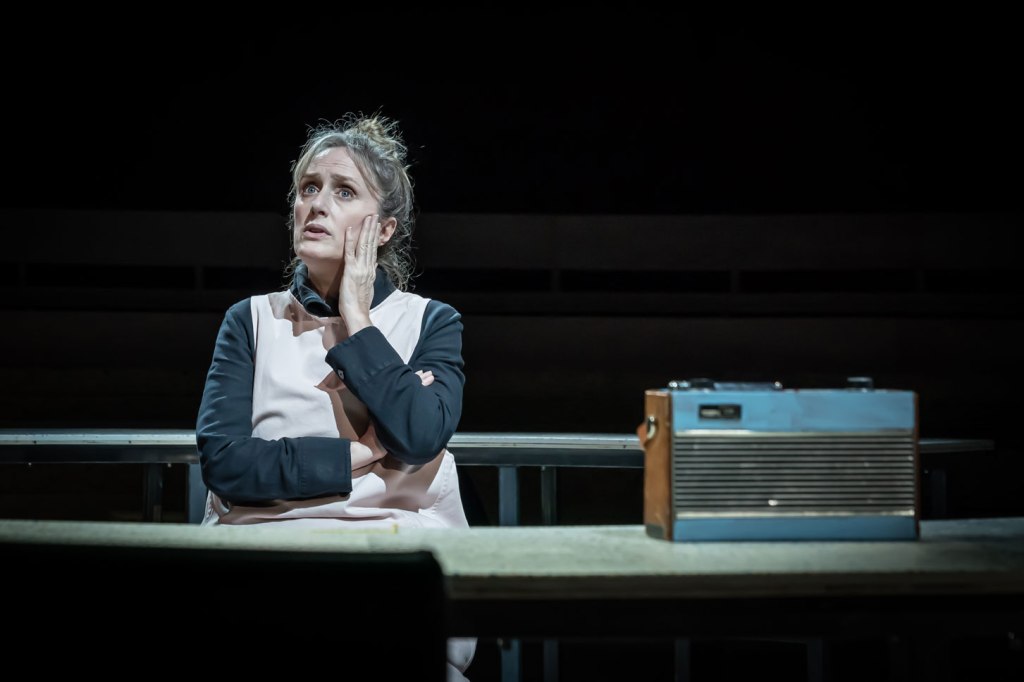
We’re in-the-round again here, and in the Atlantic Ocean with waves lapping across the bare circular stage. In the centre is projected a small island. We must believe it’s Tristan da Cunha as the play is based in many ways on part of that tiny island’s history. The small population was cut off from the rest of the world during WW2, then in 1961 a volcano on the island threatened to erupt and all the islanders were evacuated. Only a few returned. II’s a sad fact that the small community was badly treated, exploited by capitalist endeavours, and some would say their idyllic existence, detached from the modern world, was forever ruined. The playwright focuses on the troubles of one family and weaves a few historical facts around them to sell its anti-imperialist theme of the Damage that Progress can do to those scraping a living with little means. Some narrative detours were thrown in as added interest but they just slowed the pace. You would think the story should raise some hackles but I was not impressed.
I could have wept at the way circumstances were stacked against simple folk just wanting a simple life. But I did not weep. This was an everyday story of poor clichéd folk we’ve seen the likes of so many times before, once again being used to exercise our politics and moisten our eyes. The actors did their best and Jenna Russell (who drew us to see the play) held the tragedy together with her motherly portrayal of the simplistic ‘traditional ways’.
For me, the main difficulty was the production. The audience sat on benches (mostly backless – very levelling!) in four rows surrounding the very large open circular stage. The actors were always at a distance, often with backs to the spectators despite a very slowly revolving stage. And a lot of dialogue was difficult to hear across the very open space. I followed the basic theme but cared little and an irrelevant side-story of a rape passed me by. On the plus side were atmospheric lighting and sound effects which grabbed more attention than the characters did.
The typical Young Vic audience, I would say mostly politically aware, were won over, I think more by the theme than the way it was written and portrayed as a drama. The enthusiastic applause was unearned.
My rating: ★★ / Group appeal: ★★
30/03/23 Fredo writes –
A Couple of Swells: Joe Stilgoe & Liza Pulman
Cabaret at the Rose Theatre, Kingston-upon-Thames
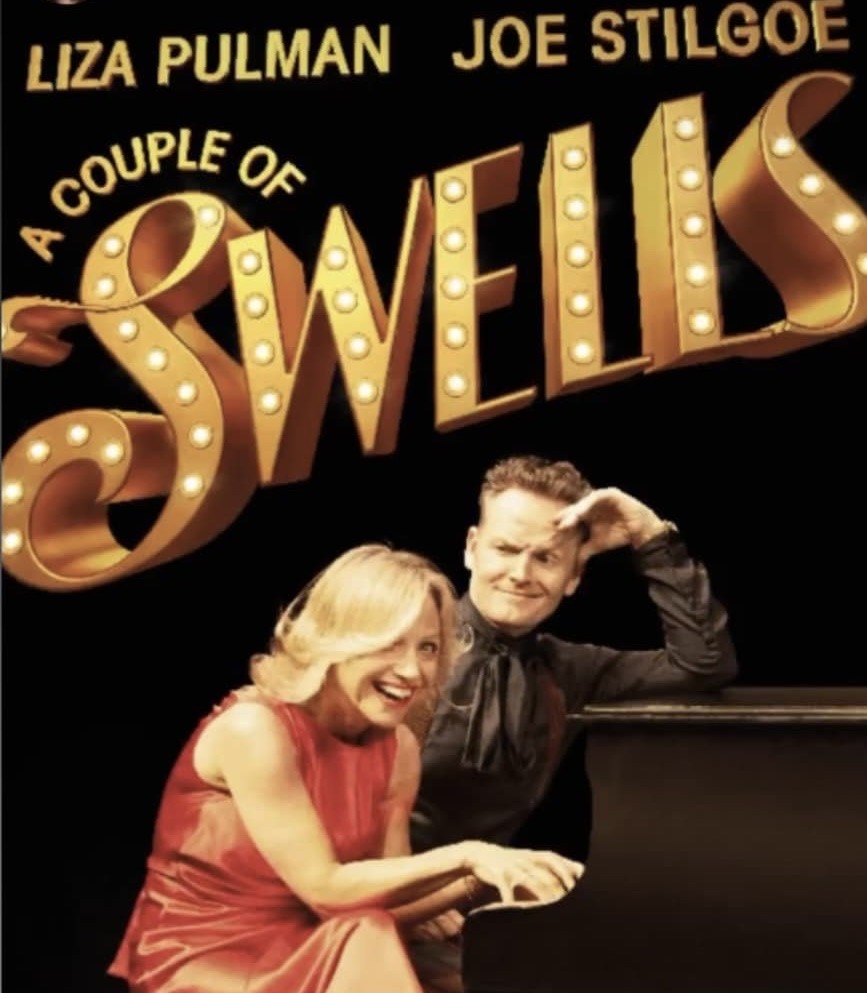
Regular readers of this website may have noticed that I keep going back to Joe Stilgoe. You must think I’m besotted. And if I were, it would be understandable: he’s a great pianist, has a pleasant voice, and an engaging stage personality. Seeing him again, and this time with Fascinating Aida’s Liza Pulman, was a rare treat. We hadn’t seen Ms Pulman before, though I was aware that she tours with her own tribute show to Barbra Streisand – and indeed, one of her first numbers was Don’t Rain on My Parade. It was very clear that she is as assured vocally as her companion is on the piano.
The programme was designed to show off their versatility and their ability to refresh old favourites and reintroduce us to the more eclectic treasures of the songbook. The seldom-heard What are You Doing the Rest of Your Life? came over as a warm caress from Liza, while Joe enjoyed himself (and we shared the pleasure) with The King’s New Clothes and his distinctive medley of audience requests, merging My Way with The Wheels on the Bus.
It was mainly a programme of duets, with an exquisite blending of People Will Say We’re in Love and If I Loved You, for the Rodgers & Hammerstein fans (that would be me!). We were also treated a lively rendition of the counterpoint I Hear Music/You’re Just in Love from Irving Berlin, and The Folks who Live on the Hill from Jerome Kern. I thought I’d gone to heaven.
Any quibbles? Well, I wouldn’t have minded a few more solos from these two gifted artists, but having too much of a good thing isn’t a serious complaint. I’ll be back for more!
(Look out for their London date at the Duchess Theatre on Monday 15 May.)
Our rating: ★★★★ / Group appeal: ★★★★
22/03/23 Fredo writes –
The Dead City
Music by Erich Wolfgang Korngold; Based on a translation by Kelley Rourke, at the London Coliseum

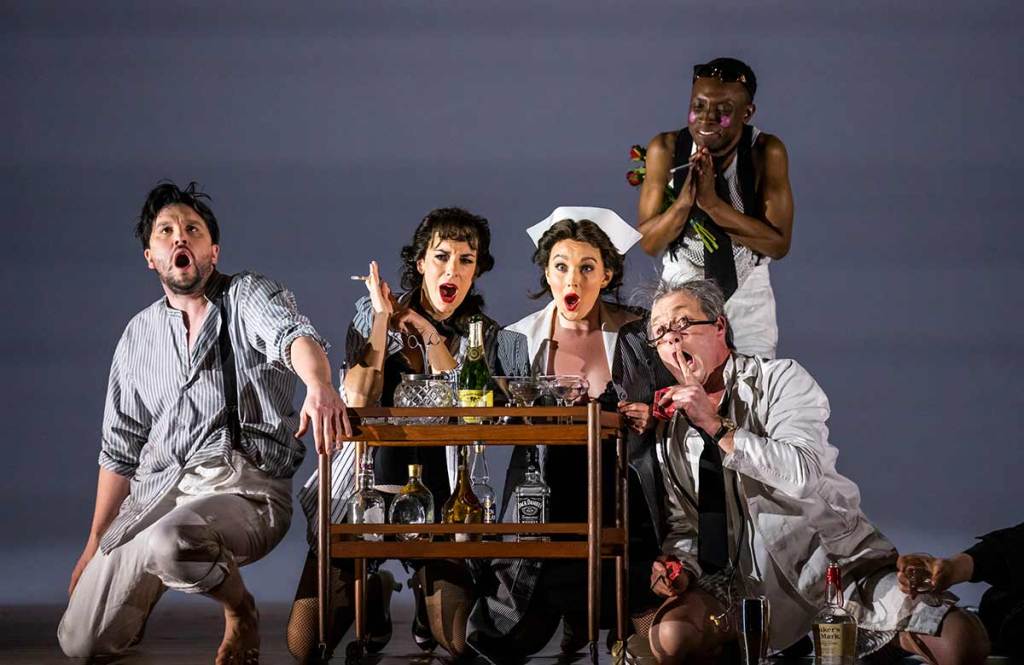
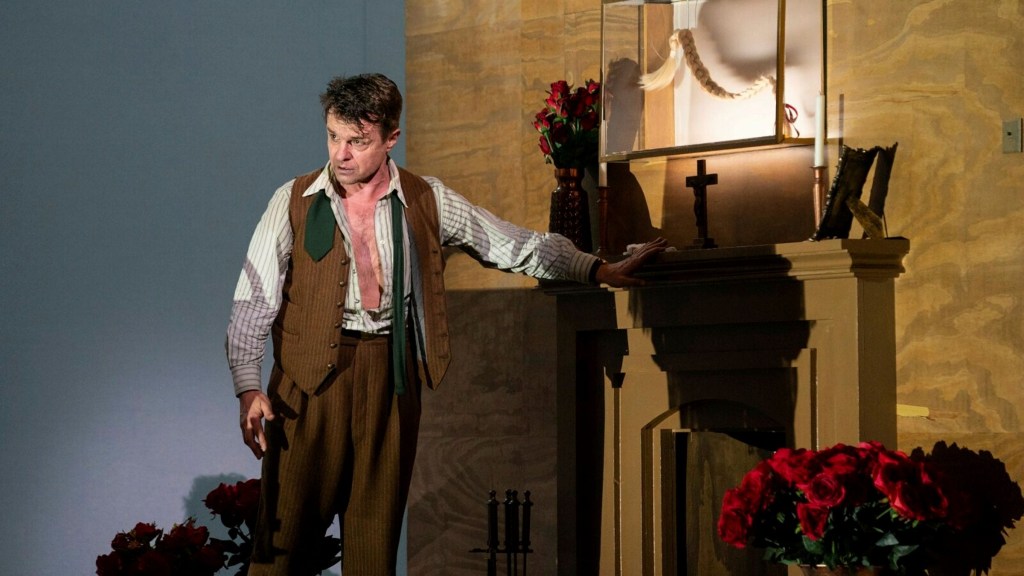
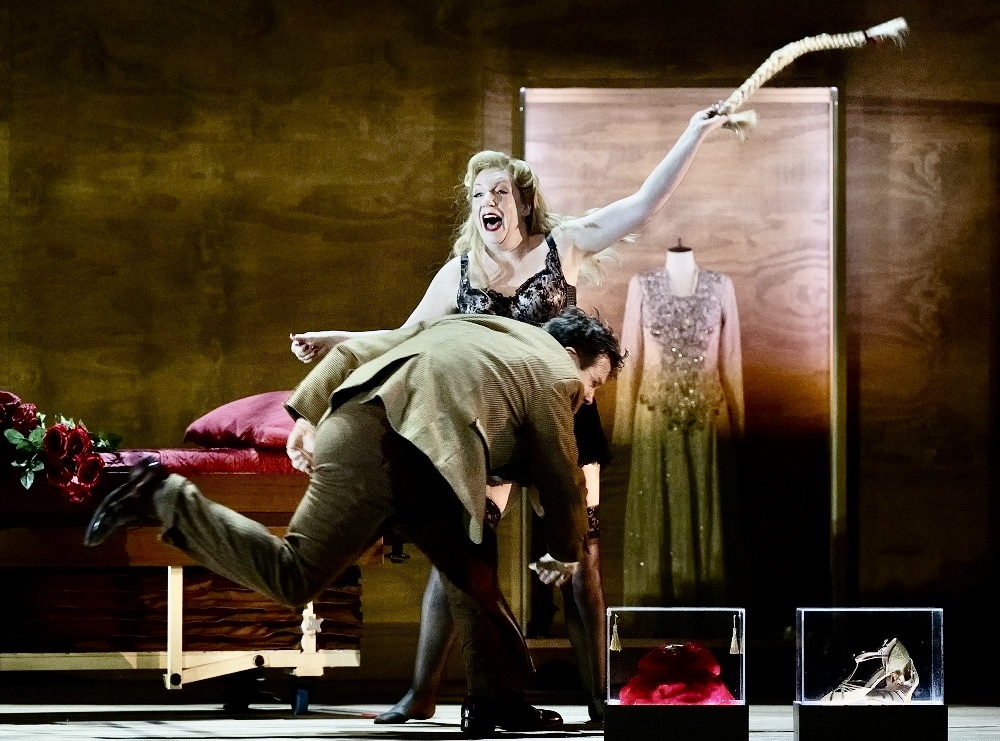
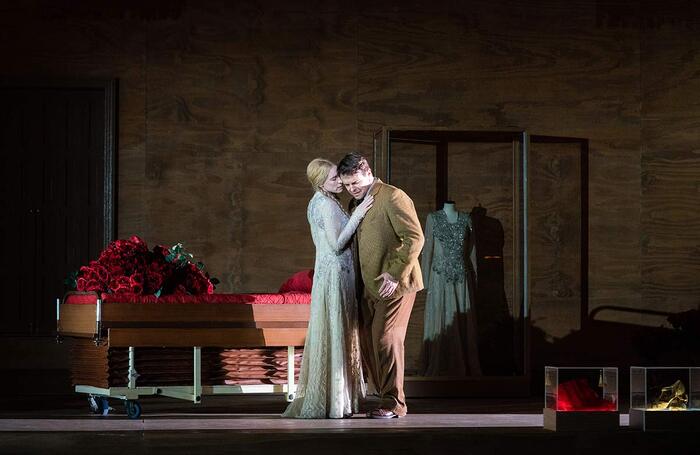
There are often good reasons why books go out of print, plays fall out of the repertoire and operas disappear from sight. Occasionally it’s a question of fashion, and in the case of opera, logistics: there just isn’t the money to stage them. However, from time to time we stumble across a major work that was just biding its time to be rediscovered. This is one of them.
Die Tote Stadt by 23-year-old prodigy Erich Wolfgang Korngold premiered in 1920, but has been seldom seen or heard in this country. That’s why it’s urgent not to miss the current production as The Dead City by the English National Opera. Given that company’s uncertain future (thanks to bad decisions by Arts Council England, as instructed by Nadine Dorries) you might not get the chance again.
It’s a strange, and rather morbid story: Paul, mourning his dead wife Marie, becomes infatuated with Marietta, and tries to transform her into Marie. We were reminded of the Hitchcock movie Vertigo, but instead of Bernard Herrmann’s theme music, we have Korngold’s lush score, with soaring arias filling the vast space of the Coliseum. (“Does it remind you of Richard Strauss?” asked our friend Meryl, who knows about these things.)
It’s a strong, confident production from director Annilese Miskimmon, with an impassioned performance from Rolf Romeo as Paul, and a suitably ambiguous one from Allison Oakes as the object of his infatuation. In the smaller role of Brigitta, Sarah Connolly was luxury casting, but was effective, as always.
It’s difficult to judge if this staging explored all the layers of this unfamiliar work, but it’s a start in restoring it to the mainstream. Sadly, this work was suppressed by Hitler, and Korngold decided not to write any more operas till the overthrow of Nazism. Instead, he continued his career in Hollywood, writing symphonic scores for Warner Bros for movies such as The Adventures of Robin Hood and The Private Lives of Elizabeth and Essex. Opera’s loss was Hollywood’s gain; it’s time to redress the balance.
Our rating: ★★★★ Group appeal ★★★★
15/03/23 Fredo writes –
Romeo and Julie
By Gary Owen, at the National: Dorfman Theatre

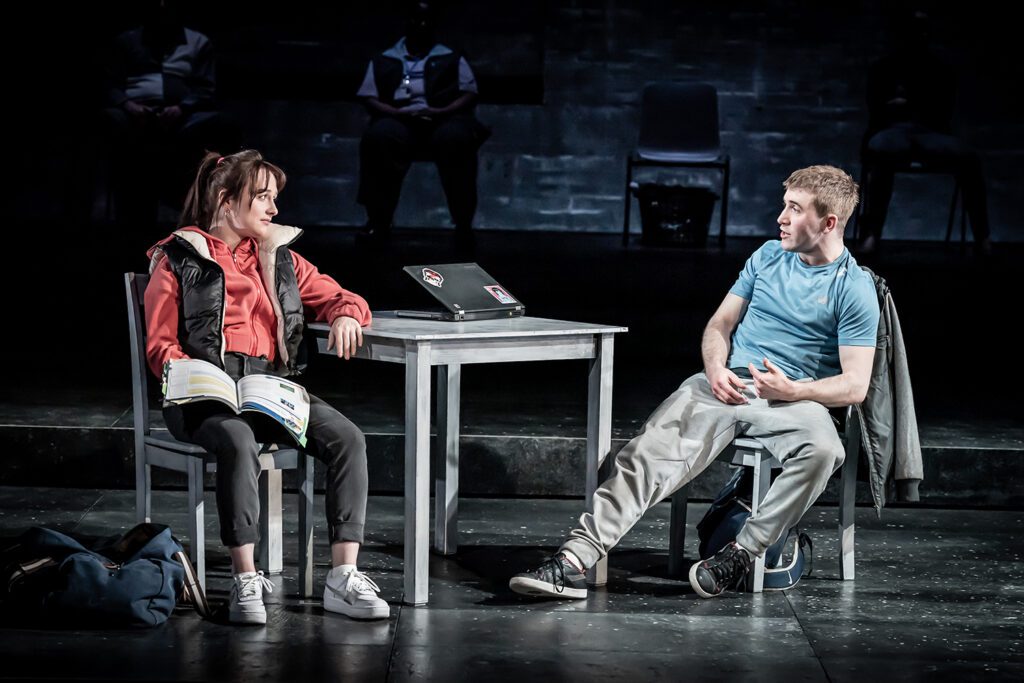
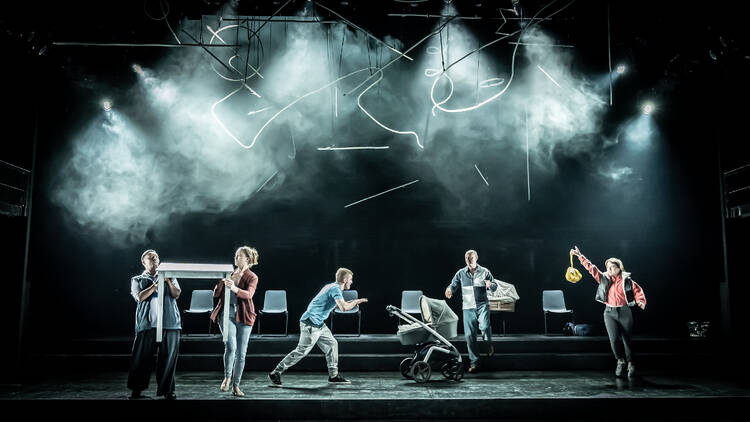
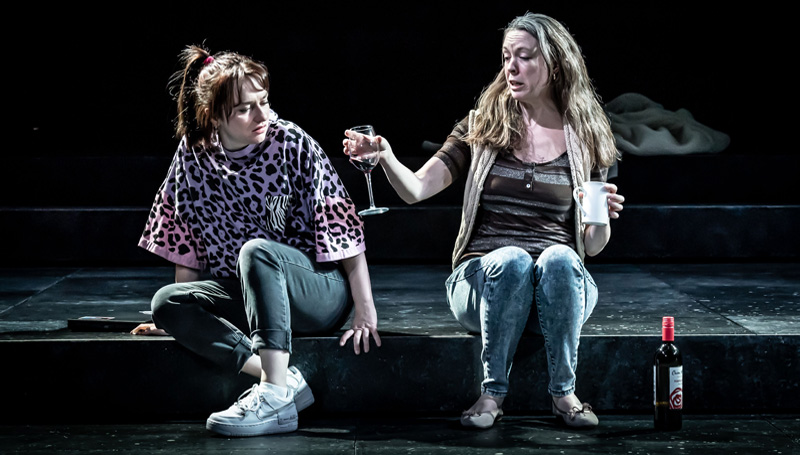
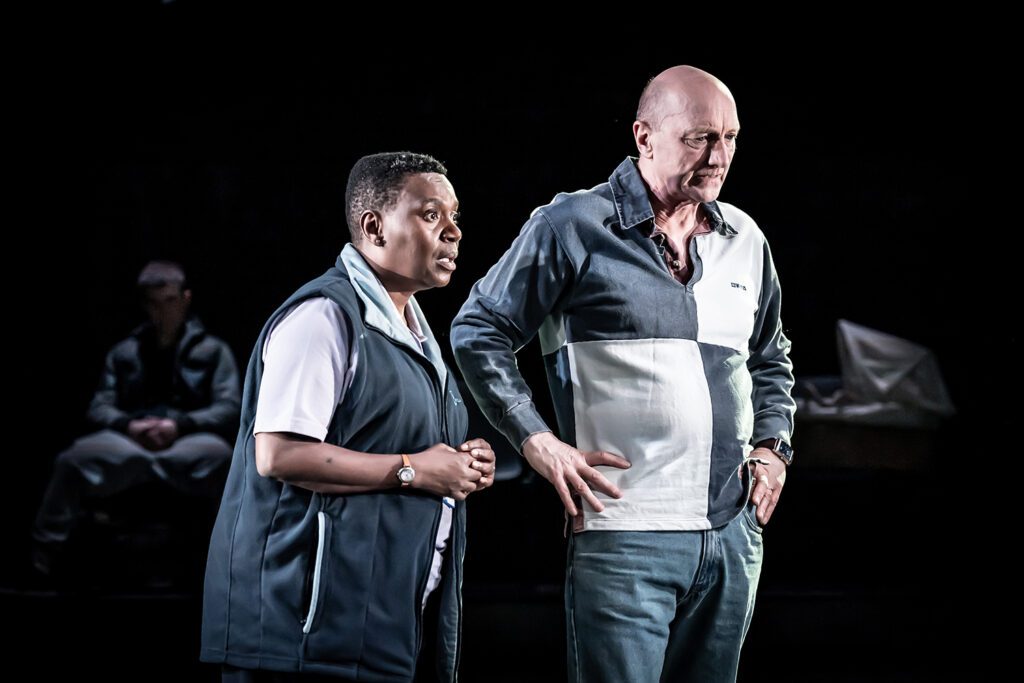
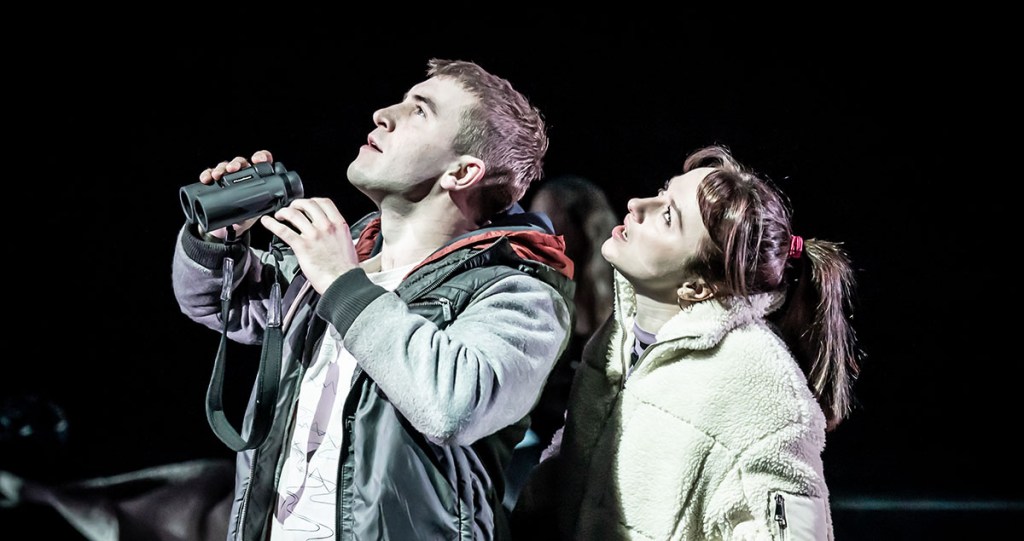
We’re a long way from fair Verona. Gary Owen’s play is set in Splott, a suburb of Cardiff. Romeo (and to make a point, it’s pronounced the Italian way, roMAYo) is a teenage single father. His girlfriend didn’t want an abortion, and then she didn’t want the baby either. Now Romeo is struggling to bring up baby Niamh on his own, and changing a pooey nappy is a major challenge.
Things look up when he meets bright student Julie, heading out of Splott to read Physics at Cambridge. It’s a rom-com, set against the backdrop of Romeo’s responsibilities to baby Niamh and the problems with his alcoholic mother, plus Julie’s personal aspirations and the expectations of her proud father and step-mother.
It’s not just the appealing performances of Callum Scott Howells (from TV’s It’s a Sin) and Rosie Sheehy (Oleanna) that draw us in, though that’s a major part of it. Gary Owens has constructed his narrative carefully, and we hardly realised how much we have invested in Romy and Julie’s future happiness until he throws a curve-ball at them. All I can tell you is that the totally engaged audience gasped in anguish and sympathy, and not a few had to brush away a tear and fix their make-up at the end.
No, it isn’t a tragedy. Interestingly; this is the second play we’ve seen at the National that refers to a classical work in its title (the other one is Phaedra) in order to show us that the familiar stories can inform contemporary situations. Yes, we have a pair of star-cross’d lovers, but in this instance, the stars are slightly more benign.
Director Rachel O’Riordan moves the story along at a fast pace, and Catrin Aron, Paul Brennan and Anita Reynolds provide parental support – or lack of it. But it is a triumph for Gary Owen, and Callum Scott Howells and Rosie Sheehey give star-making performances. No wonder they looked so pleased with the audiences’ cheers at the end.
“It will be an O-level text,” declared our friend Janice, with an air of authority. Oh, I do hope she is right. There is so much in this play for young people to identify with, to debate and argue over, but most of all, to enjoy. If you really love your teenage grandchildren, buy them a ticket!
Our rating ★ ★ ★ ★ ★ / Group appeal: ★ ★ ★ ★
14/03/23 Mike writes –
A Little Life
based on the novel by Hanya Yanagihara, adapted by Koen Tachelet,
Ivo von Hove and Hanya Yanagihara, at Richmond Theatre

You may have read the book. Apparently it was a best seller in 2016, all 736 pages of it. But Fredo tells me he disliked it. Psychologies magazine said of the book “Astonishing . . . tender, torturous and achingly alive to the undeniable pain that can scar a life.” Some say they ‘devoured’ the book! But how do you turn a tome into a stage play? Ivo von Hove, the director, has attempted it and cast James Norton in the lead to ensure good box office returns. I thought I’d better see it, and catch it in preview at Richmond, at slightly cheaper prices.
It’s tough – there’s a very long list of trigger warnings for the weak-and-whiny and the faint-hearted. No drug taking or smoking though, just a list of life challenging hazards. At first I was reminded of that two-part epic The Inheritance which we saw in the West End a few years ago, a stage masterpiece with great emotional clout. That was about the history and interaction of gay friends over many years. Here we have just four friends, together since college, now all in major professions – an architect, an actor, an artist, and a lawyer. We are introduced to each with light banter, affectionate grapplings, and then the tone of the evening turns dark, very dark.
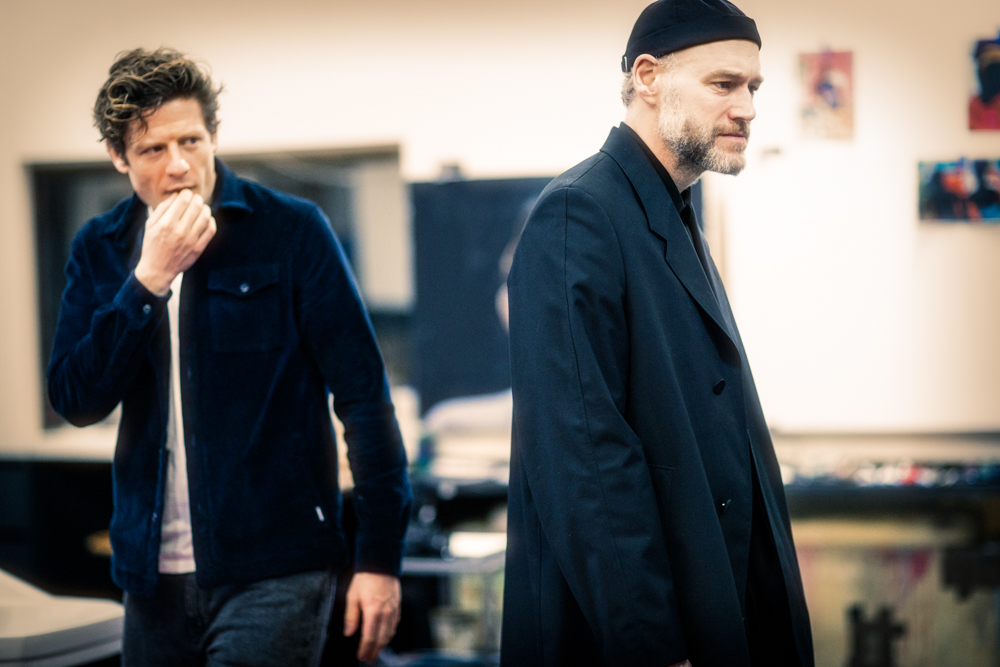
The focus is on the lawyer Jude (a name which implies suffering) partly disabled, withdrawn, mentally damaged despite his academic achievements. He cannot, he refuses, to talk of his past. Another reminder – Equus, the play about an emotionally damaged boy unable to speak of a past trauma. But A Little Life probes; the play presents in unflinching detail the horrors of what has damaged Jude both physically and emotionally. As a child, between the ages of 8 and 15, he was sexually abused, violently and continually, by a controlling Father figure who prostituted him. Then as an older teenager addicted to self-harm, he was trapped in a coercive, violent and belittling relationship which ultimately crippled him, physically and emotionally. At one point he cries “I can’t get an erection without cutting myself!”.
It’s a devastating history of trauma. Are you still with me? Are you still in your theatre seat? Obviously most readers of the book turned every page, and thanks to this theatrical storytelling and prestige casting it keeps an appalling grip on one’s attention.
The audience is clustered fore and aft of a small performance area furnished oddly with a pedestal bathroom basin, a cooking stove to one side and office furniture to the other, with background video images of New York. The worn flooring is ominously red.
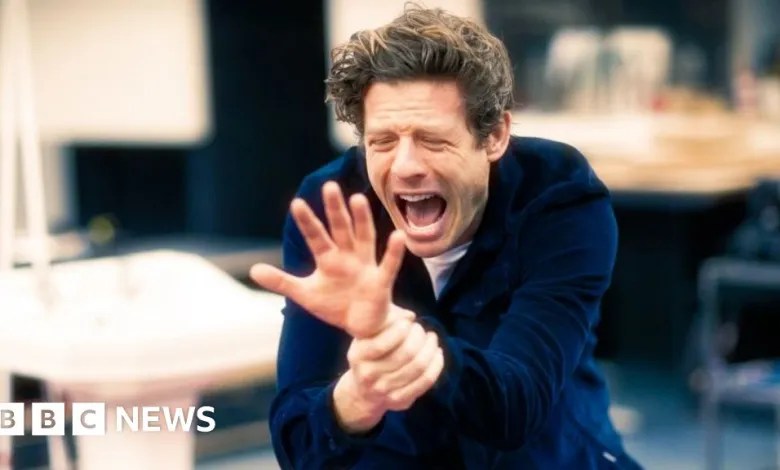
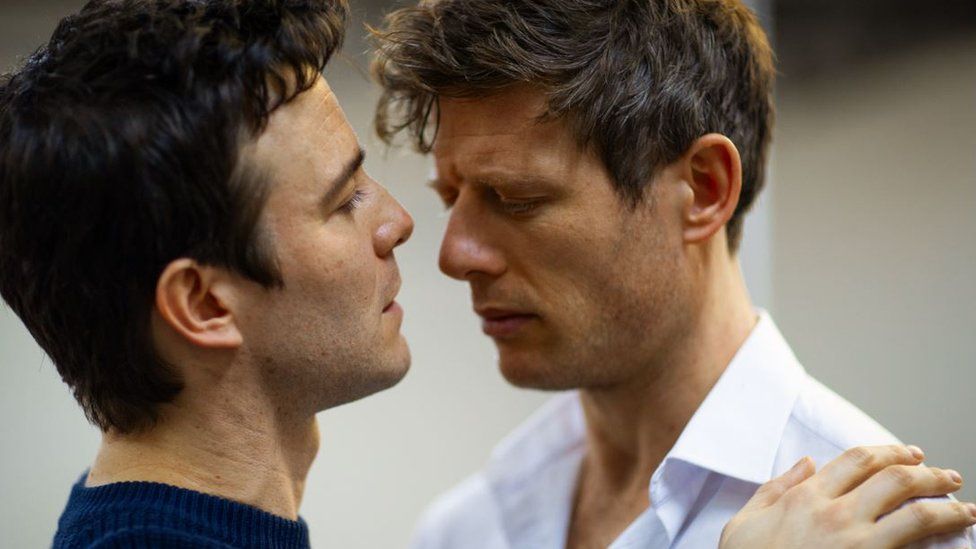
Of course it’s not an easy evening and the adaptation is not ideal. It has a truncated and fractured narrative, too transfixed on some detail and skimpy with other plot turns and characters. Some will find its negativity indulgent and persistent. I felt that the self-harm, the razors and the blood may be too much for the squeamish. The careful mopping-up of the stage becomes part of the slow decent into the horrors of Jude’s tortured life. It is epically grim. However, and this is a big however, there is James Norton leading an heroic cast and Ivo von Hove ensuring the prolonged degradation never tips over into black humour.
There’s much work for the Intimacy Director in numerous scenes with James Norton, naked and being violently abused, comatose in hospital, or lovingly coaxed into intimacy. His performance makes us care, breaks our hearts; we can even overlook the overload of disaster and coincidence which directs Jude’s life and extends the play. All that is counterbalanced by the kindness and friendship of some peripheral characters and the support of Jude’s friends – one becomes his patiently affectionate lover.
Does it all end well? Is there a cathartic redemption? Of course I’m not saying, but there’s a long silence before the cheers and well-deserved standing ovation. Cast and audience alike have suffered and survived 3hours 45minutes together, in a packed to the rafters theatre, witnessing a side of human perversion we might prefer to be left unseen. After this unforgettable journey, the destination is a relief and a release.
I wonder if any newspaper critic will protest at the exposure of such ‘filth and degradation’ on a London stage. I certainly won’t.
My rating: ★★★½ / Group appeal: ★★★
But those enthusiastic about the book may rate it more highly.
11/03/23 Mike writes –
Women, Beware the Devil
By Lulu Raczka, at the Almeida Theatre
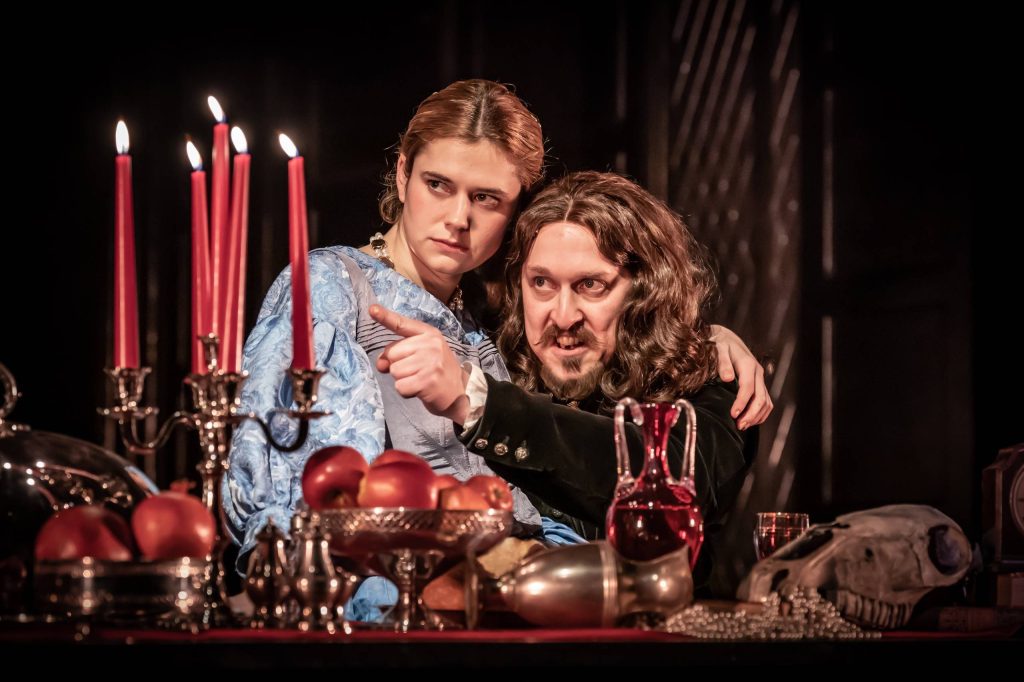
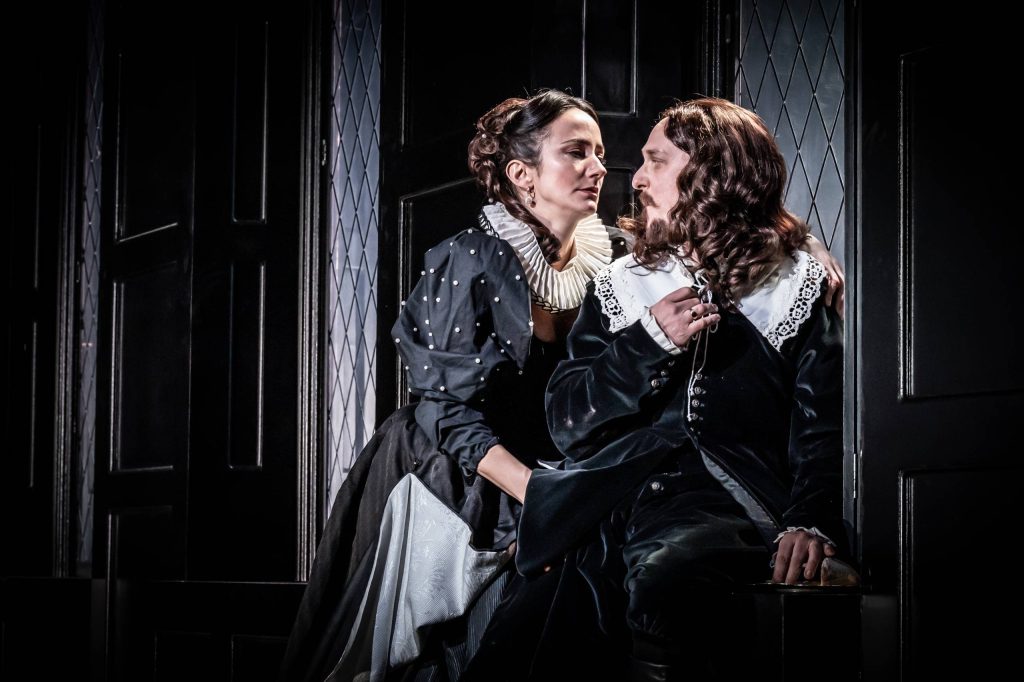
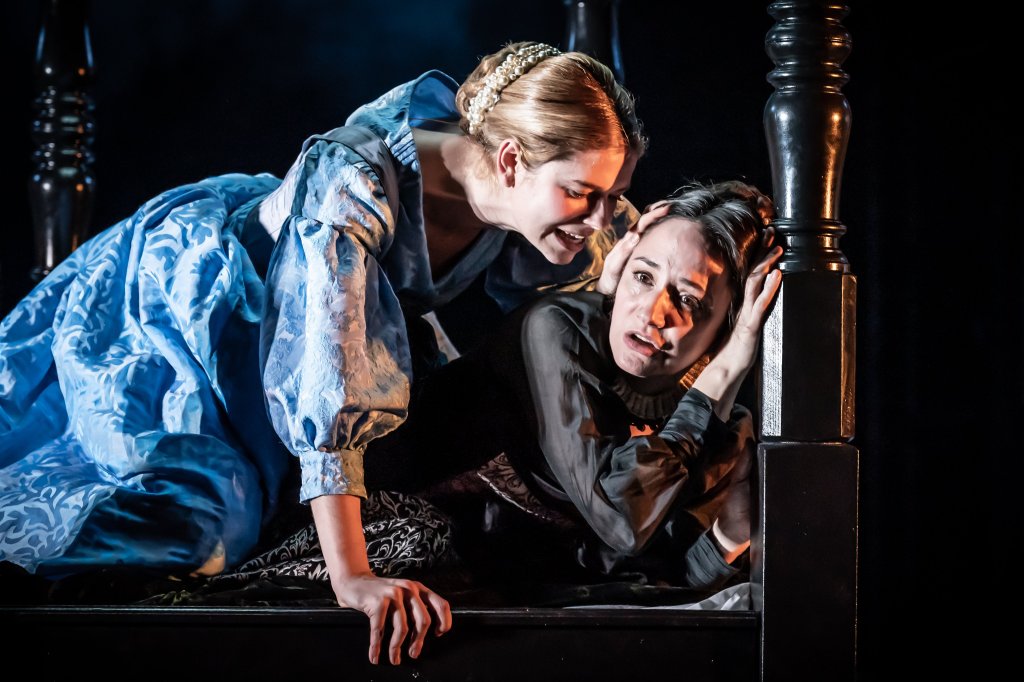
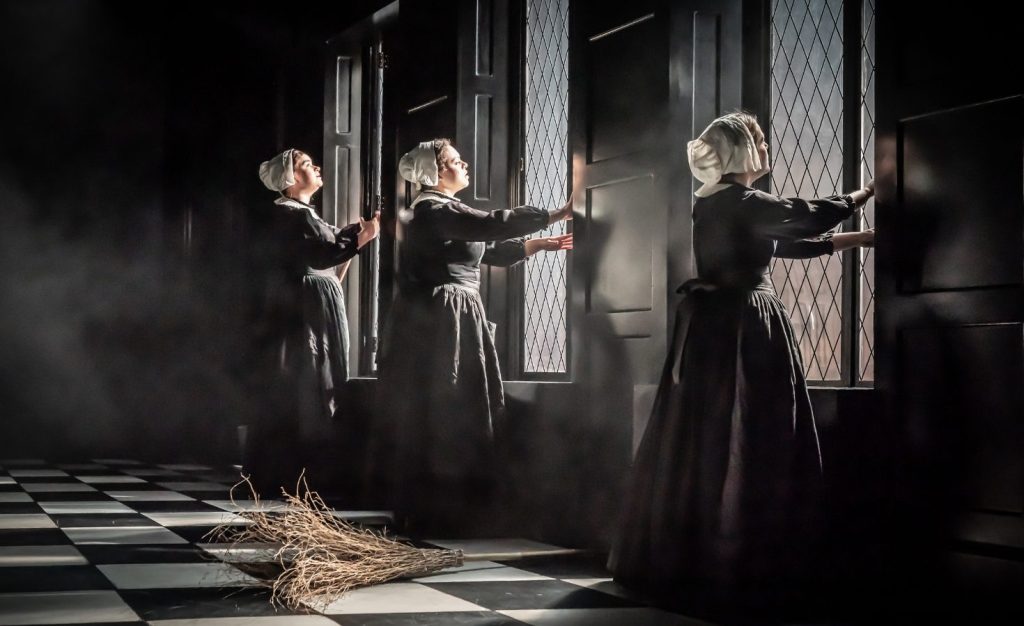
The Devil works in mysterious ways. He opens the play with a sardonic smile to the audience, introduces himself with some well chosen examples of his work today, then turns the clock back to 1640 with witchcraft in the air and a necessary task to achieve.
An Englishman’s home is his ……inheritance, and his prestige too. Without an heir, his ancestral home could pass into the wrong hands; his legacy could be lost forever and the family name forgotten. When an heir Is not apparent, the important task of providing one needs urgent, even desperate, attention. Where to turn? Who to turn to? The answer here is the Devil himself.
Lady Elizabeth wants to see her brother’s wife with child heir, but Edward prefers to romp with chambermaids or accept a helping hand from his own sister, rather than bed his wife Katherine. Elizabeth decides to appoint Agnes, with her witchcraft knowledge and covert aspirations, as Katherine’s maid, to bring the devil’s doings to the bedchamber.
Some critics have been less than kind to this play but Rupert Goold, the Almeida’s artistic director, had faith in it, directs it himself, and has provided an elegant and atmospheric production. There are candles and shadows, corridors with hidden doorways, shuttered windows, an over-laden table to feast upon, and a four-poster bed (rather too small for much cavorting) rising through the checkerboard floor for bedtime gropings.
Falling somewhere between a tragedy and a sex farce, the plot has potions and poisons, intrigue, blackmail, swapped identity and some bloody mayhem thrown in. If it misses the mark as a feminist treatise in gothic style, it still entertains enough to please a young audience and those of us who especially appreciate the visual Old Masterpiece approach.
Lydia Leonard is forceful as Elizabeth, and Alison Oliver’s maid Agnes manages her transformation from cowering servant to commanding madam with ease. Leo Bill uses his best endeavours with an OTT caricature of entitlement (Fredo noticed some Boris Johnson in him) and the Devil played by Nathan Armarkwei-Laryea is as persuasive as the Devil usually is.
We enjoyed it a lot more than some critics suggested (★ from the Times) and congratulate the young playwright Lulu Raczka on her originality and lively script.
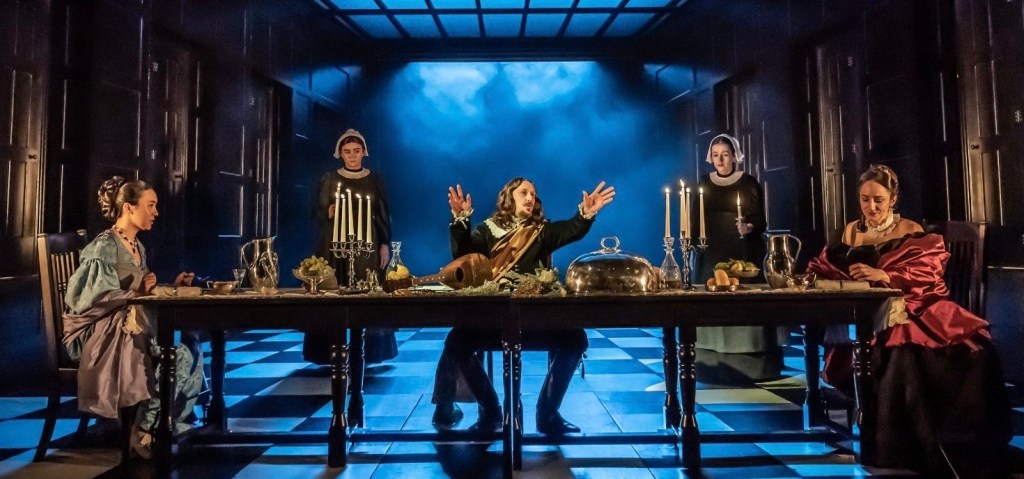
Our rating: ★★★½
Group appeal: ★★★
08/03/23 Fredo writes –
Standing at the Sky’s Edge
Music & Lyrics by Richard Hawley, Book by Chris Bush, at the National: Olivier Theatre
When you come out of Sheffield station, look over your shoulder and you’ll be astonished to see the huge Park Hill Estate on the hill overlooking the city. This brutalist structure was part of the housing programme of the late 50s, based on the designs and social theories of the architect Le Corbusier. It’s the largest Grade ll listed building in the country.
It doesn’t sound like promising material for the setting of a musical, but Standing at the Sky’s Edge is a triumph. Yes, the estate is the centre piece of every scene, recreated inside and outside on the Olivier stage, but we’re reminded that a home is not just a box to keep the rain out; it consists of what you put into it.
And writer Chris Bush introduces us to three sets of residents at different stages of Park Hill’s history, tracing their hopes, ambitions and disappointments over the 60 year history of the estate. Newly-weds Rose and Harry enter this utopia with its running water and waste-disposal unit with dreams of their future. They see that future darken, as the building deteriorates through damp and mould and rats in the wall. An immigrant family from Liberia arrive as refugees, determined to integrate but fearful of unlocking their doors. Finally, the estate is emptied and refurbished, and another refugee arrives – but this time it’s a yuppie from London, fleeing a broken relationship and trying to build a new life in her comfortable split-level duplex.
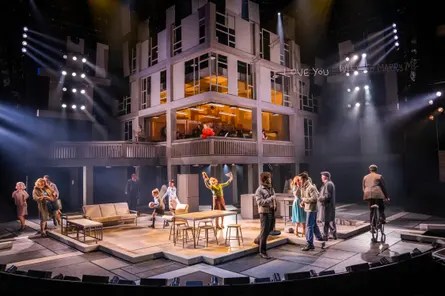
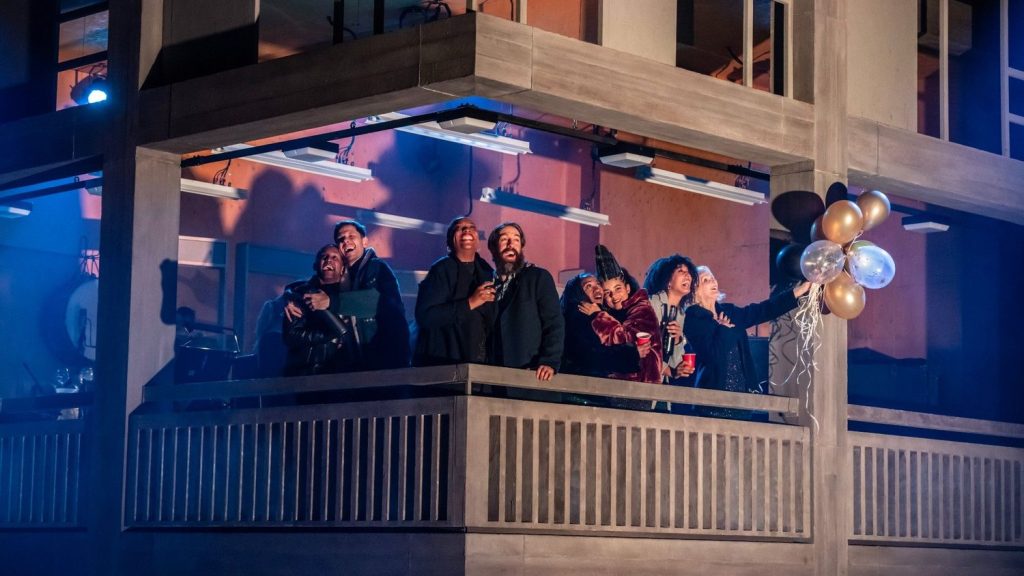
It takes a moment to adjust to the interleaving of the stories and intermingling of characters, but director Robert Hastie clearly signals the period and the concerns of the characters as the action moves forward through three momentous general elections, the miners’ strike, racism and urban renewal. There’s a brief loss of focus in a New Year’s Eve party scene, but it’s quickly back on track by the time midnight strikes. It’s a hymn to the community of Sheffield, but not an uncritical one.
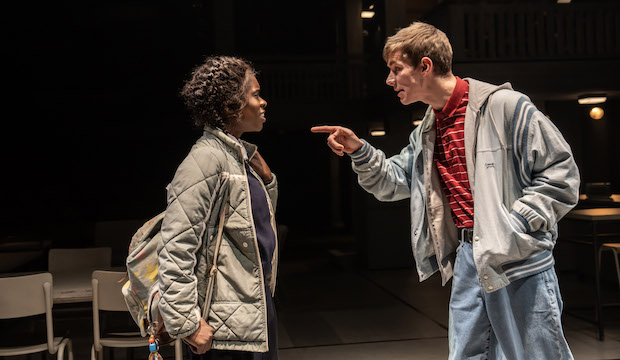
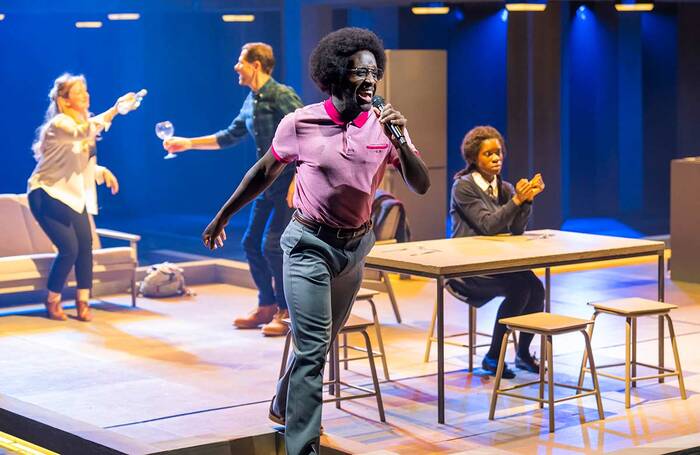
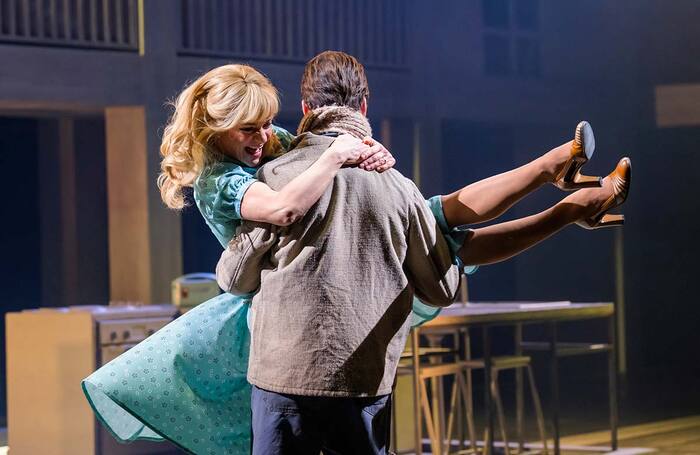
The stories are linked tenuously by two characters, but this isn’t laboured, and might easily be overlooked. The script bristles with comic lines, particularly at the expense of the yuppie Poppy’s parents, who think their daughter has emigrated to some forlorn northern outpost. But its warm heart is in the right place: Sheffield and home. Even the local nectar, Henderson’s relish, gets a name-check.
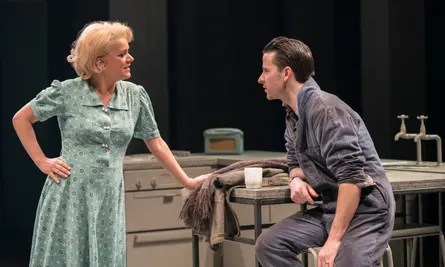
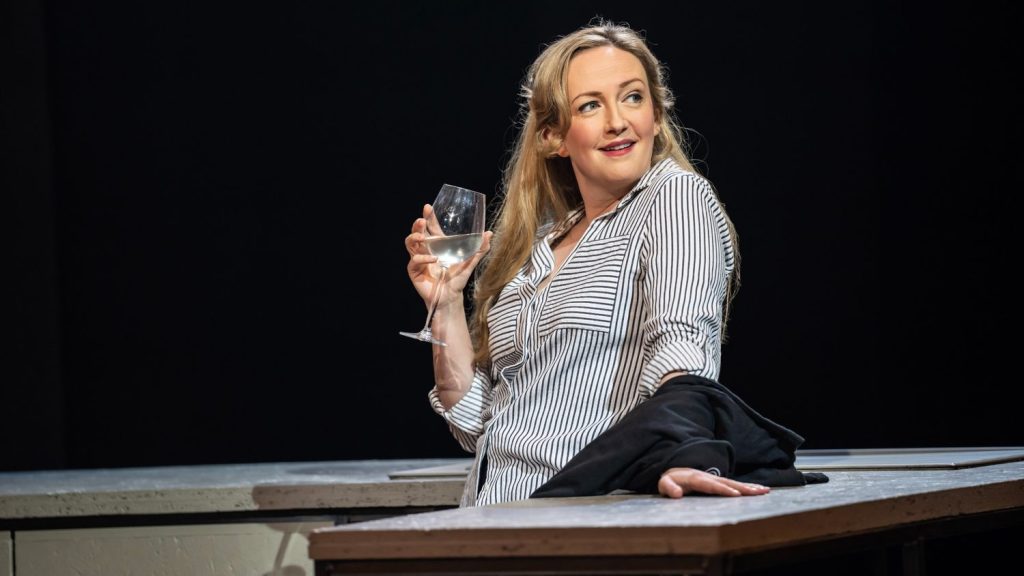
The show has transferred from the Crucible Theatre in Sheffield, and it’s strongly cast and powerfully sung, particularly by Alex Young, Rachel Wooding, Faith Omole and David McKechnie. There’s minimal dancing but the songs are sometimes highly emotional or softly lyrical and are often performed concert style direct to the audience. Two of our friends found some of the lyrics turgid and repetitive, but I can’t agree. The songs by Richard Hawley (formerly of Pulp, and with collaborations with Arctic Monkeys, Elbow and Paul Weller) seemed strong and appropriate to me. Open Up Your Door, both a plea and a song of love, could become a classic – it embraces your heart. Both the narrative structure and the placing of the songs reminded me of Conor MacPherson’s use of Bob Dylan’s songs in Girl from the North Country – high praise indeed from me.
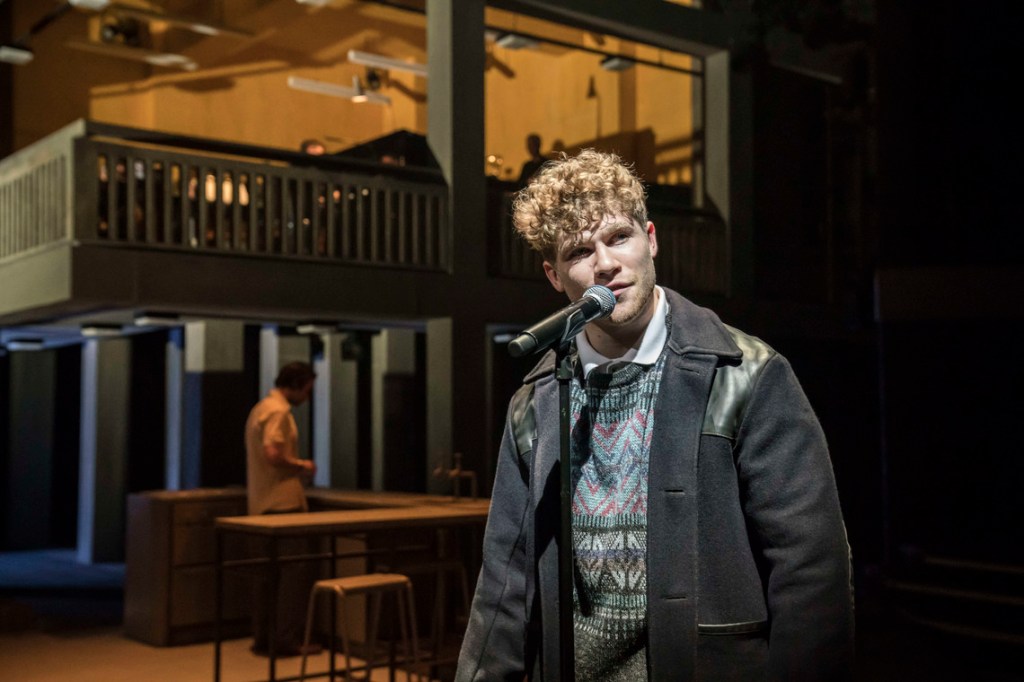
Our friend Jan reports that at the end of the performance she attended, she had to distribute Kleenex to her husband and her surrounding neighbours. I only wish that she had been sitting near me, as I had to search my pockets for my handkerchief to brush away the tears.
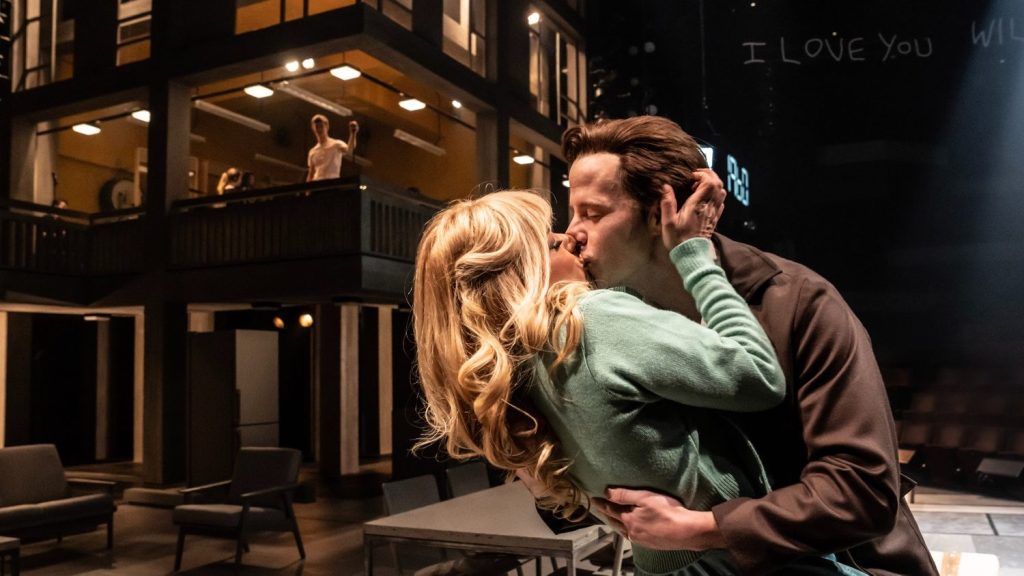
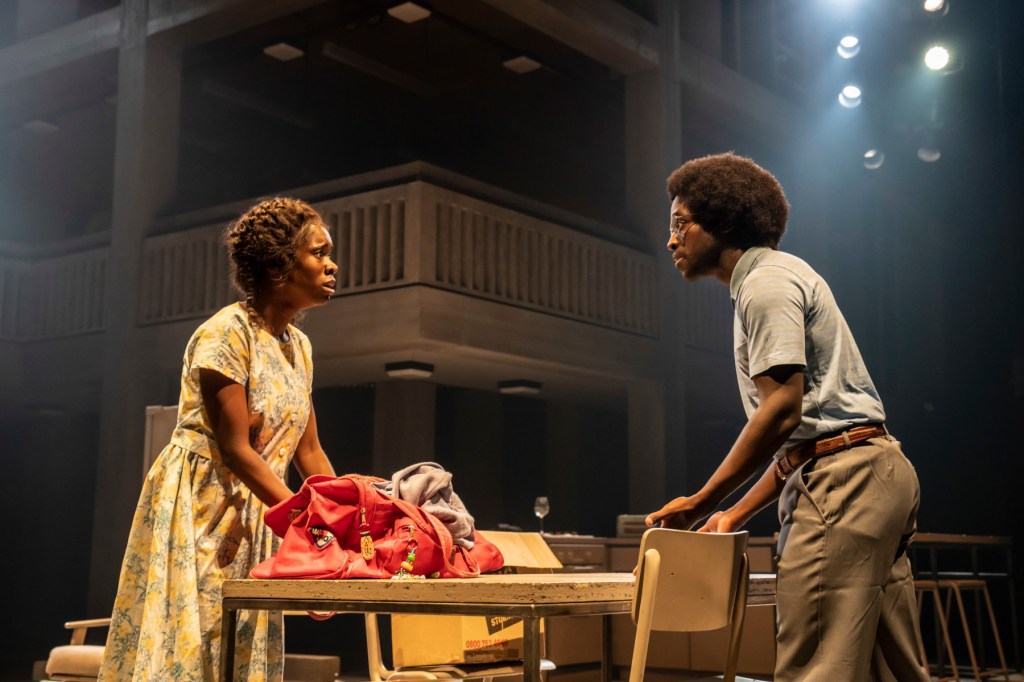
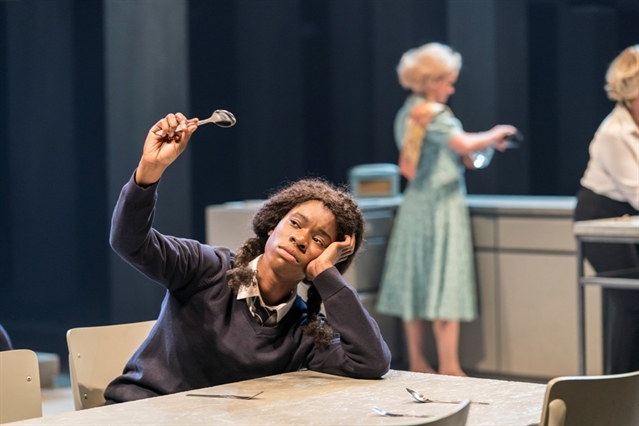
As an unapologetic lover of musicals, I’ve been embarrassed for some years in being unable to defend recent products. I’ve sat through quite a few that I never want to see again, and found difficult to enjoy once. Could things be looking up? The last six months have given us The Band’s Visit , Sylvia and now Standing at the Sky’s Edge. Are we standing on the edge of a new golden era? I live in hope.
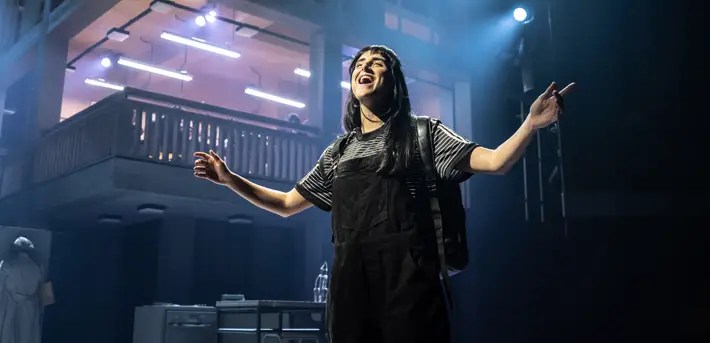
Maimuna Memon sings Open Up Your Door
Video LINK (Skip the ad on the video)
Richard Hawley, the composer, sings
Open Up Your Door.
Video LINK (Skip the ad on the video)
My rating: ★★★★★ / Group appeal: ★★★★
16/02/23 Mike writes –
The Rhinegold
The opera by Richard Wagner, directed by Richard Jones,
at the London Coliseum

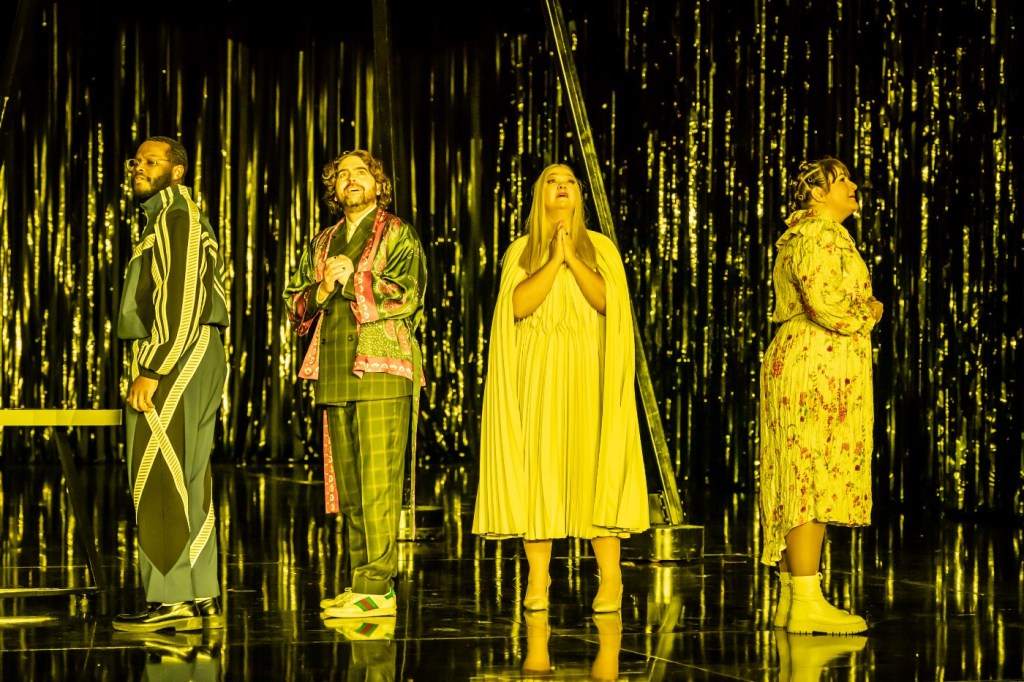
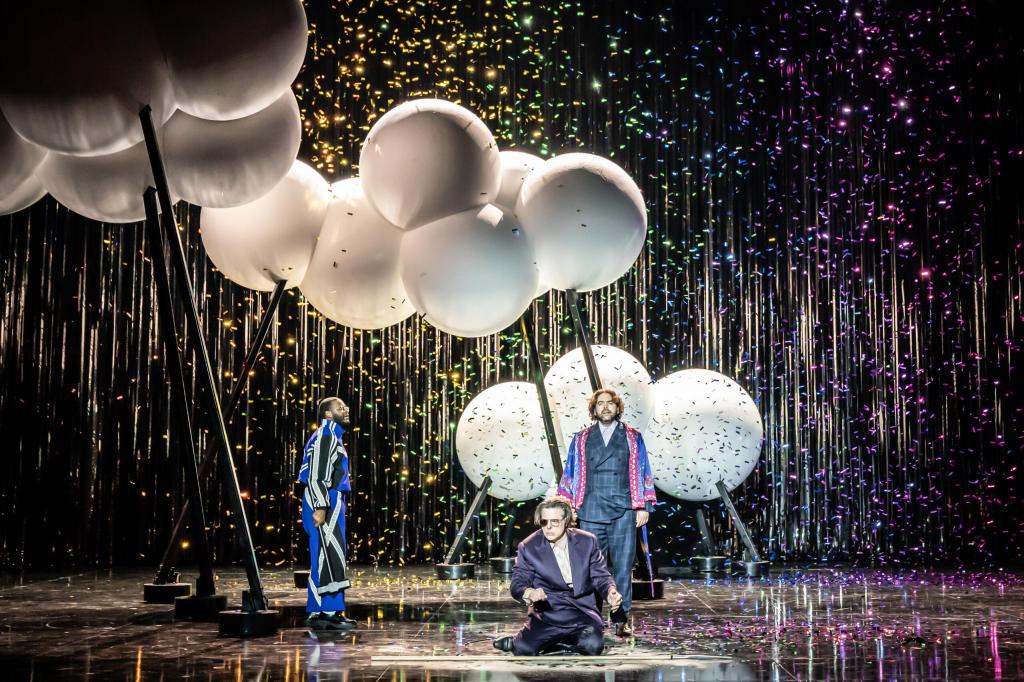
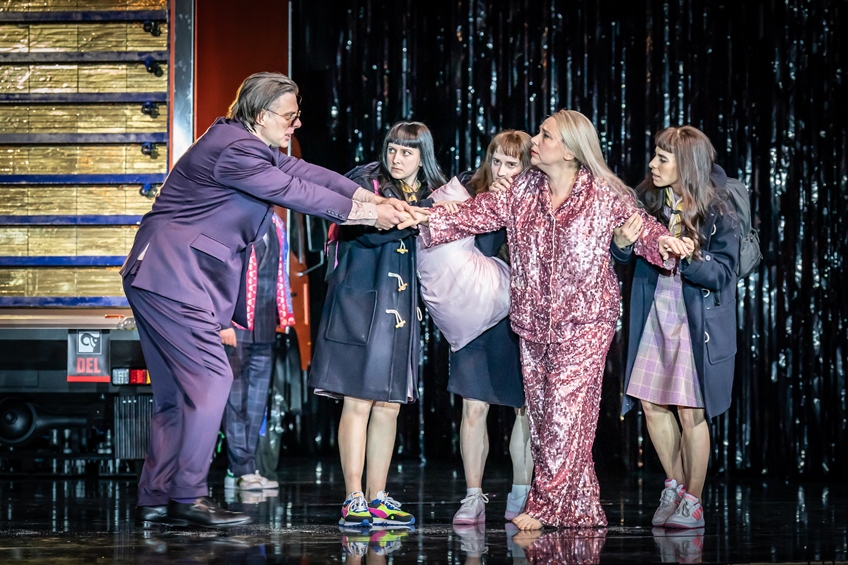
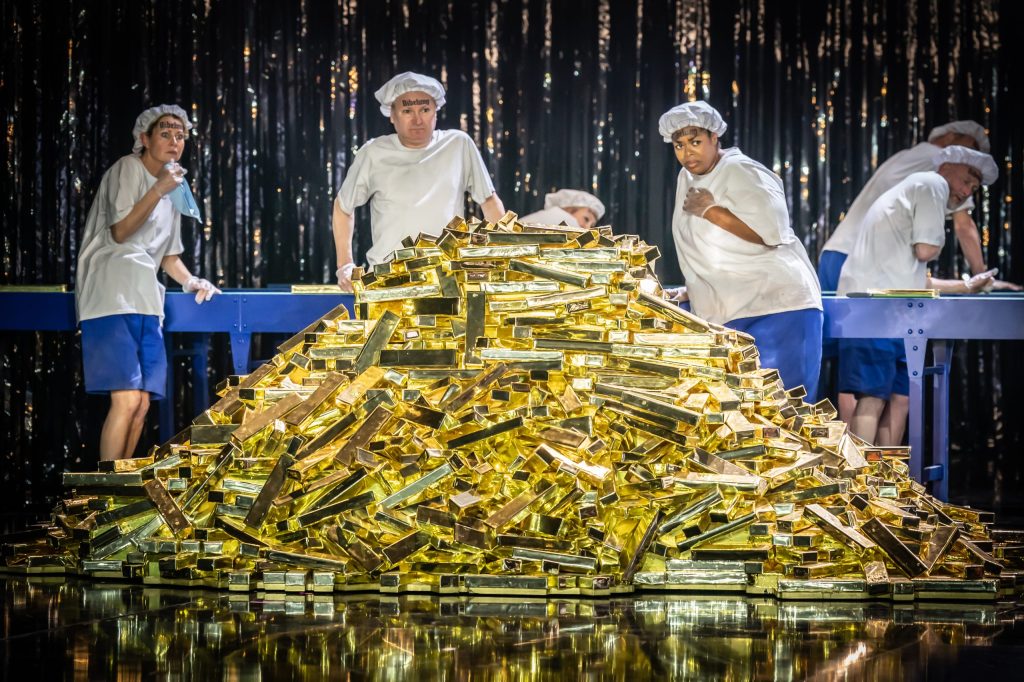
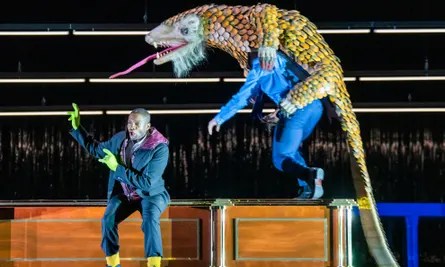
That lizard – don’t ask!
I was at the dress rehearsal of this new production (so a big Thank You to our friend Meryl for offering me the ticket). Critics, with Wagner flowing through their veins, have written in glowing terms of the Press Night performance, interpreting every aspect of the production in different ways. Perhaps I should say ‘in forgiving ways’, as the benefit of doubt has crept in to praise quirky representations and forgive very dubious choices. They say “Witty and delightful; so damn good; a cheap delight; armed with more glitter than a drag convention”. Hmmmm….
For me the epic nature of the piece (I shall not even try to tell the tale or explain the mythology) has been reduced and grounded by designs both comical and ugly. The costumes (oh, the horror of those costumes!) are mainly hideous sixties frocks, worker’s dungarees or lycra sportswear, with a few cheap suits for the leading men. The stage is surrounded by glitter curtains, with oversized atom-model globes on poles, or crates and piles of (very light!) gold blocks. The proceedings begin with a naked man (in body-stocking) dragging a tree across the stage, which encouraged some titters from the audience. This is surely not what Wagnerites have come to see.
Just close your eyes and listen. You will miss the surtitles (which I did anyway because of poor eyesight) but the huge sound from orchestra, chorus and principals is magnificent. The critics were full of praise and, with my eyes closed, I can agree.
It’s a long heavyweight slog with moments of frivolity and occasional effective staging, but I’m tempted to think the cast and chorus were allowed to improvise their acting requirements as long as they sang the right notes. They scurry about then regroup on cue.
After two and three-quarter uninterrupted hours, it does all come together with an effective storm of rainbow-coloured confetti. ‘Son et lumiere’ did the trick in the end – cheers, thanks, bows, big job done.
For my own pleasure – ★★★
For Wagnerites – possibly ★★★★★
15/02/23 Fredo writes –
Phaedra
by Simon Stone, at the National: Lyttelton Theatre
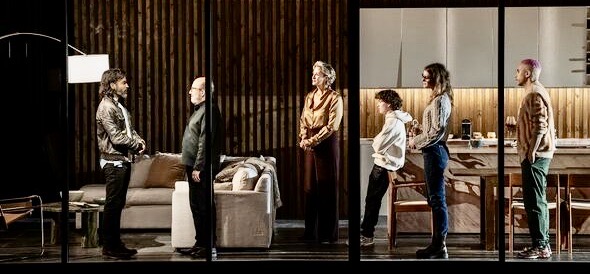
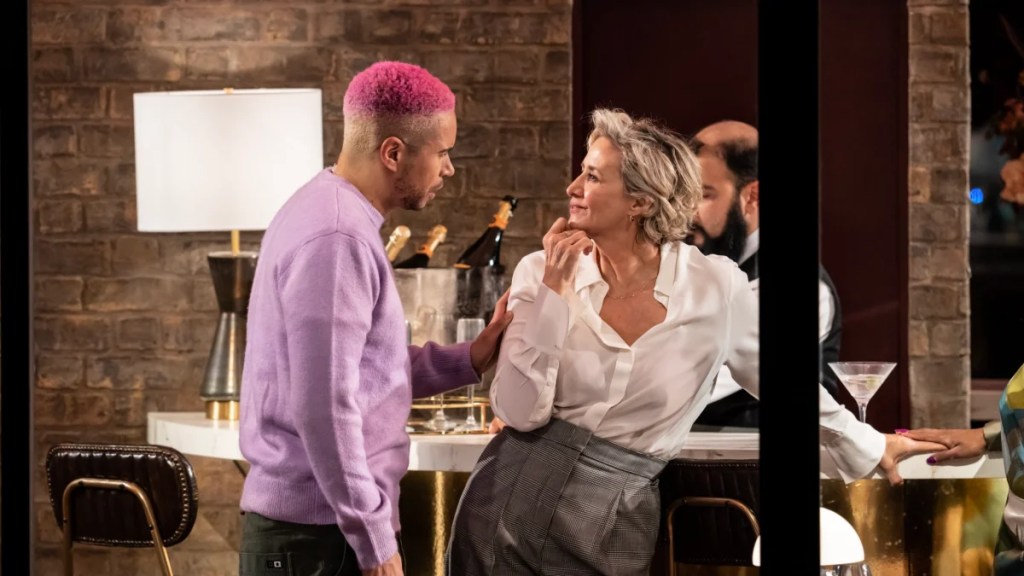
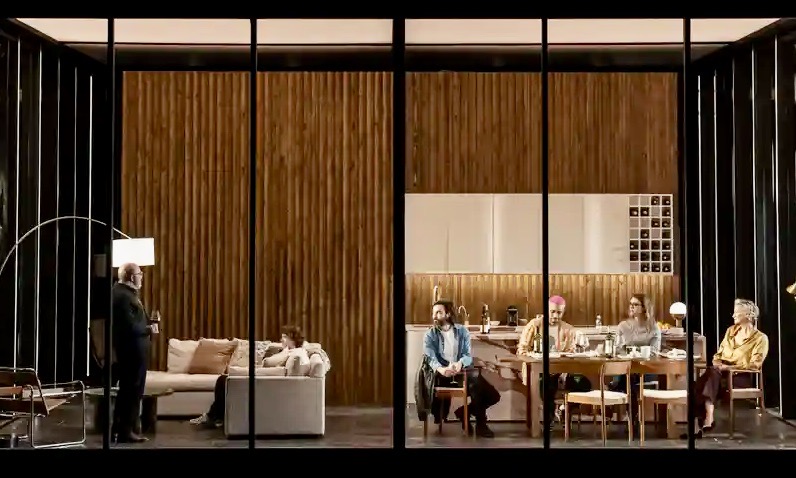
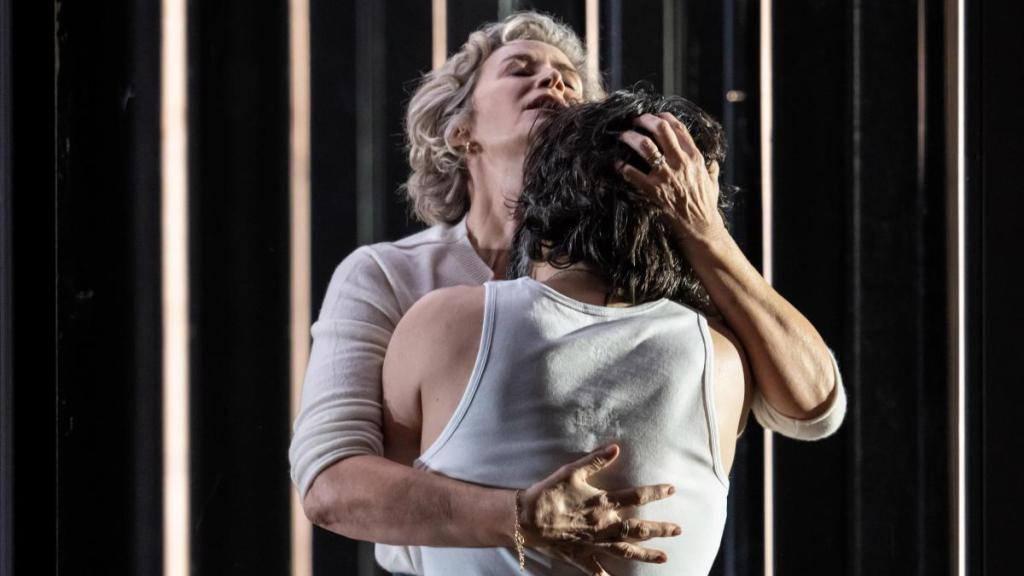
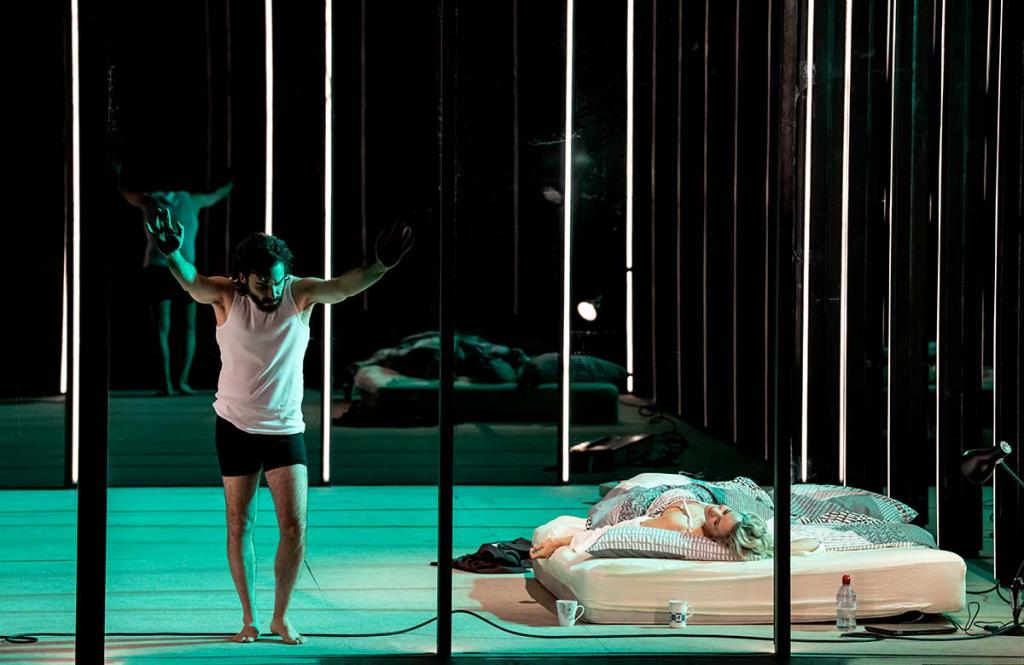
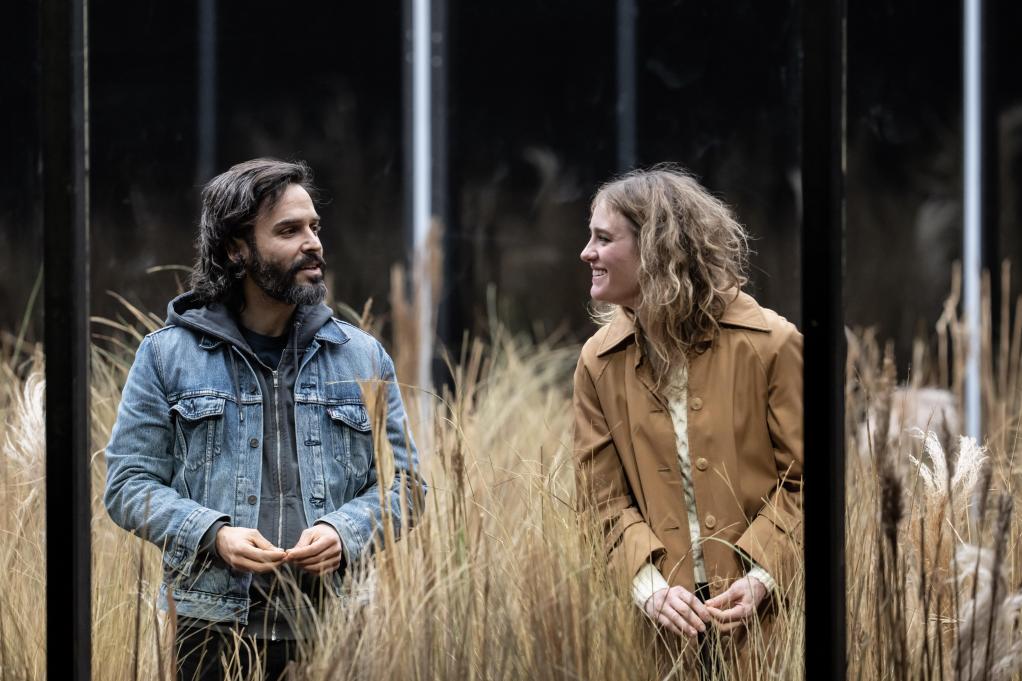
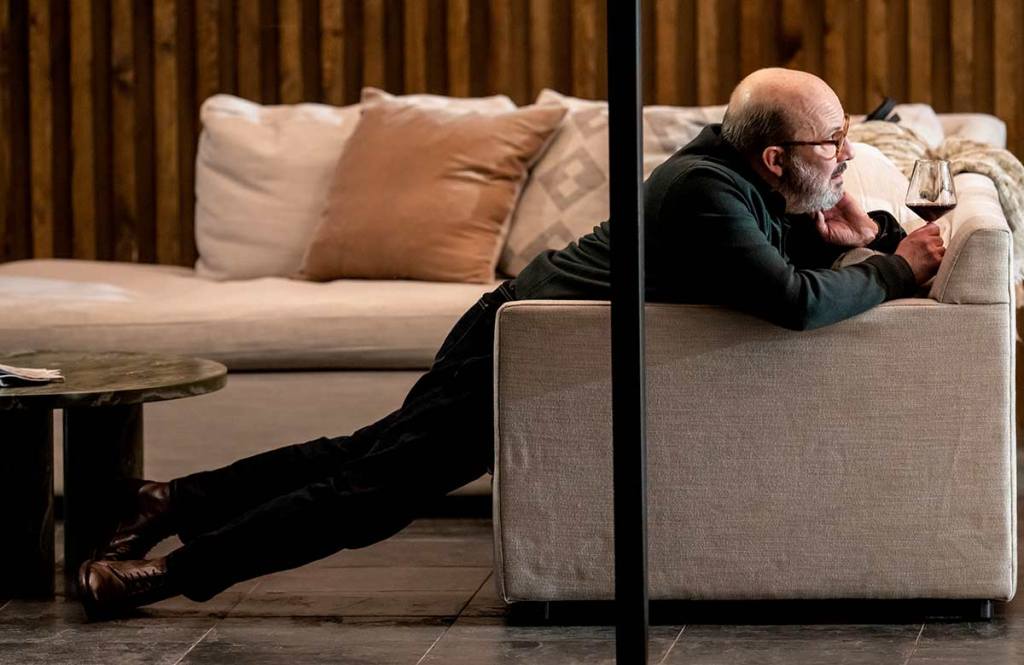
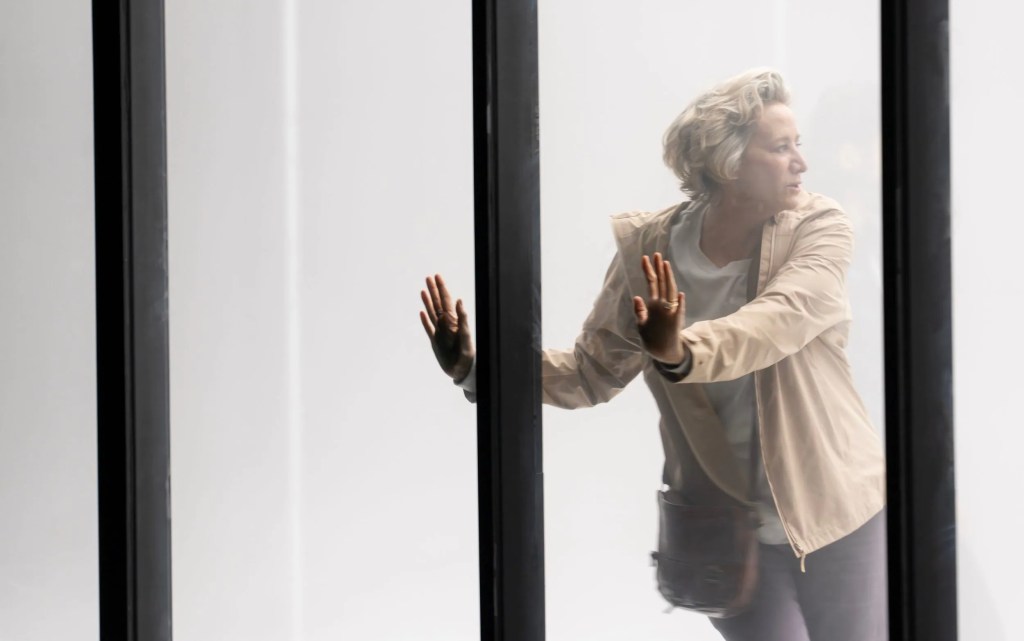
Our rating: ★★★★
Group appeal: ★★★
It’s a cosy domestic breakfast scene in affluent Holland Park; mother Helen (Janet McTeer) affectionately scolds her son and daughter Isolde (Mackenzie Davis) who bridles at the affection shown to her husband Eric by her mother. Father Hugo (Paul Chahidi) comes home with the shopping as they prepare to greet a guest from the past.
And then the tensions that have rippled on the surface of the badinage become more turbulent. We learn that the guest is Soufiane, the Moroccan son of Helen’s former lover who died.
Suddenly the set makes sense. It’s a glass box, with vertical bars hiding strip-lights. The family are caged in, and their secrets and desires are going to be scrutinised and exposed, dissected behind the glass.
When Soufiane (Assaad Bouab) arrives, the strain beneath the friendly ambience emerges as Soufiane’s long-harboured resentments explode. The glass box starts to revolve, as Helen and her comfortable world are spun into disarray.
Simon Stone’s play is billed as “after Euripides, Seneca and Racine” and it’s quite a long way after those classic texts. There’s humour in this heady mix too. It’s a chic contemporary setting and there are contemporary references to remind us that this story is timeless. Helen is an MP, Hugo’s parents fled Iran, Isolde and Eric are about to adopt a child as they can’t conceive. Their First World concerns are about to be upended by the primal passions that suddenly possess Helen, Soufiane and Isolde in the searing drama that follows.
I was possessed as well, by the escalating power of Janet McTeer’s vivid performance of a woman no longer in control of her actions. She’s reawakened to a new sexual longing by the memory of her former lover while losing her control in his son’s arms. It’s McTeer’s evening, and I never doubted her abandonment of self control. She has first rate support from Paul Chahidi as an initially supportive husband whose resentment grows, and from Mackenzie Davis as a younger woman seeking her own emotional and sexual fulfilment.
Much depends on Assaad Bouab as the object of their desires, and fortunately this actor (from the French Call My Agent, but a million miles from that comedy series) convinces the audience that he has emotional depths to satisfy the women beyond his physical attractiveness . As a company, the cast rise to the occasion: it has all the excesses of a Greek tragedy transposed to our time.
I was particularly engaged by Simon Stone’s direction. The action is punctuated by blackouts and throbbing music which enhance the tension; the stage revolves at moments of turmoil, and in one scene, the actors are lost in tall grass, almost obscured as they struggle to find their way to identify and express their feelings. The domestic scene that opens the play is almost parodied at the start of the second act, at a birthday dinner in an ultra smart restaurant where damaging secrets are exposed. I enjoyed too the way Stone has fun with the passive role of the confidante in Greek and French tragedy, where the character is almost characterless, just there to listen to the anxieties of whosever name is in the title. Here Omolara (Akıya Henry) wittily overturns this, by rounding on Helen with bold criticisms and “You don’t know anything about me, do you?”
It’s not a production that pleases everyone. The first act of the matinee was marked by several members of the audience absconding, and our two friends didn’t join in the raptures that Mike and I expressed. Fortunately, our neighbours in the front stalls were equally enthralled. I admit, the blackouts were perhaps too frequent, and some of them too long, and a crucial scene near the end that is performed in French and Arabic was poorly subtitled. The set was perhaps over furnished at times (why have a bath in the bedroom if no-one is going to have a scrub-down?). But I’m happy to forgive these blemishes because it’s a work of imagination and power, performed with commitment. Some may resist its traits and choices but I was more than satisfied.
11/02/23 Mike writes –
Sylvia
Book, Lyrics and Choreography by Kate Prince, Music by Josh Cohen & DJ Walde, at the Old Vic Theatre
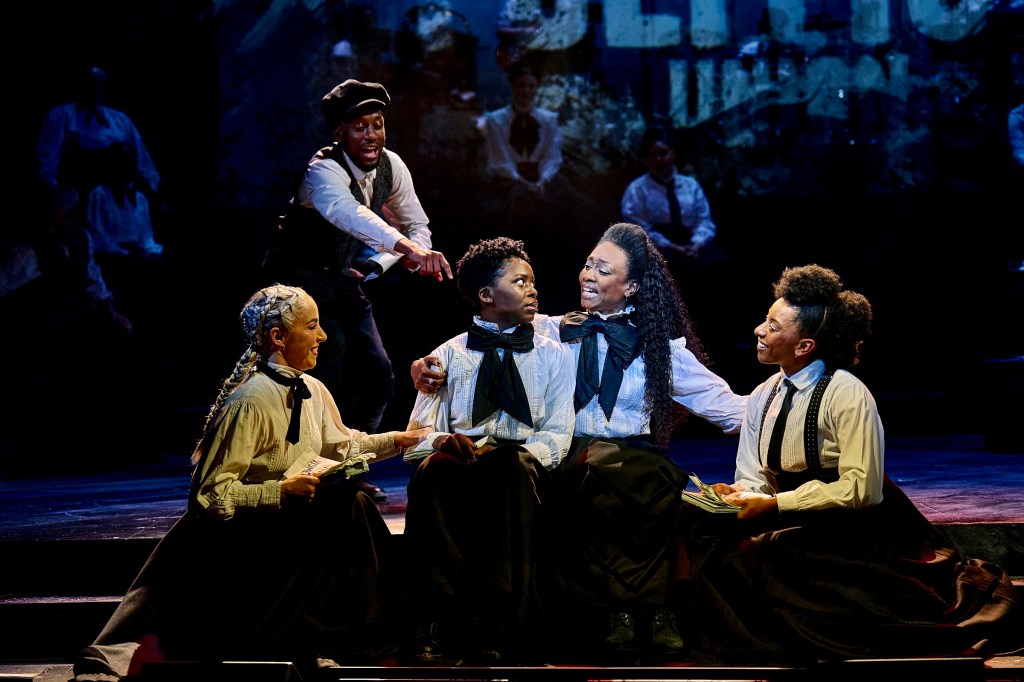
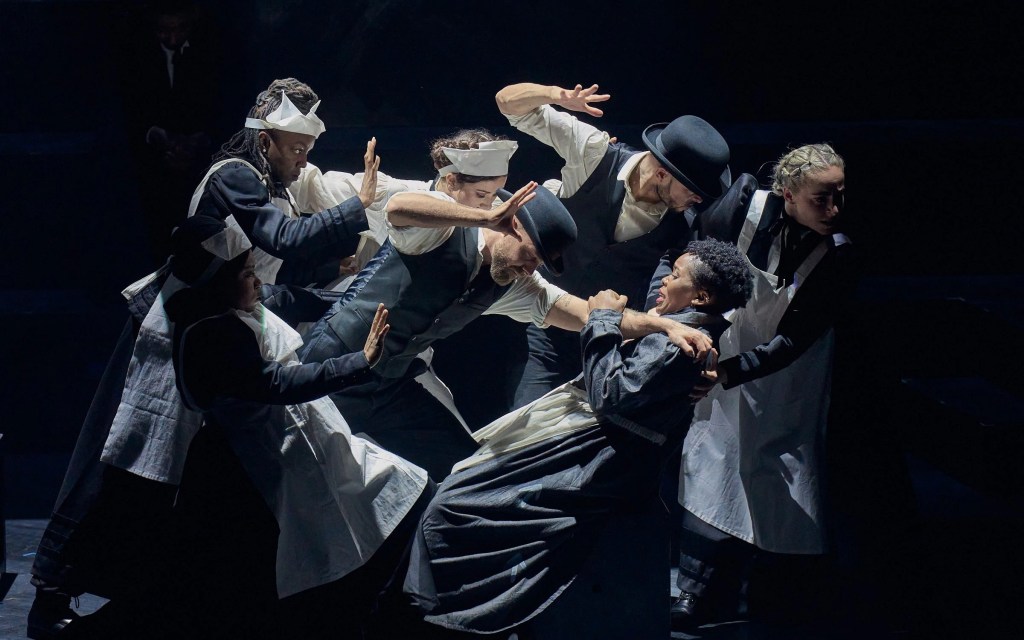

Before –
I approached Sylvia with misgivings. I knew it was a hip-hop/funk musical which had had problems on its first outing pre-lockdown. Back then there had been cast illnesses which had reduced rehearsal time. It had opened at the Old Vic in 2018 described as a ‘work-in-progress’ and received poor reports and poor attendances. To cap that, the run was curtailed when all theatres were forced to close. But the production team were undeterred, determined to continue working on the show towards a better relaunch.
As well as these problems, prospective audiences were not enthused by Suffragettes being portrayed by a reportedly black cast. It’s about the white middle-class Pankhurst family and their campaign for Votes for Women early last century – a hip-hop song’n’dance show seemed a strange and inappropriate amalgam of ideas and style.
I am not enthusiastic about colourblind casting myself, especially when people of colour are given roles written as white, even familiar real-life white characters (eg. David Harewood in Best of Enemies), where a colour change can not only misrepresent that person but also ruin any sense of authenticity. I was not alone. A recent interview with Beverley Knight in the Times received on-line criticisms. One fan of Knight opposed the black-for-white casting and mean-spiritedly wished the show a short run – women’s suffrage was not a subject to be messed with by a black cast. Of course that fan had not seen Sylvia and did not want to. I did.
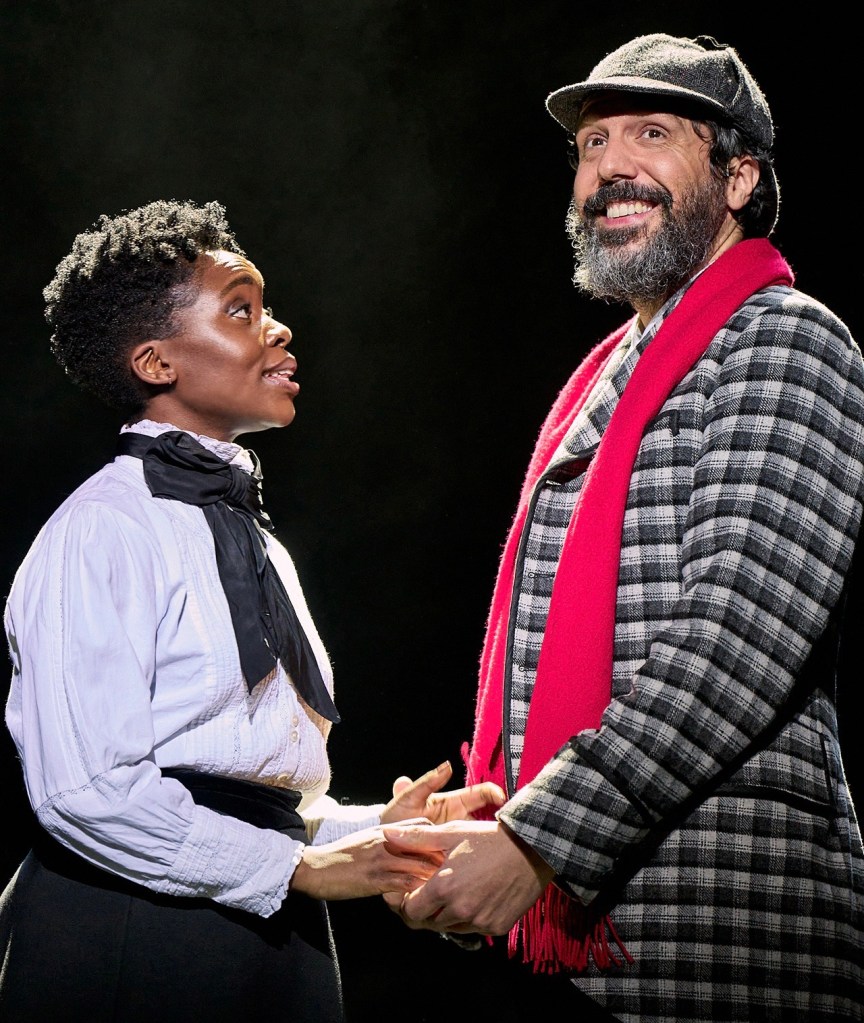
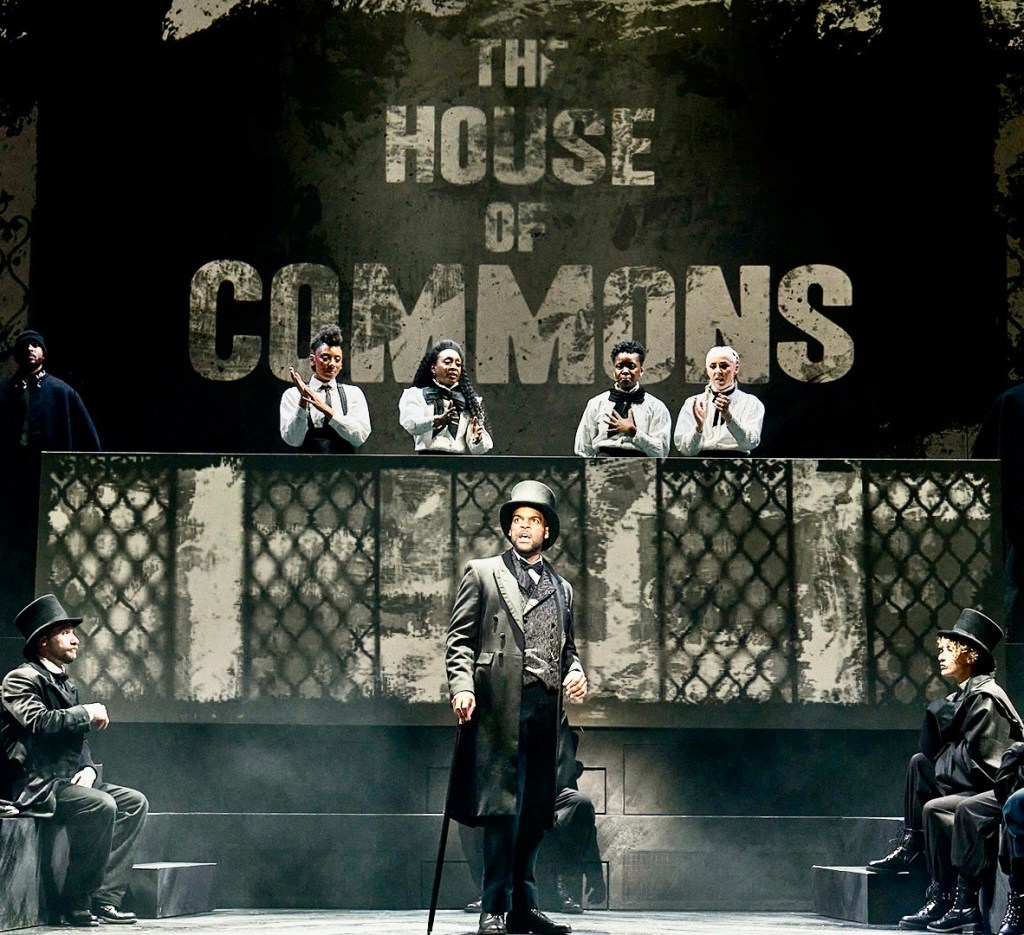
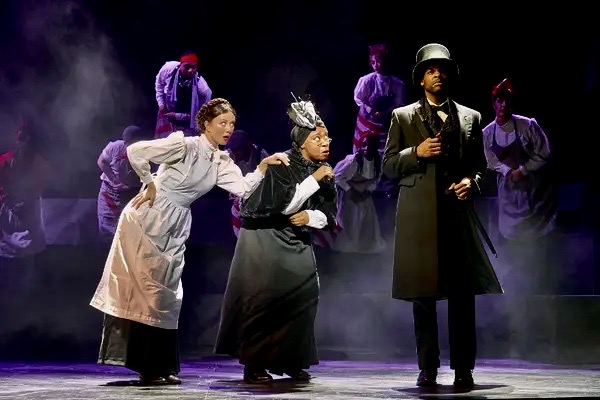
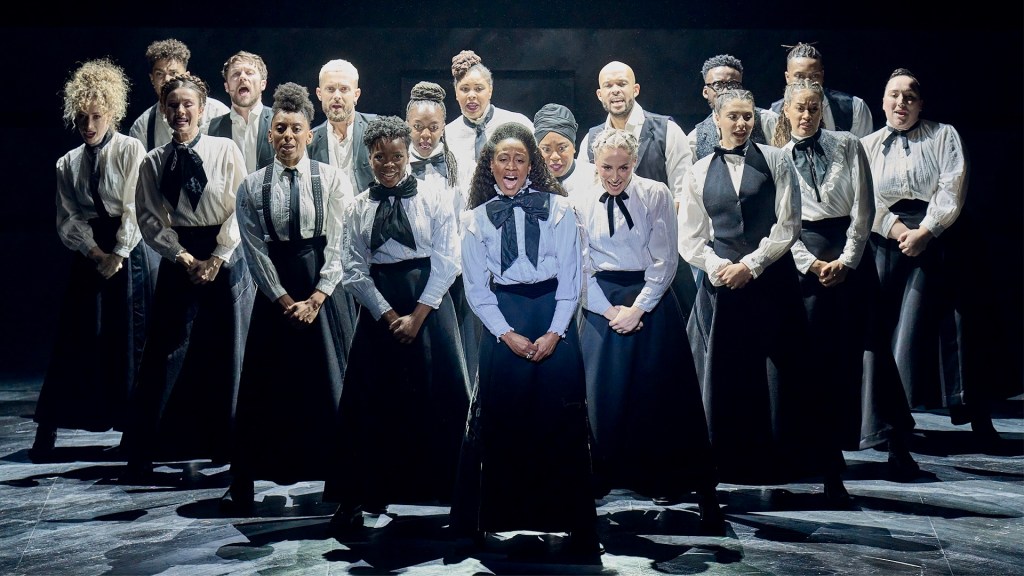
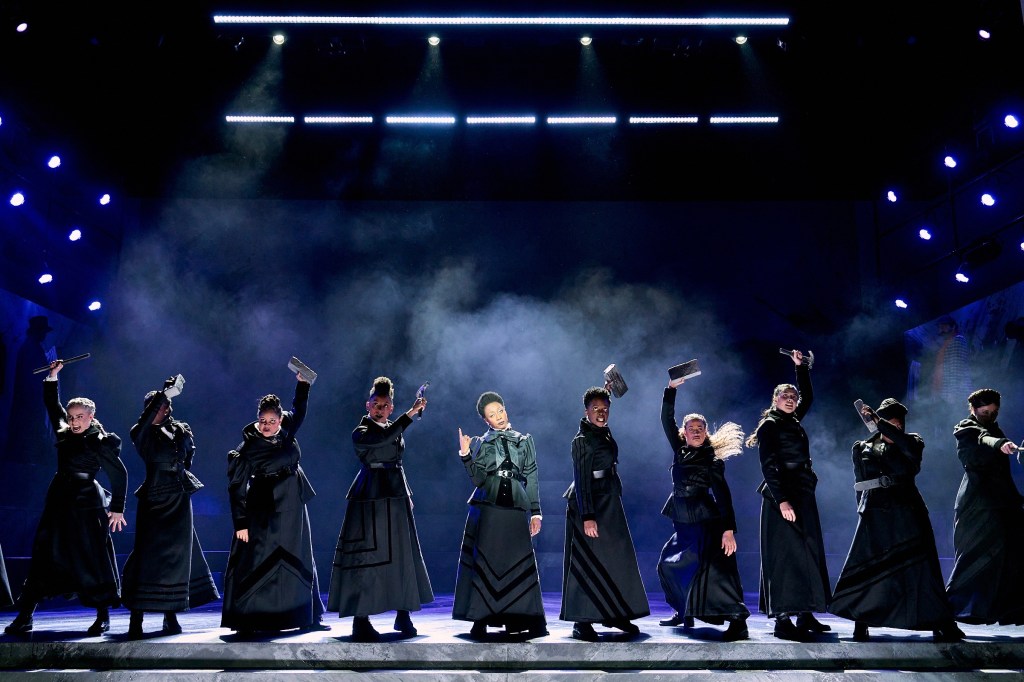
After –
Now I have seen the show myself and have had to rethink my previous misconceptions. It’s certainly a hip-hop/funk musical with all the energy, sound and dance which that suggests; it has a mixed black and white cast with the style and talent to showcase their historical tale of perseverance.
And it’s tremendous!
The Pankhurst family were as determined to succeed in their campaign as this production team were to make their show work. Pankhurst means politics, protest, prison, parades, passion…and even more passion still from not just the characters but the cast too. The show is sung-through and danced-through – it never stops and carries its audience with it all the way.
We begin in Manchester, come to London’s East End and to Parliament, sidestep to a death on Epsom racecourse, and Keir Hardie joins the Pankhursts in their political and sometimes literal battle with the Churchills and other worthies. Winston and mother Lucy were staunch opponents to the Pankhursts. It’s a family saga too with tragedy and fallouts along the way.
The songs tell the long running history of support and setbacks, with waves of historical detail on when and how to attack and defend (one song is called Suffrajitsu!) all against a background of helpful slogans and signs. It’s strikingly set and dressed (bustles and breeches, top hats and bows) in appropriate black and white, with flashes of red (always a significant colour, like Keir Hardie’s scarf).
It’s an adrenalin rush of a show, its rhyming words and soul music combining with excitingly choreographed movement to stir us to tears and cheers. Beverley Knight takes charge as mother Emmeline Pankhurst (Sylvia is a daughter) but the rest of the largely unknown cast form a well-drilled ensemble which stirs the emotions with the passion of dedicated activists.
This was a preview performance, well prepared for Press Night, with only a few brief uncertainties and loss of focus, including an ending not quite as expected – votes for ALL women without restrictions came a further ten years AFTER the Pankhursts campaign.
Of course this is about the Women’s Suffrage movement but the theme, casting and music-style stand in for any universal cause worth fighting for. The title Sylvia may not encourage the Sound of Music fans or even the sound of funk crowds, but let’s hope word of mouth from cheering audiences now will. After five years of setbacks and revisions, Sylvia has arrived, fighting fit, and ready for, I hope, a clutch of awards.
Our rating: ★★★★½
Group apppeal: Would the Pankhurst content overcome any hip-hop/funk/soul resistance? I hope it would.
Click on this LINK for previous OurReviews 2022
Click on this LINK for previous OurReviews 2021
Click on this LINK for previous OurReviews 2020
 theatreguys