OurReviews2025

Although we are a theatre-going group, we theatreguys often go to the theatre by ourselves or with friends. This is the page where we write about those theatre visits. The latest theatre visits are listed below with earlier years on other pages. ‘Our Rating’ is our opinion; the ‘Group Appeal’ star-rating is our recommendation for our general mixed group. Star ratings are not given in the SelectedPostings section.
Click here for OurReviews in earlier years – 2024 / 2023 / 2022 / 2021 / 2020

Please use the menu above to find your way around our website. You will find News in this section; details of current and future bookings in the Bookings section: earlier theatre visits on Previous Bookings pages; reviews of shows we see without the Group on Our Reviews pages; our Group’s comments on shows you see in Your Comments and Selected Postings sections; links to other useful websites in the Links section; and About Us is all about us.

READ reviews with pictures for 2025, by the theatreguys (OurReviews2025) and Group friends (SelectedPostings2025) by clicking on the titles below : Kenrex / Oh, Mary! / When We Are Married / The Playboy of the Western World / Fallen Angels / Merrily We Roll Along/ All My Sons / The Spy Who Came In From The Cold / La Clemenza di Tito / Partenope / The Assembled Parties / The Maids / The Line of Beauty / The Importance of Being Earnest/ Dead Man Walking /Othello / The Unbelievers / Mary Page Marlowe / The Weir / Water for Chocolate /The Code / Born with Teeth / Creditors / Entertaining Mr Sloane / Bacchae / La Cenerentola / The Lady from the Sea / The Land of the Living / Romans: a novel Stereophonic / Hercules / Till the Stars Come Down /Evita / A Midsummer Night’s Dream / Titanique A Moon for the Misbegotten Peaky Blinders / Evita / By Royal Appointment / Inter Alia The Estate Evita / Intimate Apparel / Mrs Warren’s Profession / Henry Goodman / This Bitter Earth / The Fifth Step / The Frogs / Fiddler on the Roof / The Deep Blue Sea / Just for One Day / Dealer’s Choice / House of Games / My Master Builder / Marie & Rosetta The Brightening Air Carlos Acosta Ballet Celebration / Here We Are/ How to Fight Loneliness / Manhunt / Ghosts / Unicorn Rhinoceros / Wake Alterations / Clueless / Much Ado About Nothing / Retrograde / Richard II Dear England / Liz Callaway  /Backstroke / Punch Oedipus / East is South / Mary, Queen of Scots The YearsFesten The Producers / The Little Foxes / Cat on a Hot Tin Roof / Natasha, Pierre and the Great Comet of 1812 Starlight Express / The Invention of Love / Kyoto Oliver! Matthew Bourne’s Swan Lake

26/12/25 Mike writes –

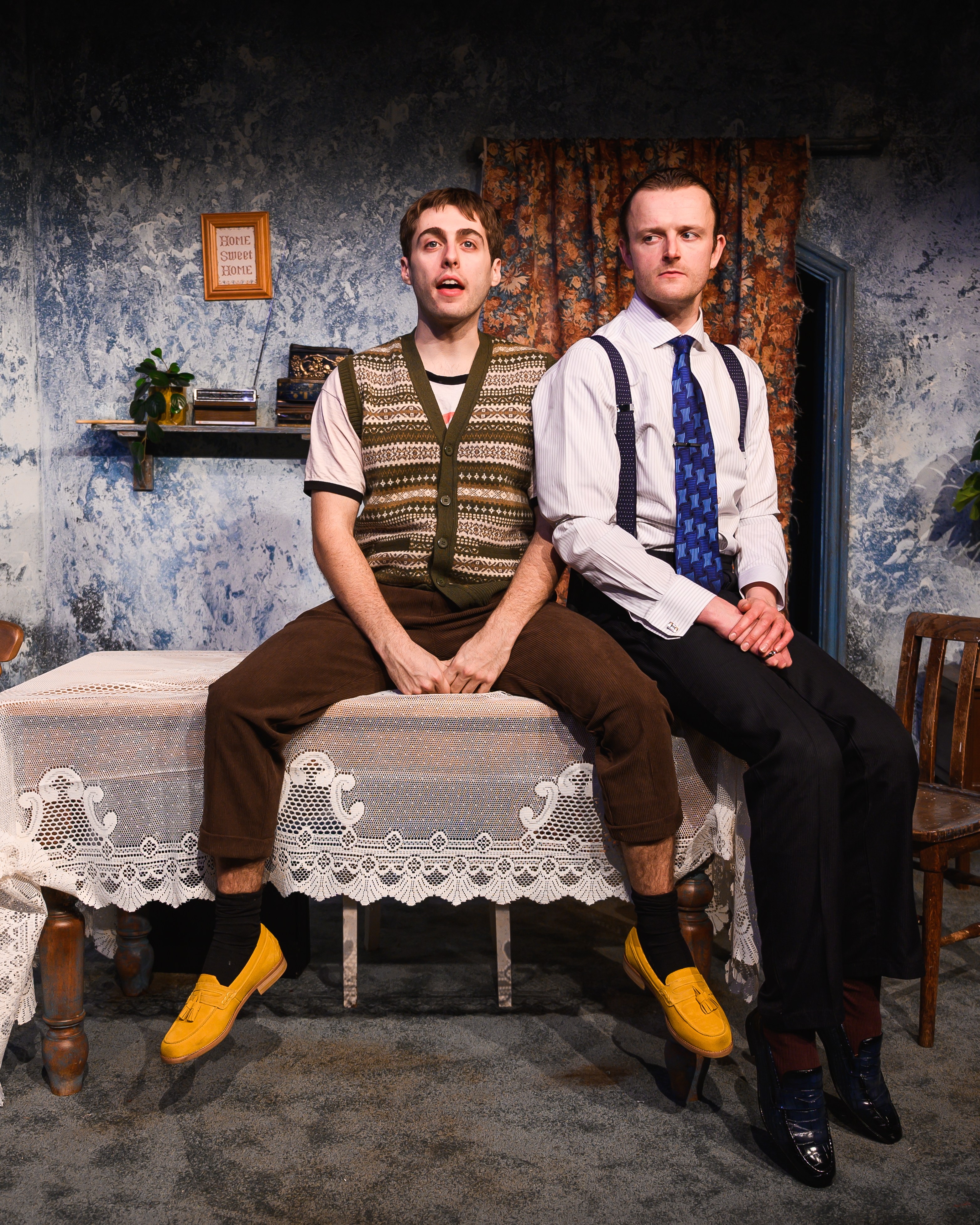
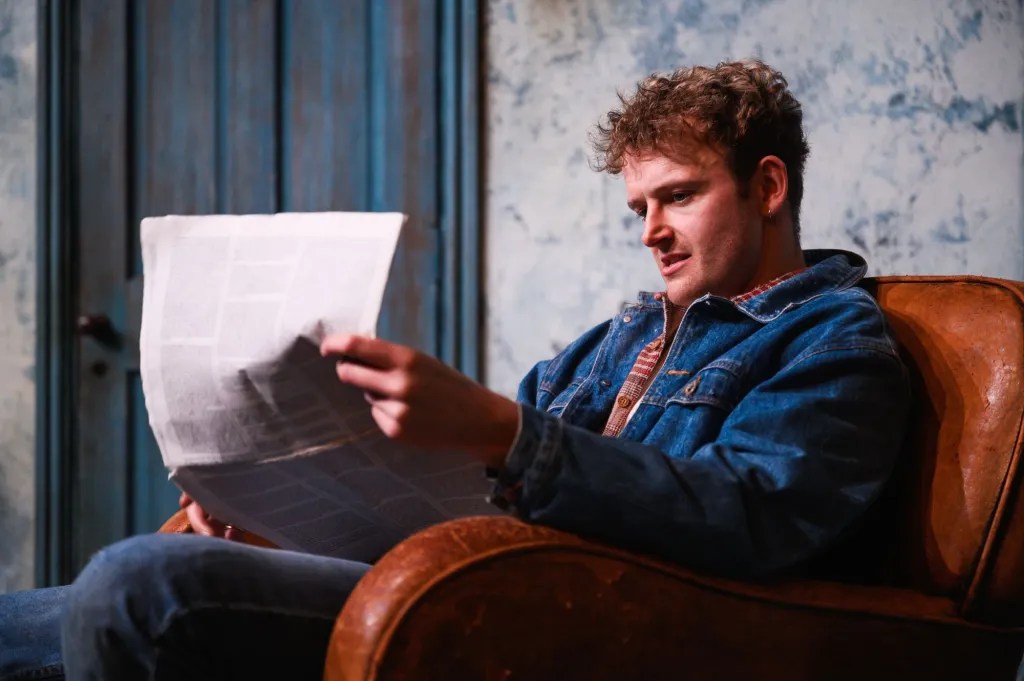
Kenrex

Written by Jack Holden and Ed Stambollouian, original music by John Patrick Elliott, with direction also by Ed Stambollouian, at The Other Palace theatre.

Who, what? No, we had no idea what it was, until a kind friend gave us tickets. Hidden away at The Other Palace in Victoria, previously the St James Theatre where new musicals often surface, it seems to be packing in audiences with no hype at all. And hype it certainly deserves. It, the show, is really Jack Holden, the performer, the story teller. He also has the musician, John Patrick Elliott, as a sidekick, and between them they stir up a storm.

I love being told stories on stage, and I do mean ‘being told’. Last year Billy Crudup did it in his one-man show Harry Clarke, and now Jack Holden is telling us the true story of Ken Rex McElroy from a small farming community in Skidmore, northwest Missouri, back in the 1980s. He was the town bully, a small-time criminal, a persistent offender who by devious means always managed to escape a Guilty verdict. This is described as “a true crime thriller”, but when the small town community decides to defend itself against Kenrex, who commits the true crime?

Jack Holden commences his story as an attorney giving evidence of the events in Skidmore, but he also plays the parts of every member of the community as well. Holden encompasses them all, from barmaids and farmhands through to the bully himself…and a dog. With his voice, accents and tones, he brings every character to vivid life, accompanied by occasional heavy metal percussion, a recorded interviewer’s questions and sound effects. A few props and some dramatic lighting and smoke effects fill in the atmosphere. I particularly liked a moment when Holden steps out of one character to become another…leaving the shadow of his former character behind on the backcloth. He needs to be athletically active, covering the whole stage, moving microphones and props, while continually switching from one character to another. He is amazing, while Elliot backs him up on a variety of guitars and percussion.

Usually, in one-person many-character plays, the performer strays into caricature adding a satirical edge, an amusement. But this is a true story, nothing played for laughs, so we believe in the time, the place, and the predicament. Our attention is held and then, like all the best crime dramas, we are left at the end to ponder whether justice has been correctly served.

The instant standing ovation for both players was not the usual audience reflex – it was justice deserved. We end our 2025 theatregoing with one of the year’s 5-star plays, a unique theatre experience.

Note: Jack Holden also wrote the stage adaptation for the Almeida of Alan Hollinghurst’s novel The Line of Beauty. His first play, Cruise, premiered at the Duchess Theatre in 2021 and was nominated for an Olivier Best New Play award. Kenrex premiered in Sheffield, transferred to the Southwark Playhouse and is now at The Other Palace.

Photos: Manuel Harlan


23/12/25 Mike writes –

Oh, Mary!

A new play by Cole Escola, at the Trafalgar Theatre

There was indecision, confusion, anxiety, redemption, more confusion, and finally resolution….and all that before the play had even begun. We hesitated before booking this – was it our sort of show? But it had been a huge hit Off then On Broadway and was coming to the West End starring Mason Alexander Park from Jamie Lloyd’s Drury Lane Shakespeare duo. We took a chance on a discount offer, then came a ticket problem – after paying on line I received no confirmation nor digital tickets. An on-line check was no help but then a phone-call to ATG on the day brought us tickets at last. At the theatre we were told the tickets had been cancelled (!) but the box office gave us duplicates. At last we were in our seats, in a packed house, in front of gold velvet curtains and footlights. Was the show to be as good or bad as the critics had said?

It’s a melodrama of sorts; short scenes and blackouts, wigs and hooped-skirts, with a full-on cabaret finale. The Mary of the title is Abraham Lincoln’s wife and, oh dear, she’s not the one you would expect. But neither is the President, played broadly and heroically and gay by Giles Terera. Broad is the word for the whole experience, but I should also add brutal and sweary and apparently hilarious, to judge by the audience and some critics. We were less amused, much less so in Fredo’s case.

Mary is frustrated and bored as the First Lady because where she really wants to be is on stage in cabaret. She takes acting lessons from a handsome pro, the now well-known actor John Wilkes Booth, and you know what he is famous for. Unsurprisingly, we end up in an on-stage theatre box awaiting….well, let’s say it does not follow the course of history!

Perhaps the show’s title could more appropriately be Oh, Mason! It’s a showcase for their talent which amazingly ranges from Shakespeare to wildly raucous camp panto. And it also ranges through the whole gender and voice spectrum, for Mason is proudly non-binary. They are a force to be reckoned with.

The show runs for 80 minutes without a pause, excerpt for the sudden blackouts, a dramatic full-stop with loud music at the end of every jokey scene. I resisted its onslaught for quite a while and then…..gradually I succumbed, I think less to the ‘entertainment’ than to the talent showcased. Remove the expletives and excesses, and the comedy was something like Morecambe & Wise. A theatre audition scene was as funny as something similar from their shows, and it was both performed and worked well for today’s audience. At one point Mason held an audience silence, in the midst of yet another cruel send-up, for a  v e r y   l o n g  time. That is not an easy feat, and to be admired especially midst the knock-about. 

By the sparkle’n’tights finale, the audience majority had had a good night out, maybe between a glass or two or several. Some were less amused.

Note: This show is still running on Broadway, with a different lead player (and different genders) each couple of months. At present the star is Jane Krakowski (seen recently in Sondheim’s Here We Are at the National) with seat prices up to $450. We paid £45 here, with the current top price being £150.

Photos: Manuel Harlan


20/12/26 Fredo writes –

The Playboy of the Western World

By J M Synge, at the National: LyttletonTheatre

I wish I could say that I enjoyed The Playboy of the Western World. Not just because it’s an Irish play, not just because it’s a classic, and not because I studied it (without much enthusiasm) for ‘A’level. It’s because I’d seen two earlier productions, and I know that on stage it can be very successfully performed – it’s funny, moving and tragic in turn. The Old Vic production in 2011 with Robert Sheehan and Ruth Negga got it exactly right. Sadly this one gets it exactly wrong.

It’s strange, because the National has brought in Caitriona McLaughlin, the Artistic Director of the Abbey Theatre in Dublin, to direct, and one would have expected her to have the measure of it. I’m afraid Ms McLaughlin may be responsible for some bad and bizarre decisions, among them the weird caoining (okay, keening to the uninitiated) of a funeral procession that starts and ends the first act, and the appearance of straw men playing musical instruments at the back of the stage at random moments in the action. She also places keys scenes at the back of the stage with a barrier of tables and chairs between the actors and the audience, and sometimes positions actors at the extreme sides of the proscenium arch, leaving a yawning gap in the centre of the stage. It’s a shame, as the actors perform valiantly. 

Eanna Hardwicke, who was chillingly evil in The Sixth Commandment on television, bravely plays the simple-minded Christy. It’s a clever and interesting interpretation mixing bravura with a snivelling cowardice. Christy claims he has killed his much disliked father and presents himself as a hero. The young women of the village admire him, all too ready to believe that he is the hero he’s mistaken for. Jealousy ensues. 

Nicola Coughlan has shown star quality in Derry Girls and Bridgerton on television, but she plays on one note of petulant shrewishness, and this isn’t attractive to the audience. Siobhan McSweeney has the assurance and presence to carry off the key role of Widow Quinn, but even she is fighting the eccentricities of the production. They are supported by veteran actors Lorcan Cranitch and Declan Conlon and they all do their best, but the director hasn’t found a suitable key for them to sing in. It’s a missed opportunity.

This is the sort of production I resent. It’s a good play, but it’s been so badly served that audiences who see it here for the first time will be put off it forever. It could easily have been so much better.

A note on the accents: It seems the dialogue coach strove for authenticity. I doubt that this strong West of Ireland accent has been heard since Synge invented stage Irishness back in 1907. I suspect contemporary Irish audiences would struggle as much as I did.

Photos: Marc Brenner


12/12/26 Mike writes –

Merrily We Roll Along

Music and Lyrics by Stephen Sondheim, Book by George Firth, streamed at the Vue Cinema, Leicester Square

Is it fair to review a stage show when it is being streamed in a cinema? The experience is not the same, but of course it’s a good second choice for those unable to get to a theatre. Fredo has suggested that screenings are like a live performance with the air sucked out!

This Sondheim musical has a long history. It is based on a play written in 1934, and when the show first premiered on Broadway in 1981 it flopped, having only 16 performances after its previews. It first appeared in London in a student production at the Guildhall School of Music in 1983, then was professionally produced in Manchester in 1984. In 1992 it was directed by Paul Kerryson in Leicester with a young Maria Friedman in the cast. Sondheimites were already taking notice after the release of the original cast recording, and the show’s popularity increased over some tweaked productions in both the UK and US. It reached the Donmar in 2000, directed by Michael Grandage, where it finally won the Olivier Award for Best New Musical, almost two decades after its first production. Maria Friedman herself directed the show at the Menier Chocolate Factory in 2012 and it transferred to the Harold Pinter Theatre in 2013 winning more awards.

In the US there were some attempts to stage the show successfully Off-Broadway but it never reached that Great White Way….until the same 2012 Maria Friedman production from the Menier transferred to Broadway in 2023 after a run Off-Broadway in 2022  It was a huge popular and critical hit. This was its first return to Broadway since its mega flop in 1981. It was still running in early 2024 when we visited New York but, hey, why pay to see it there when we had seen it back in 2012? The obvious answer was…available tickets were then selling at over $400 and reached over $900 as the show neared the end of its run! Yes, “a palpable hit” as one of Sondheim’s lyrics says. 

So here we are, paying £20 to see a special streaming of the NY show at the soulless Vue Cinema in Leicester Square – no atmosphere, no interested staff, a dreary auditorium, noisy film trailers, popcorn….but at least a respectably sized audience. Perhaps I should say now that I think the audience were glad they came. Certainly two young women sitting next to us told us they much enjoyed the show and had not seen any version of it before. Of course we have seen it several times – I have programmes for at least six productions, but none were issued for this screening.

Merrily is famous for playing backwards in time from 1977 when three close friends see their bond break apart, back to 1957 when they first meet with great hopes for their future. It’s a great show, but I am not going to review it now as this screening was not an ideal way to see it. There were no interviews, no introduction,  no Thank You for coming. Why shoot so much in close-up shots? Yes it’s good to see facial expressions, but not as if we were face to face with the characters so much of the time. From so near, the performances looked exaggerated. The best lead was Daniel Radcliffe (as Charley), warmly appealing with an appropriate aura of sadness, but Jonathon Groff’s performance (as Franklin) looked both bland and bloated, and Lindsay Mendez (miscast as Mary) never seemed to sober up after a convincing opening drunk scene. Maybe all were perfect when viewed from the rear Orchestra Stalls. We could hear applause on the soundtrack after each song but in the cinema we felt too far removed from events to join in. We were separated from them by the screen.

The production was still on the same small scale we had seen originally at the Menier, no problem for us watching a recording, but I wondered what NY audiences had thought when they realised they were not getting a big big Broadway show after paying big big Broadway prices. Did the star casting impress? Did the long delayed arrival of a Sondheim show on Broadway bring satisfaction? I hope so. For me, this gave less pleasure than any staging I have seen. Like the protagonists’ friendship, I felt my enthusiasm for the streaming faded as time rolled by. I await the next live production.

Photos: Matthew Murphy


1/12/25 Mike writes –

All My Sons

By Arthur Miller, at the Wyndham’s Theatre

Ivo van Hove (director) and Arthur Miller (playwright) together have form. The director first came to our notice in 2014 when he directed Miller’s A View From the Bridge at the Young Vic Theatre. It was an astounding production with Mark Strong in the lead and Nicola Walker playing his wife. It was like seeing the play anew through different eyes, yet wringing every moment of emotion from it and leaving audiences full of admiration for the director and enhancing the playwright’s already world-class status. 

After that presentation, all eyes were on van Hove’s subsequent productions. He has directed Hedda Gabler (with Ruth Wilson) and Network (with Bryan Cranston) at the National Theatre, Obsession (with Jude Law) at the Barbican, All About Eve (with Gillian Anderson) and Opening Night (with Sheridan Smith) both at the Noel Coward Theatre. From a bright intro, van Hove’s reputation has gradually faded. His supposed style is “an ultra-modern minimalism shot through with an expressionist theatricality”, with increasing use of stage video filming. Fair enough, it seems to attract distinguished actors, but audiences have been less keen. Even Fredo decided to stay away from this Miller play just because van Hove was directing. I was prepared to pay for an Upper Circle view, and I like Bryan Cranston (best known for tv’s Breaking Bad). I am more than happy to report that van Hove is back on form with this Arthur Miller classic. Just as Jamie Lloyd bounced back from a tedious Tempest with the fabulous fun of Much Ado, van Hove has survived the critical slaughter of Opening Night to see opening night 5-star reviews for All My Sons. He has not only pleased the critics again but the theatre is filling to the rafters.

This classic 1946 Miller play is always an emotional tour-de-force but here van Hove’s minimalism, with no video, has particularly paid off. On a bare stage a tree falls in a violent storm, even before a word is spoken. It sets the scene for bare emotions and a warning of what is to come. Bryan Cranston (Joe Keller) begins on deceptively jovial form chatting with his wife Kate (Marianne Jean-Baptiste), son Chris (Pappa Essiedu), and neighbours calling by. Joe is a businessman surviving a past accusation that he sold faulty aircraft parts for the war effort, and everyone is affected by the repercussions. They await the arrival of Annie, Chris’s would-be girlfriend who he hopes to marry. She was previously in a relationship with Chris’s brother Larry, now “Missing In Action”, and presumed dead by all except Kate who just lives for his return to the family. Larry is essentially the central character in the play as his return, or not, will affect the outcome of everyone’s lives.

The turns in the plot, the clashes of characters, are all from Miller’s genius, so the task of presenting this appropriately, unfolding the play’s complexities, is a test for any director. As family members pair off for their clashes of temperament, dreams and excuses, the tension rises and an appalling realisation spreads through the audience. I have seen this play several times, and of course know its secrets, but van Hove gives it to us as a simple, deeply moving, unavoidable tragedy. How many plays turn on the revelation of an unexpected letter? Too many perhaps, but at the climax here it’s difficult not to choke back tears. The whole audience seems to freeze with shock, believing in every character, and realising it’s not just specific to post WW2 days but a theme of tainted hopes and human flaws for any time. 

The whole cast is exemplary – Cranston, Jean-Baptiste and Essiedu should clear their shelves for well-deserved awards. Director Ivo von Hove has achieved once again the height of critical and popular success he reached with Miller back in 2014.

Photos: Jan Versweyveld


28/11/26 Fredo writes –

La Clemenza di Tito

By Wolfgang Amadeus Mozart, at La Fenice, Venice

It’s not often that we get the chance to see two rare operas in the same week, and this was another one that was completely unknown to me. Strangely chosen to open La Fenice’s winter season, this seemed like an untypical work by the composer. Apparently commissioned to celebrate the coronation of the Austrian Emperor Leopold ll in Prague in 1791, this was composed in haste by Mozart. In fact, he interrupted his work on The Magic Flute and completed it in 12 days – inspiration was provided by having to provide for a new-born baby and an ailing wife.

Unusually, he set an existing libretto to music, and while the score may not yield anything as memorable as the major arias in Don Giovanni or The Marriage of Figaro, it’s still has the tunefulness required by opera seria. The story is complicated, and though it has a historical setting, like Partenope, it depends on mismatched lovers, disguises, and to add to the confusion, female singers in trouser roles and, in this production, a soprano part transcribed for a countertenor.

Cecilia Molinari as the male Sesto and countertenor Nicolo Balducci made the greatest impact. We’d seen the soprano Anastasia Bartoli in Verdi’s Attila last year and we knew she had a strong, clear voice. However, she appeared to be giving the same performance that she gave in Verdi’s opera.

Gary McCann provides elegant and varied costumes for the massed chorus of La Fenice, and designed the set for Paul Curran’s staging.

How did we get tickets for this impromptu visit? Well, my cousin Elisabetta just happens to be President of the Amici Del Opera Lirica in Trieste, and has contacts at la Fenice. It’s not what you know….

Foto © Michele Crosera


28/11/25 Fredo writes –

Partenope

By Georg Frederick Handel, at the London Coliseum

The first line of a blues song is always sung twice, and any couplet in a Handel opera is repeated about 24 times, with variations and ornamentations. This accounts for three and three-quarter hours running time of the ENO’s Partenope. It also suggests that there isn’t a lot of plot, but that isn’t the case here. With a cast of suitors in disguise, a woman dressed as a man and two countertenors, in fact, it’s fairly convoluted, and the best way to deal with it is to relax, sit back and enjoy the music.

And it is gloriously sung and played (one of the orchestra jumped onto our train carrying his instrument, and someone else who’d been in the audience congratulated him).  Nardus Williams is striking and elegant in the title role, and she’s ably supported by Hugh Cutting.

The style of the production (for reasons best known to director Christopher Alden) is surrealism in 1920’s Paris, and one character is based on the photographer Man Ray. 

This was a dress rehearsal,  and a couple of points distracted me: the downstage area was underlit in the first two acts, so that when the singers approach the audience, they step into shade. And given the acreage of the Colisseum stage, why did the director marginalise the performers at the sides – this is most noticeable in the last act?

We were grateful to our friend Meryl for giving us the opportunity to see this collectible work. It’s so rare that it isn’t even featured in The Rough Guide to Opera, and I doubt if another company will stage it any time soon.

Photos: Lloyd Winters


14/11/25 Jennifer writes –

The Assembled Parties

By Richard Greenberg at Hampstead Theatre

The late Richard Greenberg might not be a household name in the UK but he’s the author of notable recent productions in London including The Dazzle, starring Andrew Scott and David Dawson at a short lived experimental theatre on Charing Cross Road and the equally starry Three Days of Rain which played on Shaftesbury Avenue with James McAvoy in a leading role.   

In The Hampstead Theatre production of Greenberg’s 2013 play, The Assembled Parties, he is perhaps on more familiar ground.   The members of a non-observant Jewish family gather for a Christmas celebration in 1980 in the palatial apartment of the Bascov branch of the family on the Upper West Side in New York.   Jennifer Westfeldt, an American actress making her debut on the London stage, plays Julie Bascov, the hostess who so wants everything to go well that she’s cooking for 50 just in case anyone is really hungry.  Also present are her husband Ben, her two sons, Scotty and young Timmy, Jeff, played by an affecting Sam Marks, a house guest who’s a friend of Scott from college, her sister in law, Fay, played by the marvellous Tracy-Ann Oberman, and Fay’s husband Mort together with their socially awkward daughter Shelley.  

So far, so conventional.   However, as the action unfolds and we learn more about the characters and their motivations, the plot thickens and secrets, both unpleasant and deeply hidden, are revealed.    The role of Jewish matriarchs, including Julie and Fay, in shaping the next and subsequent generations is examined clearly and with a refreshing lack of sentiment.  The consequences of unethical behaviour, in all its forms, are also laid bare as the audience is privy to pivotal conversations that most of the characters are not.  This could be a grim watch but the darker aspects of the story are leavened by zinging wit and humour.  Ms Oberman gets most of the best lines and delivers them with great comic timing while wearing a frightful 1980s wig,  What a star.

After the interval, we’ve moved on 20 years to 2000 and what has happened to the family members in the intervening period is gradually revealed.  Some have died and some are not well at all.  The mood is darker and there’s a realisation that the glory days are long gone.   However, despite it all, the play ends on a hopeful note with news of the arrival of a festive baby which, of course, brings hope for the future.     On reflection, the play could be considered a soap opera but the way in which family dynamics are presented so honestly and how, in the end,we’re reminded that blood is thicker than water, gives the story something more profound to say about human relationships.

05/11/25 John R writes –

The Line of Beauty

Based on the novel by Alan Hollinghurst, adapted by Jack Holden, at the Almeida Theatre

The novel by Alan Hollinghurst was published in 2004 and won the Booker Prize that year. It seems to me that he had generally tried to put his finger on the pulse of the nation at a given time, which is perhaps why he only produces a new novel every decade or so. This story captures the nation over five years from 1983-1987. 

The play tells the story of a new graduate from Oxford, Nick Guest, a comfortable middle class guy, who is drawn into the orbit of the far wealthier Fedden family, whose son Toby, was a college chum of Nick’s. He is instantly seduced by the glamour of the family and is persuaded to look after the Fedden daughter, Cat, while they are in Paris for a break. She is a wild girl with “issues” and is in danger of cutting herself. In the meanwhile Nick has met a young black man called Leo and they have a strong sexual relationship but only in anonymous areas such as parks or empty residences (including the Fedden house) when nobody else is around. Nick is semi-closeted but is dazzled by a series of louche, handsome men who he meets in the Fedden circle. He is also very aware of the aesthetics of furniture, paintings etc of the house. Drugs and promiscuity abound and he is soon living the high life. He and Cat form a close relationship; she is far less inhibited than her parents, who are cautious on gay issues but let it be thought that they are OK with them. 

Nick, not being able to include a working class black man into his lifestyle, is seduced into a relationship with Wani and helps him produce his glossy magazine called OGEE, originally an architectural term meaning beauty, line, curves. The Line of Beauty can be the link to all beautiful objects and human bodies, or the line of frequently snorted coke towards another aesthetic. In the background there are ominous rumblings of what turn out to be the start of AIDS.

Hollinghurst specialises in long set-pieces which are wonderful to read and include so many delicious social observations .  In his last book, All our Evenings, two pieces cover the Sports Day at a posh school and a wedding of an older Lesbian couple.  His descriptions of place are spot-on, which gives a richer texture to the stories.  

I guess the main fault in the play was trying to squash the absorbing story into 2.5 hours. I thought the acting was superb but although we were thoroughly entertained by each successive scene, we felt it didn’t quite hang together, and was trying to address too many issues at once. And again we had a play in which the leading actor (Jasper Talbot) seems to be barely out of drama school. He was superb and will go far.

08/11/25 Mike writes –

Ah, the great novel on stage. They crop up at regular intervals, some with theatrical success and some not. We remember, without fondness, those Hilary Mantels plodding across theatrical boards, showing off their fancy costumes and historical plots yet never capturing the essence which gave the novels their award-winning status. It’s the same here. Now I admit I have not read Alan Hollinghurst’s novel, and perhaps that’s an advantage when reviewing the stage adaptation without prejudice, but it’s obvious right away that that award-winning novel must have had more to it than the plot-details on show here.

It comes across as a retread of Saltburn – uni-undergrad Nick Guest falls for out-of-reach posh-boy Toby Fedden, and is invited to be a guest (geddit!) at the Fedden Notting Hill home. He stays and stays and becomes a fixture, friend to all the family and special mate and minder to posh-boy’s sister Catherine. She is somewhere on a syndrome so she can blurt out what others are too coy to say. As it’s the 1980’s, the gay lust lurking in the ether has to be indulged on-stage behind a refuse-bin, and AIDS has to be lurking too but barely spoken of. Nick’s black bit-of-rough-on-the-side boyfriend Leo is dropped when a posher opportunity arrives in the handsome shape of friend-of-the family Wani. And so this high society soap opera skims swiftly on, with father a Conservative MP, mother happy to have a helper in the house, ‘Uncle’ Gerald always ready to criticise, and an appearance by Mrs Thatcher adding period class authenticity. Frankly, this on-stage literal adaptation has the feeling more of an airport novel than a literary prize-winner. Hollinghurst is the loser here, but where does it leave us?

Well, it does have Michael Grandage as director and a strong cast who enhance its theatrical credentials where it lacks the supposedly impressive writing of the original novel. We happily follow the family set-up with Nick becoming entrenched, and then the falling-apart when circumstances take a downward turn. A simple, mostly bare but grand set lets the actors create the upper class ambiance, so luring to Nick and yet fragile to the sexual pressures and turning of the times.

Jasper Talbot is Nick (following his debut performance in the National Theatre’s Inter Alia). Incredibly, he holds the piece together in a star performance, assured, appealing, balancing naivety with determination. Charles Edwards could have played the part in his younger days but here he is the arrogant Tory MP father, with Leo Suter as the posh boy son, to be remembered certainly for his Speedo sun-bathing scene. An oily Arty Froushan snorts his line of drugs with gusto and Alistair Nwachukwu brings a streetwise allure to the discarded gayboy Leo. It’s a man’s world, definitely not to be admired, but a sparky Ellie Bamber, as wayward sister Catherine, enlivens her every scene.

We were entertained by this Line of Beauty but I doubt it will lead many to read or re-read the book. This is a pity as the reputations of both the novel and the production team were enough to sell-out the whole Almeida run.

Photos: Johan Persson


01/11/26 Cecilia writes –

Dead Man Walking

Opera in two acts by Jake Heggie (libretto by Terrence McNally).
Dress Rehearsal at the London Coliseum

A quarter of a century after its premiere in San Francisco, Dead Man Walking arrives in London and materialises in masterly form at ENO. The story line derives from a memoir by Sister Helen Prejean, a New Orleans nun and dedicated campaigner against capital punishment. The memoir, which refers to events in the 1970s, was the basis of a film in 1995. 

Heggie’s work has a deceptively simple storyline: Joe De Rocher is on Death Row in a Louisiana jail, having been sentenced for raping and killing a young woman and killing her boy friend. He will not admit his guilt, angry at what he sees as an injustice. Sister Helen Prejean has been corresponding with him and now drives to visit him, in hope of persuading him to confess – “the truth will set you free…..” Helen encounters both Joe’s mother and brothers and the parents of the two victims at the Pardon Board. Predictably the Board rejects a plea for clemency. The victims’ parents accuse Helen of ignoring their suffering. The closing scene shows Joe being taken to the death chamber – the dead man walking – where, as the lethal injection is carried out, he at last acknowledges his guilt.

This bald outline presents a dark enough story by itself. But the libretto lucidly and powerfully takes us into much deeper waters – the agonies of loss, the ethics of capital punishment, the nature of revenge, the burdens of victimhood and just who is the victim in such fraught circumstances, confession, forgiveness, spiritual freedom…….Our certainties and preconceptions in these areas are skilfully challenged – and our heartstrings are plucked – as scene follows scene.

The brilliance of the libretto is entirely matched by Heggie’s score and the very accomplished cast. I guess one would describe his musical style as modern and eclectic, owing something to the minimalists, without painful discords, often with long lyrical lines, eminently singable in English. One can detect momentary references to American folk melodies and rhythms – and unexpectedly Helen and Joe find they share an admiration of Elvis…… Contemporary opera has in some measure liberated itself from historic conventions and much of Heggie’s creation is musically conversational, so to say. But he and McNally together have also given their principals some meaty arias of great emotive force and tutti which express intense collective feelings.

As Helen, Christine Rice (mezzo) is the central figure, on stage practically throughout, a rounded character, utterly convincing vocally and dramatically, as she faces successive dilemmas. Michael Mayes, a veteran of a dozen different productions of the work, is the irascible, defensive Joe, not out of puff after his press-ups in the condemned cell. Also prominent and persuasive is Sarah Connolly as Joe’s despairing mother. Helen’s fellow nun Sister Rose is Madeline Boreham, offering counsel in a beautiful soprano voice. There’s a number of secondary roles – victims’ parents, nuns, police and prison staff – that are all very well handled, plus choruses of children and of prison inmates. At the curtain, the stage was crowded – to an enthusiastic reception. And on to the stage to take a bow came the conductor, Kerem Hasan, who managed his large orchestra and the stage performers superbly.

It seemed to me that the production (director Annilese Miskimmon) did everything you (i.e. I) might want from opera. Dead Man Walking was vocally and orchestrally terrific, simply and movingly presented on stage and stirring you from your torpor by opening up and addressing questions and feelings at the heart of our human condition. Make sure you do not miss this great and rare achievement! 

Photos: Tristram Kenton


22/10/25 Fredo writes –

Mary Page Marlowe

By Tracy Letts, at the Old Vic Theatre

Life is lived chronologically, but memory is selective. Looking back, separate events are called to mind at different times. Sometimes we seem like strangers to ourselves, and at other times life-changing events seem to have happened to a person we once knew.

Is that why Tracy Letts has five different actresses play Mary Page Marlowe at ten crucial points in her life (and I’m not counting baby Mary Page, crying in her crib)? It’s a fairly turbulent life, though the major events happen off-stage; we hear them discussed and see the repercussions. It’s a tribute to director Matthew Warchus and to the actresses that they find a consistency in the character: Mary doesn’t shirk taking responsibility for her actions, but she doesn’t share her secrets. When her lover says he wants to get to know her better, she tells him, “You’ll be disappointed.” Her own assessment is that hers is an ordinary life, there’s nothing special going on.

Letts doesn’t make it easy for the cast or the audience, as he eschews a straightforward narrative account of Mary’s life. It’s as though he’s opened an envelope and photographs have spilled out, and he ’s picked them up in random order. He always makes it clear where we meet Mary again, even as he flicks through these snapshots. In a series of short scenes, Mary tells her children of her impending divorce, then we slip back in time to her sharing her first crush with cynical school-friends, then in later life getting – at last! – some good news. We piece these fragments together, and at the end, I felt that I knew Mary better than she did herself.

Mike and I have seen many plays with a similar style in New York – plays that seldom cross the Atlantic. They’re filled with elliptical dialogue verging on the gnomic, scenes break off unexpectedly, motivation that’s obscure and has to be deduced. These elements can combine for a fairly austere and uninvolving evening, but Warchus has the measure of it, and brings a warmth to the material while making sure we keep up with all the essential information in the script.

The cast play it expertly, and what an extravagant cast they are. Dependable actors such as Hugh Quarshie. Ronan Raftery, Paul Thornley and Lauren Ward are employed for only one scene each – which they each play for all its worth. Alisha Weir and Eleanor Worthington-Cox each have one scene as the Younger Mary, while Rosy McEwen impresses in her two scenes as the more mature woman. In her scene with her therapist, Mc Ewen and Ward hold one of the longest pauses I’ve ever experienced in the theatre; it would make Harold Pinter’s eyes water.

The really heavy lifting is done by Andrea Riseborough, as Mary starts to unravel in her 50s, and then by Susan Sarandon, in three contrasting moods as Mary goes through her 60s. Riseborough charts Mary’s disintegration as her life lurches out of control, and her detailed depiction is harrowing to watch. It’s a welcome return to the stage for this expressive actress.

The indisputable star power of Susan Sarandon could easily have unbalanced the play, but Ms Sarandon shows that she is a team player. Her Mary is the woman created by the experiences of her younger self, and she plays the words and the space between the words, measuring out the meaning that her lines contain. It’s an all-too-brief appearance, but it’s a masterly debut on the London stage.

Is the “Page” in Mary’s name an indication that her life is a blank sheet to be written on? At the end of the play, as Mary collects her dry-cleaning, she enquires if the cleaner can deal with a quilt, which is stained in places, and with some patches slightly threadbare. As she describes it, it clear that this is a symbol of her life – battered, tattered but not torn.  A jigsaw puzzle might have been a fitting metaphor for the structure of the play, but the quilt has a resonance as an American heirloom, possibly stitched by many hands in a quilting-bee.  I liked it that Tracy Letts kept this suggestion up his sleeve until the end, rather than using it as a motif throughout the play. And I felt that Mary Page Marlowe was not an American Everywoman, but a person with a distinct presence in her own right. It was rewarding to spend time with. her.

Photos: Manuel Harlan


21/10/26 Fredo writes –

The Weir

By Conor McPherson, at the Harold Pinter Theatre

Certain plays perform miracles: they involve us in the lives of their characters, they enfold us and we feel that we have shared their experiences as the action progresses. We leave them, knowing all about their lives, and a little more of our own.  A few examples are Uncle Vanya, An Inspector Calls, Intimate Apparel and The Weir by Conor McPherson. 

McPherson performs his miracle by sleight of hand. Three bachelors, Jack, Jim and Brendan, sit in a pub in a remote town-land in Ireland. They share a bond of familiarity and loneliness, and small tensions which they overcome with goodwill. They even accept Finbar, the local entrepreneur – when a dispute breaks out between him and Jack, it’s quickly settled with buying each other a drink.

Finbar introduces Valerie, a young woman recently arrived in the area from Dublin, and in their rough country way, the men welcome her. The conversation drifts into the telling of ghost stories, starting lightly with Jack referring to a fairy-path allegedly leading through Valerie’s new home. Jim is rebuked for recounting the most disturbing story, but then Valerie reveals her own ghostly experience, which is the most devastating of all.

Photos: Rich Gilligan

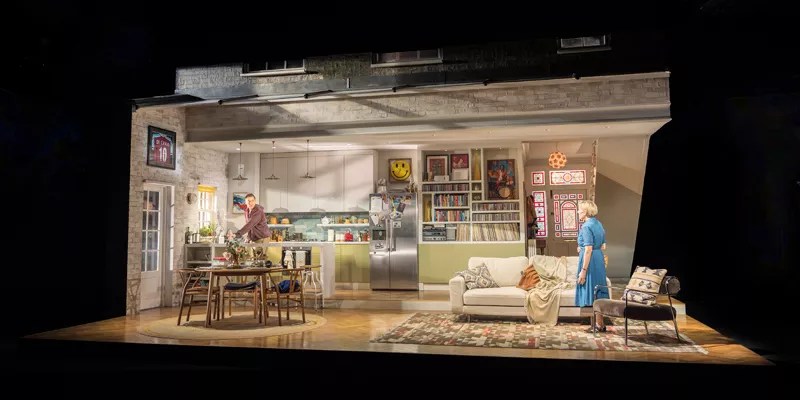
It’s a slow-burner, and McPherson, who also directs, orchestrates the actors to show their hand at the deliberate pace. We’re drawn into their world, and the three raconteurs  – Brendan Gleeson. Tom Vaughan-Lawlor and Sean McGinley – held the audience spellbound. Kate Phillips, as Valerie, had the difficult task of following these virtuosos, and for me, she didn’t quite reach the extremes of quiet desperation that other actresses have brought to the role. I suspect the rest of the audience might disagree with me, as I could hear them holding their breath throughout her narrative.

It isn’t the end of the stories. When Finbar and Jim leave, Jack confides in Brendan and Valerie how he missed his chance of love and happiness, and how he received a quiet benediction from a barman by the simple act of making him a sandwich. The depth of feeling that McPherson and Gleeson pour into this small gesture of kindness is incredibly powerful in the context of the play, and is perhaps the moment when it’s most difficult to hold back tears.

It must be difficult for Brendan Gleeson with his great talent and forceful personality not to dominate anything he appears in, but in his London stage debut – he’s done lots of theatre in Ireland – he is a team player. Sean McGinley embodies Jim, who is a realist by virtue of having no imagination;  his response to Valerie’s story brings the house down, with a line that is masterly placed by the writer and matched by the actor’s timely delivery. Tom Vaughan-Lawlor was very animated as Finbar, anxious to impress Valerie and to keep on the good side of the men.

I was disappointed that McPherson as director and the actor Owen McDonnell didn’t make more of the bar-owner, Brendan. There was no sense of the growing affection between him and Valerie that has been such a positive aspect of other productions, and no hint that she might save him from turning into another Jack or Jim.

The Weir has been counted among the top 100 plays of the 20th century, and I won’t argue with that. I thought I had to explain some of the Irish expressions to Mike, such as the pub being in the shadow of the knock (that’s a hill, from the Irish “cnoc”) or Jack’s dismissive use of the word “culchie” – that’s someone from the country who’s crude and uncouth. Mike said it didn’t matter; the play stands without footnotes.

It always surprises that this play has been embraced by an international audience. The world of The Weir is well-known to me. These people were familiar in my parents’ generation: men who were single because of their emotional or sexual reticence, women whom they’d disappointed and who remained single as well. The stories of William Trevor capture the coldness of these unfulfilled lives, and I can think of no higher praise for Conor McPherson than to thank him for bringing some warmth to that world.


17/10/25 Fredo writes –

The Code

By Michael McKeever, at the Southwark Playhouse, Elephant

Although the high-living, hard-drinking, out-spoken Tallulah Bankhead grabs our attention in Michael McKeever’s tell-all exposee of Hollywood in the 50s, she’s really a narrator/Greek chorus figure in the play. 

The real centre of the drama is Billy Haines, who had effortlessly made the transition from silent star to talking pictures. Why is his career as an actor totally forgotten, and why is he forging a career as a successful interior designer? Billy refused to conform to the Code of Hollywood – live your life, but within the rules. In Billy’s case, conceal your gay relationship with your long-term partner, and enter into a “lavender marriage”.

Tallulah is a victim of the same code:  as a leading stage actress and part-time movie star, she sees herself passed over for the role she craves in favour of a more respectable performer. Enter Henry Wilson, notorious agent and creator of pretty-boy starlets, with his latest protegee.  Wilson seeks to exploit this ambitious and malleable youngster, and to bend him to the strictures of the Code.

Tallulah Bankhead / Billy Haines / Henry Wilson

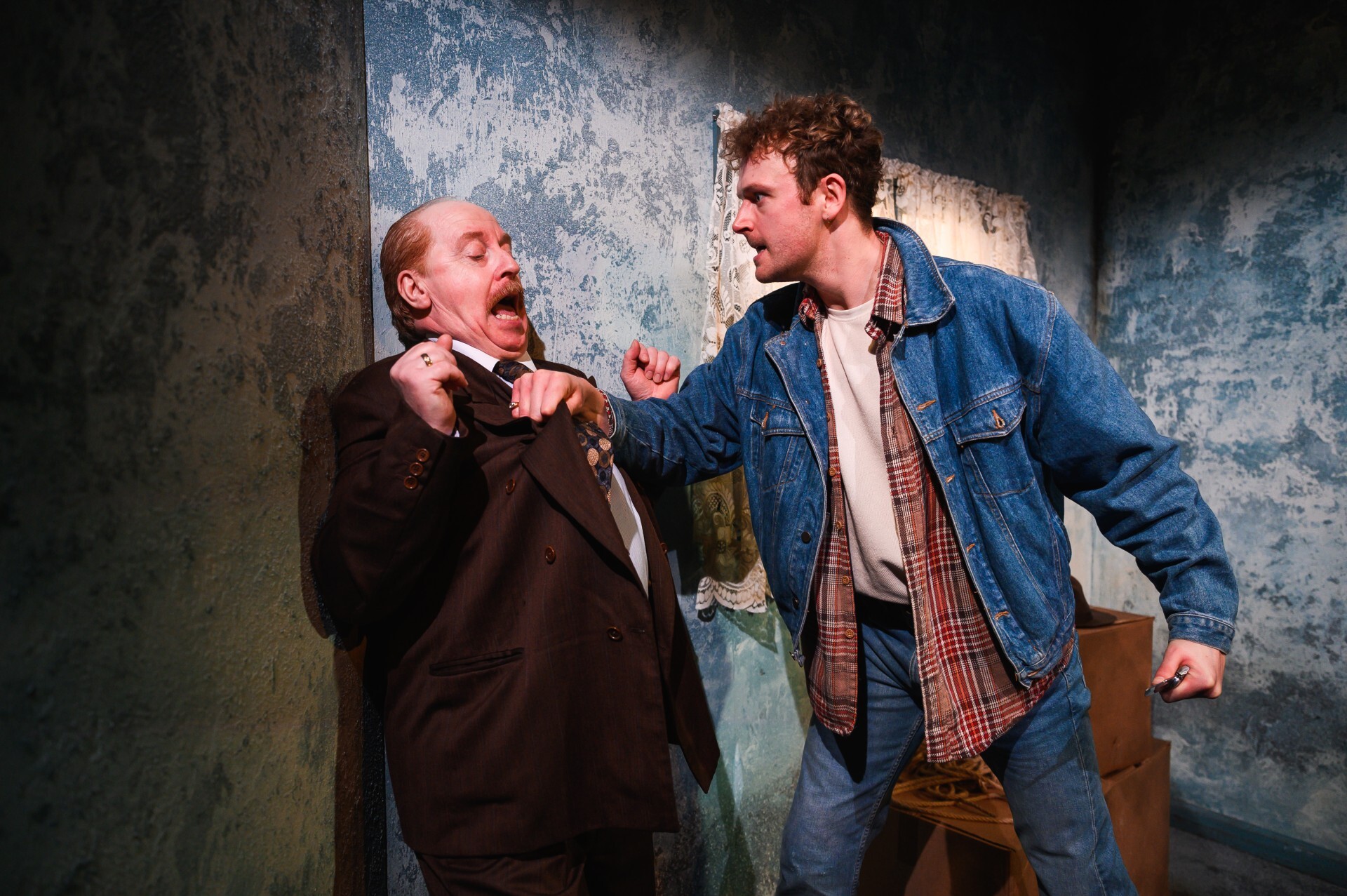
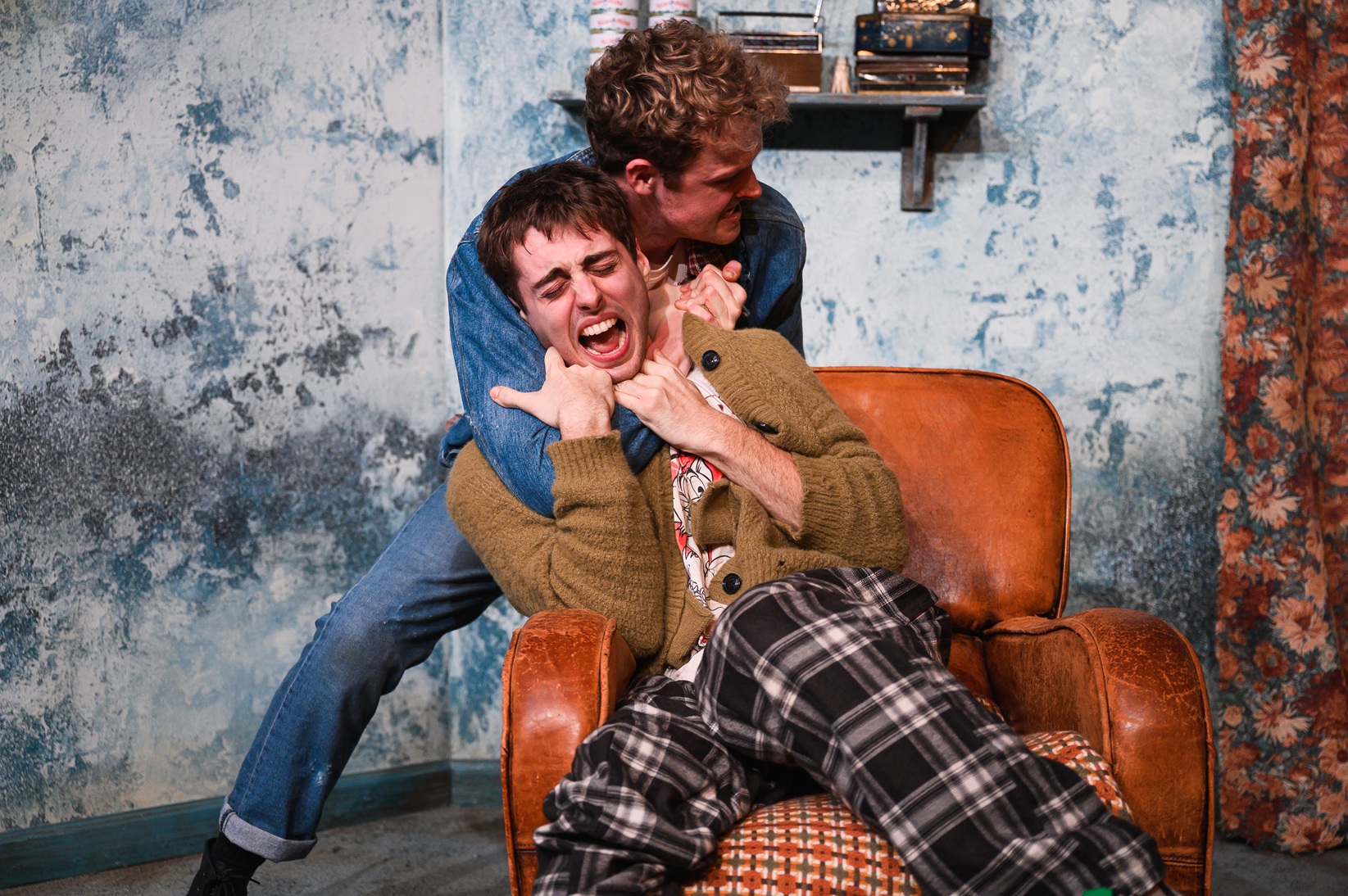
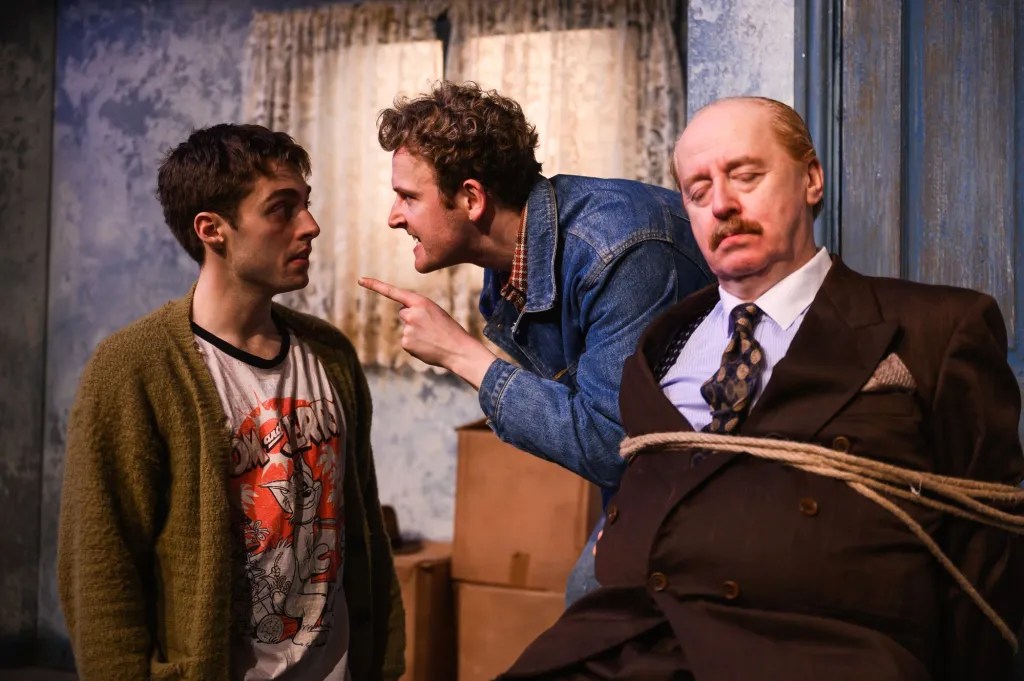
This play could have been written with me in mind; I’m well-versed in Hollywood folklore, and playwright Michael McKeever generously dishes the dirt on the stars of the Golden Age. It’s fast and entertaining, and director Christopher Renshaw balances moments of great humour with tense confrontations. I enjoyed it hugely, while knowing that I would hate myself the next morning. Because there’s a certain spuriousness about the content.

Gary Cooper / Clark Gable / Claudette Colbert / Joan Crawford / Cary Grant

McKeever has done his research, reading between the lines of yellowing pages of Modern Screen. Every rumour is treated as a hard fact, substantiated or not, and names are tossed around like confetti: Gary Cooper, Clark Gable, Claudette Colbert, Joan Crawford, Cary Grant – they’re all name-checked, and most of them are (allegedly) gay. It’s a scatter-gun approach, and it made me wish that McKeever had concentrated more on the drama. He can construct a scene (he’s written 35 plays and another one has been announced for the Marylebone Theatre) – one outburst from Wilson drew gasps from the audience. And I relished Tallulah’s take-down of Henry when she ponders, “Why don’t I like you?” 

Tracie Bennett revels in Tallulah’s flamboyance, but shows us the vulnerability of an actress looking for a major role (and the part she lost – though she was the director’s first choice – was Amanda in The Glass Menagerie by Tennessee Williams. It was filmed with the more respectable Gertrude Lawrence). John Partridge glides elegantly through the central role of Billy, interior designer to the stars, yet reveals the steel that has helped his navigate the setbacks in his career.

Guy Maddison / Roack Hudson / Tab Hunter / Dack Rambo / Rory Calhoun

Henry Wilson was the Harvey Weinstein of handsome young men, though he never had a Me-Too moment. It was an open secret that his client list were predominantly gay, or at least hungry enough for fame to string along with Wilson’s demands. The only one named in the script is Guy Maddison, but take your pick from Rock Hudson, Tab Hunter, Dack Rambo or Rory Calhoun. Some of them had talent, but only a few of them endured once they had wriggled out from under Wilson’s management.  Wilson specialised in ultra-macho screen names, and Solomon Davy plays the young man whose name Henry hasn’t yet invented. He shows promise of talent as well.

The point is strongly emphasised that all of Billy’s 50 films have been forgotten. Southwark Playhouse helpfully have a foyer display of some of the stars, writers and directors mentioned in the play. A criticism levelled at Born with Teeth was that you needed to know not only who Shakespeareand Marlowe were, but also Hollinshed and Kyd. Are Joan Crawford and Clark Gable now as remote and forgotten as the Elizabethan writers? My friend Debbie told me that some of her younger colleagues had never heard of Paul Newman. If this is the case, it’s the end of civilisation as I know it.

In the meantime, we enjoyed The Code as both a guilty pleasure and a historical document.

Photos: Steve Gregson

Tracy Bennett / John Partridge / Nick Blakely / Solomon Davy


05/10/25 Mike writes –

Hamlet

By William Shakespeare, at the National: Lyttelton Theatre

A bracing breeze is blowing through the corridors of Elsinore in this “fearless, contemporary take” on the Bard’s most performed play. I quote the National’s description and admit that I feared a “To be or not to be, innit?” approach. I need not have worried, the text has not been changed, just slightly trimmed, but the production and performances, with Rob Hastie directing, give us a Hamlet for new younger audiences and certainly for me too. 

 Photos: Tristram Kenton and Sam Taylor

Now set in a vast, ornately frescoed stately hall, it startles us right from the opening scene when security staff see a ghost in the darkness. And so begins the familiar plot with a disturbed and vengeful Hamlet bringing on the downfall of his family. His mother has married his father’s brother, too soon, and this is no quietly wandering/pondering Hamlet. Hiran Abeysekera in the title role is a revelation – fragile, troubled and intense, he talks, shouts, muses in anguish to himself and to us, ensuring everyone pays him attention (especially the audience). We watch captivated, drawn in to his fraying world. I have seen many Hamlets but this one is right up there with the best.

There are hurdles for those with a more traditional taste in Hamlets – modern dress; no castle battlements;  and a conventional approach to settings and the Bard’s conversational style – but mainly the hurdle of DEI casting. I’m no fan of this myself, believing (appropriately for this play) that “the play’s the thing”. But again, no need to fret. The performances, with colour and gender changes, make the text race along with passion, humour, and clarity. The characters and the actors playing them are an ensemble, reacting with intelligence and a familiarity with each other.

Slight quibbles – Act 2 loses some of the power of the drama, possibly because we know where it’s going and it gets there quickly; there are fewer characters to spar off each other; and the gravedigger pause, as always, seems a needless diversion.

I liked the diminutive Francesca Mills as a lively Ophelia and especially Geoffrey Streatfeild as Polonius, wheedling his way into the Hamlet family dynamic with sharp wit and flair. Alistair Petrie was a kingly Claudius and, briefly appearing as the First Player (not the Player King!), Siobhán Redmond uses a more traditional dramatic approach to the text, noticeably ‘playing the actor’. Others brought individual characteristics to their roles, particularly a nerdy R&G, and a warmly comforting Horatio played by Tessa Wong. But appropriately, Hiran Abeysekera as Hamlet was always the central magnet of attention, brandishing a gun but just as lethal with his quick words and endless agility.

Seldom has Hamlet, both play and character, been so exhilarating. This is the most intelligent, detailed and exciting revisionist production of Hamlet you are ever likely to see. It plays fair with the text and gets real with its players. I can now use the words ‘fearless and contemporary’ for myself.

Note: I like to read reviews, and the general consensus on this production was disappointment – every ‘newsprint’ review had complaints and one even thought it dull (average rating 3 stars). Was the Press Night an ‘off night’ as can sometimes happen? We were lucky at our matinee – Row A Stalls seats (only £20), plenty of legroom, perfect view, heard every word – so were others disadvantaged? One exception seems to be the Broadway World reviewer who rated it 5 stars. ‘On-line’ reviews have been much more enthusiastic with 5-stars leading the ratings on theatreboard.co.uk. We stood to applaud and received a nodded smile from Hamlet himself! And we met three teenage students from Northampton, all studying various aspects of Theatre, who were totally enthralled. And that, I suggest, is what really matters.


04/10/25 Mike writes –

Creditors

By August Strindberg, adapted by Howard Brenton, at the Orange Tree Theatre

August Strindberg was a man of many cultural talents, novelist, poet, painter, and author of more than 60 plays, some of which brought him a reputation for being anti-Jewish and a misogynist. In his day he was at odds with a younger generation of left-wing activists….and so an ideal choice for stirring up today’s audiences. But at a Q&A after our performance, Charles Dance told us a previous Under-26 audience received the play with great enthusiasm. For our performance the audience’s average age was possibly Over-70 (it was a Richmond matinee after all) and were there less for Strindberg than to see Geraldine James and Charles Dance on stage together with Nicholas Farrell, rekindling memories of their more youthful roles in tv’s Jewel in the Crown from 1984. Enthusiasm was again the result from this white-haired appreciation society.

I fortunately recognised no anti-Jewish sentiment on stage but in the opening scene Dance’s character, Gustaf, did a spectacular job of demolishing the reputation of women and particularly his friend Adolf’s wife, Tekla. We wondered why, especially as poor Adolph was devastated and made ready to accuse his wife of flirtations and infidelities on her return. When Gustaf had gone and Tekla  appeared, she was a delight, joyous and protective of her husband, so unlike the character described. The relationship between these three, and who was in credit to whom, certainly held our attention as the truth beneath the surface manners was revealed.

Described as a tragicomedy, this One Act play of only 80 minutes was originally part of a double-bill, and whatever happened to those? Budgets no longer stretch as far as they used to, so we have to be satisfied with theatrical short measures. Howard Brenton’s adaptation recreated the period and its Upper Class society well, with just a few modernisms to keep us alert. Certainly, I doubt anyone felt short-changed after this afternoon entertainment, so well produced and performed.

Photos:  Ellie Kurttz


28/09/25 Mike writes –

Bacchae

A new play by Nima Taleghani, after Euripides, at the National: Olivier Theatre

The staging opens with a stunning visualisation of a warring horse. Onto the simple set of revolving rectangular platforms run the Bacchae with Vida (Clare Perkins) leading a chorus of diverse wild women, angry and ready to liberate the women of Thebes. One by one they address the audience, introducing themselves with the familiarity of new mates eager to please those like-minded in the audience who feel they need liberating too. They are aggressive, sweary feminists in the style of the dystopian Mad Max franchise. At this point I guess the young among us sit up and take notice while the older NT audience recoils in anticipation of a clash between old and new attitudes to Greek Tragedy.

I found the streetwise language wearisome, alienating in its confrontational urban earthiness. There are modern references too and some groan-worthy jokes. But as this reworked Theban Tragedy progressed, with Dionysus (Ukweli Roach) and Pentheus (James McArdle) leading opposing factions, I became more involved. The staging, the choreographed movement and dramatic lighting and sound effects became a greater attraction, and the dialogue a lesser distraction in the telling of the old story.

This new version of the play “after Euripides” made its moral point with parallels to current conflicts despite its over-desperation to startle us into submission. Whether it is a suitable opening, in the Olivier Theatre, for Indhu Rubasingham’s new regime at the National, seems to be a moot point, opposed by some and half-heartedly supported by others. We were more impressed than we expected to be, and certainly everyone involved entered into the spirit of the enterprise and pleased the audience.

Photos: Marc Brenner

28/09/25 Mike writes –

La Cenerentola (Cinderella)

An opera by Rossini, at the London Coliseum. (The dress rehearsal)

This was a dress rehearsal. I emphasis this as allowances have to be made. This rehearsal still had a long way to go to be good enough for the paying public. What it needed was the firm hand of a Matthew Bourne. We all know the Cinderella story but here it’s reset in what appears to be an Essex Travelodge. Centre stage are lift doors with revolving rooms on each side. Cinders works in the kitchen. It’s not an easy set to populate and no-one yet seems entirely sure what to do there. Mistakes were made, props left scattered, and at one point a stagehand had to walk on to mop up spilled liquid. The opening, both visually and musically, was subdued and unfocused, the cast seeming unsure of what to do and still improvising. It is permitted for voices to be subdued at rehearsal and several of the cast were withholding both voice and energy. It is a light-hearted opera needing characters to be fun, but some overcompensated in an effort to be funny and camp. 

Best of the leading players was Dandini (Charles Rice), big of voice and presentation. Don Ramiro (Aaron Godfrey-Mayes) was less a Prince but more a Kenneth Branagh lookalike, not a good look for a Prince Charming; Cinders, renamed Angelina (Deepa Johnny), had the right feminist approach for this ‘re-imagination’ of both pantomime and opera, and should be on form for the opening; and Don Magnifico (Simon Bailey, of course) lived up to his reputation. 

Act Two was an improvement, maybe already better rehearsed, and the curtain-call got cheered, mainly by the school groups in the audience. But the conductor, Yi-Chen Lin, failed to appear. I wondered why.

Photos: Mark Douet


28/09/25 Fredo writes –

The Lady from the Sea

By Simon Stone, after Henrik Ibsen, at the Bridge Theatre

The Lady from the Sea has always seemed to me to be an aberration among Ibsen’s plays. It’s like a bracing ocean breeze bringing a breath of fresh air to the Norwegian noir of his later masterpieces. George Bernard Shaw was so impressed that he simplified it to articulate its feminist message for his early success Candida.

Simon Stone has previously received acclaim for his reworkings of Lorca‘s Yerma, powered by a self-lacerating performance from Billie Piper, and for Racine‘s Phaedra, which I enjoyed, though it didn’t captivate everyone.

Turning his attention to Ibsen’s romance, it seems to me that while mostly retaining the structure of the play, he has overloaded it with plot complications and has strained for contemporary references. In the original, Ellida has a mystical connection to the sea; here she’s one of the tiresome tribe of cold-water swimmers in Ullswater. The focus has altered to her husband Edward – Andrew Lincoln, in a fiery, concentrated performance – and while Alicia Vikander is perfectly fine in the title role, she doesn’t occupy the pivotal character in the play.

I am awarding the young actresses playing Edward’s daughters (and therefore Ellida’s step-daughters) the coveted Fredo award for the most irritating performances of the year. But of course that is the way they are written.

At one point, one of them comments “Just because you can do something, it doesn’t mean you have to.” I suggest that Simon Stone heeds this advice. He pulls all the stops out in the second act.  Most of the cast get a drenching from an extended cloudburst, and Ellida and her returning lover Finn attempt to have sex while half-submerged in the water. I thought this would have been a passion-killer, but then I’ve led a sheltered life.

Finally the raised stage fills with water, and Andrew Lincoln does lengths in the swimming-pool. Now we understand why A Midsummer Night’s Dream closed mid-week in order to construct the set for this play. It’s all impressive, and leads to a spectacular closing image – but what does it mean?

At least the production revealed that Andrew Lincoln‘s long sojourn among The Walking Dead on television hasn’t blunted his vitality on stage.

Mike enjoyed it more than I did, and our friend Nicholas commented:  “I was stimulated by the production and the performers but felt that it was a mistake to pretend that the writer was Ibsen. With a pretty starry cast like that, it would probably have sold quite well in any case and it was so far removed from the original that it could have been by any half decent playwright.”

I’d like to enter a plea here: this year, we’ve seen “versions” of Ibsen‘s Ghosts, The Master Builder and now The Lady from the Sea, and I understand that An Enemy of the People was tampered with as well. These versions have had varying degrees of success in drawing contemporary equivalents with Ibsen’s society, but please – we’re grown-up people, and if we see the plays in their original form, we can make these judgements for ourselves. His voice is strong enough to echo through the ages.

Photos:  Johan Persson


20/09/25 Fredo writes –

The Land of the Living

By David Lan, at the National, Dorfman Theatre

There are several scene-stealers on show in this epic play. Let’s start with the scene itself, an enormous traverse set designed by Miriam Buether with a vaulted ceiling, retractible lights, and enough filing cabinets under the stage to satisfy the most dyed-in-the-wool bureaucrat. It’s Ruth’s London flat in 1990, but it serves as multiple settings: German and Polish villages, a hospital, a refugee centre and even, thrillingly, a train. Most tellingly, its vast length acts as an emblem of the distance between Ruth and her visitor Thomas.

He is a successful Polish concert pianist now working in America, and has come to find out the truth of his experiences as a child, when he was torn from his adoptive family and rescued by Ruth. She was working for the UN to reunite families, divided by the war when certain children were selected for their racial purity and deported to Germany.

As Ruth is played by Juliet Stevenson, I expected that the emotional temperature of the play would be turned up to white hot before we reached the end. I wasn’t disappointed. This is an actress who can convey dismay, disappointment, anguish to any size of an auditorium; sitting in the second row, I felt the heat.

Photos: Manuel Harlan

It’s difficult to steal a scene from Ms Stevenson, and visiting German actor Tom Wlaschiha (Game of Thrones) held his own in their exchanges. However, no-one could take their eyes off 10-year-old Artie Wilkinson-Hunt, one of the four boys playing young Thomas. This is a huge and demanding role for a child, and performed mostly in Polish. This accomplished young actor gave an extraordinary performance. It brought tears to my eyes to see the cast stand back and let the audience applaud his achievement at the end, as he looked slightly embarrassed by all the attention. Don’t worry: the actors got their fair share of applause as well.

The main scene-stealer wasn’t on stage. It’s always an event when Stephen Daldry directs, and he meets the high bar that he set in An Inspector Calls, Billy Elliott and The Inheritance. His stagings are always imaginatively complete and detailed, and while he provides movement and pace in his productions, he never loses focus on the author’s message.

In The Land of the Living, David Lan explores the disorientation and trauma of being a refugee and a Displaced Person, of being uprooted with no sense of security, and of the uncertainty of those who try to help by actions that are both well-intentioned and expedient, but ultimately damaging. Is it Place or Family where our home is? It’s a complex and multi-layered play, which takes us on a long journey, but developed with a clarity of purpose that makes a tense and riveting experience.

Mike and I had endured Romans, another play that makes claims to being multi-layered and that resulted in obfuscation (see below). And after a couple of misfires by the National – Inter Alia and The Estate  (in my opinion) – it’s good to see this theatre back on form with a terrific play staged by a confident director. 


15/09/25 Mike writes –

Romans – a novel

By Alice Birch, at the Almeida Theatre

Last year the Almeida had a huge hit with The Years, the story of one woman’s life with a cast of five women actors. It was one of the best plays of the year. The advance details for Romans led me to expect the pendulum to swing and the men to get a turn to dominate the stage this time. Let’s not underestimate the play’s intentions – this “monumental, kaleidoscopic portrait of masculinity from the nineteenth century to the present day explores how male narratives have shaped the world we know.” It’s also about novels – romans, geddit! Will this be the male equivalent of last year’s The Years? We were intrigued to find out from this preview, before Opening Night.

Oh dear, the answer to that question is a definite No. Roman is just the surname of the family dynasty portrayed here. A few years ago we had The Lehman Trilogy: now we have three brothers trying to show just how masculinity can turn toxic…in three Acts through the ages (but Acts Two and Three run together).

Act One – the brothers are traumatised at boarding school by a Dickensian sadistic headmaster, then go adventuring.
Act Two – we are treated to a 1960s hippy cult satire degenerating into a drugged-up rave.
Act Three – this is a mash-up of a restaurant argument, a raucous podcast, a therapy session with the participants behaving as animals, and a guy in a swimming pool doing…oh, my interest had long since departed the theatre. Too many ‘chapters’ and little to bind them.

If Act One left me pondering a three star rating, it lost a star with Act Two and lost a further star with Act Three. The actors gallantly do all they can with chaotic direction of an unfocused, wildly disjointed and wearisome script. Abysmal. 

Fredo adds:

After 10 minutes, my customary goodwill evaporated and I admitted to myself that I was starting to get bored. This was despite excellent work by Kyle Stoller as eldest brother Jack and Oliver Johnston as Marlowe. Boredom gave way to irritation, despite the committed work of the entire cast, and though I was distracted by the many literary allusions (Marlowe = Heart of Darkness, and there’s a Prufrock and a Clarissa), the play never engaged my interest.

There was worse to come in the second act, which leaps forward in time with the same characters in the same predicaments. The third act (which follows directly; no second chance for escape) starts with a promising confrontation between father and daughter, but then descends into an exercise in humiliating the actors.

It seems that neither the husband and wife team of Sam Pritchard (director) and Alice Birch (writer) serve each other well. The play cries out for cutting and more dramatic tension; instead, it’s slack and self-indulgent.

We didn’t wait to see if there was an ovation. We just rolled our eyes and ran for the exit.

Photos: Marc Brenner


06/08/25 Margaret writes –

A Moon for the Misbegotten

By Eugene O’Neill, at the Almeida Theatre

The first thing to say about this production is that it exceeded all my expectations because published reviews had varied between two and four stars and, at a running time of three hours, I wondered if I had the stamina to stay awake. The second thing to say is that I am not convinced that I understood all the narrative, deception and self-deception and changing stories being strong themes throughout. In the event not only did I stay awake but I was entranced by every word, every silence and every movement. It scarcely mattered that the plot was sometimes ambiguous as the production’s power and impact came from the intensity of emotions conveyed (although not necessarily expressed) and from the totally convincing performances by all the actors.

There’s the stubborn and irascible father, Phil (David Threlfall), with son Mike (Peter Corboy) who flees his clutches; Ruth Wilson is the daughter Josie who stays, hiding her femininity beneath a tough protective vocabulary; and there’s Jim Tyrone played by Michael Shannon, their landlord and a failed actor drowning his sorrows in booze. All are at the top of their acting skills.

Set on a poor rural farm where alcohol permanently offers oblivion and following the story of a character from O’Neill’s earlier tragedy “Long Day’s Journey Into Night”, the scene is set for misery and despair. Indeed, there are moments of intense sadness, especially for the sole female character, Josie, and there is little hope of happiness for any of the protagonists at the play’s conclusion. Some violence and cruelty highlight the desperate selfishness of each character. 

Then suddenly and unexpectedly there are moments of humour, tenderness and resilience that illuminate and create such a strong desire for everything to be all right after all. The audience cares about these people who are vulnerable, complex and so very human in their longing for happiness against all odds. Guilt, poverty and grief stand against moments of nobility and forgiveness. In a scene towards the end of the play, Josie cradles Jim in her arms, almost like the Pieta pose of the Virgin Mary and Jesus. The audience was enthralled.

The lighting is very effectively used to highlight the image of the cold light of the moon as truths are unravelled through the night and then the warmth of daybreak as the characters go forward to face the future with these newly gained insights into each other and into themselves. The intimacy of the Almeida is a perfect setting for this intimate play and all of the actors deserve accolades for the sensitivity and subtlety with which they performed. This was five star experience and one not to be missed.

Photos: Marc Brenner


31/07/25 Kathie writes –

Girl from the North Country

By Connor McPherson, with songs by Bob Dylan, at the Old Vic Theatre

Since being first performed at the Old Vic in 2017, this masterful conflation of Bob Dylan’s music with Conor McPherson’s imagination has been toured and staged at home and internationally. A return to the Old Vic has proved very popular and we welcomed the opportunity to see a new cast at work. 

The story puts us in a run-down boarding house in Duluth, Minnesota over just a few days in 1934, with the couple running the business and their 2 children in as dire straits as the residents, with the country just about emerging from the 1929 Depression. The other characters  that add to the story – a doctor and a comfortably-off shop keeper – are only seen in the context of the trials being endured by the inhabitants of the boarding house, be they financial, health, racial, dashed expectations, criminal intent or an unexpected baby on the way. 

Woven into this setting the songs of Bob Dylan are used to powerful effect, revealing deeper truths and feelings. There are some standout songs and performances which are particular highlights among an entirety of excellence. 

The original cast featured a number of well known names (Ciaran Hinds, Shirley Henderson, Sheila Atim and Ron Cook amongst them) and in this production Katie Brayben as the wife of the boarding house host is probably the best known. Nevertheless, it mattered little that there were less starry names as it was thrillingly proved that this ensemble could deliver the same enjoyment and response. Catch it while you can! 

Photos: Manuel Harlan


26/07/25 Mike writes –

By Royal Appointment

By Daisy Goodwin, at the Richmond Theatre

Let’s rename this one The Queen’s New Clothes. We are in the Queen’s dressing room with HRM, her attentive but dour dresser, and the milliner and designer who provide the hats and frocks fit for a queen. The colours have to match the occasion, celebration or remembrance, and yet balance the Queen’s catholic tastes (more High Street than haute couture) with the more flamboyant enthusiasm of her two closeted designers. I was expecting this peek into the Queens closet to be lightweight, but I also hoped for a more satirical touch than the quietly amusing yet slow plod of the passing years featured here.

We are given a countdown through the decades, and for each year an announcer tells us news of the topical headlines, the hit chart, tv programmes and celebrity gossip, to set the scene. We wait for the comedy which surely must take flight, but it’s slow to build and then fades into a comfort zone of nostalgia and sadness. (A flash-forward announcement for 2026 says “Oasis Splits!” – the biggest laugh of the night!). The characters and their senior actors remain the same age, of course, throughout the decades – that’s the play’s prerogative.

But we can’t help watching the cast of favourites. There’s Caroline Quentin as the dresser with a glance that can kill: James Dreyfus providing a gay flourish for every hat; and James Wilby, somewhat under strength, as the quietly keen-to-please designer. And queening it over them all is Anne Reid, now 90 years of age, the biggest pull for the audience (and us), and every moment she is perfecting just what we imagine our own departed queen must have been like – a clipped tone of phrase, a dry humour, a careful tread, a clear view, a kind word, but a no-nonsense approach to every situation.

The senior Richmond audience, queuing outside before the performance, were reminiscing about Anne Reid in Coronation Street decades ago, and they loved every moment of this easy viewing experience. I guess she did too, with no thought or reason to retire.

We understand there’s to be an exhibition next year of the late Queen’s Costumes so this is ‘the play of the exhibition’, a trailer (with frankly very few exhibits) of what’s to come when the real garments are on show. The play passes muster in a tour of the provinces (the realm!) but is well short of what it needs to be a hit at the Palace or in the West End.

Photos: Nobby Clark
(Note: At one time the majority of theatre production photos seemed to be taken by Nobby Clark. Not so much lately and not so surprising. He’s back with this production and by checking on line I find he has been photographing theatre people for nearly 60 years. Welcome back, Nobby, but maybe you never really went away.)


25/07/25 Jennifer writes –

Inter Alia

By Suzie Miller at the National: Lyttelton Theatre

Jessica Parks has it all: she’s a KC who’s recently been appointed as a Crown Court Judge.  She has a lovely home, a loving husband called Michael, a teenage son called Harry who she’s raising as a feminist, and good friends who help keep her sane when juggling the strands of her life gets too much.   Oh, and she runs her court from a feminist perspective, giving female plaintiffs in the rape cases she oversees the space to put their side of the story.   How do we know all this?  Because Jessica addresses the audience directly and tells us about her life and how she navigates the male dominated world at court and at home. 

The technique of addressing the audience was used to great effect in Suzie Miller’s earlier one woman play, Prima Facie, directed by Justin Martin as here but starring Jodie Comer.   Prima Facie concerned a solicitor who prosecuted rape cases and what happened when she made an accusation of sexual assault against a colleague.   Inter Alia is, in some ways, a companion piece to Prima Facie in that it focuses on what happens when Harry is accused of sexual assault by a girl after a party (no more spoilers!).  

After the extended introduction to Jessica’s life in the earlier scenes, we now move into darker territory and it’s no great surprise when the existing cracks in her relationship with Michael and Harry deepen as the plot unfolds.   Miller’s legal background, and strength of feeling about the issues, is evident in the lengthy exposition on how rape cases are handled by the courts including the tactics used to present each party in the best possible light.   At times, it feels like we’re being beaten about the head with a legal textbook. At others, as if we’re attending a lecture on the scourge of the internet and its toxic influence on teenage boys. Of course, these topics are of vital importance to our society but, in this case, they don’t make for good or involving drama.  

Rosamund Pike works extremely hard with the part she’s given and it’s great to see her back on stage after such a long time.  She’s in every scene, sitting in court,  completing multiple costume changes and endless domestic tasks including, at one point, ironing her son’s shirt (did the domestic help have the day off?).   We even see her doing karaoke on a girls’ night out which feels self indulgent at best.   I was also distracted at points by the over complicated set design and what felt like the unnecessary inclusion of a child actor playing the younger Harry.   Sadly, after all this frenetic activity, as the play moves towards a denouement that feels rushed with its implications under explored, Pike doesn’t quite pull off the emotional reactions required of her character. After the triumph of Prima Facie, which would admittedly be hard to better, this play is a disappointment.   That said, I’d be surprised if Pike doesn’t receive an Olivier nomination (Jodie Comer got the award, and a Tony).   

Photos: Manuel Harlan

Mike adds – I understand this is Number Two of a Rape Trilogy in the pipeline. I think we could call it the High Court Olympics, given the amount of running and jumping about the writer and director give their leading ladies. Really the subsidiary characters here, and especially four children (with their chaperones), were both superfluous and an indulgence. It seemed to me that once we got passed about an hour of our judge’s lively domestic pressures and into the rape allegation from the son’s girlfriend, there were three possible endings – she lied, he lied, or “surely there was some mistake”. Or to put it another way, based on what preceded it, Fiction, Fact, or Wishful Thinking. Maybe the writer had a focus group to see which of these possible endings would sell most tickets. Anyway, she hit the jackpot and most perfs are already sold out. It is an audience pleaser with its subject (and the ending), and it looks like most reviewers felt they had done their duty to the delicate subject by praising the play and the gymnastic Pike. I was hooked, but in the end the play let down its subject, and us too, by going for the easy option.


24/07/25 Fredo writes –

The Estate

By Shaan Sahota, at the National: Dorfman Theatre

My irritation began before the play had started. I looked at the cast-list and noticed that the writer Shaan Sahota had given the educational CV for all the characters. Was this a message for the niche National Theatre audience to decode, to give them an insight into the background and attitudes of these people? Couldn’t this information have been conveyed in the body of the work? Or was it one of those uncomfortable in-jokes designed to belittle those who don’t understand?

The opening scene failed to lift my mood. It’s set in a campaign office, where Angad, a British Sikh, played by the personable Adeel Akhtar, is standing for election as leader of his party (and heaven forbid that we should be told which party that might be). Quips and jokes are scattered throughout like confetti. The audience warmed up to the  contemporary humour*, but the man in K3 (that’s me) thought it seemed like a bad parody of one of David Hare’s weaker plays.

The focus shifts from politics to Angad’s family, and the dissension that breaks out between him and his sisters over their late father’s estate. Issues such as patriarchy, family loyalty, the position of daughters in Asian families, and how private actions are influenced by political expediency are all flagged up. There’s always drama to be mined from suppressed family resentments, but I was reminded of other, better plays, namely The Price by Arthur Miller and currently Till the Stars Come Down by Beth Steele.

The second act takes a darker and more dramatic turn. The laughter has to stop as the family infighting becomes unexpectedly physical. By that stage I was resenting the way the writer was letting us in on family secrets too late in the day; she withheld critical information in order to reach an implausible climax where family and political differences are aired publicly at a political rally.

I was also noticing flaws in the staging. The set is huge and obviously expensive – and why did stagehands have to intrude, visible behind a video screen, to sweep up and carry off furniture while the actors valiantly carried on as if this invasion wasn’t taking place?

I don’t blame the actors for any of this. They play it for more than its worth, particularly Adeel Akhtar who moves convincingly back and forth between victim and authority figure. Even so, I felt that some scenes were over-directed and he was allowed to overact.

(He’s also of diminutive stature; he has to play key scenes with the 6ft7ins Humphrey Ker and doesn’t even reach his shoulders. When they move close together, Akhtar looks like the Incredible Shrinking Man!).

The rest of the audience responded well, but despite the subject of Asian family traditions and the presence of a true Asian star in Adeel Akhtar, I didn’t notice any Asian people as we left the theatre. Diversity efforts do not seem to reach beyond the stage. I thought the play needed more work in terms of structure, characterisation and staging. The National has resources to provide support for emerging playwrights, but they have let Shaan Sahota down by giving her exposure too soon.

Mike adds: SPOILER HERE – I rated this slightly higher than Fredo because I liked the serious dispute between Angad, who had inherited all the family estate from his father, and his two sisters who argued that they all deserved a third each. You might agree, by Western standards, but the play sets the sisters, who had escaped the family, up against Angad, who was given a strict Sikh upbringing – he had been cruelly manipulated by his father who severely interpreted the Sikh traditions. Should he not at last benefit from his suffering? The end is certainly a cop-out  – the political thread is tied up but a caption above the stage reminds us that the Estate settlement has still to be resolved (in court). And so Western and Sikh thinking is left in the balance, probably to not upset either faction in the audience. But at least they have been moderately challenged and left to decide.

*And here’s a flavour of the humour – “No paler makeup please – I don’t want to look Whiteface!” and “Don’t worry about the affair – at least she was over 18!” and on a social media revelation “But it was only banter!”, etc. – certainly up-to-the-moment’ and at least we can laugh or not laugh. I smiled.

Photos: Helen Murray


29/06/25 Fredo writes –

Henry Goodman Q&A

Interviewed by Edward Seckerson, at the Crazy Coqs.

He may not be a household name, despite numerous featured roles on film and television, but among theatregoers and to his peers, Henry Goodman is held in high esteem. He’s an actor whose career encompasses leading roles in Shakespeare and Sondheim, and who moves easily between classics and the razzle-dazzle of musicals.

It all began, he told interviewer Edward Seckerson, in a humble dwelling in Cable Street, He and his twin brother were the youngest in a family of 6 (he understands now why his mother always wanted a flat on the ground floor). It wasn’t easy. His father was schizophrenic, and was frequently heavily drugged and sat staring at the wall. His mother was told to divorce him, and then she would get benefits, and she was offered the option of the children being placed in an orphanage.

Instead they moved to a ground-floor flat in Christian Street, near the synagogue, and though home life was tough, Henry and his siblings attended the youth club at the end of the road, which was organised by Jon Sopel’s parents. This was a world of opportunity, offering sport, recreation and creativity; it was here that Henry directed his first musical, Love from Judy, aged 16.

School provided outlets as well, with visits to the National Gallery, and equipped young Henry to apply to RADA aged 19. I wondered at this point if similar opportunities exist for youngsters in his situation nowadays? Do youth clubs led by a dedicated Mr & Mrs Sopel still exist? Do schools arrange visits to galleries and museums? Are grants available to allow working-class students to attend drama schools? Government priorities have for many years downgraded school’s extra curricular activities.

Was RADA very competitive? asked Edward. Oh, you want me to make salty comments about the other students! laughed Henry. He admitted that there was a fair amount of competition. As an East End boy, he was thrown in with others from public schools and visiting Americans, as well as fellow-students Jonathan Pryce and Ben Cross, but it was here he learned his craft. The principal was Hugh Crutwell, who was inspirational, and they had to learn technical things like diction – cue a quick demonstration of tongue twisters.

Henry also developed an interest in Transactional Analysis, as described in the book by Thomas A Harris, I’m OK – You’re OK. In brief, this breaks down all human behaviour into three groups: Parent, Adult and Child (and read the book if you want to know more). This became a useful tool for Henry to analyse the characters he played and their interactions with other people in the play. For instance, his supreme performance in The Merchant of Venice was based on how and why Shylock behaves as he does with different groups.

Assassins, Donmar 1992 –
Henry Goodman fourth from left

The Merchant of Venice, National Theatre 1999 – Henry Goodman and Gabrielle Jourdan as Shylock and Jessica (credit Geraint Lewis)

This led Edward to ask if Henry considered this play anti-Semitic. No, replied Henry, carefully adding that he respected the opinion of those who disagree. He feels that Shakespeare imbues Shylock with such humanity that he transcends any prejudice.

Yet there was another string to Henry’s acting bow: Continued at this LINK


28/06/25 Mike writes –

This Bitter Earth

By Harrison David Rivers, at the Soho Theatre

Two hander romances are common on stage these days, opposite or same-gender pairings, and inter racial couples too. In this gay partnership Neil is white and Jesse black. They connect, are mutually attracted and fall into bed, they argue and humour each other, and over the months develop a mutual deep affection. It’s a union of opposites held together by respect and an element of antagonism. Not so uncommon on stage or in life. But this duo reverses our racial expectations. It’s Neil, white, affluent and educated, who’s an “activist”, the word used in a rather derogatory tone by his friend. The writer Jesse, black, prefers white company and avoids black politics, one cause among many that Neil supports.

Alexander Lincoln plays Neil as strong, impulsive and warm hearted; Omari Douglas is Jesse, the softer more thoughtful one, learning to cope with the vagaries of love. Together they are a frisky, tactile, combative, and devoted couple.

The play provides them with snippets of scenes to explore their relationship, and the smart but simple staging allows flexibility for their disagreements, their sparring, and for their love for each other to evolve. It’s an intense piece, always likeable and ultimately moving.  The two actors are terrific together, creating strong characters – two guys easy to understand, difficult to turn away from when things become complicated and the reality of their partnership brings unexpected drama. 

The US’s Billy Porter, actor/personality and recent London star of Cabaret, is directing here for the first time in the UK. He certainly brings an Off-Broadway edge to the show. At barely 90 minutes straight through, my only reservation is that the fast pace and sometimes unclear chronology can momentarily drop the narrative thread. Otherwise it’s a little gem worthy of its message – quoted on stage and written in lights above  – “Take care of your blessings.” Good advice, touchingly given.

Photos: Tristram Kenton


18/06/25 Mike writes –

The Frogs

A comedy by Aristophanes, adapted by Burt Shevelove and Nathan Lane, with Music & Lyrics by Stephen Sondheim

Collectable of collectables, The Frogs is one Sondheim musical you are least likely to see revived. It was first performed in 1974, in the swimming pool at Yale University and we first encountered it ourselves in 1990 at the Old Brentford Baths. You can imagine that a swimming pool’s acoustics are not ideal for hearing Sondheim’s music and lyrics, and a theatre is not ideal for presenting a journey down the River Styx plagued by dangerous frogs.

It’s a brave theatre company that takes it on, even with tongues in cheeks, but it has appeared once ‘on Broadway’, and we were there for it in 2004. Other revisions and revivals have occasionally surfaced and this month the ever resourceful Southwark Playhouse even imported a US actor for its production. Three enthusiastic croaks for their enterprise.

It was written for students and the whole show comes across as a college jape; it helps to know your myths and ancient Greek history, and not take them seriously. This is broad comedy with the same tone as A Funny Thing Happened on the Way to the Forum. Dionysos (played by Dan Buckley) and his servant Xanthias (Kevin McHale from tv’s Glee) are taken to Hades (currently a popular destination in the West End’s theatreland!) to bring back a worthy cultural icon which the world badly needs. In the end it’s a toss up between Shaw or Shakespeare who present their writings in a contest of words and song.

This is theatre not so far removed from panto, but with (quoting a lyric) “jokes and insults, Bacchanals and social comment”, and of course it spawns a selection of Sondheim’s more lightweight songs – I Love to Travel, All Aboard, Hymn to Dionysos, It’s Only A Play – and Shakespeare’s Fear No More. Perhaps the most quoted song, outside of the show, is Sondheim’s  Invocation and Instructions to the Audience, given to us by the lead actors as they explain what we are about to see. So take heed – “Don’t say What? / To every line you think you haven’t got”; then “When there’s a pause, please / Lots of applause, please / And we’d appreciate / You turning off your cell phones while we wait…” Still good advice!

Along the way we meet Herakles, Ariadne, Pluto and a bunch of Fire Belly Dancing Frogs. Dan Buckley leads the hugely energetic cast giving his all to the wordy script, but it’s his sidekick, the super cool Kevin McHale, so calm and collected with just a hint of camp, who is our ideal courier on the journey down the Styx to Hades. The role of Pluto is being played by a different actor each week and for us it was Sooz Kempner (comedian and Associate of the Royal Academy of Music, no less) channeling a glam Essex Girl, knowing, cheeky and stealing her one brief scene.

For me this Sondheim musical is less than essential viewing, and I’m not a fan of Forum either, but with rare sightings a catch-it-if-you-can policy can prove entertaining, as here.

Photos: Pamela Raith


29/05/25 Garth writes –

House of Games

by Richard Bean, at the Hampstead Theatre

Well, Garth has led a sheltered life and so was entirely bemused by the worm-filled can that opened before him at the Hampstead’s House of Games. How can people be so naughty? (Another indication of his innocence is that he had not realised that there’s a television series called House of Games, as well as Mamet’s original 1987 film…..). 

In search of a summary of the story line, he unfortunately came across and paused to read professional reviews of the production, including one vicious attack by Dan Sinclair from the website All That Dazzles which disdainfully focused more on the play’s deviation from Mamet’s story than on the qualities of the show he’d been watching.

(Coincidentally, My Master Builder provoked a similar debate among FTG loyalists over how far the playwright is in debt to Ibsen’s drama and to what effect. Of course, a renowned incorrigible plunderer was the Bard who, on the whole, put his stealings to transformative, memorable use, a skill found less often perhaps among other writers).

Anyway, taken as presented, Richard Bean’s gently comedic version was engaging and had me wondering in the midst of all the obscurities of card-dealing, cash-counting, role-playing, gun-pulling, double-bluffing, verbal sharp-shooting etc, who if anyone among the characters might turn out to be beyond reproach. 

The two-tier set – flicking between light-filled office and gloomy gambling den – worked very well. The cast were fully into their roles and the fluid ensemble playing was exactly what the elaborate scam theme required. Arguably, at 105mins with no Interval, the play was just a shade too long – the closing scene offered what could be seen as an unnecessary soft landing, but in doing so, answered my question – it’s only Kathleen, the office drudge, who is above suspicion.

Photos: Manuel Harlan


26/05/25 Mike writes –

Marie and Rosetta

Written by George Brant, with songs, at the Rose Theatre, Kingston. 

We meet Marie Knight and Sister Rosetta Tharpe just at the time they are getting to know each other in the late 1940s. Both are from the world of gospel singing, but the older Rosetta is already established as an artist on the rock/gospel circuit whereas the young Marie is joining Rosetta from a church choir background. One is worldly wise and divorced, the other married with kids but still primly demure. That soon changes. They bond and become a popular duo, touring and recording to great fame, both separately and together. And their popularity helps break the barrier against black artists performing in white-only venues.

This bio-play-with-songs tells their story. With an all-female cast of two and two on-stage instrumentalists (plus three hidden) there’s much conversational exposition, a little forced…but ‘any excuse for a song’. It’s the performers who carry the show bringing an infectious appeal to their relationship – we cheer them along with each number.

The simple set, part chapel part show-biz, serves its duel purpose, but it’s the actor/singers, the reliable and always in-character Beverley Knight with the new-to-us Ntombizodwa Ndlovu, who hold our attention with their developing relationship and talent to draw us to their obvious affection. The show’s programme notes promote their “LGBTQ+” credentials but (and its a big but) the script wisely chooses to emphasise their friendship with only a hint (a raised eyebrow when Marie declares she’s married with children) of anything closer. It’s the talent to sing which binds these women personally and professionally.

Photos: Seamus Ryan/Bob King Creative

The songs, unknown to me, mix Gospel, Blues, Rock and Jazz to leave us wishing for more. This is no substantial and all encompassing musical like say the more familiar Tina or The Drifters Girl, but it does entertain us with its lesser known characters who deserve to be remembered for their talent and contribution to the development of music in their time. You don’t often get an ovation for a packed matinee at Kingston’s Rose Theatre. It was deserved here and the show now goes on tour including Chichester, so catch it if you can.


18/05/25 Fredo writes –

Attila

An opera by Giuseppe Verdi, at Teatro La Fenice, Venice

No, this wasn’t the reason we were in Venice, but while we were there enjoying a relaxing week, why not add to the hedonism by wallowing in the music of Verdi at a Sunday afternoon performance? 

The helpful lady at the Tourist Information office in St Mark’s Square advised us to avoid certain seats, and warned us that the tickets we chose had limited visibility.  After all, we only paid 25 euros, so we knew not to expect much.

However, we didn’t anticipate – and nor did she – that though our seats were at the side of the front row near the stage on the fifth level of the theatre, that there would be a bank of stage-lights in front of us obstructing most of our view. Never mind; we were in La Fenice, one of the most famous and most beautiful opera-houses in the world, mingling with the fashionistas of La Serenissima (and one or two fashion-victims as well).

Theatre photos: Mike

It wasn’t our first visit to this venue. On previous occasions, we had better and more expensive seats, but we didn’t mind shuffling and even standing to get a better view of the stage; fortunately, there was no-one behind us. In compensation, we could see the orchestra led by the energetic conductor Sebastiano Rolli, and we were easily able to read the surtitles, which La Fenice helpfully offers in both Italian and English.

Attila is an early work by Verdi, and clearly is inspired by his fervent nationalism during the unification of Italy (the Risorgimento). It’s easy to read the heroine Odabella as his symbol of Italy. Her lover Foresto thinks she has betrayed him, but they unite and overthrow there oppressor. There’s even an appearance by Pope Leo – no, not the current one, a predecessor. Any resemblance to historical fact is entirely accidental.

Production photos: (Unknown)

It’s an unashamedly old-fashioned opera, written for this opera house in 1846, and indeed the style of performance seemed to date from the same era; it’s very much stand-and-deliver, with the singers giving full bodied renditions of Verdi’s arias and choruses to the back of the auditorium, and drawing many “Bravas” and “Bravissimos” from the audience. The set and lighting seemed imaginative (we could see enough to appreciate that) but it was the singers who carried the day. Rising star Anastasia Bartoli was sensational as Odabella, and Andeka Gorrotxategi also got cheers. Michele Pertusi was a powerful Attila, and the chorus delivered Verdi’s Risorgimentale sentiments with vigour. Subtle it ain’t.  It’s a tub-thumper of an opera, and we enjoyed its many virtues as much as its limitations.

This opera is rarely performed in this country, and perhaps in Italy as well – and after all, why stage Attila when you can choose from Rigoletto, La Traviata or Don Carlo? This makes it eminently collectable, and we’re glad we caught it as part of our Venetian idyll. Viva Verdi!


03/05/25 Fredo writes –

Here We Are

Music & Lyrics by Stephen Sondheim, Book by David Ives, at the National: Lyttelton Theatre (A preview performance)

Here we are, again. Mike and I enjoyed Stephen Sondheim’s final show in New York last year. In fact, it was the main reason for our visit; at that time, a London staging was by no means certain.

Tracie Bennett prepares…
(Photos by Mike)

But here we are, at an identical production, on a bigger stage, and with two of the original cast. How would it play in London? In New York, it was greeted with the usual air of respectful puzzlement that often surrounds a new Sondheim show. Critics scratch around trying to match the composer’s cleverness, and at a loss, declare that the emperor has no clothes. With Here We Are, I too was a bit nonplussed: I enjoyed it, but felt it was an enigma. As it happens with Sondheim, a second viewing yields more enjoyment.

“Why are you here?” is the first question that Marianne asks her friends Paul and Claudia, who arrived unexpectedly for brunch. It’s a question that pervades the very funny script by David Ives, as the frequent assertion of “Here we  are” in the first act is adjusted to “Why are we here?” in the second act.

But first, Sondheim and Ives have a lot of fun with Marianne and her husband Leo, Claudia and Paul, and their friend Raffael. They are easy targets, in the self-centred, self-regarding world of privilege and entitlement that they inhabit so nonchalantly. It’s only Marianne’s sister, Fritz – or maybe it’s Fritzi, who’s a gay, possibly transitioning, would-be anarchist – who dissents from their cosseted world.

Enjoy Act One, particularly Dennis O’Hare and Tracie Bennett in several roles. They play eccentric waiters and restaurant proprietors as the Manhattanite friends go in search of a restaurant to meet their gastronomic needs . There’s fun to be had as the fantastical expectations of the group are thwarted, and their quest becomes even more fraught than the challenges of Into the Woods

The Second Act is darker. In Raffael’s embassy, the group have sated their appetites, and have been joined by a Bishop, a Colonel and a Soldier. The mood alters as they decide to spend the night, and the sexually confused Fritzi is attracted to the Soldier. The next morning, everyone is reluctant to leave; in fact, they can’t leave, even as food and drink run out. Sounds of a revolution are heard from the outside world. The Bishop has a crisis of faith, and relationships break down. Marianne, who had a schedule for another long, exhausting day, tries to remember a commitment that she can’t recall. She confesses her awareness of her superficial life as she sings “I like things that gleam. I don’t want things to be as they are, But to be as they seem.”  

Yet it’s Marianne who has the more questioning perspective on their world. “Why are we here?” she asks the Bishop, as they find a mutual understanding.  Rediscovering his true vocation as a priest, he explains that to be is to live; to go on living is to be…continued: here we are. That satisfies them both.

Jane Krakowski, as Marianne was delightfully ditzy (her New York counterpart brought more gravitas to the role; it wasn’t better or worse, just different). Chumisa Dornford-May as Fritz delivered her big act one number impressively, and Martha Plimpton brought a Manhattan flavour to Claudia – I’m sure that there’s a Joanne and ‘The Ladies Who Lunch’ in Company somewhere in her future. All the cast were in command of this admittedly tricky material, and delivered it with confidence and pizzazz.

Here We Are is based on two films by the Spanish director Luis Bunuel (The Exterminating Angel and The Discreet Charm of the Bourgeoisie – geddit?) and Sondheim and Ives tip their hats to the occasional surreal element in his work. However, they have made it their own by melding two very different stories together, and Here We Are stands on its own, with its own themes and message. There’s a delicate balance in it between the frothy comedy of the first act, and the more disturbing questions of the second. In fact, the closest comparison I can find is Edward Albee’s play A Delicate Balance, where two central characters are driven from their homes by an existential fear of the hollowness of their lives. At the end of Here We Are, the characters confront the meaninglessness of their riches and possessions. Are they willing to divest themselves? As they rush off on another quest, that’s the question…for them and for us.

In New York, the audience was perhaps too in awe of it being Sondheim’s last work, and didn’t seem entirely to buy into the satire. Director Joe Mantello has hit his stride in this re-staging. The pace is better, the previous longueurs of the Second Act have been excised, and it’s altogether more coherent. The audience at the National Theatre for this preview performance were up for a good time, up to be challenged, and responded enthusiastically. And the company seemed surprised and pleased by the reception they received at the end. 

I expected to find it slightly unsatisfying (as before?), but instead it gave me ideas to consider, and I enjoyed it a lot. There you are!


01/05/25 Mike writes –

How to Fight Loneliness

By Neil LaBute, at the Park Theatre

It was the name of the writer, Neil LaBute, which attracted us to this production, no matter the subject. We have seen a few of his plays over the years (including The Shape of Things, bash, and Some Girls) so we thought we could rely on his reputation as a somewhat controversial US film and stage writer to hold our attention and get us talking. He certainly achieved the latter, mainly by falling very short on the former. 

So what’s it about? The title is no help! The first twenty minutes are beyond tedious as the two main characters, Jodie and Brad, shift nervously around a subject they really don’t want to mention. But they should. They really need to engage us. When at last we learn that Jodie has a brain tumour and wants to be helped to die, at last there’s a glimmer of hope that the current and important topic of Assisted Dying will stir our interest. That hope is soon dashed when they seek unlikely assistance from a prospective assassin, perhaps willing to do the job. He enters their middle class home like a hick cowboy, maybe a solution to their problem but also dashing all our own hopes of any intelligent insight into what is currently a subject of very British concerns.

We are further alienated by an odd choice of setting, mostly barren desert, but also doubling as a living room with scenic rocks used as furniture, and props brought on and off as required. Certainly there’s a desert denouement, but the open stage space and bright light detracts from the play’s focus on its emotive theme. The players are stranded in a situation trying for personal and social conscience, yet dramatically inert and sidelined by an inappropriate thriller element. 

By the interval we have at last reached a contract killing arrangement and just want the job done with. One of our party left, knowing any serious developments in Act 2 were unlikely. We were then teased with a couple of complications, a hint of inappropriate romance, a final confrontation completely lacking tension or resolve…and three actors taking their bows with a look of nervous embarrassment. They had done their best with a script that lost its way even before the set-up had been revealed. With an important bill at last going through parliament and everyone having contrasting opinions on its necessity and implementation (avoiding the use of hired assassins!) this could have been a play very much for today. Unfortunately its use of a big timely subject was mishandled and audience interest wasted.

Photos: Tristram Kenton


Ghosts

By Henrik Ibsen in a new version by Gary Owen, at the Lyric Theatre Hammersmith

17/04/25 Fredo writes –

It’s not just a new version of Ibsen’s towering play, it’s a riff on his characters and themes. While that was interesting – but only up to a point – Rachel O’Riordan’s production begged the question: was it worth the effort?

Gary Owen has updated the action to the present day, and the first shock is that the brightly-coloured costumes are at odds with the sombre mood of the original. The dialogue and performances invite laughter, and while this isn’t inappropriate, it creates difficulties for the actors to regain the dramatic ground that they have sacrificed.

The greatest loss is for the character of Oswald, the tragic son in the drama. Here, he’s a petulant youth, and it’s hard to muster up any sympathy for him. Callum Scott Howells, who can be relied upon to bring his individual warmth to any role, seemed unsure of the appropriate tone to strike in the early scenes.

The relationship between the widowed  Mrs Alving  and Pastor Manders relies on tense repression in Ibsen’s play, but Owen recasts and explores it more fully. Rashan Stone and Victoria Smurfit seize their opportunities here. She has a long and demanding scene in which she reveals the truth of her relationship with her husband, and the actors win back some of the dissipated tension. Unfortunately, their arguments become repetitive and less involving as action unfolds.

The play is over-extended. Ibsen develops the action at breakneck speed, and ends his play with an unforgettable scene of anguish. In this version, I grew impatient with Oswald and his lover Reggie (Patricia Allison), and the ending comes nowhere near the devastating impact of Ibsen’s play. There, the sins of the father are remorselessly visited on the son; here, they’re all too easily accommodated.

There were several ghosts haunting this production, among them the memory of earlier and better productions of Ibsen’s superior play. I suspect Ibsen himself may have been a restless spirit, as both the heightened drama and the more radical themes of his Ghosts were diminished here.

On this occasion, the Theatreguys were divided in their opinions. I was intrigued by the first act, and found elements to admire in it. Mike disliked it intensely, and found Victoria Smurfit’s performance coarse; I thought she did well in a demanding role.

Would I have enjoyed it as much if I hadn’t been familiar with the original? Was it the inventive updating that held my attention? Possibly it was, as I enjoyed it less as it wore on. Does it stand on its own, without knowledge of its antecedent? The audience responded well, but I felt they were being short-changed. I’d urge them to seek out Ibsen’s shorter, leaner, stronger play instead.

Photos: Helen Murray

17/04/25 Mike adds –

Despite those worrying words “in a new version” I was looking forward to at least a version updated but with the same tone and dramatic impact of Ibsen’s original. We last saw the play with Lesley Manville in the lead and we were left very suitably shattered; it is a tragedy after all.

The play has been rewritten as if a tv soap for young adults, with the characters played broadly, broadly enough to raise laughter for their surface entertainment value. And for many young people in the audience, unaware of Ibsen’s original, they were certainly entertained, cheering at the tragic though weakly directed ending.

Victoria Smurfit admittedly had a hard task in following Lesley Manville, but really this Mrs Alving was a different person (now called Helena), a flirty woman-of-the-world. The best performances, both behaving naturally, came from Rashan Stone (recast as a lawyer instead of a pastor, cuz pastors are so ‘yesteryear’) and from Patricia Allison as Georgie, the girlfriend of Oswold (now renamed Oz). The three other actors had that actorly exaggeration suggesting this was Drama writ Large, I assume as directed. 

SPOILER ALERT: The shock value of the original is based on the revelation of inherited VD, obviously a no-go for writer Gary Owen in this enlightened age of penicillin. But the value of the original is lost here as the plot now just twists and turns on revelations of Infidelity, possible Rape,  Coercion, questions of Consent, etc. plus any other boxes thought worth ticking and labelled Today’s Concerns . Fine, if this was a new and original play, but it’s not – it is misrepresentation to still sell it under Ibsen’s name.


08/04/25 Fredo writes –

Rhinoceros

By Eugene Ionescu, at the Almeida Theatre

It was clear from the start: this wasn’t a usual Saturday matinee. Paul Hunter, wearing a white overall, introduced the play, and got us involved copying him in synchronised arm-exercises. Soon we dissolved in laughter – he’s a natural comedian – as we floundered behind his instructions, which were impossible to follow. But this was a fitting introduction to the play.

In a square in a small French town, (ie on a white platform on the white stage) Berenger meets his friend Jean for a quiet drink. Passers-by pass by; oddly, everyone except Berenger is wearing the identical white overall, even Madame taking her cat for a walk (the cat is played by a water-melon, obviously). Suddenly, the tranquillity of the square is broken by the sound of a rhinoceros thundering past.

It’s about to get odder. Was it one rhinoceros or two? Did it have one horn, or two? It really doesn’t matter; very soon there are more. A distressed elderly lady complains of being followed by one, until she recognises that it’s her husband who’s been transformed into the affectionate pachyderm.

Under the direction of Omar Elerian, the tone of the play changes and becomes more sinister. One by one, the townspeople turn into rhinoceroses. Only Berenger is left to resist this overwhelming take-over, and the play ends on a chilling note as he insists that he will not surrender, certainly not surrender, no…,,the rest of the cast ignore him and take their bow.

Eugene Ionescu’s play dates from 1959, and was his response both to the creeping tide of Nazism before the war, and to the anti-semitism that he observed growing up in Romania. Is it a satire on the complaisance of a society that unthinkingly colludes with political figures and allows them to impose their authority? In giving Ionescu’s text a wash and brush-up, Elerian draws uncomfortable contemporary parallels.  We’ve seen it happen; we’ve let it happen.

There’s a lot of fun to be had here – at least in act one, as the cast provide the sound effects of the rhinoceros stampede, as Paul Hunter reads out the stage directions, and as others manoeuvre and improvise props, play the piano, and add to the humour in many supporting roles. We laugh at the fantastical hairstyles, and at conceits like the watermelon acting as the cat (when it’s been run down by a rhinoceros, it’s broken open, and yes, the actors begin eating it).

As we returned to our seats for Act Two, we were offered kazoos to provide sound effects for the rhinoceroses. I declined, but Mike grabbed one to try and proved to be quite the virtuoso – he gave lessons to his neighbours.

The play darkens as Berenger visits his friend Jean (the always lively Joshua McGuire) who is painfully becoming part of the animal kingdom. Even Berenger’s girlfriend Daisy (Anoushka Lucas) who sings an Italian love song to him, is transformed too. His isolation is complete. Is his refusal to surrender futile?

Even in this inventive production, the everyman figure Berenger (Sope Dirisu from Sky Atlantic’s Gangs of London) was given too little to do with his role. But having previously been passive and subdued, even wooden, he rose to the occasion in the final scene powerfully declaring his resistance to the overwhelming conformity. 

Disturbing as the play is, I nevertheless felt that it was overlong, and both scenes after the interval made their point at great length. It’s a small complaint in a long play, and a production that raises its voice against the insidious trend of acquiescence that appears to be informing society on an international scale. In the end, I decided it isn’t a satire. It’s a warning.

Our rating: We discussed if it should be ★★★ or ★★★½. I’ve decided to upgrade it to ★★★★, because it had an impact which has stayed with me.

Photos: Marc Brenner


31/03/25 Fredo writes –

Much Ado About Nothing

By William Shakespeare, at the Theatre Royal, Drury Lane

The play began with whoops of anticipation from a packed audience at the huge Theatre Royal, Drury Lane. The fans were here, but perhaps not for the Bard. Although this play is one of Shakespeare’s most accessible, I had a fear that it might not live up to the crowd’s expectation, especially following Jamie Lloyd‘s previous production, The Tempest. I needn’t have worried.

We were dazzled by the stage being smothered in shocking pink confetti (with more to fall in the course of the play), and our attention was soon held by the clear verse-speaking of the cast, led by an assured Hayley Atwell, as the combative Beatrice; every line made its point, every shaft of wit hit its target. We knew we were going to have a good time.

But it was the entrance of Tom Hiddleston that really excited the audience. Easy on the eye, and oozing natural charm, his exuberant performance conveyed his glee in the role of Benedick, which seemed to fit him like a glove.

Knowingly playing on his fame and popularity, Hiddleston took the audience into his confidence, unabashedly inviting their approval and adulation. He pranced, he danced, he twerked, he unbuttoned his shirt – all to rapturous applause. It may not please the purists, but try telling that to 2,000 adoring fans.

In fact, there were several other elements that might upset the purists. The plot has been trimmed slightly, and I  joined my friends in rejoicing that director Jamie Lloyd had dropped the tiresome characters of Dogberry and his companions altogether.

Photos: Marc Brenner

The upbeat music and dancing was certainly an embellishment, and actually irresistible. But I slightly regretted that the famous “Kill Claudio” line was played for laughs, as seems to be the fashion in recent productions.

The plot darkens in the second act, and again I had misgivings that the audience would become restive, but no; when their laughter resumed, it was clear that the story had held their attention the whole way through. They cheered when Beatrice and Benedick finally kissed in this feel-good romcom. And when the cast actively invited the audience to give them a standing ovation at the end, no-one needed coaxing; they were already on their feet.

This was due mostly to Tom Hiddleston’s extraordinary performance. Totally in command of his talent, he played every scene (and every corner of the house)  as Benedick but also generously displayed his range as an actor. He was partly John Gielgud, partly John Bishop, with a strong measure of Rod Stewart added to the mixture, and more than a hint of Johannes Radabe in the closing dance with Hayley Atwell

Mike had had to persuade me to see this play, as I’d seen a couple of lack-lustre productions in the past, and I wasn’t keen to see it again.  However, I was captivated from the start, and I’ll happily award it 5 stars – the fifth one is for Tom Hiddleston’s outstanding star-turn.


29/03/25 Mike writes –

Alterations

By Michael Abbensetts, with additional material by Trish Cooke, at the National: Lyttelton Theatre

The National Theatre has delved deep into its Black Plays Archive to rediscover this workplace comedy from 1978. It was first seen at the 80-seater New End Theatre in Hampstead, a building previously used as a hospital’s mortuary. The play must have livened up the place back then, as well as being one of the first black-themed plays, with an all black cast and writer, to be seen in London.

Set in Walker’s rented upstairs tailor’s shop, festooned with hanging garments everywhere, the panicky plot is set in motion when in comes an urgent order for dozens of trousers needing alterations. This is a hands-on assignment for the few staff, and the one chance for Walker to make enough money for downpayment on a new shop in Carnaby Street. With his wife being wooed by his flash temporary assistant and his other two helpers on the verge of life changes too, this is a make-or-break opportunity.

For this version, we have “additional material” and extra characters, so it is not quite as writer Michael Abbensetts wrote it for a cast of four. Times have changed but I’m sure the original intent has been kept intact and possibly expanded for today’s audience. Director Lynette Linton has used every possible device to fill the Lyttelton’s wide open spaces – a large revolve-staging, hanging and sliding racks of clothing, extra cast members; walk-ons (understudies?) in flash-back memories; reggae music for some impromptu light entertainment. There are pluses and minuses in this resolve. She keeps our eyes occupied by the always energetic cast. But she has staged the play as a two-hour single Act when it was originally, I assume, at least a two Act play. For me, this meant pauses for the revolve to turn, for the racks to rise and fall, and longueurs when the plot seemed to repeat itself despite the cast’s continual activity with those trousers still piling up for stitching as the deadline approached. 

But the natural characters are the play’s heart. The cast make us laugh and care, and impress us with performances steeped in ‘90s immigrant concerns as well as fashions. It was good to see Arinzé Kene again (previously Sam Cooke in the Donmar’s 2016 One Night in Miami) as the pressed-upon Walker; Gershwyn Eustache Jr as father-to-be Buster; the lothario Horace is played flamboyantly by Karl Collins; and the warm and sympathetic Cherrelle Skeete plays exploited wife Darlene. Mr Nat, the Jewish trader with all the trousers, is played by Colin Mace, and younger born-in-the-UK black attitudes are represented in the sweeper-upper, Courtney, played by Raphel Famotibe

Despite my misgivings with the expansive production values (a play more suited to the Dorfman than the Lyttelton) Alterations is still, nearly 50 years on, an audience pleaser and an early milestone in black theatrical history. 

Photos: Marc Brenner / Now click arrows to see the Slide Show below –


27/03/25 Mike writes –

Clueless

Book and original film written by Amy Heckerling, Music by KT Tunstall,
Lyrics by Glenn Slater, at the Trafalgar Theatre

“Sporadically” – that’s the word-of-the-day at Beverley Hills High, to be dropped into conversations until tomorrow’s word seeks attention. It’s the word I was temped to use at the Interval, when describing how much I was enjoying this High School musical – yes, sporadically. I admit my taste for this type of show, from Grease all the way down through numerous others over the years, has not increased with my age.

But we had been invited by DelMack to see it just after its Press Night, so we expected to be the oldest in the audience and possibly in the gender minority. I was not wrong. It is certainly ideal for a Girls’ Night Out and the bar was doing good business in white wine sales.

The show is based on (or “is a glancing reference to” says Fredo) Jane Austen’s Emma. More precisely, it’s a new version of Clueless, the even-more-legendary non-musical movie from 1995 beloved by teenagers at that time. Emma (now renamed Cher, after the new ’90s pop-idol) is bossing her High School peers into following all the latest trends and manners (plaid clothing, knee socks, mini-skirts, clique friendships….and rating all the boys for their boyfriend status, with looks, money and a car the essentials).

Cher is played by Emma (!) Flynn and deserves huge kudos for her energy, appeal and multi-talents, hardly ever off stage, voice and eye-contact reaching every part of the house. And for winning us over just as she does her high-school friends. The songs have appeal too, nothing to take home with you but their anticipated rhymes and jaunty tunes keep everyone smiling. I particularly liked the raucous hymn to acceptability “She’s All That, and a Bag of Chips”. Emma certainly is.

You can probably tell that by the second Act I had been won over. Have you ever thought that often you enjoy Act 2 more than Act 1….of any show? It’s not the show, it’s us – by Act 2 we know everyone, have settled into the experience, and so we enjoy it more. I did.

The pace never lets up, and the abundant energy of all the young cast is evident from their multiple quick costume changes and their sweaty brows. This is a smartly produced and slickly performed musical romcom, not dated but nostalgic, not cliché but retro….and it’s fun. By the end Cher has learned that at least in the rom department of this romcom, she is clueless. Cue for the final song and the ovation, helped perhaps by the white wine.

Photos:  Pamela Raith


26/03/25 Jennifer writes –

Retrograde

By Ryan Calais Cameron, at the Apollo Theatre

Retrograde has made a deserved transfer from the Kiln Theatre in north London (where it somehow escaped the attention of the theatreguys when staged in 2023) with Ivanno Jeremiah reprising his role as Sidney Poitier at the start of his Hollywood career.   The play is a single-Act three-hander and all the action takes place in the office of the lawyer, Mr Parks, who has ostensibly invited Poitier there to sign a contract for a leading role in a film written by Poitier’s friend, Bobby.   However, as the conversation between Mr Parks and Bobby unfolds before Poitier arrives, we realise that more will be asked of the young actor. Is he “Belafonte Black” or “Black Black”?  Does he espouse “American values”? In other words, will he behave as expected by those who run the studios and who have the power to make or break his career?   

Once Poitier is in the room he discovers he’s being asked to accept a clause in his contract distancing himself from any suggestion of Communist sympathies and to denounce publicly a well known friend for those sympathies.   As the tension mounts, we see in Jeremiah’s performance the anxiety and confusion of the young man who wants to be a star but is coming to realise that talent and good looks are not the only requirements for making it big.  Stanley Townsend inhabits the role of the serpentine Mr Parks as he subjects Poitier to a slew of subtle and not so subtle racist comments designed to show who’s the alpha male and put the young upstart in his place.   You could have heard a pin drop in the auditorium at the moment when Poitier, pen in hand, agonises over whether to sign the contract…. 

Of course, we know that Poitier went on to be a huge star and win two Oscars (for Lilies of the Field and a lifetime achievement award), but the cleverness of Calais Cameron’s writing is that, in the moment, we are completely bound up in the battle of wits and words between the characters.   When Bobby, Poitier’s white liberal friend, appears to abandon his principles and his friend for the sake of his career, we can’t help but be shocked and disappointed.  When Poitier finally loses his temper and asserts his right to speak up we can’t help but cheer.  Later in his career, Sidney Poitier received some criticism for being typecast as the faultless black man who was too good to be true. This thoughtful play serves as a pertinent reminder of how ground breaking he was and how the world, now more than ever, needs good people in it.   

Photos: Marc Brenner


19/03/25 Fredo writes –

Aspects of love

A recital, at the Council Chamber, Southend-on-Sea

Full disclosure: Andrew Walters is an old friend, and that is why Mike and I attended the lunchtime concert at the Civic Centre. These monthly Wednesday concerts, from 12:15 to 1pm, are little gems tucked into the music programme in Southend. Admission is free, and there’s a parting collection, and it’s well worth the money.
Andrew and Vanessa Cozens had chosen a selection of songs on the theme of love, and they ranged from Mozart to Freddie Mercury, taking in Jerome Kern, Rodgers & Hammerstein, the Gershwins, Ivor Novello, and of course Andrew Lloyd Webber along the way.
They were both in superb voice, and they are confident and lively performers with an easy rapport between them. They were expertly accompanied on the piano by Andrew Palmer.
Together they made a great team, and it would be lovely to hear them again.

Photo: Kim Tobin Photography 


17/03/25 Mike writes –

Dear England

By James Graham, at the National: Olivier Theatre

This popular footie play is back at the National Theatre again after a season in the West End, and has had an update from its author James Graham. I had seen it twice before (and I’m no footie fan) but I had  loved its theatricality, humour and its affection for manager Gareth Southgate and the England team – I needed to see the latest version.  Since it was last here, England have lost another championship final and Southgate has retired, so does it still finish on a high to send us all home happy? Of course it does.

I detect some tweaks along the way and now we have some extra kind words on Southgate included from his successor, which echo all the fans’ appreciation for how Southgate lifted and remoulded the England team’s attitudes. And we have some new faces in the cast.

Gwilym Lee is now Gareth Southgate, indistinguishable from the man himself – the voice, the accent, the self-effacing mannerisms, equalling the previous fine performance from Joseph Fiennes. Liz White is the team therapist, bringing a warmth and understanding to footie psychology. Unchanged of course is the slick and stunning production, the excitement of those penalty shootouts, and the atmosphere of the stadium, both on the pitch and back in the real world of camaraderie, preparation, disagreement and persuasion. It’s a world as well choreographed on stage as any match on the sacred turf.

The players are gently satirised with affection, some different players now introduced, but all are easily recognised by the theatre audience of football fans. By the end of the performance, the fight for that 2024 Euros cup may not have been won but the audience has been won over by the England team, Sir Gareth Southgate honoured, and a cheer-worthy win achieved by the National Theatre.


18/03/25 Fredo writes –

An Evening with Liz Callaway

In cabaret at The Crazy Coqs

Certain songs take on a special resonance at particular times. During the pandemic lockdown, I sent a YouTube link of Bobby Darin singing Once Upon A Time to several friends, and they told me the poignant lyric reduced some of them to tears. When Liz Callaway mounted the stage at Crazy Coqs, and sang A Cockeyed Optimist with determination, there seemed to be a coded and encouraging message to her audience in these troubled times.

And what an enthusiastic audience it was! It’s nearly 30 years since Mike and I came across Ms Callaway and her sister, singer/songwriter Ann Hampton Callaway in their show Sibling Revelry at the Donmar, and I hadn’t realised how popular she had become with cabaret audiences in London in the following years. She was pleased to be at Crazy Coqs again, and her fans greeted her with enthusiasm.

No wonder. Despite her maturity (she’s now 64) Liz has maintained a youthful appearance, and her voice has retained its lustre. Everything she sang in her generous programme of nearly 20 songs was carefully chosen, and polished till it gleamed. It’s difficult to choose a stand-out performance, but I enjoyed You Don’t Own Me, Something Wonderful and an unfamiliar song, I’ll Be Here, from a show I’d never heard of, called Ordinary Days

One of the delights of cabaret is the chance to hear the performer relate their music to their own experiences, and Liz displayed great irony and self-awareness in recounting her career setbacks. She was in the running for the singing voices of several Disney princesses, and got down to the last two choices for Princess Jasmine in Aladdin. She was playing in Miss Saigon at that time, and she discovered that she hadn’t got the job when Lea Salonga announced just before curtain-up, that’s she’d been cast in the role. Liz admitted that there was an extra tension in the hotel-room scene that night.

A bonus was a surprise guest, the always welcome Jenna Russell. Liz and Jenna met when Jenna was giving her stunning performance as Dot in Sunday in the Park with George on Broadway, and now Liz had invited her to join her in song. Jenna paid tribute to Liz’s early cast recording in a show called Baby, and how much one special song had meant to her. She then sang a flawless Losing My Mind, and Liz joined in with Not A Day Goes By. I’m not a fan of the mash-up that ends this duo-arrangement, and I wished the two ladies had treated us to their own separate and full versions of these heartbreakers.

At least a third of the evening was devoted to songs by Stephen Sondheim, including a tongue-twisting parody that exposes the difficulty this composer and lyricist presents to singers. Then, as an encore, Liz apologised to her guest. “Sorry, Jenna – I’m going to make you cry,” and she sang Our Story Goes On, from Baby. Ms Russell, sitting in the corner with her mother, brushed away a tear.

It was cabaret Heaven, and we are grateful to our friend Jan for inviting us to share it with her.


16/03/25 Mike writes –

Farewell Mister Haffmann

By Jean-Phillipe Daguerre, Adapted by Jeremy Sams, at the Park Theatre

Paris, 1942; Jews are being hounded by the occupying Nazis, so it’s time for Monsieur Haffmann, a Jewish jeweller, to send his wife and children away to Switzerland and save his own life and livelihood. In this Occupation Drama, he hands the daily running of his jewellery store to his gentile assistant Pierre and wife Isabelle on the understanding they hide him in the basement. So far, so ‘Anne Frank v. The Nazis’. 

But Pierre has ideas too. He is sterile and will only agree to the plan provided Haffmann impregnates Isabelle as they are desperate to have a family. While the bedsprings are exercised and to distract him from the downstairs activity, Pierre noisily practices his tap-dancing. The tone changes not quite to French Farce, but more to a mild English sex comedy. We smile uneasily, hoping there will be more to this than a behind-the-counter affair.

The play was an award-winner and long-runner in Paris, and a couple of years ago was filmed with a distinguished French cast to moderate critical success. The Park Theatre has now imported the confection from its British premier in Bath to follow other Jewish themed plays – Giant, What we Talk about When we Talk about Anne Frank, and of course The Merchant of Venice 1936. On their tiny stage with a minimal budget, the Park has recast it well with other experienced actors – Alexander Waldmann (Mr H), Michael Fox (Pierre) and Jennifer Kirby (Isabelle). All are appealing performers from many stage and tv productions and they easily involve us with their characters.

Midway, I was wondering whether the play’s Parisian popularity was purely a local taste, based on local history, and maybe the very English translation was failing to transport the subject across the Channel. But the tone thankfully darkens just as we are beginning to lose some affection for the desperate but foolhardy trio. And after an uncertain first half, the tension rises with the late arrival of the politely smiling nasty Nazi commander (Nigel Harman) and his vulgar wife Suzanne (Jemima Rooper). 

It becomes an edge-of-seat conversation piece around the dinner table, with surprise twists to keep us rooting for the childless couple. At 100 minutes with no interval and a light touch, it’s an audience pleaser and it’s worthwhile making a trek to the enterprising Park.

Photos: Mark Senior


26/02/25 Mike writes –

Oedipus

By Sophocles, in a new adaptation by Ella Hickson

Is it the times or politics which now make this a season for Greek Tragedy? Sophocles revivals are rare over the centuries but in recent months two have appeared in the West End. First came Icke’s reworking of Oedipus with Mark Strong in the title role, set realistically in today’s political scene and, for me, one of the top plays of 2024. Now it’s the turn of Ella Hickson to tell the tale, turning away from realism with a highly stylised presentation. 

Director Matthew Warchus brings light, sound and dance to the fore giving Hickson’s plain speaking a lesser priority. A bare stage is given a dramatic sound and light show, with spots, colour, blackouts and a dominant electronic soundscape. Co-director Hofesh Shechter’s dance troupe wave and writhe to a pounding jungle beat to accompany the mythical drama unfolding.  

Hickson’s Oedipus, with his family and associates, wrangle over a drought in the community, power politics, and a fateful relationship history prophesied by the Oracle. The dramatic presentation accentuates the myth while the language simplifies the narrative for those of us new to Sophocles.

I particularly liked the exchange between a father and young daughter –
“Can I help you, Daddy.”
“A daughter shouldn’t have to help her father, Antigone.”
“Then you shouldn’t have put your eyes out!”

That got a laugh from several of us, almost a soap-style exchange, perhaps intended, but at least the writing makes the high stakes tale accessible for today’s celebrity-seeking audience. 

Here the one the audience has come to see is Rami Malek (Freddie Mercury in Bohemian Rhapsody, and a Bond villain, etc), acquitting himself well in the lead, and better than some Press Night reviews had suggested. One of our favourites, Indira Varma, plays straight-talking Jocasta, more vamp than mum, in slinky red dress; Sophocles’ Tiresias (Cecilia Noble) is a grump, hobbling with cane (interrupted while having “a nice cup of tea”); the Oracle becomes a malfunctioning, box-like tape recorder; and the dancers replace the Chorus. Surprisingly, this reshaping of myth as down-home commonplace lures us into the tragedy while the stage spectacular continually holds our attention.

The start was held up for a late-arriving school party but I’m sure they were memorably entertained. The standing-ovation at the finish, by half of the full-house matinee audience, proved that Sophocles (with a little help from his assistants) can still thrill the crowd.

Photos: Manuel Harlan. Now click arrows to watch the Slide Show below –


24/02/25 Cecelia writes – In the EXTRAS section at this LINK.
Pictures are below.

Mary, Queen of Scots

– opera (1977) by Thea Musgrave at the London Coliseum on 18 February 2025

Festen

– opera (2025) by Mark-Anthony Turnage at the Royal Ballet & Opera House on 9 February 2025


21/02/25 Fredo writes –

East is South

By Beau Willimon, at the Hampstead Theatre

The play is fizzing with ideas, the cast bring great conviction to their roles, and the set is the high standard expected at Hampstead Theatre.

Sadly, the ideas fizzle out, and there’s no dramatic friction between the themes of religion, family abuse, AI, lies and deception, and government control. Writer Beau Willimon simply throws these ideas in the air, and we’re left with the unseemly spectacle of a juggler watching his balls fall around his feet.

At several points in the 100 minute no-interval play, I could feel my mind closing down as the script became more and more incoherent. It’s all credit to director Ellen McDougall and her cast that some individual scenes do spark briefly into life. The heavy-lifting is done by Kaya Scodelario, suspected of introducing a Trojan into an AI programme, and her interrogator Nathalie Armin (who at one point refers to her wife; why? This is irrelevant, as the character has no off-stage life. It’s as though Willimon is ticking an equal opportunities box).

Alec Newman, an actor with talent and presence, who graced this stage as Astrov in Uncle Vanya not long ago, is marooned on the upper floor of the split-level set with nothing to do for long stretches of the action. Aaron Gill is given even less to do, while both Luke Treadaway and Cliff Curtis are given too much – and seem to do it without embarrassment.

We can’t blame the actors. Theatres always have a pile of scripts on the Literary Manager’s desk. I’m mystified that this one got to the top of the list and even more perplexed as to how it got on to the stage.

Photos: Manuel Harlan


02/02/25 Mike writes –

Cat on a Hot Tin Roof

By Tennessee Williams, at the Almeida Theatre

After Streetcar, I suggest this is the second of Tennessee Williams’s major plays. Expectations are always high, revivals always worth a visit for any new cast and director. It is tempting to hope for a 5-star rating and then make deductions for any shortfalls. Three/five/three are my star ratings for the three long Acts of this Cat. 

Photos by Marc Brenner. 

Director Rebecca Frecknall has certainly put her own stamp, rather heavy handedly, on this Hot Tin Roof, as if she wanted to cool it off, play down its inherent sexuality. The play should, of course, breathe heavily with sexual longing. First there’s Maggie’s desire for her uninterested husband Brick, and then his own missed opportunity to consummate feelings for his dead team-mate Skipper. But Frecknall only lets the play catch fire in the confrontation between Brick and his father, when Inheritance and Family Status lead the agenda. 

The long first Act is all Maggie’s, almost a monologue, as she rails interminably against her near comatose husband who is struggling with a hangover, a bottle of booze, and a crutch. Daisy Edgar-Jones climbs the mountain of words bravely, emotionally, and word-perfect but, oh dear, she just lacks the necessary sexy determination to seduce Brick or us. In tv’s Normal People she had an attractive fragility balancing Paul Mescal’s quiet masculinity, but here she should have more than wordiness to reach through Brick’s resistance.

In Act Two it’s the turn of Brick and his Big Daddy, in denial of his cancer, to hammer out the family’s problems. Lenny James brings anger and power to the confrontation, well matched by Kingsley Ben-Adir as son Brick, now roused from his stupor to provide the hot drama Tennessee Williams wrote.

The final Act brings all the family together to fight their corners. Frecknall has made changes from Williams’s ideas so we must blame her for it lacking the necessary focus. The prominent bed, central to the play’s theme, has been swapped for a piano, and a pianist’s crashing chords. Is he the ghost of Skipper, sometimes leaving his piano stool to wander across the stage? With a bare-box glossy-tiled set, it becomes a clinical ‘concert version’ of the play.  There is no sense of a steamy Southern setting. Metal chairs are thrown around at intense moments and of course the piano-top serves conveniently as major drinks-table and platform for Maggie to writhe on.

All the strong cast give dedicated performances – Clare Burt oddly cast as Big Momma, plus the in-laws and the screaming “no-neck monster” kids. They all grab our attention as they should. They save the play and prevent the skewed and simplistic production distracting from its warring characters. 

My star rating for the three Acts averages out to a fair three and a half – the play itself deserves more, so after both Summer & Smoke (with pianos) and Streetcar (with a drummer) I think Ms Frecknall should leave Mr Williams to other directors. I wish I could have liked it more. We attended a matinee on the play’s final day so it’s too late to catch it now. Maybe the Almeida was hoping for a transfer, as per their Streetcar with Paul Mescal, but we must wait to see.

Now watch the Slide Show below –

17/01/25 Mike writes –

Kyoto

By Joe Murphy and Joe Robertson, at the theatre @sohoplace

Here we have a play of the proverbial two halves, and I found it hard to settle into Act One. Maybe it was just me, but with the subject being ‘world conferences on Climate Change’, I was not expecting a show so energetically theatrical. It’s more about people trying to agree than the subject they are trying to agree on. Let’s blame, no, let’s praise directors Stephen Daldry and Justin Martin for bringing so much movement into what could be basically just a static round-table discussion.

The play settled itself into the Second Act more calmly when it arrived in Kyoto with some Japanese decorum….and cherry blossom. Until then we were rushed from one COP conference to another, with shouty comings and goings, guided by a climate change disbeliever up against delegates from around the whole world – statistics, politics, protocols, and petty tiffs over word-correctness and commas, with much one-upmanship to avoid consensus. All this digressing from any reasoning or mutual understanding. It’s lively and quick paced but more variation and moments for thought would have added more interest.

One fact I latched onto is the climate change in Japan’s 72 micro-seasons – so much easier to recognise their climate changes than in our 4 rather vaguely defined seasons. You can find out more at this LINK. (Now is the time pheasants start to call – well, they do in Japan.)

The politics leading up to The Kyoto Protocol is turned into a humorous and fast moving narrative featuring real life personnel who we know – we’ve seen them all before on our tv screens. Nancy Crane does her bit for the USA government, Ferdy Roberts is a caricatured John Prescott, and Kristin Atherton a young Angela Merkel. But it is Stephen Kunken, as highly-strung oil-lobbyist, lawyer and smoker Don Pearlman, who narrates the COP history in a major performance that’s appealing despite (as he suggests himself) “being on the wrong side”.

The stage here is a round table, and the round table a stage, with seats for the delegates and some audience members around it. (We are given lanyards to feel we’re part of the conference, but we do have to give them back after the show!) Digital backdrop screens show us images and info to back up the central squabbling. I’m sure such disagreement happened, and happens at any organised gathering, but I was expecting more debate on the real issues.

The subject matter attracts a wide-range of ages to the play, and it was enthusiastically received with obvious pleasure along the way. I just wish its focus on climate matters had been more coherent. 

Photos: Manuel Harlan