
03/12/24 Fredo writes –
Local Hero
“Great seats, Fredo,” a lot of people commented at our visit to Hamilton at the Victoria Palace Theatre. And indeed the view of the stage from the Dress Circle was great, with every inch of the action-packed stage visible. “It looks like a Matcham theatre,” I commented (ever the one to flaunt a little knowledge). And indeed it is – in fact the last major theatre designed by Frank Matcham (1854-1920), the great architect and designer, who created 90 theatres and redesigned and refurbished another 80 during his lifetime.

Photo: Mike Richardson
You can tell a Matcham theatre, because he managed to do away with pillars in the vast majority of his buildings. Circles and balconies are cantilevered to allow a clear view of the stage. This adds to the grandeur of the design that has thankfully been restored in buildings such as the London Colisseum, the London Palladium and the Hackney Empire. Entering a Matcham theatre gives you a sense of drama before the show starts. Audiences can usually be confident that they have good sight-lines. Unfortunately, some refurbishments have reconfigured the seating, and filled in gangways, which have detracted from his original designs.
The Victoria Palace has a surprisingly exquisite interior, though many of us regretted that Frank seemed to have skimped on the toilets. This seems to have been the trend in Edwardian times. Of course, audiences didn’t take drinks into the auditorium, or drink incessantly from their water bottles. Ladies, you may be pleased to know that the gents were no better catered for than you were.
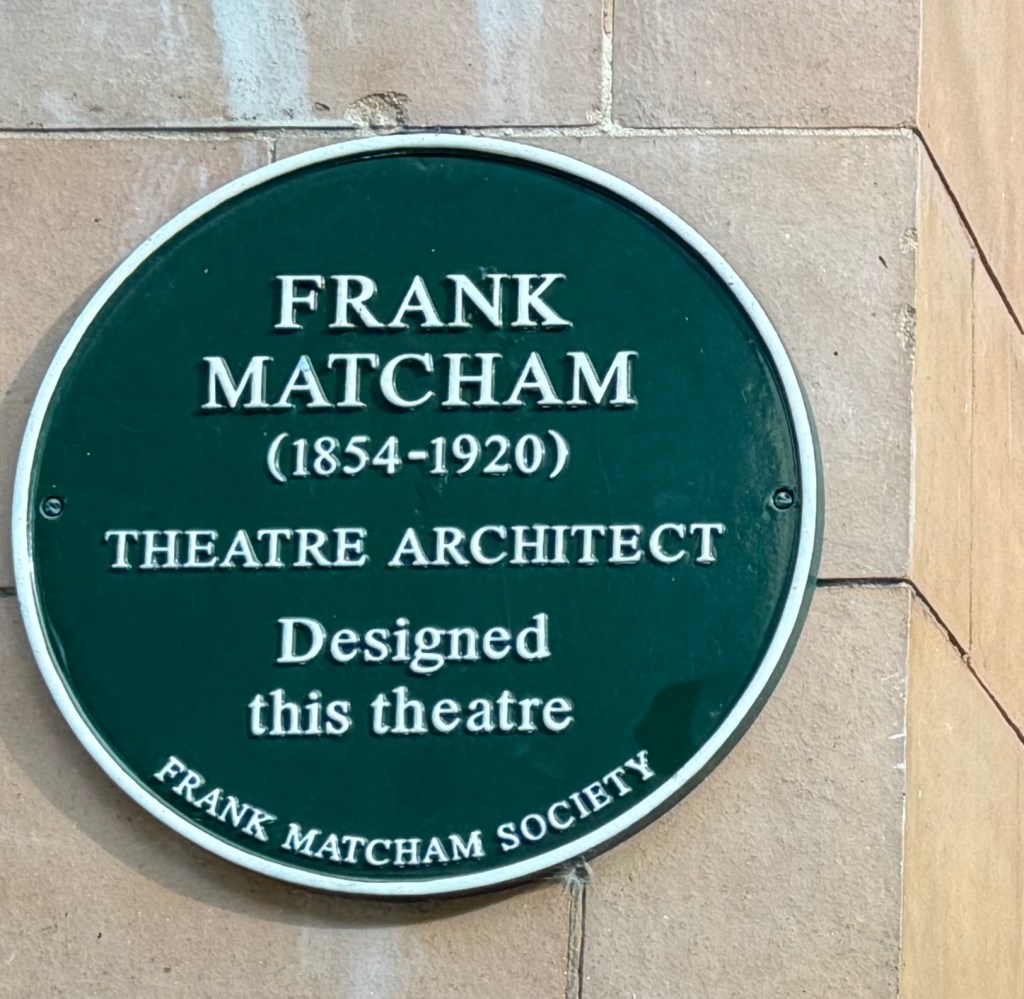
On Strictly recently, I tired of everyone saying what a thrill it was to dance in Blackpool’s “iconic” Tower Ballroom; yes, that’s one of Frank’s as well, though no-one mentioned it. However, he was the subject of a question on University Challenge on 2 December. Perhaps his fame is spreading.
What’s the local connection? Frank Matcham was born in Newton Abbot in Devon in 1854, but he retired to Southend and lived at 28, Westcliff Parade, just past the Cliffs Pavilion. He had a splendid view of the estuary flowing into the sea. No, he did not design Westcliff’s Palace Theatre – you can tell! He died in 1920.
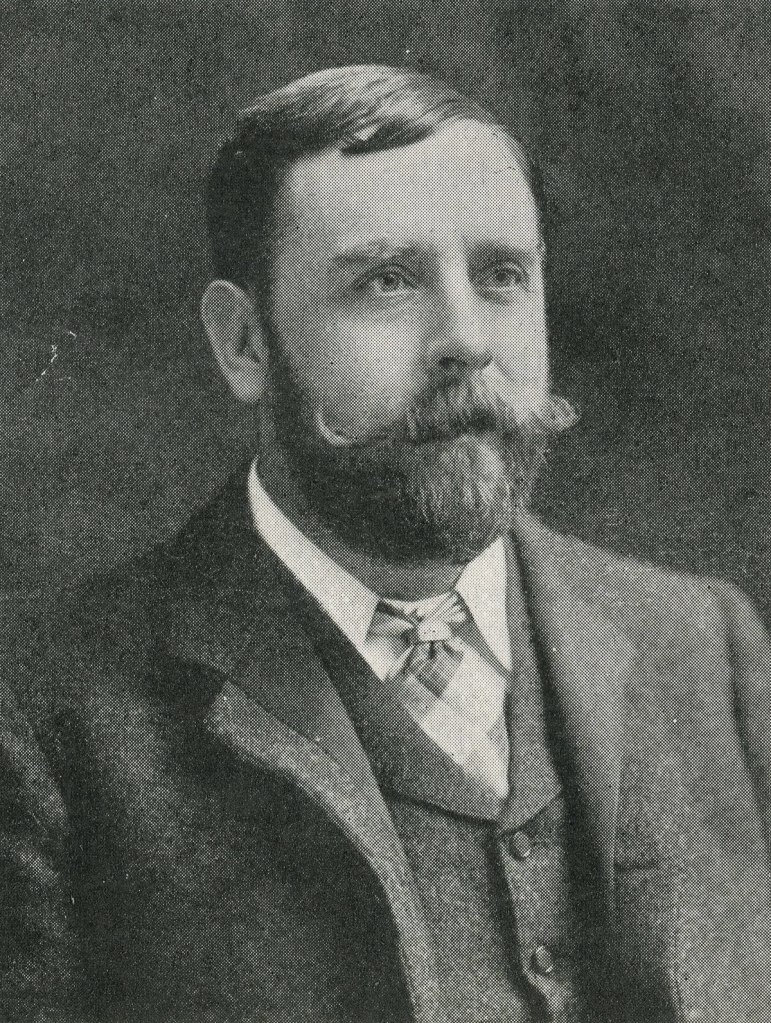
There is a plaque on his former home, installed by the Shorefields Conservation Area. I often mention this to people, and I’m always surprised that no-one knows who he is, and what a major figure he is in theatrical history. I think it’s a great shame that he isn’t more celebrated locally at least, and that’s why I’m taking this opportunity to thank Frank for our great seats at Hamilton.
22/10/24 Fredo writes –
TRISKAIDEKAPHOBIA

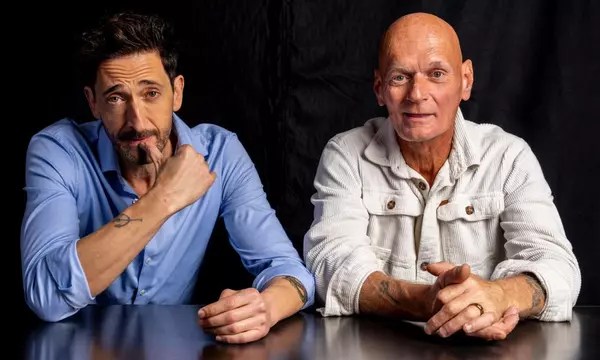
Adrien Brodie
with Nick Yarris
A much larger than usual crowd waited for the Q&A following the Supporters’ performance of The Fear of 13 at the Donmar. It had been a tense, absorbing evening, with gasps as the story unfolded, and the audience had been engaged throughout. Clearly they hoped to see Adrien Brody as himself, and not as Nick Yarris, whose story the play is based on.
However, Mr Brody didn’t join his fellow-actors, and I’m happy to give him a pass for that: he’d been on stage for almost two hours, had got soaking wet, and had spent at least the final 10 minutes of the play in wet pants. I was worried about him catching a chill, when he had another 7 performance to do that week.
It was left to Michael Fox, Aidan Kelly, Nana Mensah, Posi Morakinyo, Cyril Nri, Ferdy Roberts and Tommy Sin’aan to field the questions from Craig Gilbert, the Donmar’s Literary Manager.
Lindsay Ferrentino had based her play on two prison memoirs (you can buy them at the box-office) and a television documentary by Nick Yarris, who spent 22 years on Death Row for a crime he didn’t commit. The American prison system is tough, and the legal system very different from our own. Craig asked the actors what research they had done to prepare them for the play.
Cyril had previously appeared in a docu-drama, The Exonerated, which told the story of three people who had been wrongly arrested and who were eventually cleared of their crimes. He had done extensive work to prepare for that, and he drew on this information, as well as Nick’s accounts. Michael described the cast’s visit to the high-security Belmarsh Prison. This was a humbling experience, to see the conditions in the the jail, and to witness the relationship between the inmates and the guards. He was impressed by the care that the guards showed for the trusted prisoners.
Cyril Nri

Nana Mensah
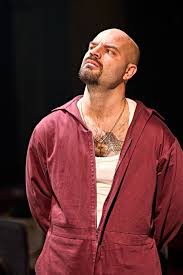
Tommy Sim’aan
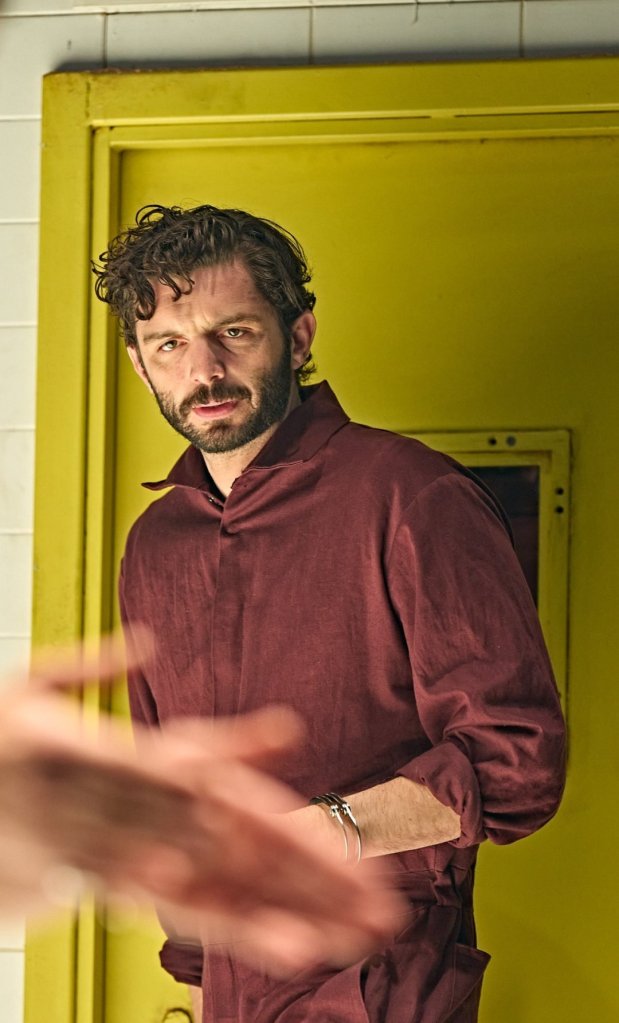
Michael Fox
Although the play is based on fact, Nana emphasised that her character, Jackie, was highly fictionalised, and that the real-life Jackie had not been involved or co-operated in the writing of the play. All the cast had watched Nick’s documentary, and they had had a Zoom meeting with him. One of the cast was not susceptible to their protagonist’s appeal in person: he found the documentary unconvincing, and he and another cast member admitted that the Zoom session, intended as a Q&A, had developed into a monologue from Mr Yarris. This didn’t surprise me. People who have suffered trauma often become single-minded in their quest for vindication, even when the events that caused the upheaval have long passed. Nana added that she had found Nick both plausible and charming; he attended the press night, and complimented her on her performances. Aidan laughed: he plays Nick’s adversary and he said Nick had behaved as though Michael was his greatest enemy.
The rehearsal period with director Justin Martin had been rigorous. There was no table-reading; the cast were on their feet from day 1. In addition, a lot of work was done outside the rehearsal room, and nuance was added quite late in the process. As all the men, except Adrien, play multiple roles, they had to differentiate, and to be aware that their characters were seen through Nick’s eyes. The play is fast-moving; do they play it the same way every night? Yes, replied Nana – and it breaks her heart.
And Triskaidekaphobia? It’s the fear of the number 13. When Nick was in prison, he became obsessed with words, and this is one he learned to identify his own fear. It isn’t in the play. You’ll have to read the book to find out.
11/10/24 Fredo writes –
Watch the Skies!
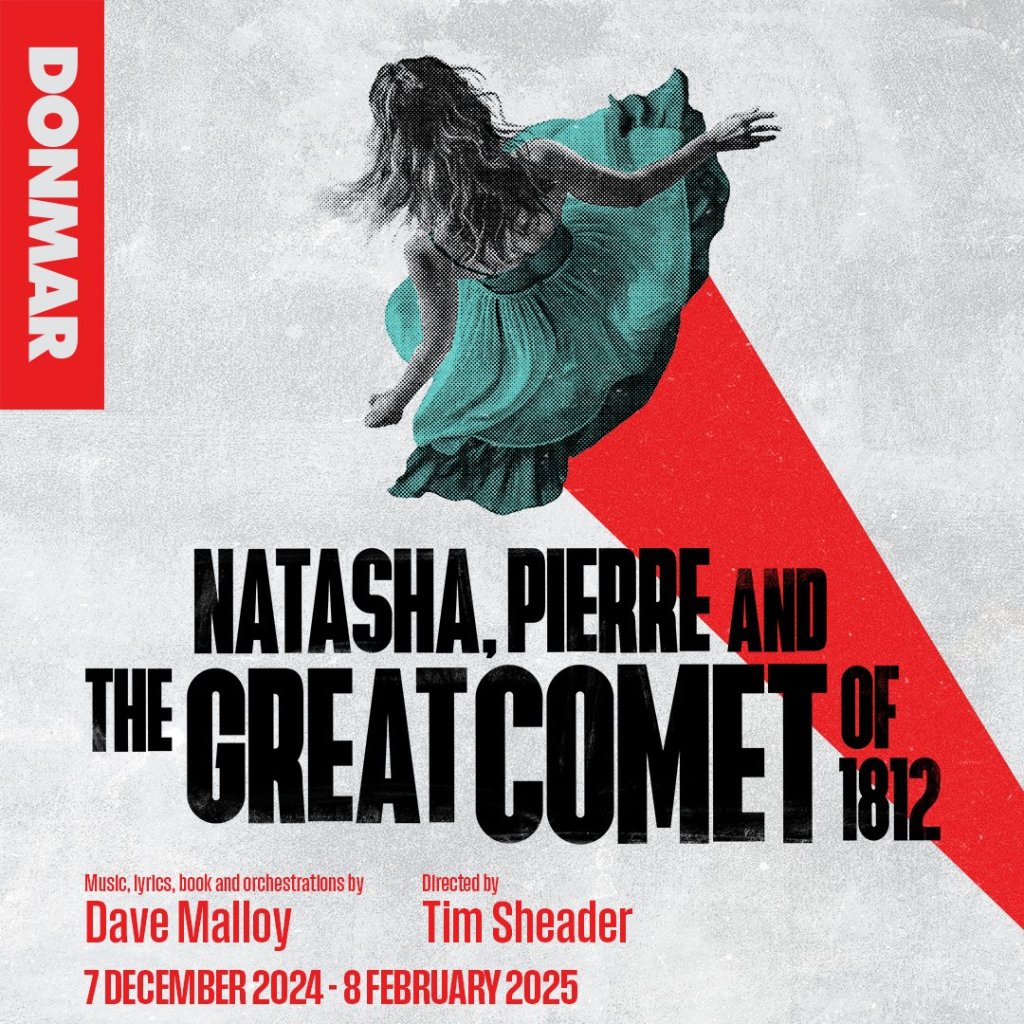
I was suffering only slightly from imposter syndrome as I pushed open the door of the glamorous Ivy Club in West Street and climbed the opulent staircase, It’s a classy joint; would they turn me away? I know now that the classier the place is, the better they treat you. And I was only slightly gate-crashing the presentation by the Donmar for their forthcoming production of Natasha, Pierre and the Great Comet of 1812.
.
As soon as I found myself in the right room of the deceptively spacious club, I was welcomed by our friends on the Donmar team. Mike had to miss this event as was seeing The Real Thing for a second time. Everyone there was eager to hear from Artistic Director Timothy Sheader about this new production. It will be the first show Tim himself will direct at the theatre since he took over from Michael Longhurst. Why this one?
Tim’s ides were quite clear: he wanted to use the Donmar space to present Dave Molloy’s unique show in a way that the theatre had never been used before . It will have a big cast of 12 singers, 4 understudies and 10 musicians, some of whom will take part in the action. While the stage will have the normal three-sided configuration, there will be full use of the auditorium (but no audience participation required, mercifully). And no, he hadn’t seen the New York version, but he invited Declan Bennet to tell us about it.
Declan, who previously worked with Tim at Regent’s Park in Jesus Christ Superstar, was in New York when Natasha (to her friends) opened at the tiny, 60-seater Ars Nova Theater way off Broadway. There was an immediate buzz about it, and not a ticket to be had, so it transferred uptown to a tent, and then to a Broadway theatre, getting bigger and bigger on its journey.
Now Tim wants to bring it back down to size, but it will still be a big show in a small space – always an exciting dynamic. Tim wants to feel the excitement that the Donmar’s proximity between performer and audience engenders and feels that the multi-genre score and the mixture of action incorporating the interplay of characters with direct address to the audience will be galvanising.
It was time to hear the songs: Chumisa Dornford-May will play Natasha, and I’ve no doubt her name will be on everybody’s lips when the show opens. Her aria – and that’s what it was – expresses the nervous and confusion of a young woman experiencing love and sexual longing for the first time. We were spellbound as her voice filled the room.
Declan will play Pierre, an older man who sees that Natasha is skirting danger with her infatuation for the rakish Anatole, followed with another aria. He has a powerful voice and it was a demanding number, and he delivered it with ease.
Craig Gilbert, the Literary manager at the Donmar, asked the cast how they felt about Tim’s approach to the show. Maimuna Memon, who had played Mary Magdalene for Tim in Superstar, said that she couldn’t wait. In fact, she knew the show very well, and when she heard that tIm was directing him, had sent furious e-mails telling him she had to be in it. Tim smiled, and said that they had always earmarked the role of Sonya for Maimuna.

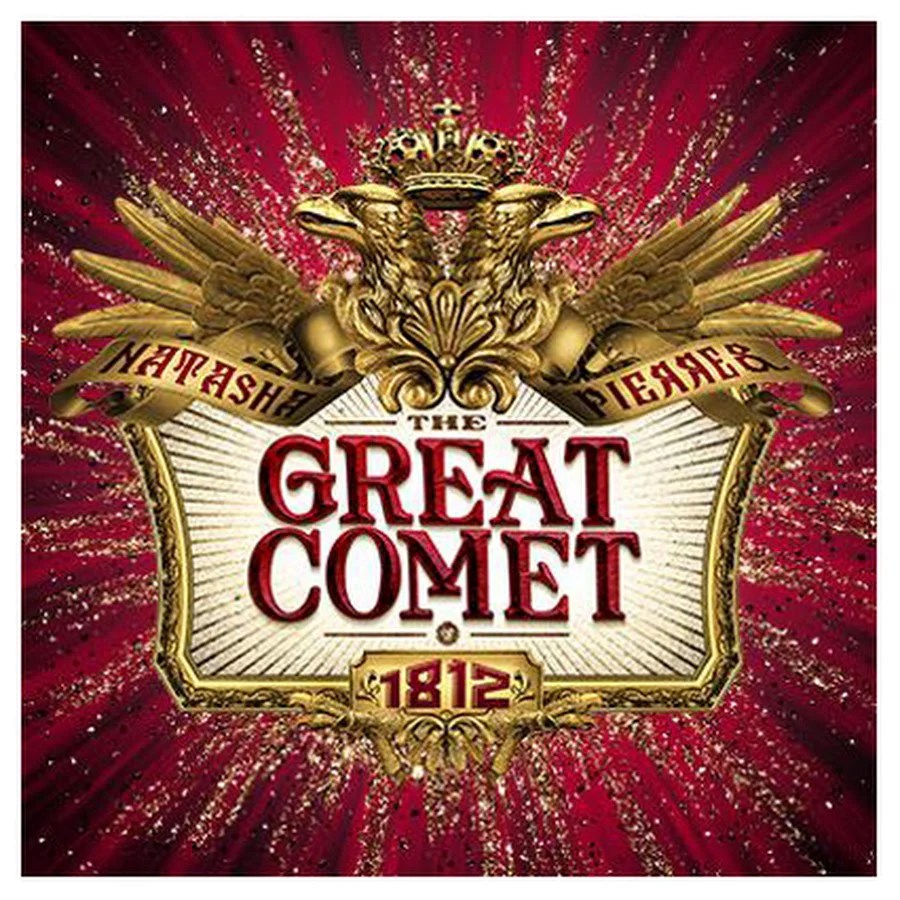

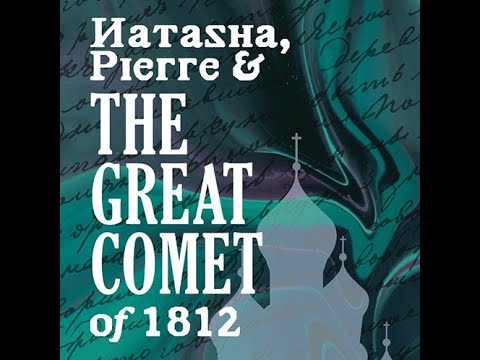
Ads for various previous
productions in the USA
Tim explained that while the show is based on a small section of War and Peace, it focuses on what happens to Natasha, but is really about the impact that this has on Pierre. He hinted that it may not have the same resolution as Tolstoy provides in his epic novel.
We were reminded that Tim had not rehearsed the singers for this presentation; what we were hearing was all their own work. Cat Simmons will play the vampish Helene, sister of Anatole, who aids and abets her brother in his seduction of Natasha. I would suggest that Tim has little work to do with Ms Simmons, whose powers of seduction already appeared very much at the ready. My friend Jan and I agreed that there was a definite sound of the great Patti LaBelle in her voice.
The evening ended with Maimuna singing as Sonya, cousin to Natasha, who vows to protect her from Anatole. Maimuna is blessed with a pure and beautiful voice – listen to her sing Open Up Your Door from Standing at the Sky’s Edge and you won’t disagree. (Here’s the LINK)
Four singers with sensational voices – Tim will have to find another 12 of equal calibre. When Pierre gazes at the firmament to find the Great Comet, they should blow the roof off the Donmar.
Watch the skies!

Declan Bennet

Maimuna Memon,
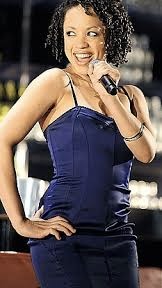
Cat Simmons
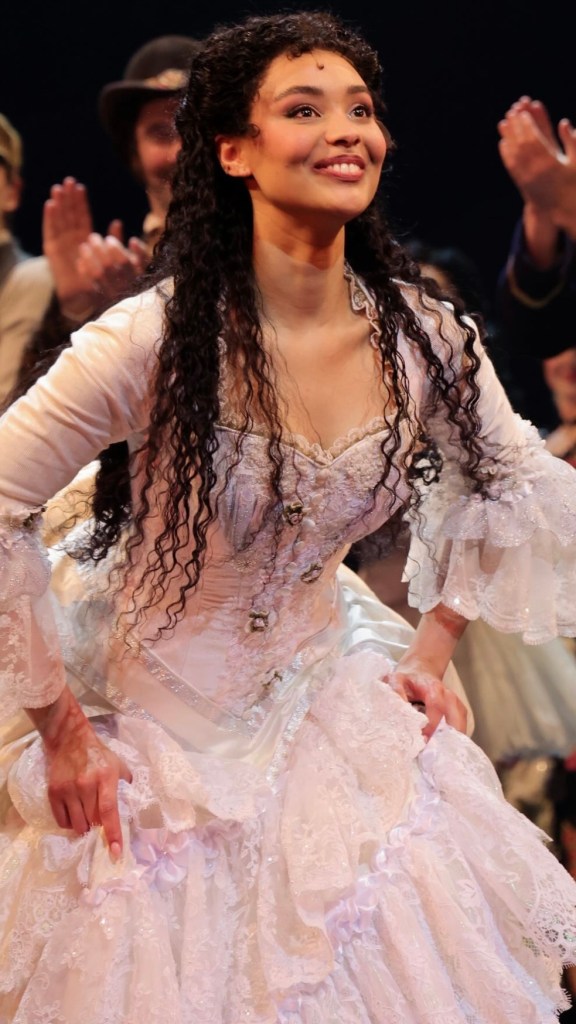
Chumisa Dornford-May
29/09/24 Mike writes –
Maggie Smith has died
In recognition of this theatre legend, the West End’s lights will be dimmed this Tuesday evening (1/10/24). Thankfully her performances will live on in this digital age, and in the memories of every theatregoer who ever saw her. I think I first encountered that magical stage presence when she played Desdemona to Olivier’s Othello (1964} and then lastly, dozens of roles later, alone on stage, she held me and every audience member transfixed in A German Life at the Bridge Theatre (2019). For decades she has been one of that small group of actors one has to see, no matter the role, because she could do it all, do it right, and yet it would always be done reliably her way. For laughter or tears and emotions between, she always found a sardonic touch all her own to add edge to every performance. On screen her fans multiplied by millions, but on stage, in her presence, that electric spark never dimmed – it was very special, it was all hers, and she was ours. She will be remembered for as long as anyone cares about the Theatre.
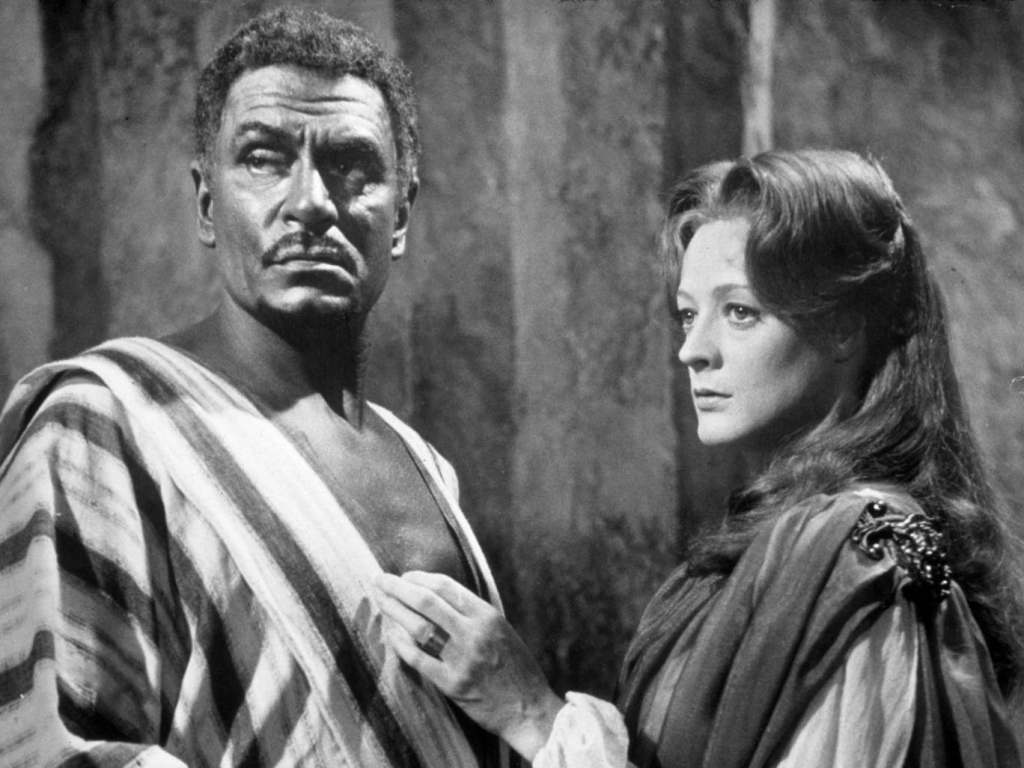
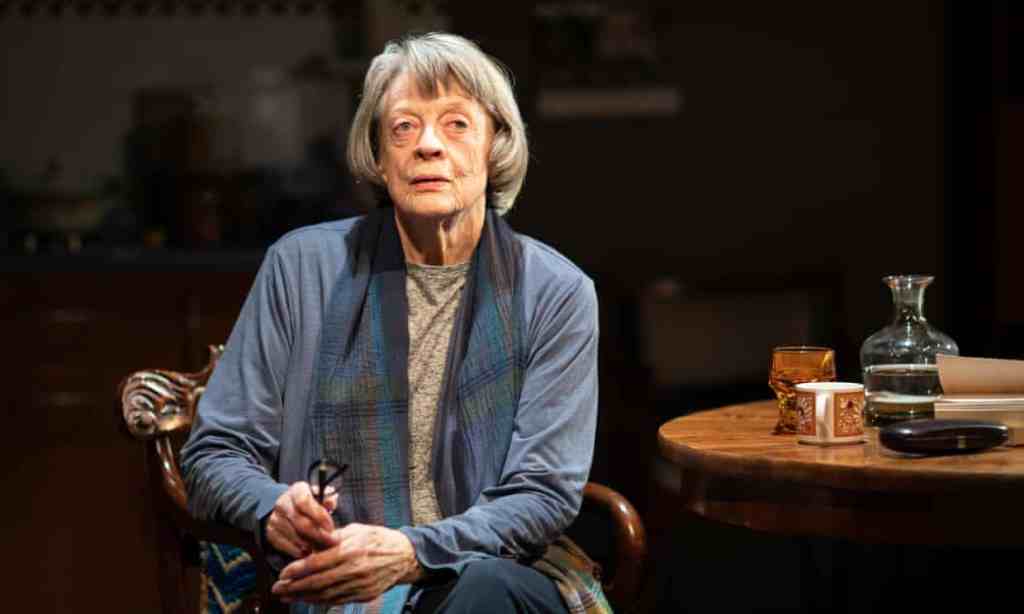
With Olivier in Othello + A German Life
26/09/24 Fredo reminisces –
I’ve seen ’em all…
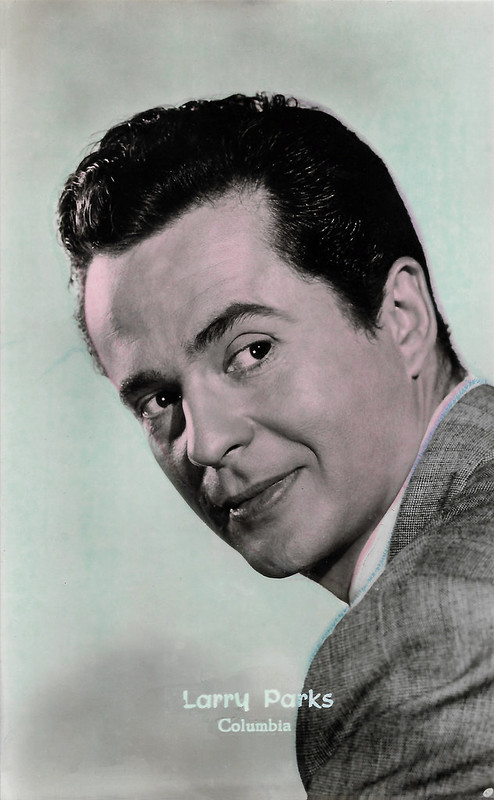
We’ve been to the Orange Tree Theatre in Richmond to see Here in America, a new play centred on the anti-Communist movement in America in the 50s (see my review on the OnOurOwn page: click LINK). One of the people who gets name-checked is the almost forgotten Hollywood star Larry Parks, who was blacklisted though he had played the title role in The Jolson Story and Jolson Sings Again. I reminded Mike that we had met his widow and son in New York.
About 20 years ago, Matthew Warchus directed a revival of Follies on Broadway. Lines of the lyric of the song I’m Still Here in that show hint at the blacklist – see foot of this article.
As I have mentioned many times before, I think Follies is the greatest masterpiece of musical theatre. Mike is also a huge Sondheim fan, and we planned our visit to New York to coincide with the show.
Warchus had assembled almost the starry senior cast that Follies requires for its retired showgirls, although in the end it looked as though that had absorbed the budget, and it didn’t have the lavish splendour that Dominic Cooke was later allowed at the National. Even so, we were excited, and on our first night in New York, after we’d eaten and though it was 11.00pm, we headed for the Belasco Theater on W44thSt to look at the production photographs.

Although it’s the city that never sleeps, that stretch of W44thSt between 6th and 7th Avenue was deserted, except – just ahead of us – an older woman was walking with a younger man. “That’s Betty Garrett,” I told Mike, because – and nobody believes me – I recognised her by her figure and her deportment. She always had that body profile of Empress style perfume bottles so beloved of our mother’s generation (and I used to have an eye for the deportment of certain actresses – Ms Garrett, Paulette Goddard, Romola Garai).
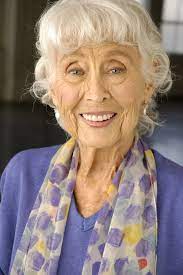
Betty Garrett
We caught up with them, and introduced ourselves, and told them that we had come from London especially to see Follies, and were looking forward to her rendition of Broadway Baby. She was pleased to stop and chat, introduced us to her son Garrett Parks, asked us if we lived in London, and went on to reminisce about touring the north of England when she and her husband Larry Parks couldn’t get work in America. We talked for 10 or 15 minutes, and I was thrilled to bits.
The next evening we saw Follies, and of course waited on the street afterwards. The sidewalk was packed with other fans, and what a night it was, as other grandes dames had chosen that night to see the show. Cast members mingled with their visitors. Polly Bergen (who appeared with Doris Day in Move Over, Darling and in Cape Fear with Gregory Peck and Robert Mitchum) held court as she had the show’s showstopper I’m Still Here, while Ann Miller, Celeste Holm and Marge Champion streamed out of the theatre. I felt very smug when Garrett Parks pointed me out to his mother and said, “There’s that nice man from last night.”
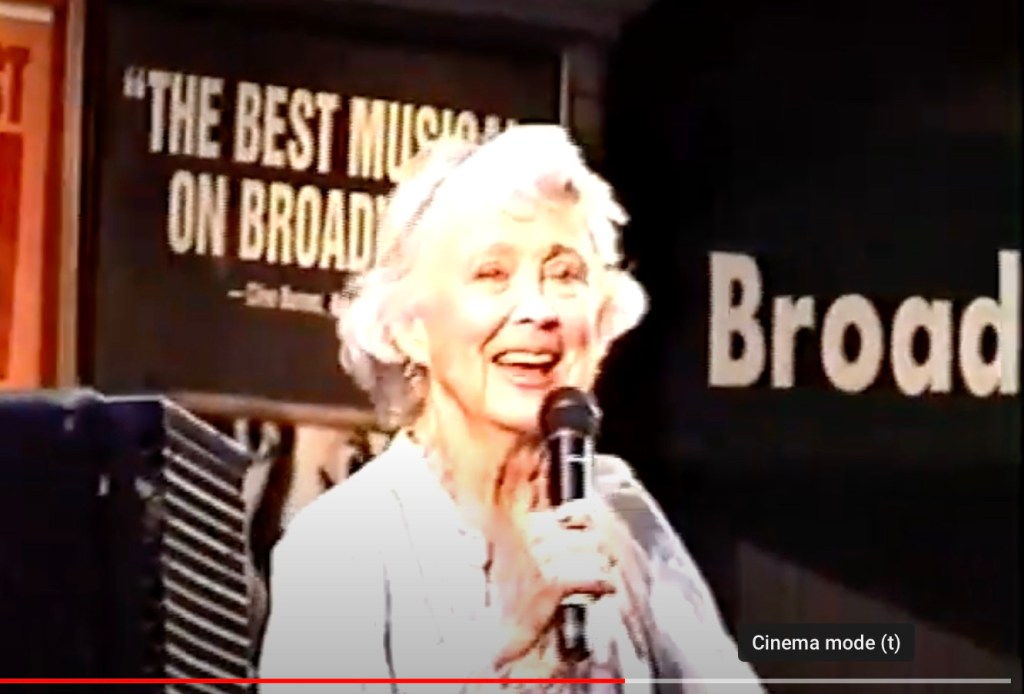
Betty Garret sings Broadway Baby outside the theatre: Click for video LINK
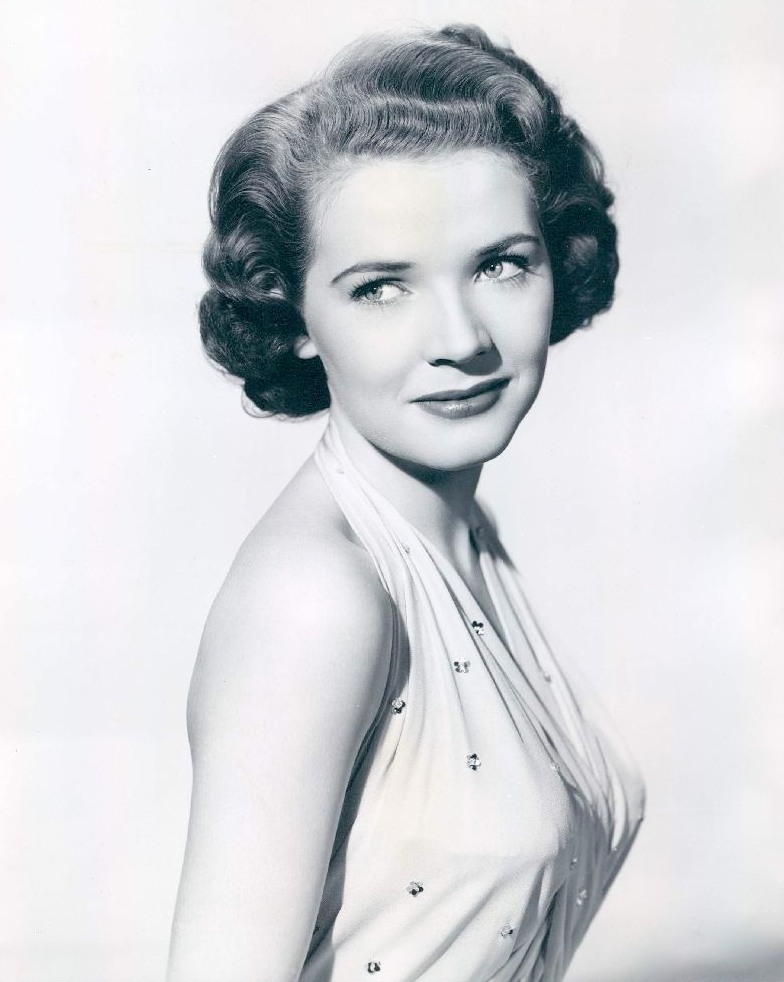
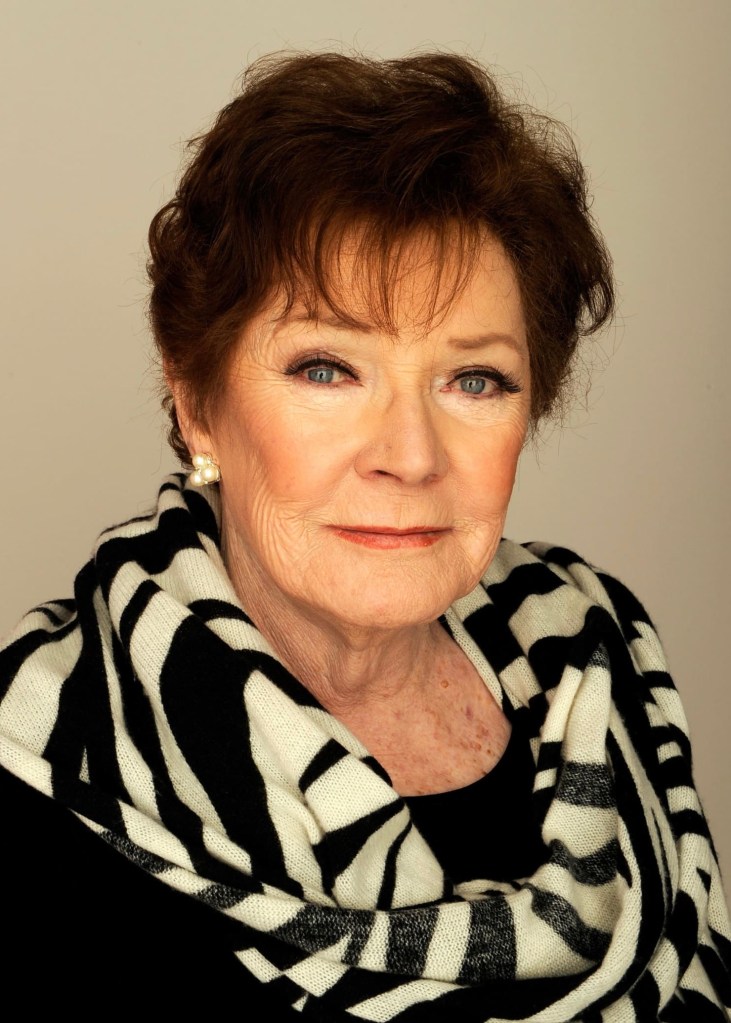
Polly Bergen

Ann Miller
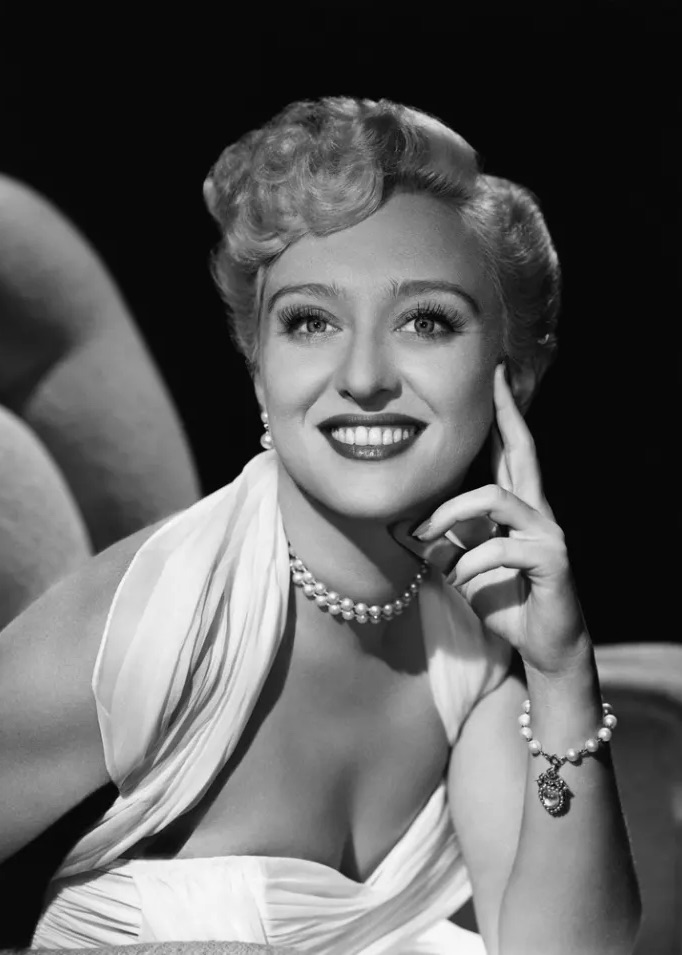
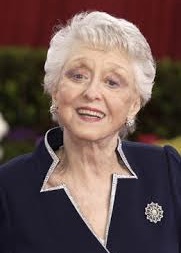
Celeste Holm

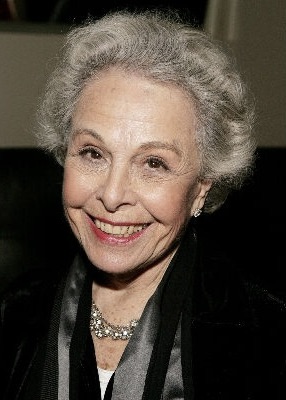
Marge Champion
But who are these other names, I think you may ask. You may know Ann Miller, the fastest tap-dancer of her time, and who’d appeared with Betty Garrett in On the Town. Celeste Holm brought grace and elegance to the screen, and is probably best remembered for duetting with Frank Sinatra on Who Wants to be a Millionaire? in High Society. She also shared the screen with Bette Davis in the famous scene in All About Eve, when Davis, as Margo, contemplates her life: “Funny business, a woman’s career. The things you drop on the way up the ladder, so you can move faster. You forget you’ll need them again when you go back to being a woman.”
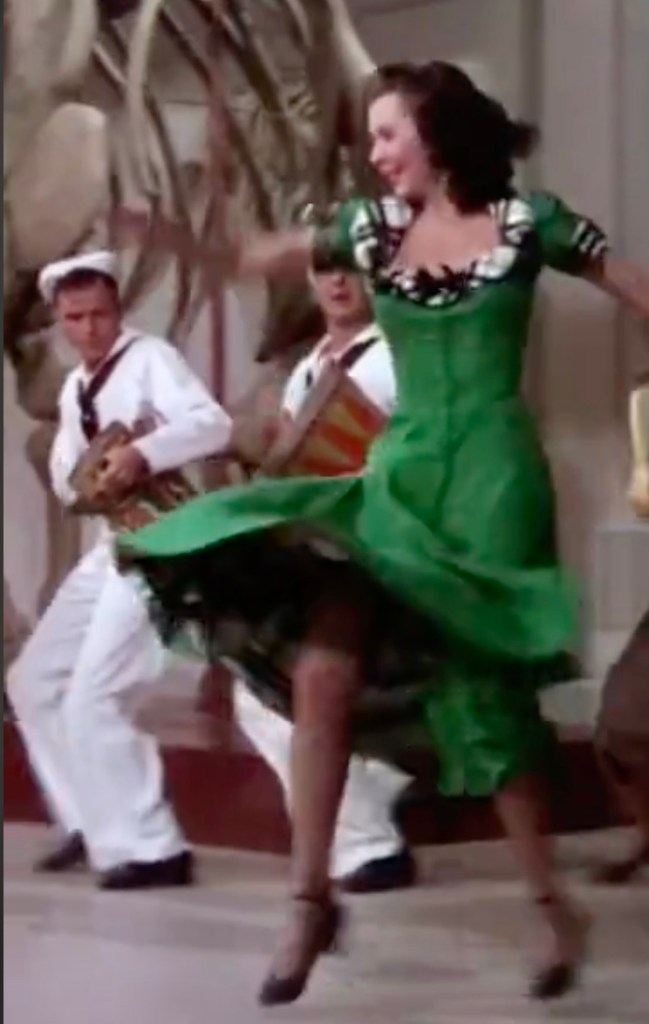
On The Town:
Click for video LINK

Celeste Holm and Bette Davis –
All About Eve: Click for film clip LINK

Marge Champion –
Life Upon The Wicked Stage:
Click for sound clip LINK
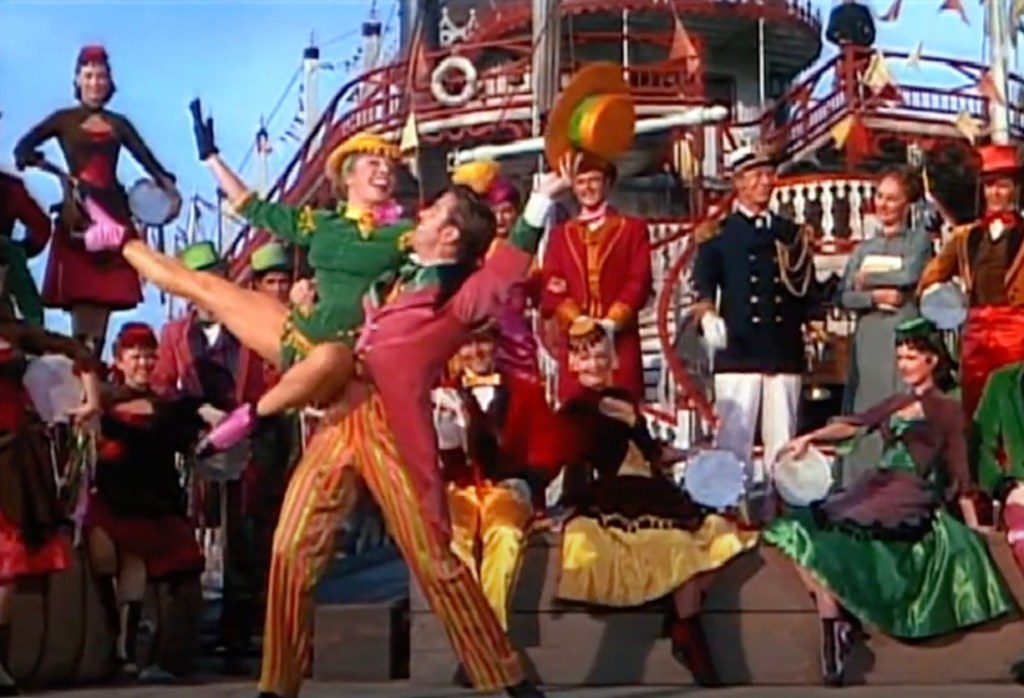
Marge and Gower Champion –
Showboat: Click for film clip LINK
I asked Ms Holm for her autograph, and she asked me for a dollar. She’d recently had a stroke and she was difficult to understand (she later made a remarkable recovery), so her son explained that she charged a dollar for her autograph and donated it to UNICEF, as she was one of its ambassadors.
My big moment that night was talking to Marge Champion. As a young girl, she’d been the dancing model for Disney for Snow White, and later she and her husband Gower Champion were a speciality act at MGM (he went on to direct Hello, Dolly! and 42nd Street on stage). They have a breath-taking routine in the 1950s version of Show Boat, so of course my opening line with her was, “Excuse me, Ms Champion, is Life Upon the Wicked Stage Always what a Girl Supposes?” and she turned to me and said, “Do you know, the last time that show was on Broadway, they cut that number?”.
It was a very exciting evening, and it was great to brush up against these people who to me were legends. In Sondheim’s words: “Lord knows, at least I was there – And I’m here! Look who’s here! I’m still here!”
I’ve gotten through Herbert and J. Edgar Hoover,
Gee, that was fun and a half.
When you’ve been through Herbert and
J. Edgar Hoover,
Anything else is a laugh…
Been called a pinko / Commie tool,
Got through it stinko / By my pool.
I should have gone to an acting school
That seems clear.
Still, someone said, “She’s sincere” / So I’m here
I’m still here!
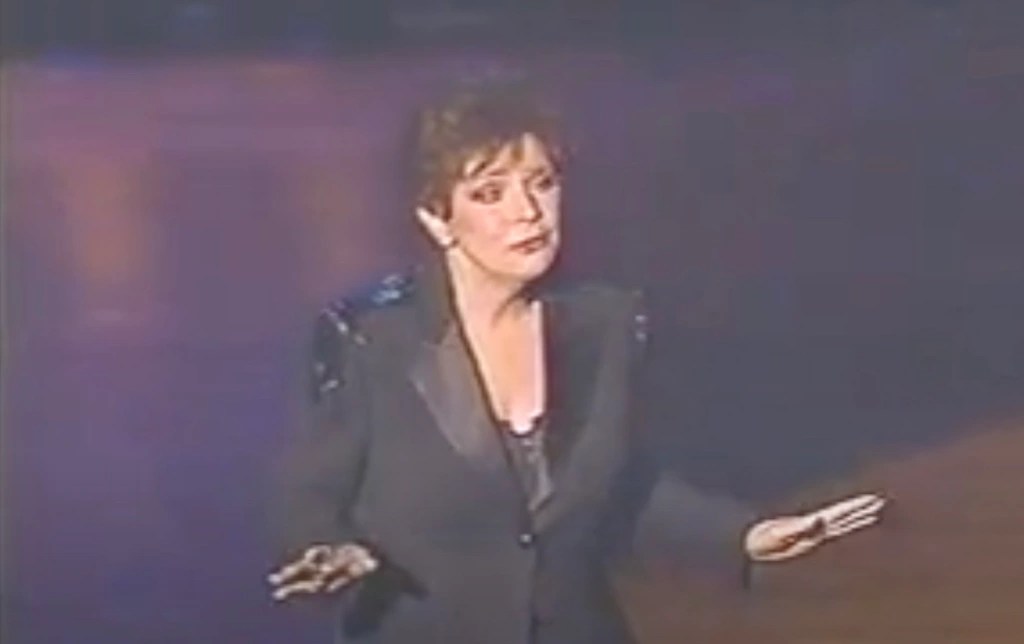
Polly Bergen –
I’m Still Here from Follies:
Click for video LINK
12/08/24 –
The Years experience
You may have read of audience members fainting during The Years at the Almeida, a controversial stage adaptation of Annie Ernaux’s book of the same name. She won the 2022 Nobel Prize for Literature. We shall see the play shortly, but in the meantime a good friend of ours has told us of her own theatre experience. She was seeing it with a female friend –
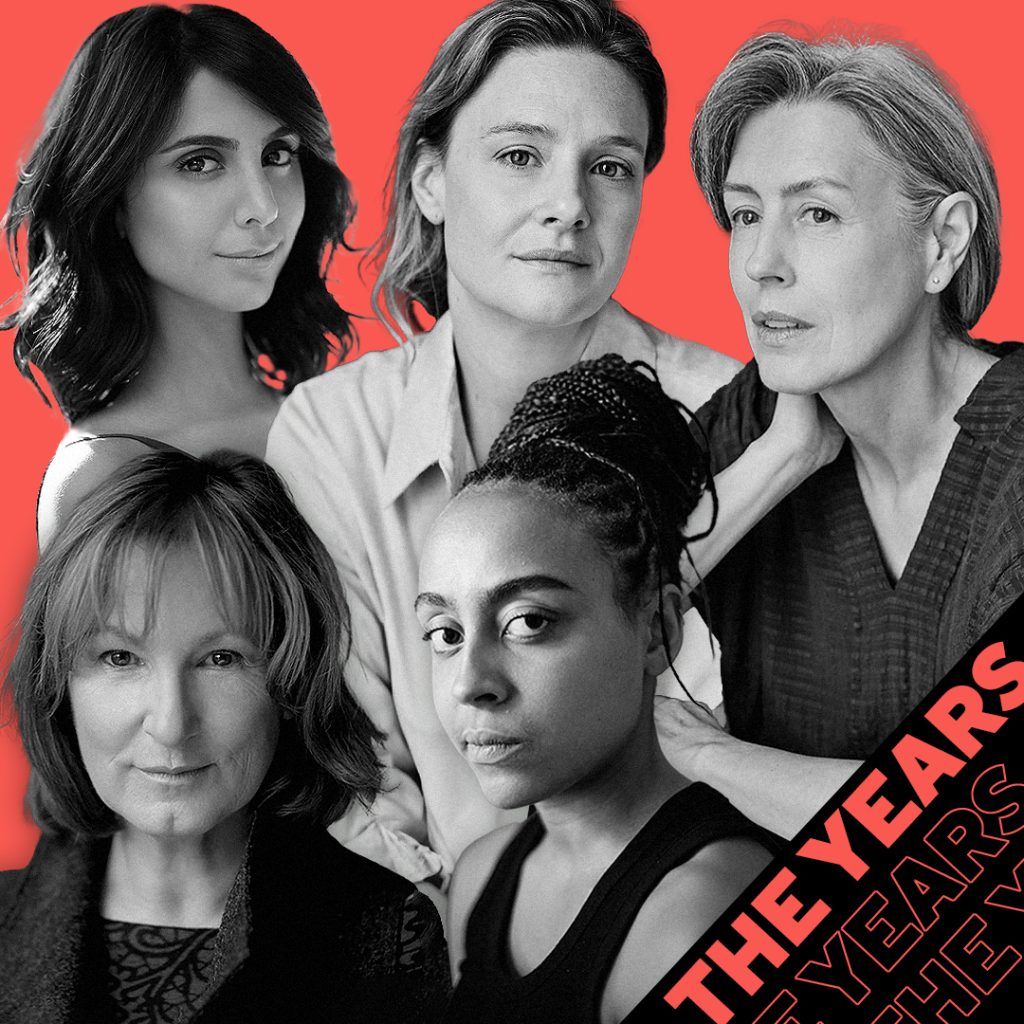
“Well, the sobbing started about half way through the ‘abortion’ scene. It was loud, in the stalls, and we thought we heard Romola Garai swear under her breath (we were sitting in the Circle) and then she walked to the side. The stage manager came on stage and asked us all to stay where we were while they helped a “distressed audience member”. During this pause a young woman in the front row of the Circle and a middle-aged woman to the left side both got up and left. Quite how Romola Garai picked up again in the middle of a very emotional and hard-hitting scene (it was a detailed and bloody abortion scene) is testament to her professionalism.
Having watched The Years, I was reminded of reading Middlemarch – It is probably much better appreciated by people who have lived a bit and, like the playwright Annie Ernaux, have fewer years ahead of them than behind. Annie Ernaux is a few years older than I am, but the historical, political and even domestic references, though from a French angle, really resonated with me. It is also about the only play I have seen where everything is seen from a female perspective. Along with the harrowing bits, there are some very funny bits.
All the five actresses play the central character at her different ages, as well as all the other characters in the play! I liked the direction, I loved the use of the succession of white tablecloths that grace the family table (so French, the family table) and the fact that as each scene ends often as a bit of a mess (rather like life) so the ‘Annies’ clear it up! There is a lot of what the Almeida Theatre terms ‘sexual content’ throughout. But I think you will cope!! I don’t want to mention anything more about particular scenes as it will spoil it for you, so I will just return to the notorious scene you have heard all about.
Attending the play you can be under no misapprehension that there are potentially very upsetting scenes. Apart from the first email detailing this three days before the performance, then another email on the day, there are signs up in the foyer – and in the Ladies’ loos. (Don’t know about the Men’s!) For the woman who was sobbing, I wondered whether she had perhaps suffered a miscarriage (or perhaps she had had an abortion but thought she could cope) as the language in the scene is descriptive as well as bloody.
The audience was heavily female, old (like me), and gave the cast a terrific reception (a standing ovation of course). The opening lines, and the end of the play, I found moving. Some people were quite emotional. When we got outside, we decided we needed to have a debriefing session. My friend needed a drink I think (there was so much to think about) but she settled for a cup of tea.
We walked to the tube and were still talking….. I think I shall have to read the book by Annie Ernaux, though probably the adaptation will have been different. I look forward to reading the critics and I shall be interested to note any differences between male and female reviewers. I think the play and production will stay with me for a while. The Years challenges its audience, something that I realise has been largely missing in my recent theatre-going.”
(One of the theatreguys will be commenting further on the play later.)
04/07/24 Fredo writes –
Looking Forward with the Donmar: New Director, New Season
It’s always exciting when the National or the Almeida or especially the Donmar reveal what plays they’re going to present in their season. Anticipation mounts, and it’s time to get out diaries and plan important theatrical events. Fortunately, I was armed with my Academic diary for 2024-25 when Mike and I made our way to the Guy-Whittle Auditorium at 1 Wimpole St to find out what the Donmar has planned for the next year.
This was also our first opportunity to see the new Artistic Director in action. Timothy Sheader had held this post at the 1,300 seater Open Air Theatre at Regent’s Park for some years; why, asked Literary Manager Craig Gilbert, did he want to come to work at the Donmar?
Tim replied that he had seen shows at the Donmar for 23 years, and respected its pedigree and history. He always approached it with a feeling of expectation and excitement about the connectivity with the audience that this intimate theatre affords. It’s all about connecting the artist to the audience, and his vision for the Donmar is to become an extension of this. He wants to programme plays that will bring us together, not divide us, plays with ideas yet are not didactic.
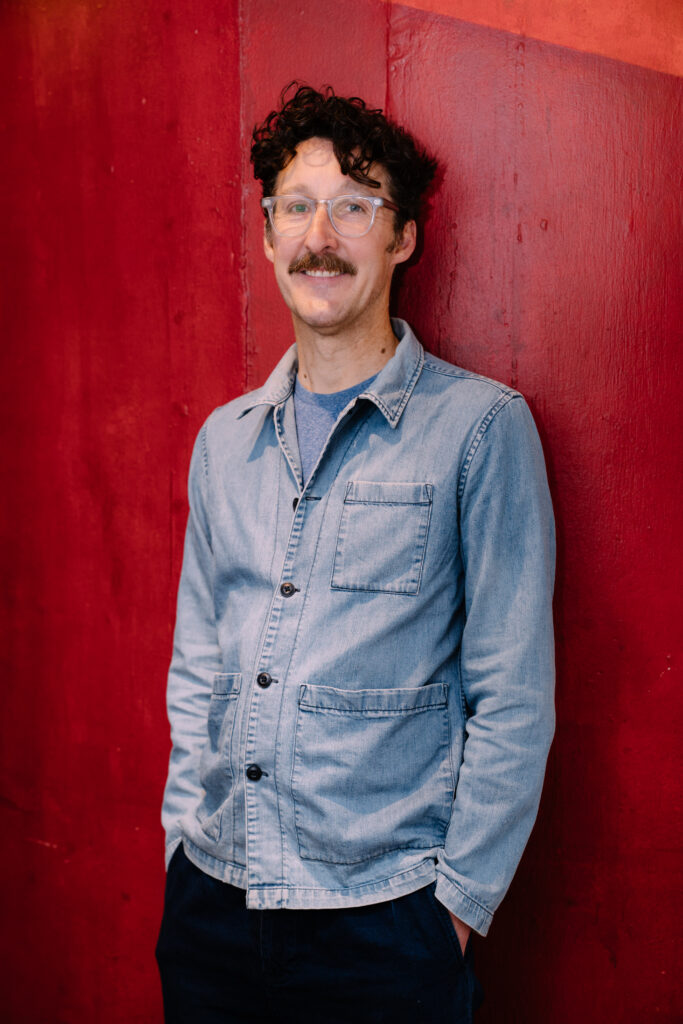
Photo: Helen Murray
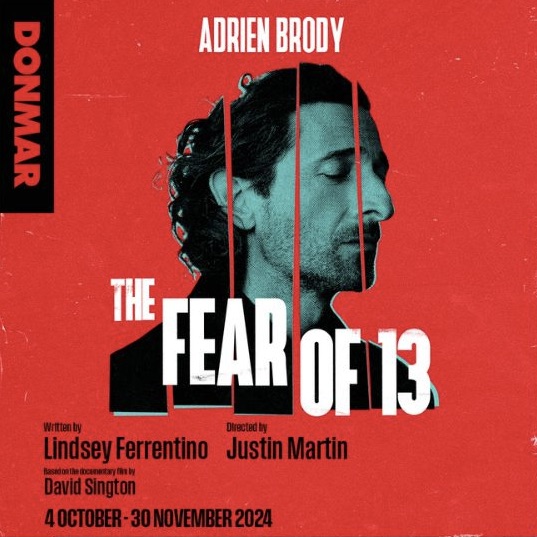
This, then, was the moment to talk through the four plays that will make up his opening season. First up is The Fear of 13, a new play by Lindsey Ferrentino based on a documentary film about a prisoner Nick on Death Row. He was stopped for a traffic infraction, and this somehow led to a murder conviction.
At this point, Titas Halder, the Associate Artistic Director, jumped in. He had been with his wife and 3-day old baby in the maternity ward, at 3a.m. when he noticed that Tim had e-mailed him the script. He glanced at it, started to read, and it held him intently till he got to the end.
Both Tim and Titas were excited about the casting of Oscar-winner Adrien Brody (The Pianist); he was their first choice, and they thought they’d give it a shot at asking him. Tim said there’s often scheduling conflicts, movie deals and dental appointments that get in the way, but Adrien accepted within 9 days (further casting tba).
The Executive Director Henny Finch had whispered to us that this season would contain a musical, and given the Donmar’s great success with musicals (Parade, The Band’s Visit, Next to Normal), we couldn’t guess what they would choose. We didn’t expect it to be the catchily-titled Natasha, Pierre and the Great Comet of 1812. Tim will direct this himself, and it is the British (and possibly European) premiere of a hugely successful show that started life off-Boadway, then moved to a NY tent, and then into a Broadway theatre. Dave Malloy, the man responsible for music and lyrics, has based this extraordinary show on 7 chapters of War and Peace – I’m sure you all know which ones. Casting is going on at the moment for 12 multi-talented performers.

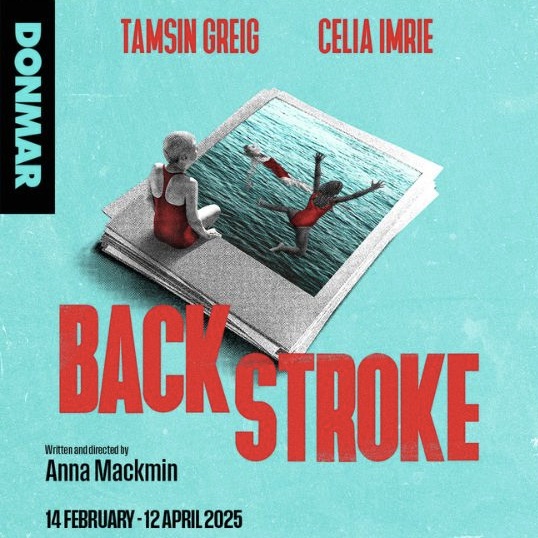
Tim handed over to writer/director Anna Mackmin to introduce her play BackStroke. Anna explained that her drama is based on personal experience, yet is entirely made up. Her mother died shortly after having had a stroke, and Anna wrote a speech for the funeral. Her mother liked to make lists, and following the stroke, this had grown to an obsession, so Anna cast her eulogy in the form of a list. Well, they say about writers that everything is material, and she thought this was too good to waste, and the idea of the play started to grow.
It’s a play centring on three generations of women – mother, daughter and grand-daughter – and it’s not so much about death and dying as about life and living. Tim praised its joy, complexity and compassion. With Tamsin Greig and Celia Imrie leading the cast, it’s sure to be a great success.
The final play is Intimate Apparel starring Emmy Award winner Samira Wiley. This touching period piece about a seamstress, set in New York in 1905, reunites writer Lynn Nottage with director Lynette Linton following their work together on the sensational Sweat and the heartwarming Clyde’s. But that’s not until June next year!
In the meantime, the Donmar continues its education work with schools in Camden and Westminster. Associate Director (Participation) Phil McCormack described with great excitement the current Schools’ Tour of Macbeth: Something Wicked and lamented the fact that 68% of pupils in the schools they visited had never been to the theatre, despite living within a stone’s throw of the West End. To help rectify this, the Donmar will offer two free performances for each of its plays this year to these schools.


Wiley / Brodie / Imrie / Grieg
We were reminded that the Donmar receives no national or local government grant, and that only 60% of its income comes via the box-office. The shortfall is made up by supporters and donors, for which they are truly very grateful.
At the reception afterwards, Mike and I enjoyed a long chat with Titas and Anna. In the various roles they have held in different theatres, they have become experienced play readers. How quickly, we wanted to, know, do you know if a play is any good? “Almost right away,” said Titas. “You can usually tell on the first page. And then if it grips you and you read on, you’re praying “Don’t disappoint me!’” Anna concurred, but added that she has a 10-page rule. If she’s not convinced after 10 pages, out it goes. I think I should apply this formula to all those books waiting to be read…
It was a fascinating evening. Both of us were impressed both by Tim Sheader’s clear vision of how he wants to lead the Donmar, and by his warm personality. And it was a pleasure to spend time with Titas and Anna.
And the good news is that we have secured tickets for all 4 plays. The dates will be announced soon. As always, Donmar Friends will be offered priority booking, and I think demand will be heavy for most of these shows. Watch this space!
14/06/24 Mike writes –
A Kiss distracts from The View
A kiss on the lips may be quite controversial…..but especially these days after that fiasco at the women’s football in Spain. Even more-so than a man kissing a man, now commonplace on all television channels.

Photo: Mike Richardson
Of course it depends on circumstances. And society. And times, which have changed since this play was written. I mention kissing in this context as A View From the Bridge (Haymarket Theatre) has a crucial kiss, so unexpected and so shocking that it pivots the play. It must be difficult for any director to decide how to present this scene today, to anticipate how an audience will react. In this great revival, either the director or the audience got it wrong.….there was laughter! Oh no, this must not happen!
A View from the Bridge is a classic, one of The Great Plays, up there with the greatest, but it is very much a play of its time, the 1950s. The time, the people, the social and financial situation, all these aspects of Life back then are present on stage and they reverberate down the decades to Today. A few years back the adventurous (but now devalued) Ivo Von Hove directed it at the Young Vic and created what remains the definitive version. It was highly stylistic in presentation and emotionally devastating. Now, Lyndsay Posner, a more traditional director, has gone back to a more realistic style, just slightly heightened, with grounded performances and a simple but representative natural setting. It’s a production that slips very comfortably into the Haymarket Theatre where traditional ‘safe’ theatre used to live. Yes, times have changed, even the Haymarket Theatre has changed hands and broadened its repertoire, and yet this production does seem a perfect fit even now. The general audience obviously loved it, giving a deserved standing ovation. So why am I so concerned about a kiss?
There were actually two kisses here (and there are SPOILERS ahead). The jealous Eddie Carbone (played plausibly and magnetically by Dominic West) kisses his niece Catherine on the lips. There’s a shocking intake of breath from the audience realising he has overstepped the conventions of both the 1950s and the 2020s. This kiss is not written into Arthur Miller’s script – it is an invention of the director, and not necessary. We understand the situation and do not need it underlined.
A moment later, he then unexpectedly kisses her boyfriend Rodolpho aggressively on the lips too, as an insult, as an accusation of unmanliness, as an exercise of power, even as a subconscious reaction to his own feelings of jealousy and unrealised desire. Carbone feels that his family does not give him the respect he thinks he deserves, and with this kiss he wants to show his disrespect for Rodolpho. And there was laughter.
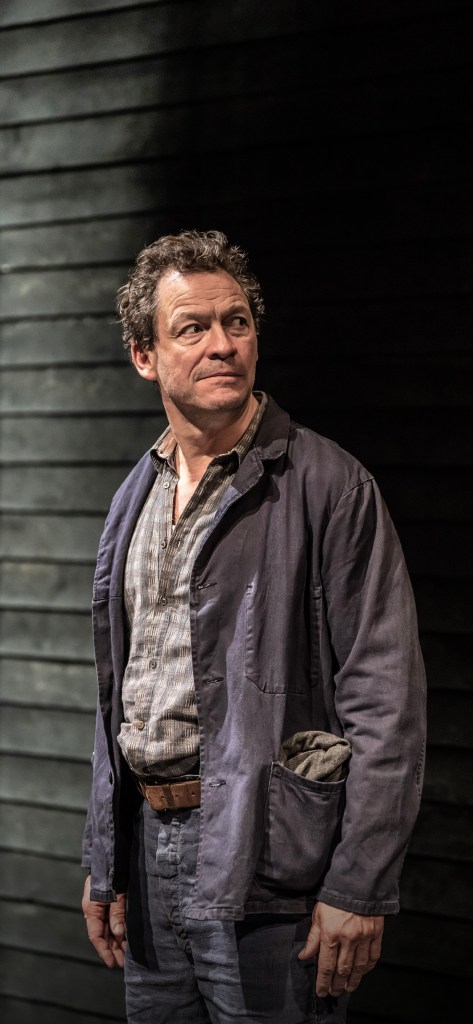
Photo: Lia Toby/Getty Images
More photos at this LINK
Instead there should have been a frisson of shock throughout the audience as all aspects of the plot come together with just this one hugely inappropriate kiss. The outrage at that Spanish football kiss should have been repeated in the theatre at that moment.
Back in 1956 when the play premiered in London, our then censorious Lord Chamberlain would not permit the kiss which was written into the script. It was inappropriate for the public of the day, he judged, because homosexuality was illegal back then. The play (with kiss) had to be performed under club conditions. It opened at the New Watergate Theatre Club, now the Harold Pinter Theatre. After the demise of the Lord Chamberlain, revivals include the ones at the NT’s Cottesloe in 1987, at the Duke of York’s in 2009 (directed, as now, by Lindsay Posner), and most recently in 2014 (directed by Ivo Von Hove) before transferring to Broadway. It has been nominated for, and won, a huge number of awards over the years.
I assume that Posner, directing the play for the second time, decided that the kiss was by now well known, anticipated, and would not shock. However, he knew that an unwanted kiss to a woman’s lips (not in the text) would shock in the way the Spanish football kiss did, so he gave us this as an inappropriate extra. Unfortunately, this weakens the second kiss (in the text) and subsequent scenes of the play, when Eddie continues to deny his attraction to his niece.
This kiss controversy was just a moment which disappointed me, but otherwise I really enjoyed the play. All the actors were superb, with Dominic West adding a star presence. Two roles, sometimes overshadowed, were particularly well played by Kate Fleetwood as wife Beatrice, and Piero Niel-Mee (seen last month in Machinal at the Old Vic) as Rodolpho’s brother Marco. Callum Scott Howells (now well established after his first appearance on tv in It’s A Sin) was an appealing and determined Rodolpho, and Nia Towle in her first professional role as young Catherine grows from teenager to feisty woman before our eyes.
The play begins on a moment of hope for a brighter future and better things for these dockworkers’ lives, and then the storm clouds of emotion slowly creep over us until we have to realise that tragedy is inevitable. There are lighter moments too, a few, and the audience found humour (laughter!) which I thought out of place. But it is exhilarating and never depressing despite the conflict and sadness of its theme. It’s a satisfying drama that examines what happens when we are possessed by emotions that we can neither understand nor control.
And it’s a play that always deserves a re-viewing whenever it’s revived.
30/05/24 Mike writes –
Touts, Booking Fees and Discounts
There was an interesting article in the paper today about a ‘secret meeting’ of ticket touts and the people behind ‘resale websites’ such as Viagogo and StubHub. The selling-on of tickets is already on the fringe of legality and there are rumours that if Labour wins the election they plan to tighten the legislation, to protect punters from being scammed. This ‘secret meeting’ was arranged to raise money to fight against such legislation. Huge profits are made by those raising the prices and selling-on tickets. It applies to tickets to concerts and sports mainly, but also of course to theatre tickets. (To read the article click this LINK.)
We all know how much the cost of going to the theatre has skyrocketed over the last couple of years. It is legitimate to add a booking fee to the price of a ticket at a theatre, but a tout or resale website may double the price. Most legitimate Theatre Ticket Agencies only add a booking fee to cover the extra costs not met by a show’s producers. But fees vary, even for the same show, depending where you purchase your theatre tickets. Some website agencies offer discounts for selected shows instead of additional fees, so it pays to shop around. But beware – try to pick the right agency with the lowest fees to avoid paying the highest prices.





Here’s a tip – the lowest fees are charged by the agency associated with the theatre where a show is being performed.
Here’s another tip: If you want to know which agency is associated with which theatre, we have details on our website. Please click on this LINK.
Here’s an example for MJ: the musical – The same Dress Circle seat costing a basic £85.50 at the theatre will cost £104 if you buy it from Ticketmaster. Their booking fee of £18.50 seems a lot extra to pay, but they do have additional overhead costs. Touts may charge twice the original price or more, for their own profit. Buy the same ticket from Delfont Mackintosh, the Prince Edward Theatre’s agency, and they will add only £4.50.
I should now remind you here that if you bought from Fredo’s Theatre Group that same ticket for MJ, the discounted price was only £69! We always try to keep our prices LOW for you and obtain a group discount whenever we can. Recent HUGE discounts have included £34 off for Phantom, £37 off for The Constituent, £23 off for A Chorus Line and even £44 off for Hello Dolly! See more to save more and then see more still. We organise our theatre visits on a not-for-profit basis so you SAVE by coming with us.
15/05/24 Fredo writes –
An Orchard visit – Another cast Q&A at the Donmar
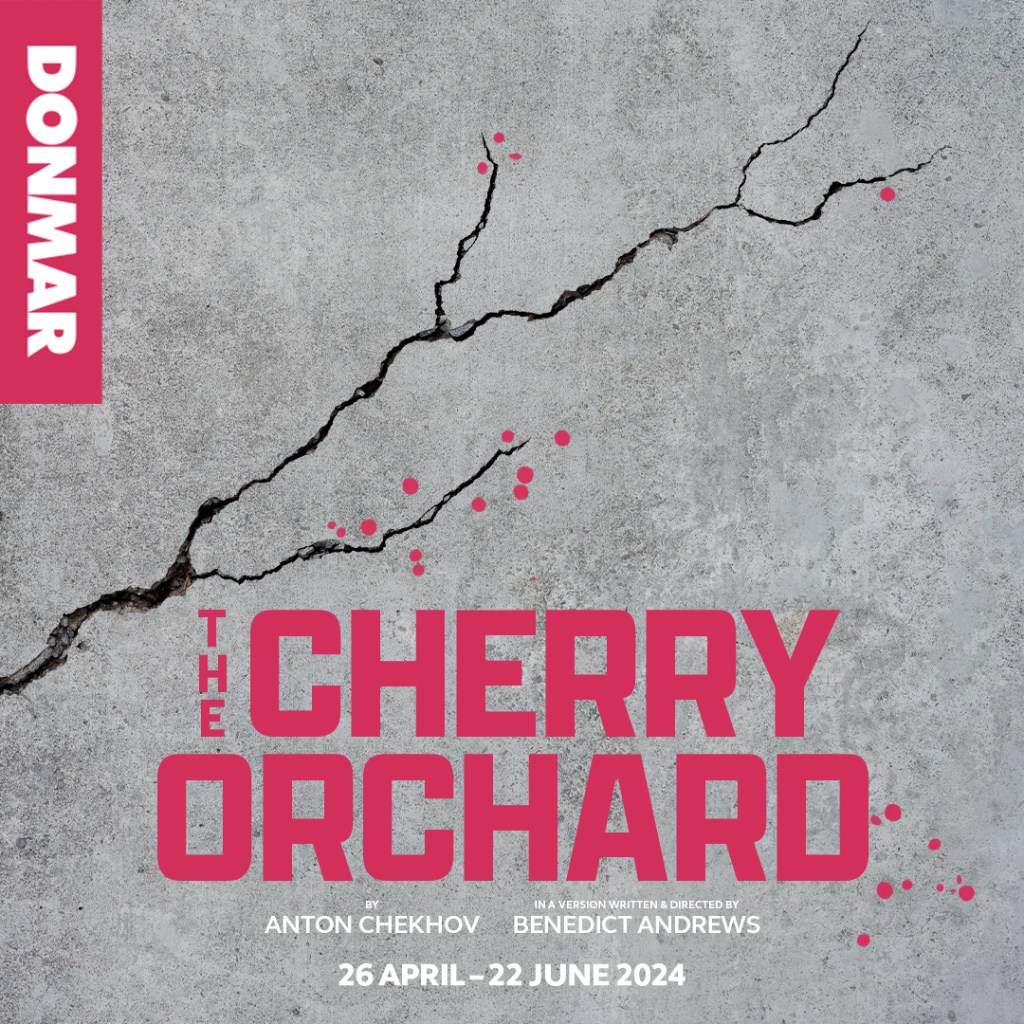
I admit that I had had misgivings about seeing this production. The Cherry Orchard is one of my favourite plays – Anton Chekhov captures people at a moment of transition, when their world is falling apart because of their own fecklessness and the changing circumstances of their community. Few writers combine Chekhov’s dispassionate observation of his society with his depth of feeling for his individual characters. Every character has an extensive back-story, and it’s important to listen as their histories unfold, as this is what binds them together.
Mike and I had read the reviews, which ranged from 5 star (predominantly) to a few 2 star ones. We were anxious about reports that the production is in-the-round with carpet on the walls, the house lights are on throughout the play, the costumes were an ugly mixture of styles and that the script was littered with obscenities. Even assurances from our friends at the Donmar when we attended the Supporters’ Evening couldn’t entirely set our minds at rest.
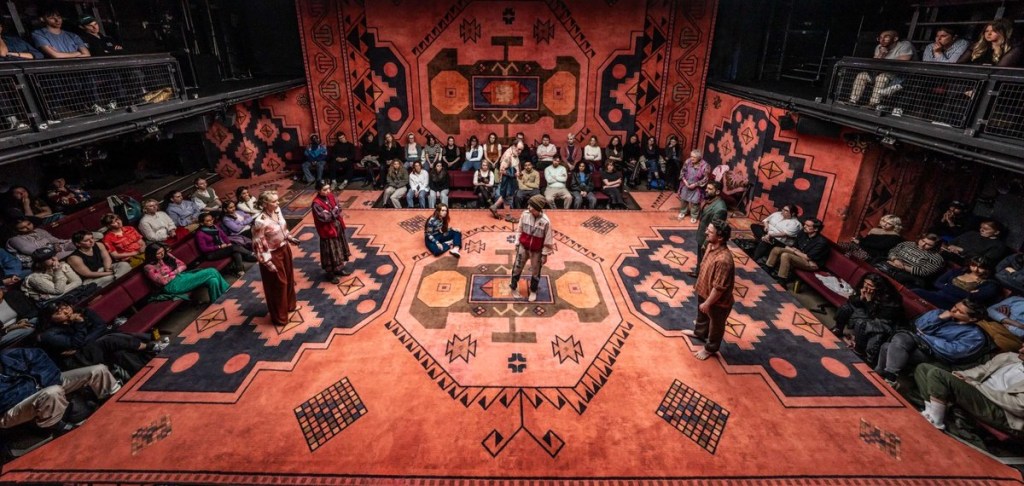
And then the play began. Wait! Weren’t those the actors scattered around the front rows? Was that Adeel Akhtar over there, near June Watson? Why was Nina Hoss sitting just in front of us? Was that a stage-hand belatedly cleaning the carpet with a Henry Hoover?
Within minutes, it all became clear. Yes, the auditorium stayed alight, as if actors and audience were in daylight, but strangely this wasn’t distracting. Actors suddenly emerged from the audience, and returned to their seats when they had played their scene. The clothes they wore were hardly flattering, but, we discovered later, they were based on contemporary photographs of Russian agricultural workers. There was indeed the occasional obscenity, but I’m sure that even in the early 1900s, the serfs and the servants allowed themselves an expletive now and again.
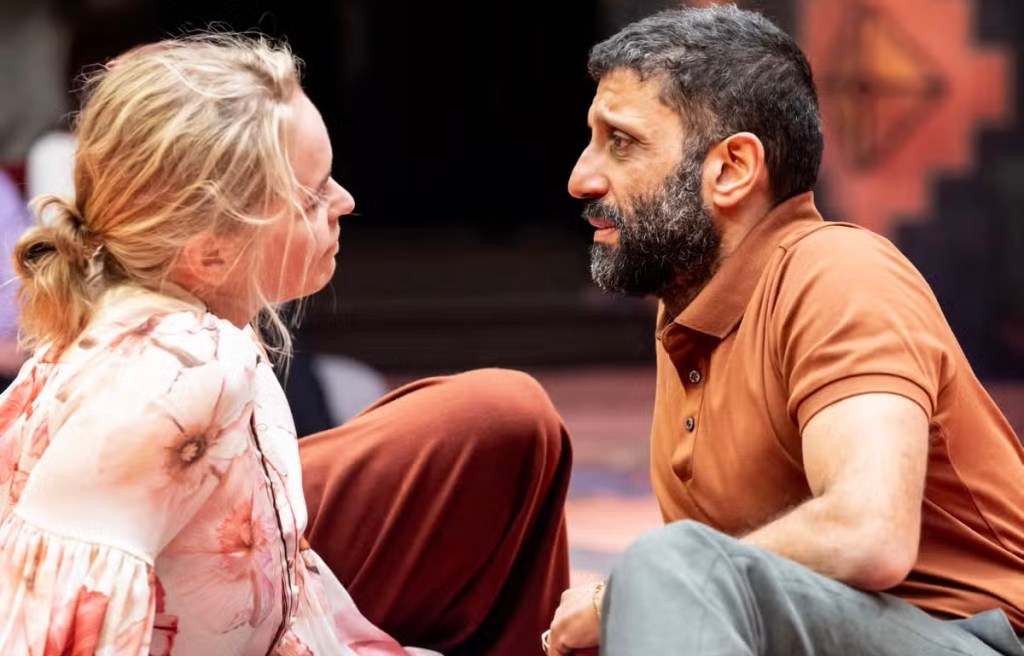
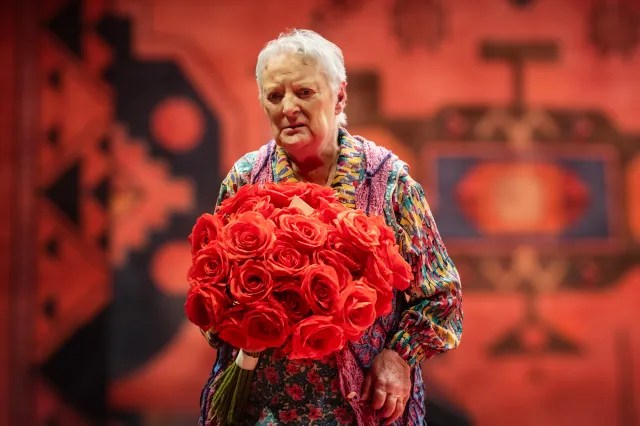
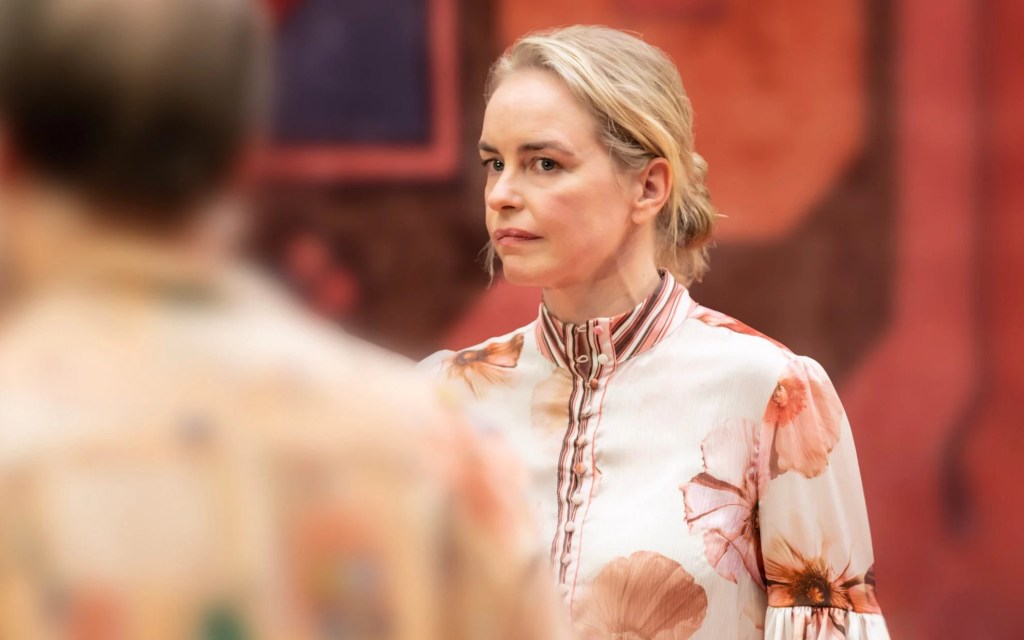
In the Q&A led by Literary Manager Craig Gilbert after the performance, we learned more about this. Veteran actor Michael Gould told us that he was excited by the translation from Director Benedict Andrews. The language is very contemporary, and it makes comparisons between Chekhov’s time and our own. He was excited by Benedict’s footnotes, and by the music that would be used during the play.
Daniel Monks, an Australian like the director, had seen many of Benedict’s productions in their homeland, and was excited to work on this one. He plays Trofimov, the Communist student (and sports a Lenin-like beard to emphasise the point). Eanna Hardwicke (looking younger and much less threatening than his predatory character in television’s The Sixth Commandment) added that the rehearsals were very organic; the actors were not given call times, but were invited to attend all the rehearsals, so that they would all understand the development of each others’ characters. June Watson agreed. She plays the aged family retainer Firs, and said that in most productions, she might have attended rehearsals on 10 or 12 days for such a small role, but this time she was there every day – “10 to 6,” she added ruefully.
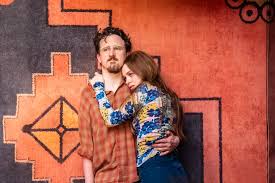


The rehearsals began with a week of sitting round the table, said Nina Hoss, but then they became much more improvisational. This has spilled over into the run in the theatre, said Nathan Armarkwei Laryea, so that they often don’t know what movements the other players are going to do. It keeps the production alive and, he said, sometimes it surprises. Daniel compared this technique to improvised jazz.
The actors are always on stage or present somewhere in the auditorium, and June admitted this was tiring, although the cast benefitted from continued invilvement. She asked us how we felt about the house lights being on, and everyone agreed that it hadn’t deterred us; it fact, we’d all forgotten about it and felt involved with the cast.

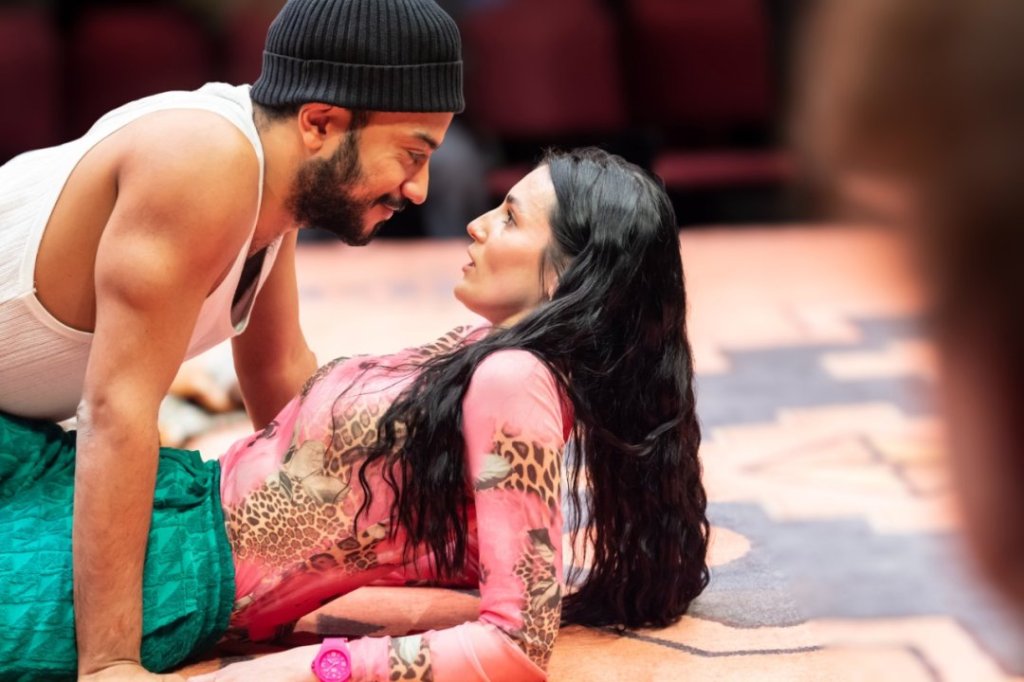
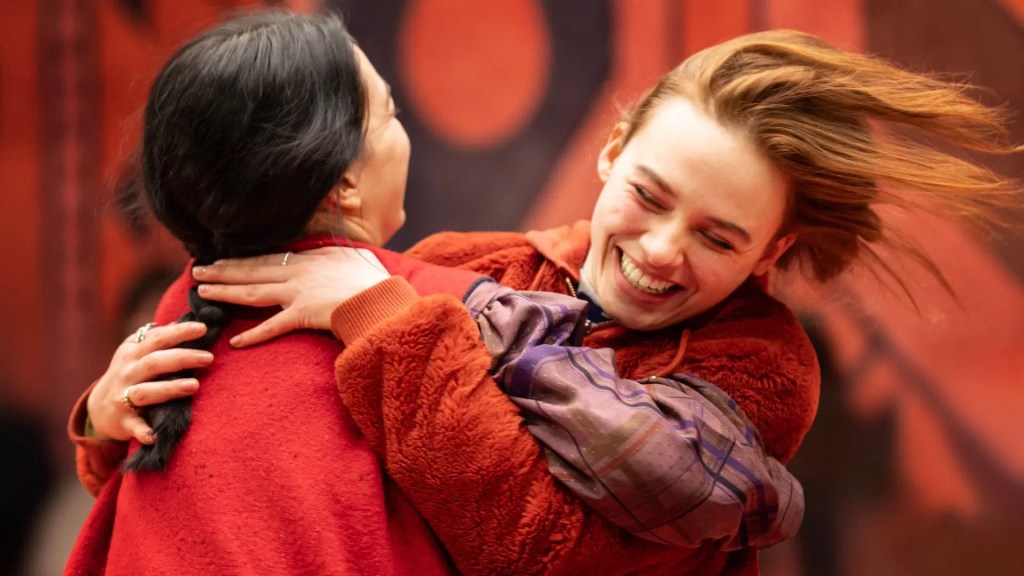
Photos: Johan Persson.
We were able to report to our Donmar friends that we’d enjoyed this interpretation very much. “Four and a half stars,” said Mike firmly. I commented on the often measured pace, but Mike pointed out that this helped slow down the pulse of the audience then quicken again to build tension, so we were able to absorb every detail of the protagonists’ lives. This adds tremendously to the impact of the play’s end – but no spoilers from me!
Chekhov’s plays often divide audiences, and this one may offend staid purists. But it’s a landmark production, and this style of performance was both a triumph and a vindication.
04/04/24 Fredo writes –
Zurich International Concert Series 2024-25, at Cadogan Hall
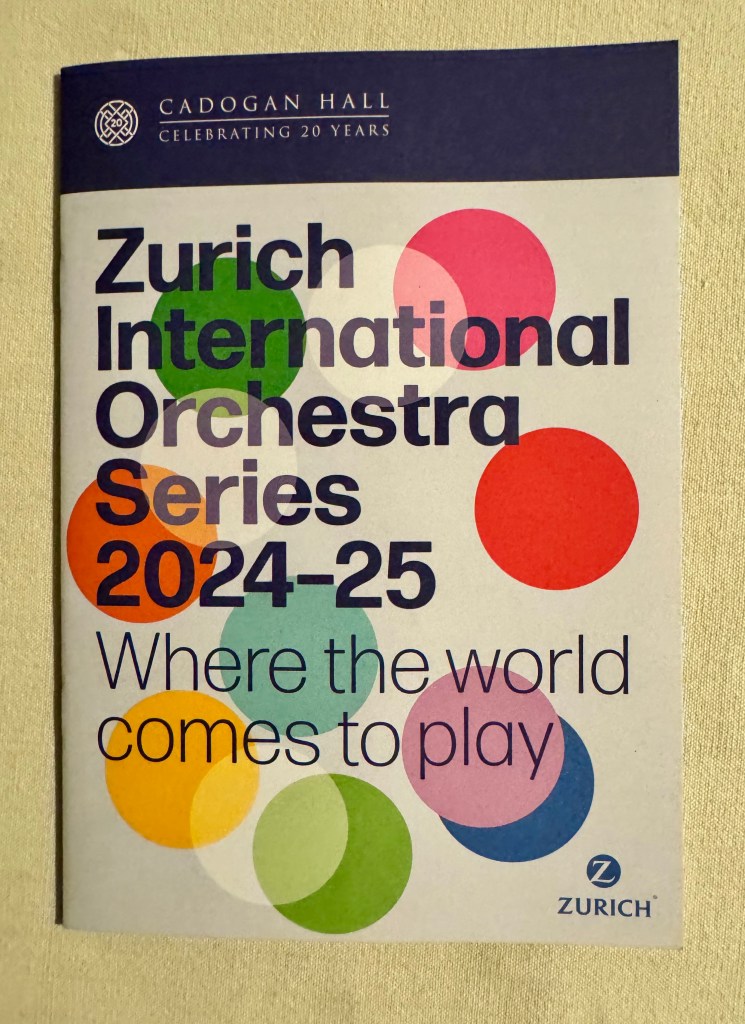
How lucky can we get! There are certainly perks to this job, as Mike and I are invited occasionally to attend promotional events at different venues. We’d been to the matinee of Black Boys….(See OnOurOwn section for Mike’s review) and we then made our way to Cadogan Hall for an introduction to the forthcoming concert season sponsored by Zurich Insurance Co Ltd.
Now, an admission: I blush to admit how little I know about classical music, and as I haven’t spent enough time extending my experience, I’m eager to learn more.
Adam McGinlay, the Managing Director of Cadogan Hall, welcomed us and noted that this venue is celebrating its 20th anniversary as a concert hall. He introduced the pianist and Radio 3 presenter Iain Burnside to talk us through the programmes for the 9 concerts that start in October this year.
Iain proved to be exactly the sort of guide needed by a novice like myself. His knowledge is wide-ranging: he had information about each piece that will be performed, and its place in the career of the composer. For instance, he told us how Rachmaninov’s confidence had been destroyed by the reception of his first symphony (the conductor was drunk) and highlighted Beethoven’s Violin Concerto. “Violinists are famously terrified of this,” he added mischievously, But assured us that the instrument would be in the safe hands of Christian Tetzlaff.
He warned us that there are not many laughs in Symphony No 4 by Sibelius; he also directed us to the same composer’s contrasting Symphony No 7 in a later concert.
Iain’s enthusiasm for the composers and musicians was infectious. He entered a plea for the cause of classical music in general. Funding for music education and instruments in schools is declining, and yet the benefits of music and the pleasure it brings are immeasurable.

Jeneba Kanneh-Mason
(Photo: John Davis)
As if to prove the point, the strikingly beautiful pianist Jeneba Kanneh-Mason (yes, another member of that family) strode on to the stage , dazzled us with a smile, then sat at the piano and gave it a hard stare, as though cowing it into obedience. We could see her fingers on the keyboard as she drew amazing music from it – Sonata in A Major by Scarlatti, a waltz and a sonata by Chopin, a tone poem by William Grant Still, and Hungarian Rhapsody No 2 by Liszt, all but one without music. Wow, even for my uneducated ears!
You can download the series brochure at this LINK.
Perhaps you could give us some feedback on any of the 9 concerts that take your fancy. I’m sure Mike and I would like to organise a visit to at least one of these. Well, it would be rude not to!
20/03/24 Fredo writes –
A BRIEF ENCOUNTER ON THE NHS
You wait a long time for a play about the start of the NHS, and then two come along at the same time. Following hard on the heels of Nye at the National Theatre, The Human Body at the Donmar focuses on a doctor fighting for this service, and for her place as a woman in the repressive society of 1948. Mike and I enjoyed the Supporters’ Evening performance of Lucy Kirkwood’s play, and were interested to hear how the cast coped with the challenges of this very technical production.
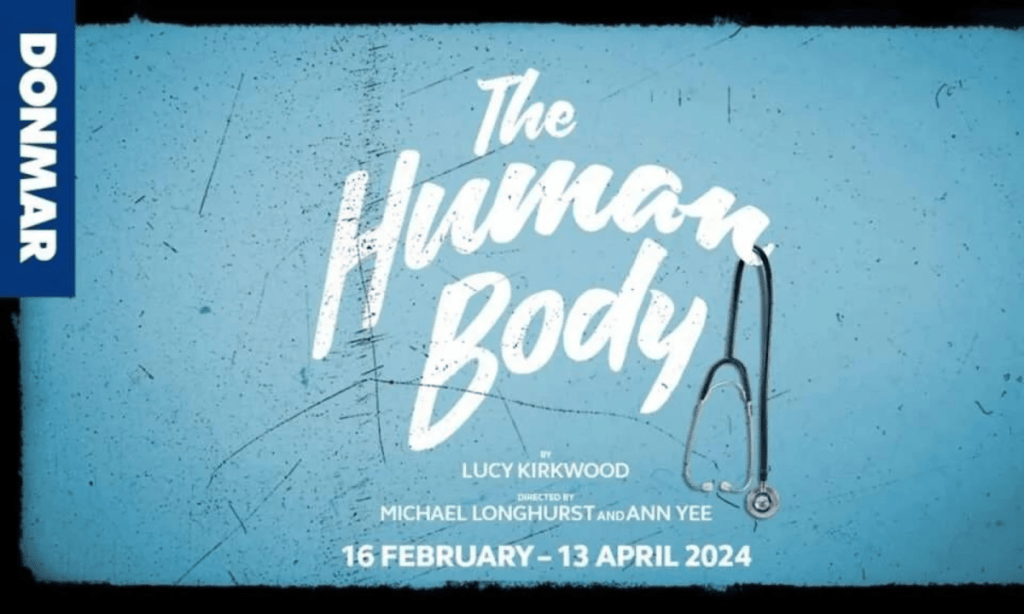

Michael Longhurst, directing with Ann Yee, uses a revolving stage and cameras to bring us closer to the Brief Encounter-style affair conducted by Iris and George. She’s a doctor and would-be Parliamentary candidate, and he’s a louche British actor visiting home from Hollywood (and does anyone do louche as well as Jack Davenport?) When they meet, and as their relationship progresses, we examine their every move projected on to the Donmar’s back wall, with close-ups of the waves of emotion crossing Keeley Hawes’s expressive ace.
All the cast joined the Donmar’s Literary Manager Craig Gilbert for a post-show Q&A. They confided that they all cringe when they catch a glimpse of themselves “on screen”, even though they had the cameras with them in the rehearsal room. Equally challenging was that the revolving stage never stops moving (I thought that it had, but it merely slows down). Keeley is hardly off-stage, and she thanked Matt who controls the speed of the revolve by computer from a perch in the wings.


Between them, Siobhan Redmond, Pearl Mackie and Tom Goodman-Hill play nearly 30 characters, across the 36 scenes of the play. Tom and Siobhan described the off-stage ballet as the stage crew rotated wigs, costumes, scenery and props in the confined space behind the stalls. Siobhan worries about coming on as the wrong character, and claimed to have almost come on stage as a female character wearing a moustache from a previous scene.
Siobhan pointed out that there were no marks on the stage for the crew to place the scenery, and this added to the risk element for the actors. Any mishaps? “Don’t ask,” advised Tom, while Jack laughed that he had almost ended up in the lap of someone in the front row.
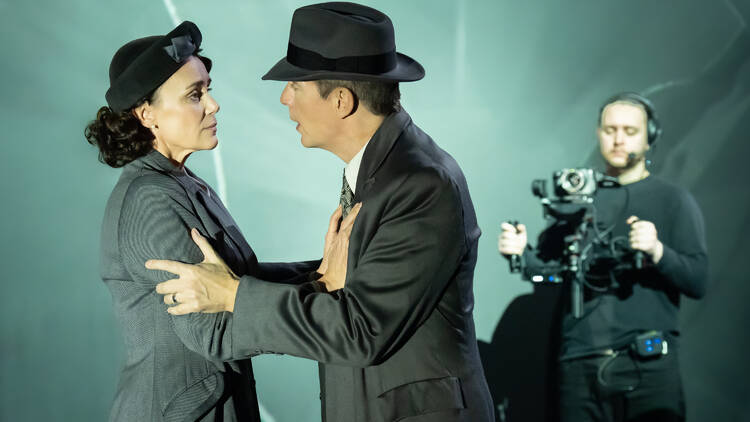


Neither Jack nor Keeley had done a play for some time, and they were dazzled by Lucy’s control over the material and by her sense of period. Pearl added that the number of characters had increased since they were first offered the play. That had been an exciting moment for them.
However, the play isn’t a period piece. In its examination of a time of political change, and of the pressures placed on women to conform, and of the reality behind a public image, it seems pertinent and relevant. I’m looking forward to seeing it again!
18/03/24 Mike writes –
THIS IS A TRIGGER WARNING
If you are brave enough to go to the theatre, any theatre, you may be offended, upset, traumatised, challenged, hear language you don’t like, or wish you had made a different choice. All that is fine by me. Of course I speak for myself but it seems that theatre managements are worried on your behalf. They are so worried that in their publicity they feel obliged to warn you against any of these occurrences which may trigger in you….what? Might you Faint? Sue? Disturb the peace? Assault the actors? Your guess is as good as mine, but I wish they wouldn’t mollycoddle snowflakes in this way.
In my view Theatre is Life. It is live. Be prepared to experience the unexpected. And if you do experience the unexpected, that is all part of life, education, and of course entertainment.
These Trigger Warnings are becoming more and more prevalent and obviously vary between different productions. I was first concerned when one theatre thought it necessary to warn us that during the play a man’s hand would be placed uninvited on a woman’s knee. Perhaps I should add that this would happen on stage not in the audience! OMG!
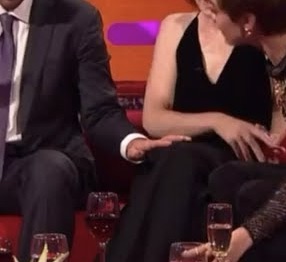
Example!



We are regularly warned about haze, flashing lights, gunshot sounds….and at the other extreme we have been warned that artificial cigarettes will be smoked containing no tobacco or nicotine, latex balloons will appear, and of course for Shakespeare “On stage there is blood, scenes of violence and depictions of death”. Again, OMG!
I can understand that in particular cases we are asked not to bring peanuts into the auditorium if an actor is allergic. That has happened recently at the Bridge and the Donmar. But I really think audiences should be left to look after themselves and not be ‘protected’ in this overreaching way.

Theatres also worry about politics and religion – heaven forbid that anyone should have to listen to any view which may offend their own political or religious sensitivities! Well no, let’s not forbid it as challenging viewpoints is a valid reason for many playwrights to write. It makes us think, discuss, and sometimes even change our views. Or air our thoughts, among friends, on line, in letters to the press.
A recent visit to the Young Vic to see Nachtland brought all this Trigger happy nonsense to my mind. The play concerns politics, religion and a painting. We had previously heard that one on-stage exchange caused an audience member to shout out “Fuck Off!” They expressed their outrage – the play caused a reaction – good! When we were there, the most vocal audience response was a loud intake of breath when an actor abruptly told his stage wife to “Shut up!”. Someone was being over-sensitive. I was gleeful that a play was creating such a response, was so directly involving its audience. This was following the really ludicrous and extended list of Trigger Warnings published on the Young Vic’s website. Not only were we warned about dialogue and subjects mentioned, we were also given the timings in minutes and seconds into the play when certain ‘triggers’ would occur. Should we bring a stopwatch in order to know when to cover our ears? This is madness. (See our OnOurOwn report at this LINK and the Trigger Warnings HERE.)
Several leading actors including Sir Ian McKellen and Ralph Fiennes have now expressed their concern that Trigger Warnings are going too far to extremes, and should be no part of the theatre-going experience.
I entirely agree. I understand that a child’s Age Recommendations for any play would be appropriate, and perhaps General Advice about content, as in Film Certification. But for supposed grown-ups, definitely no more explicit warnings, please.
Any feedback would, of course, be welcome. You want to read more? Click on this LINK
24/01/24 Fredo writes-
MACBETH REVISITED

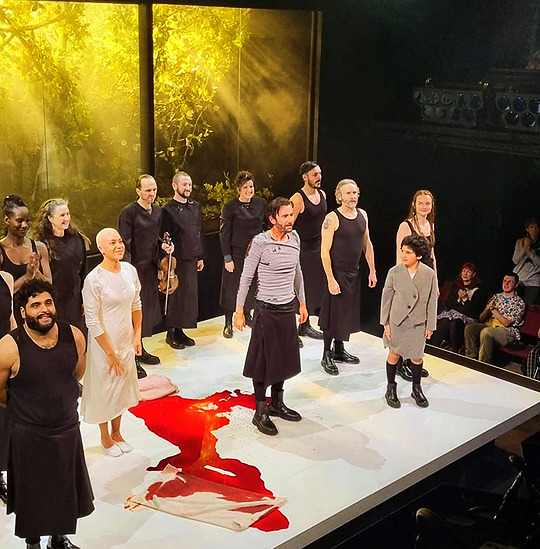
“I’m David Thane of Paisley Tennant, and I was last at the Donmar 20 years ago – when I was 8.” David Tennant was being debriefed by Literary Manager Craig Gilbert after another strenuous performance as Macbeth. This was the Supporters’ Evening, and Mike and I saw the play for a second time.
The impact of the first performance was still in our minds. This time, we were prepared for the astonishing soundscape provided via the binaural headphones, and the clarity of the story-telling. One of Shakespeare’s most difficult texts became clearer, and the performances even more vivid with this innovative technology.
David and Cush Jumbo, his Lady Macbeth, revealed that they had signed up to do the play before director Max Webster told them about his plans to stage it in this unexpected way. They had both had good experiences at the Donmar before – David in Lobby Hero, when he was quite a bit older than 8, and Cush as Mark Antony in the all-female Julius Caesar.
Nevertheless, playing to an audience wearing headphones presented a challenge. The actors had to tone down their projection, which means that it is difficult to pick up cues; Cush said that they have developed a sense of timing and just know when to come on, and take their cues from movement and gestures. She loves this, as it means that in a bigger theatre, people in the cheaper seats would hear just as well as everybody else. David agreed it’s an equal experience for everyone, and he doesn’t have to worry about hitting the back wall with his voice.
It’s also challenging for the musicians, Annie Grace and Alasdair MacRae. They’re in a soundproof box, where even the drone of the bagpipes can be turned down.
Had there been adverse reaction to this presentation? David admitted than the odd person didn’t like it, and that is fair enough. This production creates a different experience. Alasdair added that Macbeth is a known text, yet some directors impose a concept on it, which causes difficulties; audiences have to grapple with the concept before they can understand the play – not so here.
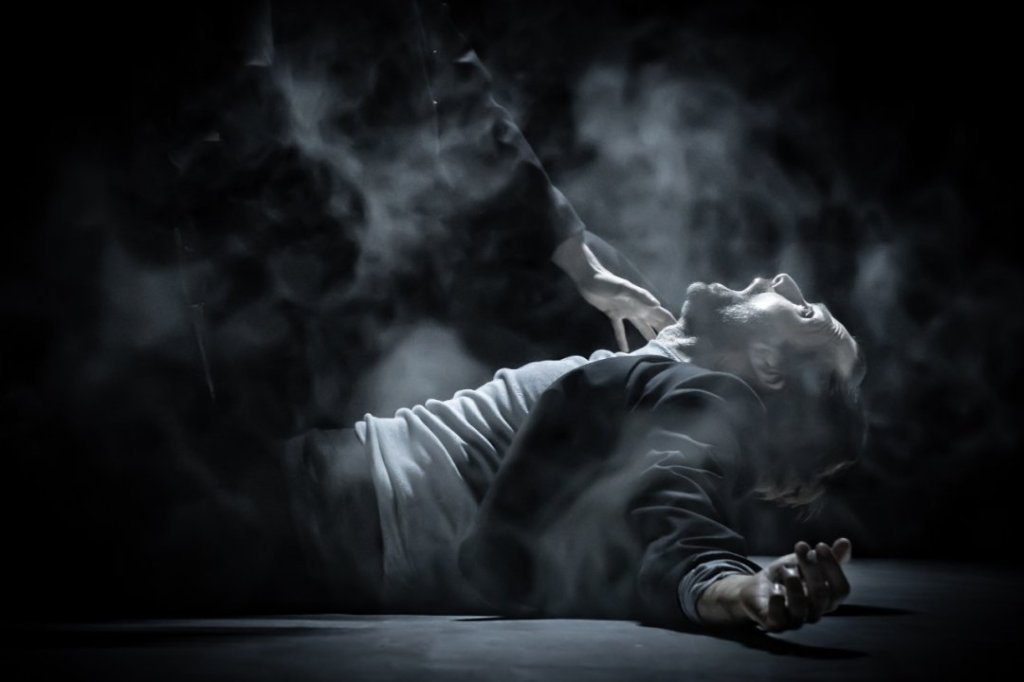
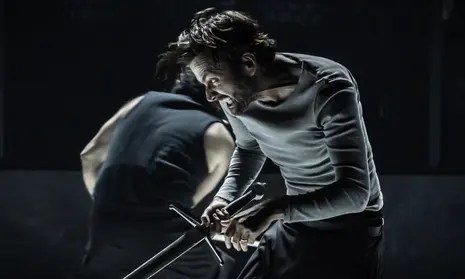
Had working in this way changed the actors’ perspective? “Yes, I’m quitting,” joked Cush, before going on to say that actors are constantly developing their skill-set. They have to learn new things for the survival of theatre, as they depend on attracting new audiences. They’d had one comment from a younger person – “It’s really cool how you changed the words to modern!” (They haven’t!).
A Scottish voice asked a question – and admitted that she may be biased – as she felt that the play was enhanced by all the cast – with the exception of Cush – being Scottish. David told us that Max had worked in Edinburgh with an all-Scottish cast in The Winter’s Tale, and that had made his mind up to use a Scottish cast on this play. Cush was the notable exception, but no-one would quarrel with the charisma she brings to the stage.
Mike and I are always amazed that actors can pour their energy and emotions into their portrayals of complex characters, and then bounce back on the stage to discuss and analyse their work so soon afterwards. It’s a privilege to hear actors of this calibre talk about their approach to this great play.
And I’ve decided I only want to see Scottish actors as Macbeth from now on.
01/01/24 Fredo writes –
THEATRE THINGS WE DO TOGETHER
A round-up of our Group theatre visits in 2023
For several reasons, 2023 was a remarkable year in the theatre. There was still a lingering worry that audiences would be slow to return to live entertainment after lockdown, but an appetite returned for the shared experience of enjoying a good show.
As usual, Mike and I tried to find a mix of popular shows, new and classic work, and plays that some of our group might not have discovered on their own. There were some that we had to leave out, simply because the ticket prices were too high, with top prices reaching nearly £200! This is a worrying trend, and one which I hope will settle down in the next twelve months.
Nevertheless, we were able to obtain substantial reductions on most of the shows we offered, and I was surprised to find that the average ticket price for the year was only £48.95 (this does not include the coach fare, of course).
However, we only managed two visits to the Royal Opera House, which always provides a sense of occasion as we enter the splendour of the auditorium. This venue no longer offers group rates, and seats at the front of the Amphitheatre are now expensive. Even so, watching the Royal Ballet dance Woolf Works and the visiting Australian Ballet’s Jewels, it was worth every penny.

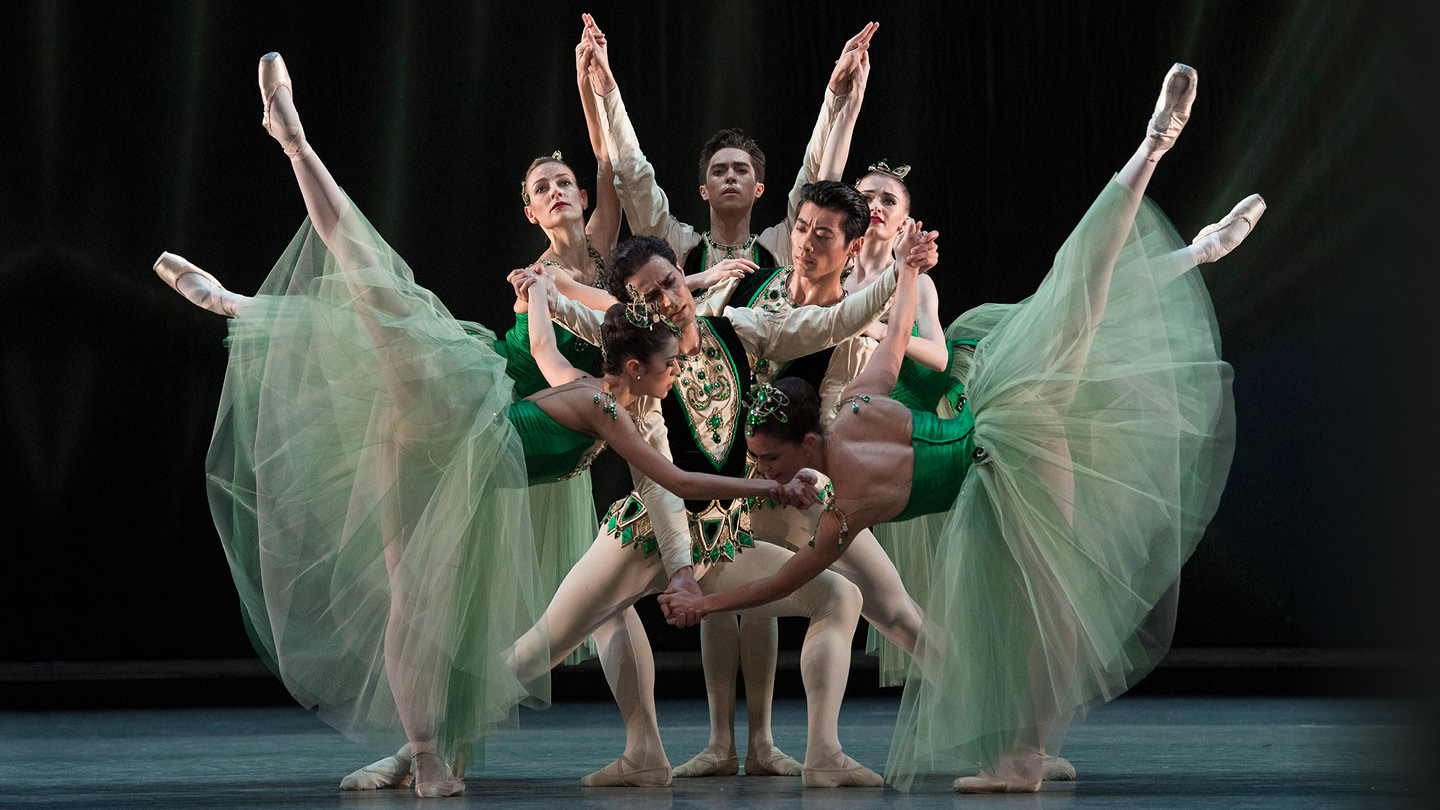
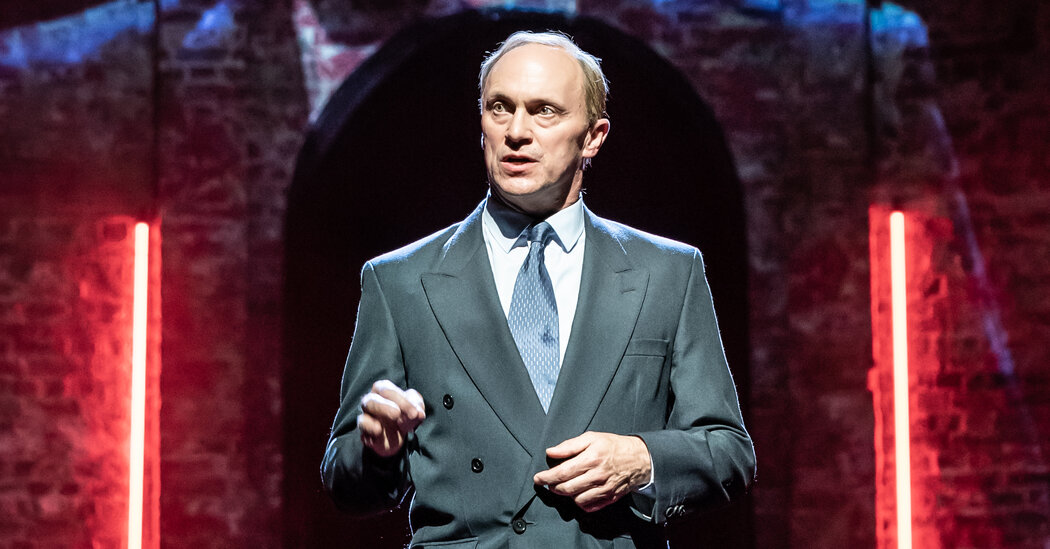
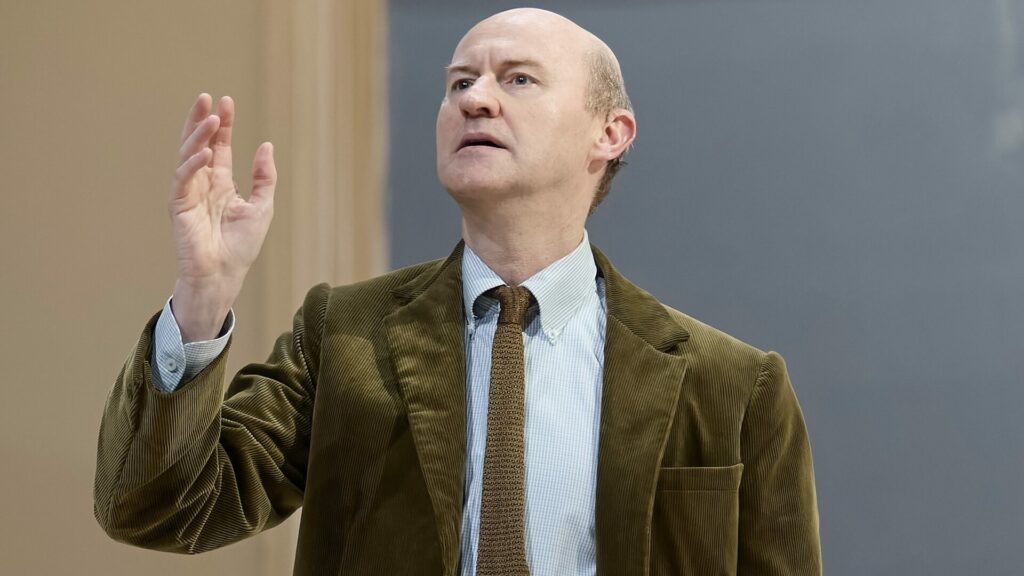
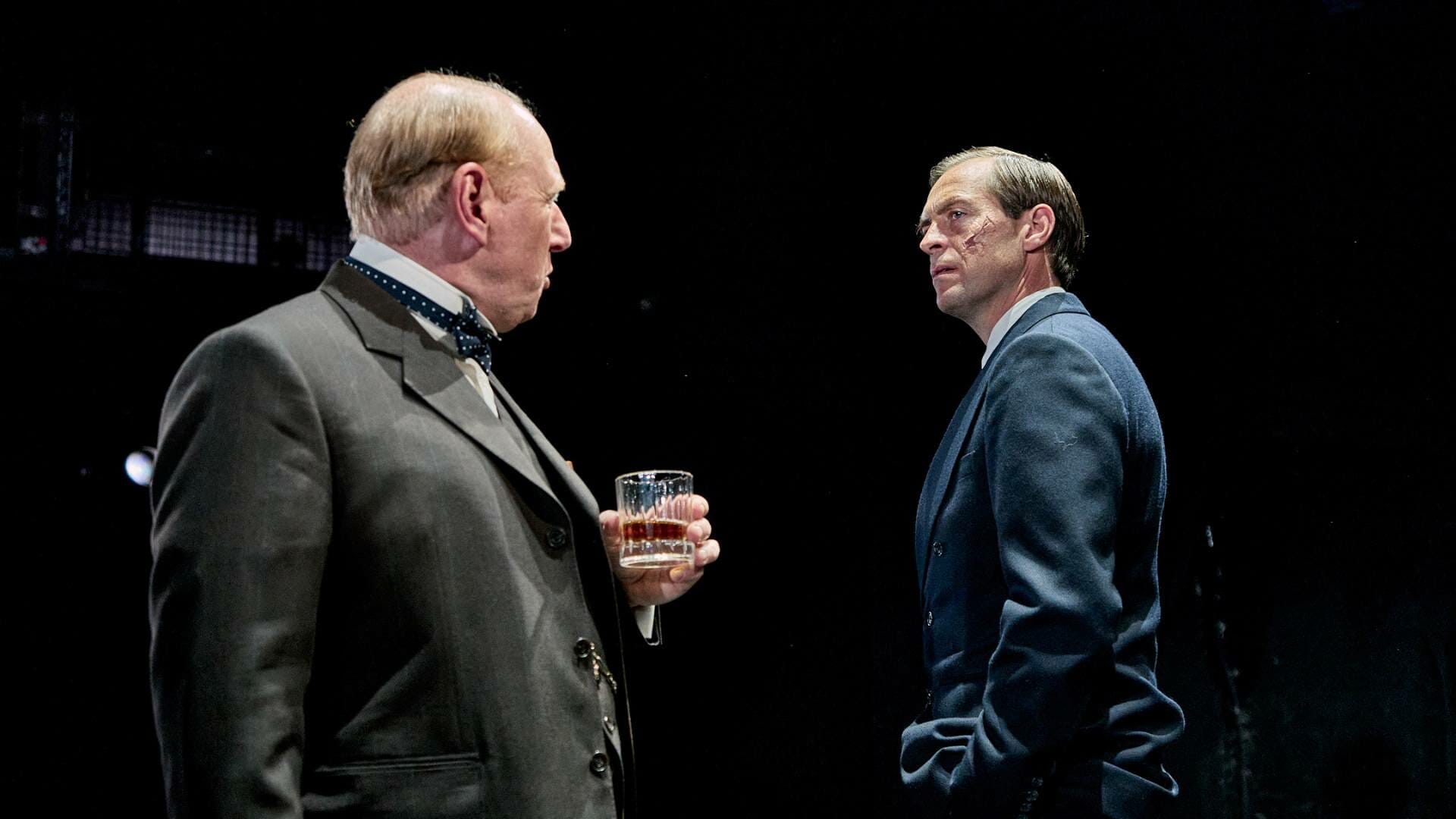
Interesting themes emerged. Of the 12 new plays that we offered, at least half were biography plays. This gives an extra frisson to the performance: will the actor transcend impersonation and give a persuasive performance? In Patriots, Will Keen was a scarily convincing Vladimir Putin, Mark Gatiss was an elegant and touching John Gielgud in The Motive and the Cue, and whilePenelope Wilton may not have been an obvious choice to play the Queen Mother, her exchanges with Luke Evans in Backstairs Billy were believable and hugely entertaining.

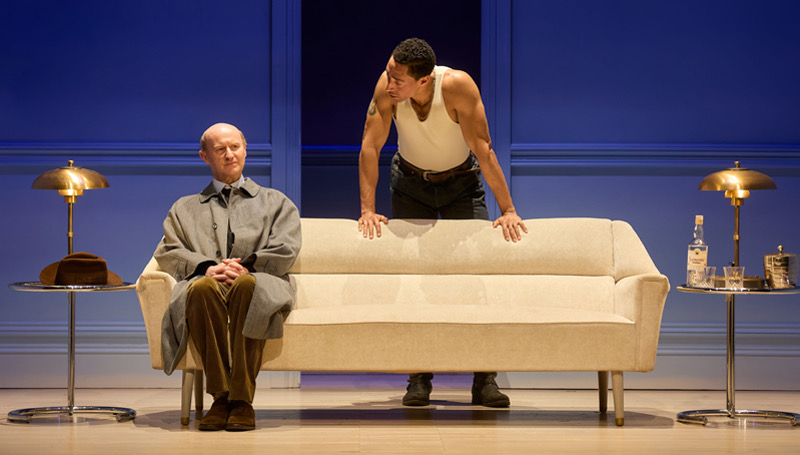
Plays with a gay theme were much in evidence as well, with gay characters prominent in The Motive and the Cue, Winston, Matthew Bourne’s Romeo and Juliet, Backstairs Billy, and in the transgender Orlando. It was interesting to contrast the depiction of the passionate relationship of the two young cowboys in Brokeback Mountain, played sensitively by Mike Faist and Lucas Hedges, with the older more extrovert couple in Frank and Percy, with Ian McKellen and Roger Allam giving irresistible exuberant performances.
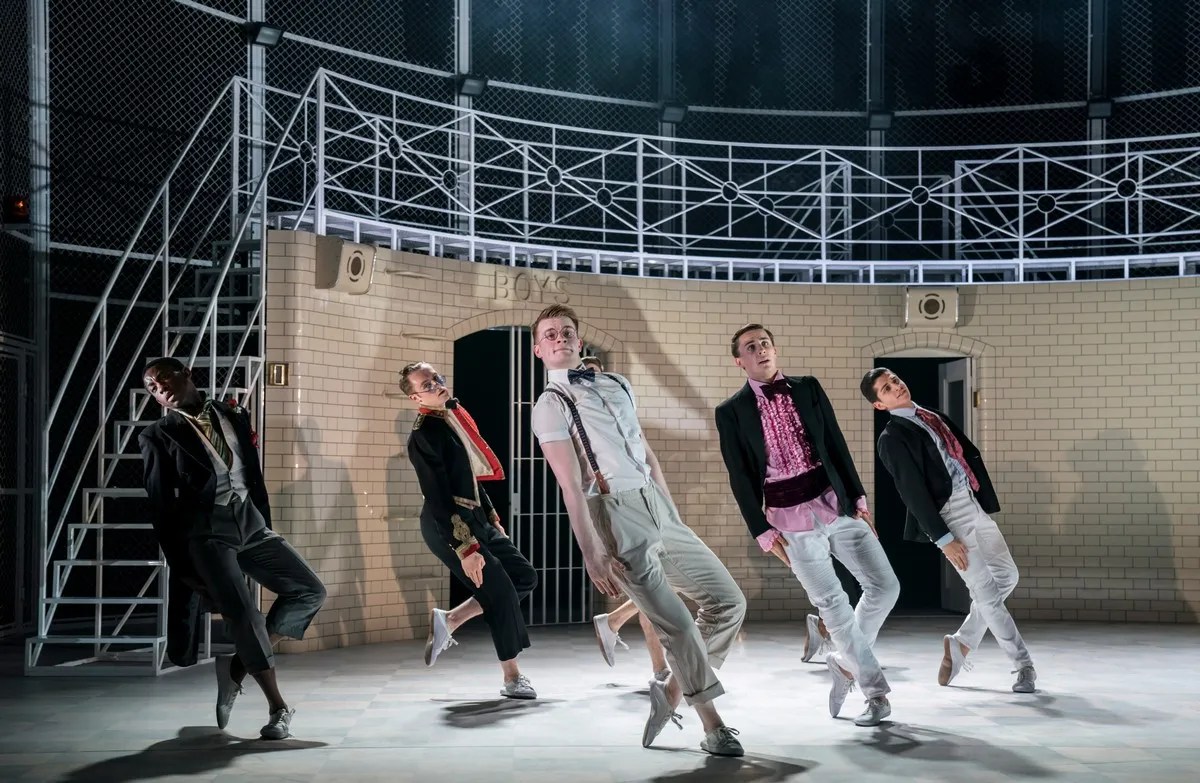


The Donmar had a great year, with unexpected revivals of Watch on the Rhine, and with director Michael Longhurst and his cast of Racheal Stirling and Stephen Mangan shocking some audiences in Private Lives with the juxtaposition of humour and violence in this interpretation. Winston was a kaleidoscope of history, and sadly was the last stage appearance by the late Haydn Gwynne. Clyde’s was a small miracle of a play: we suddenly felt invested in the lives of the characters and their struggles. It was heartwarming, with a redemptive quality, and Giles Terera in the lead role brought it all beautifully together. The musical Next to Normal was another tour de force, with reliable performers such as Caissie Levy and Jamie Parker managing not to be upstaged by the white-hot newcomers Eleanor Worthington-Cox and Jack Wolf.

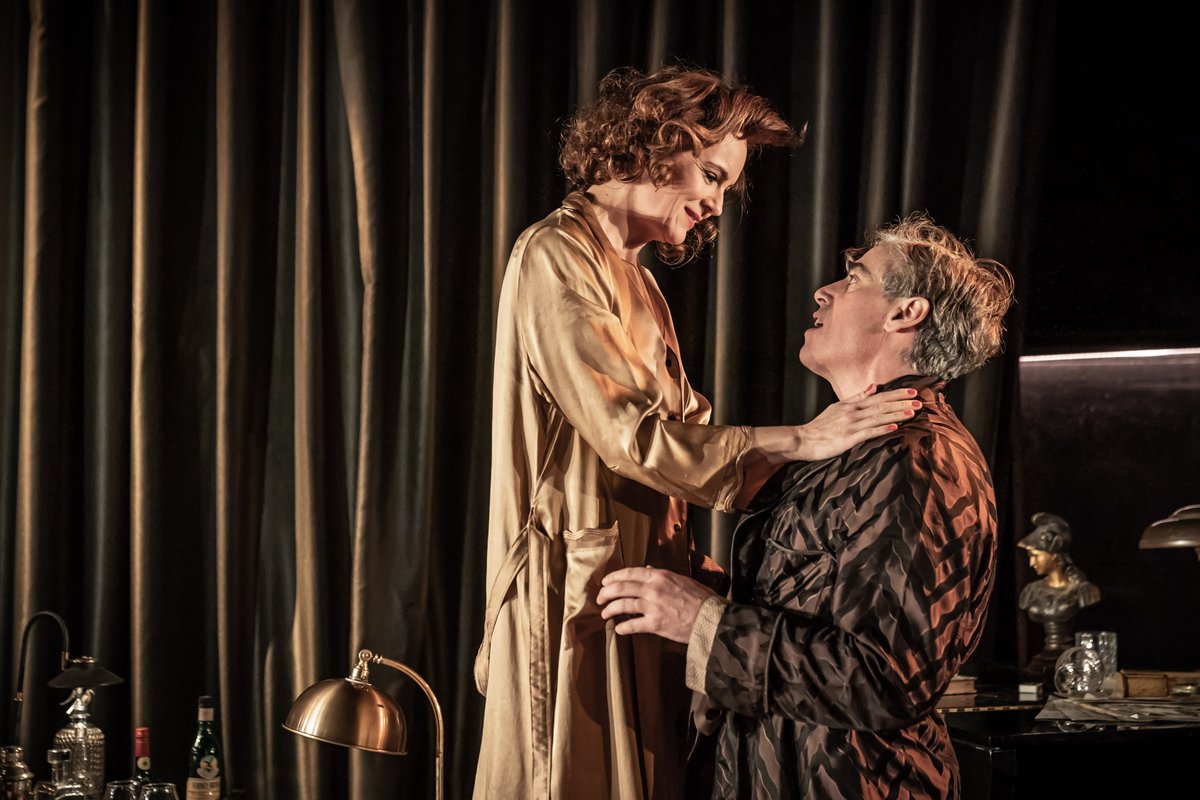
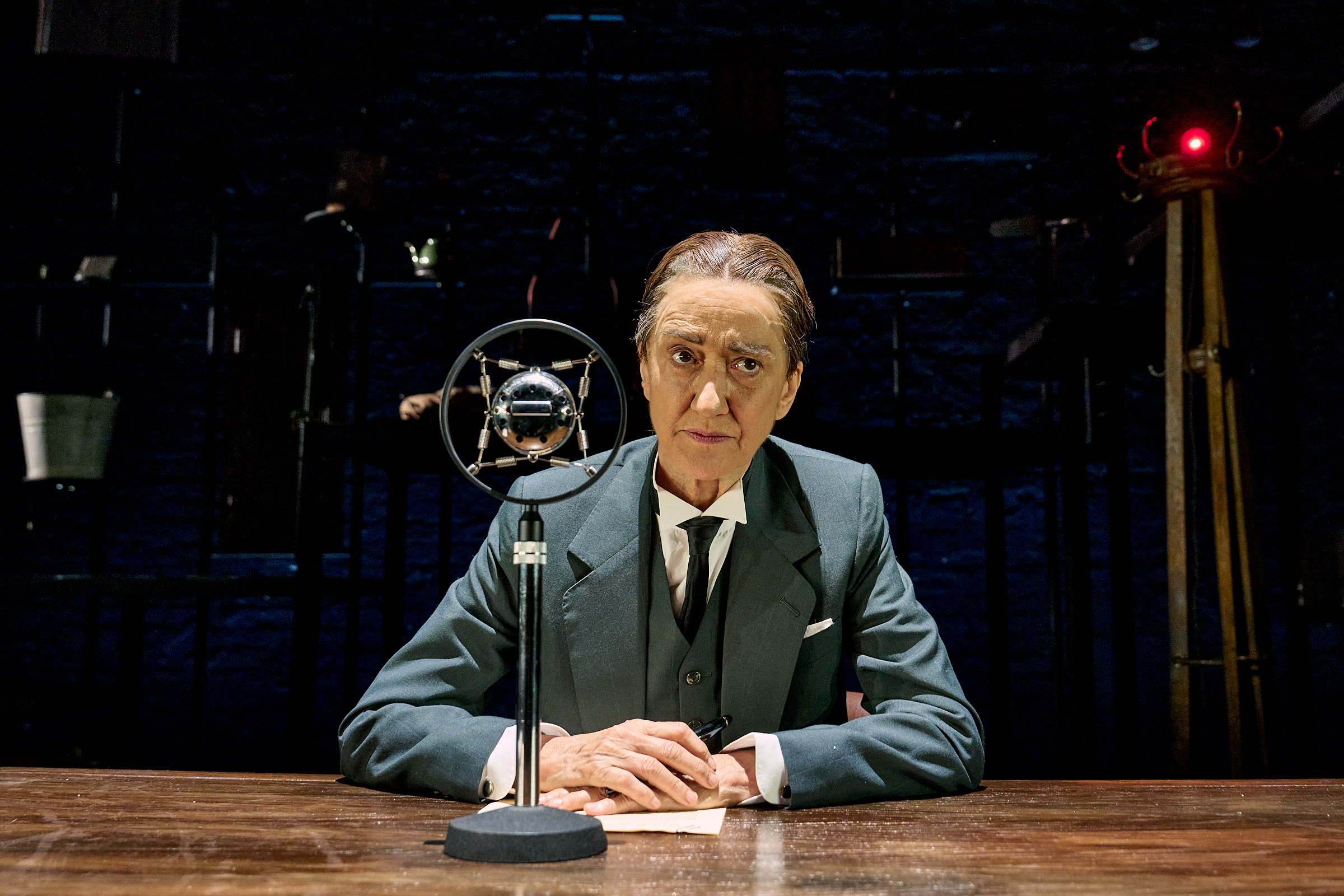


There were a few misfires, and I wish I had trusted my original instincts over both The Crown Jewels and Lyonesse. Hampstead Theatre were at less than their considerable best with a troubled production of To Have and To Hold. The most egregious failure was the National Theatre once again making a hash of The House of Bernarda Alba; this is the second time they have failed with this great play.
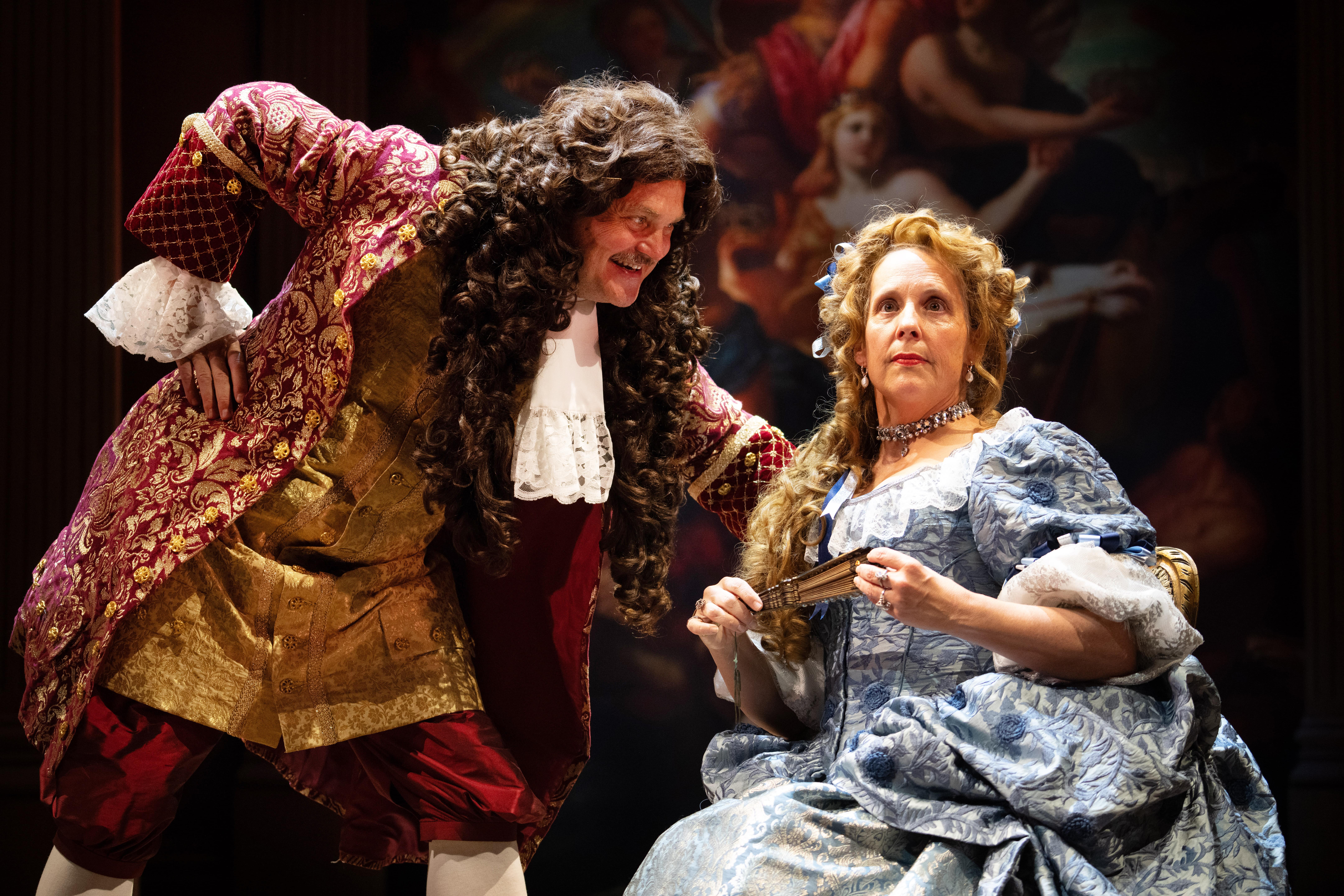


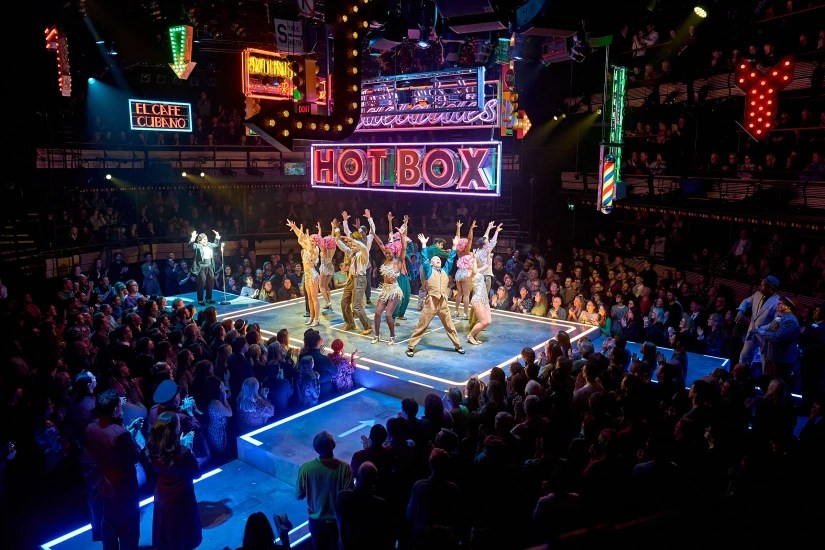
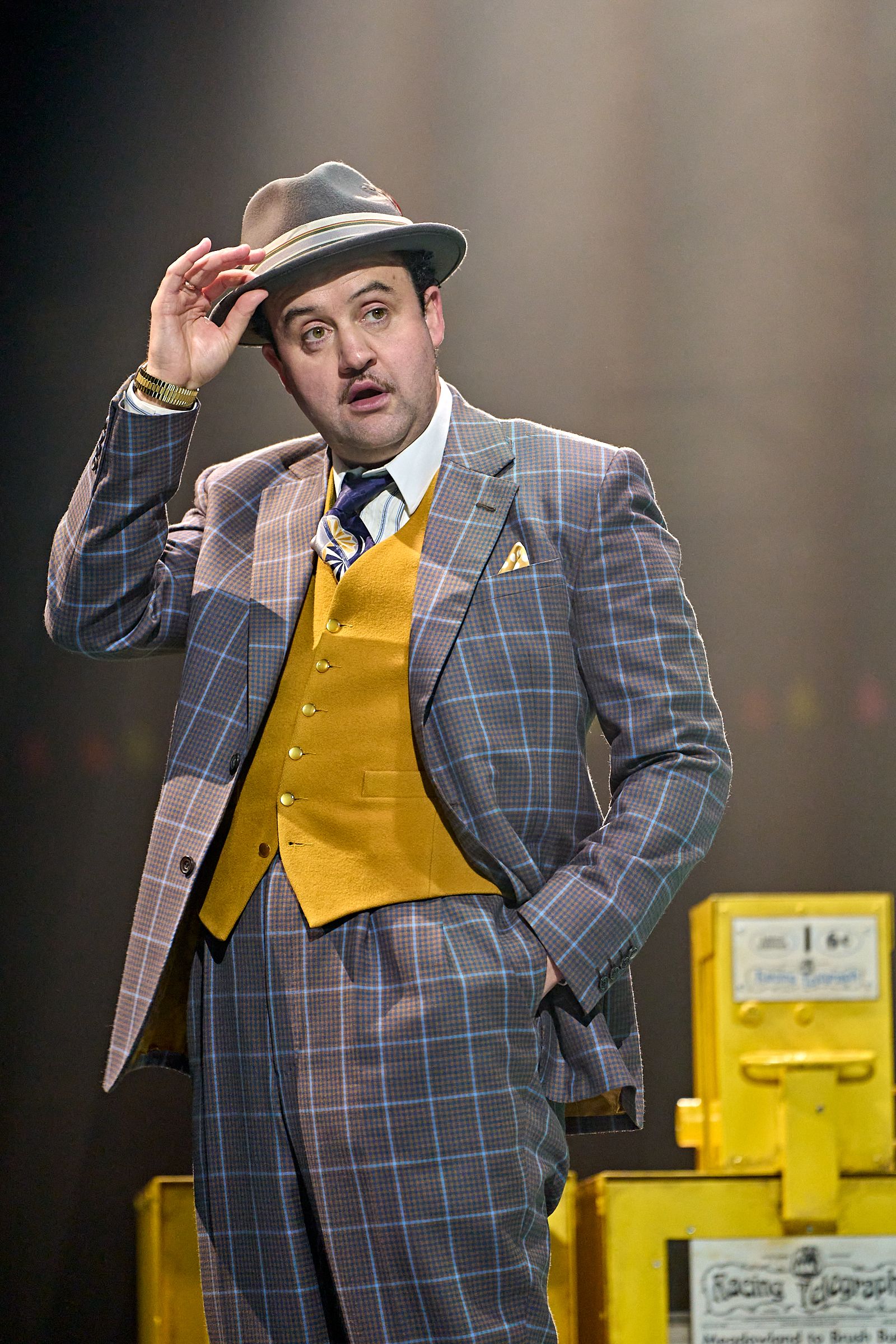
At the Bridge Theatre, director Nicholas Hytner presented the timeless musical Guys and Dolls in a unique way. A promenade audience surrounded the players on stages that appeared by magic from the floor, while those of us in seats around the action watched in amazement as the talented cast, led by an irrepressible Daniel Mays, applied their talents to this fabulous show. I just didn’t want it to end.
The year was end-loaded with three great successes. The stage at the Gielgud Theatre groaned under the weight of the assembled talent for Sondheim’s Old Friends. When the women in the company lined up to sing Broadway Baby, the audience went wild. I’m not sure that this show got the audiences it deserved, but everyone there had the best night of the year.

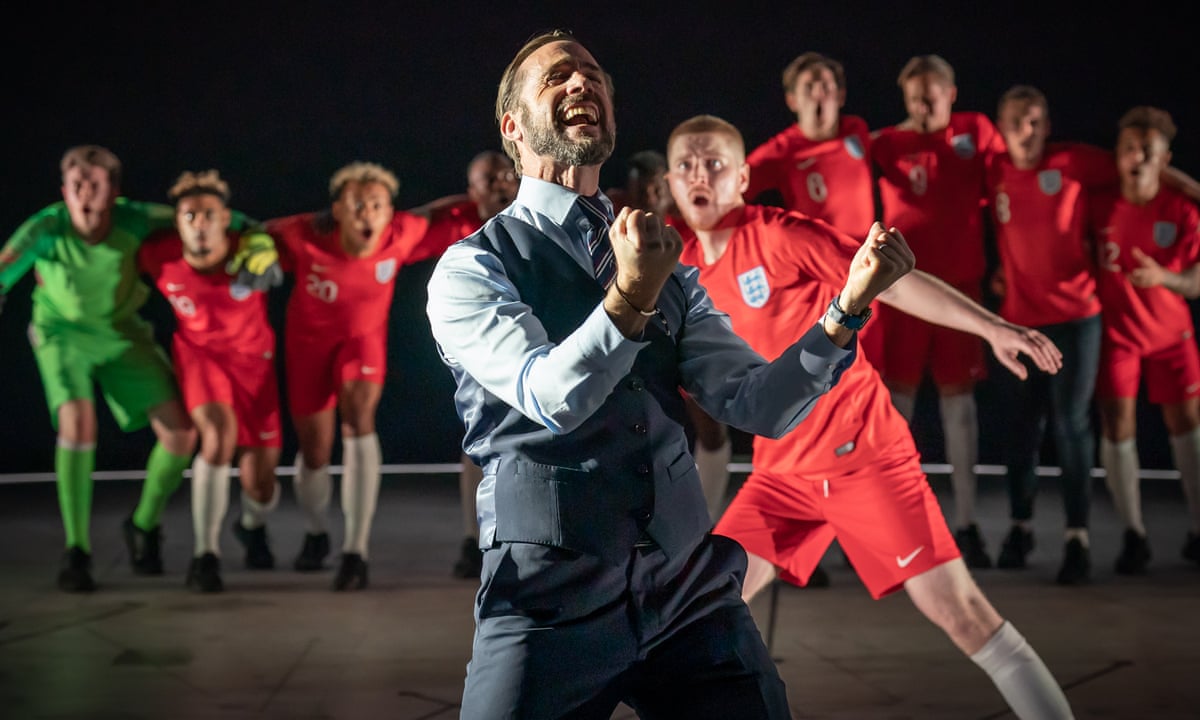
Both the National’s Dear England and Macbeth at the Donmar pushed the boundaries of what theatre can achieve. The former started life at the National but transferred comfortably to the huge Prince Edward Theatre (usually reserved for musicals), I imagine that director Rupert Goold felt just like Orson Welles did when he was turned loose on a Hollywood Studio to direct his first film – he thought it was the biggest train-set in the world. I can’t think of a dramatic device that Goold and writer James Graham didn’t use to present this story of Gareth Southgate and the England team. Even for a non-football fan like me, it was a thrilling evening, and Joseph Fiennes as Southgate gave the biography performance of the year.
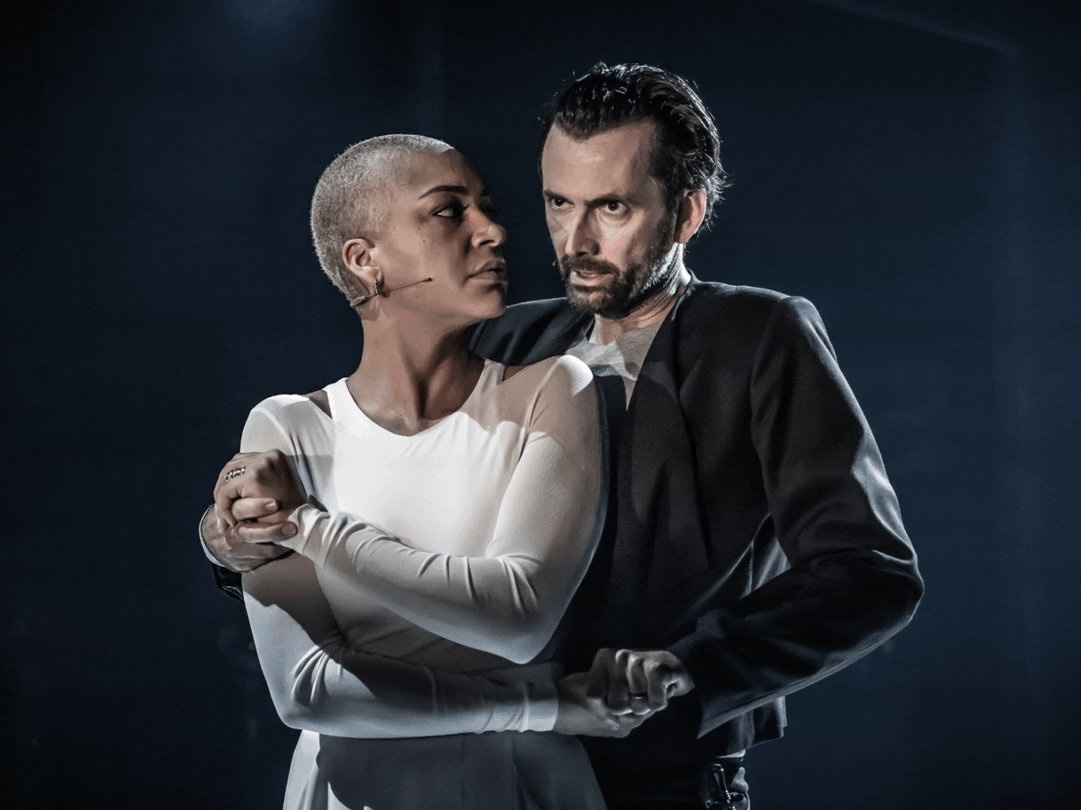
On a smaller scale, but equal in ambition and achievement, Max Webster’s production of Macbeth was a landmark. I was worried that audiences might be alienated by the use of headphones but these were very simple to use and incredibly successful in transmitting the play. Both the text and narrative were extremely clear (it’s one of Shakespeare’s most difficult plays) and David Tennant and Cush Jumbo gave riveting performances. It was a historic evening.
And I haven’t mentioned veteran actress Anne Reid with Nancy Carroll in Marjorie Prime, or Sheridan Smith winning audiences’ affection in Shirley Valentine, or Charlie Stemp singing and dancing his way through the delightful Crazy for You.
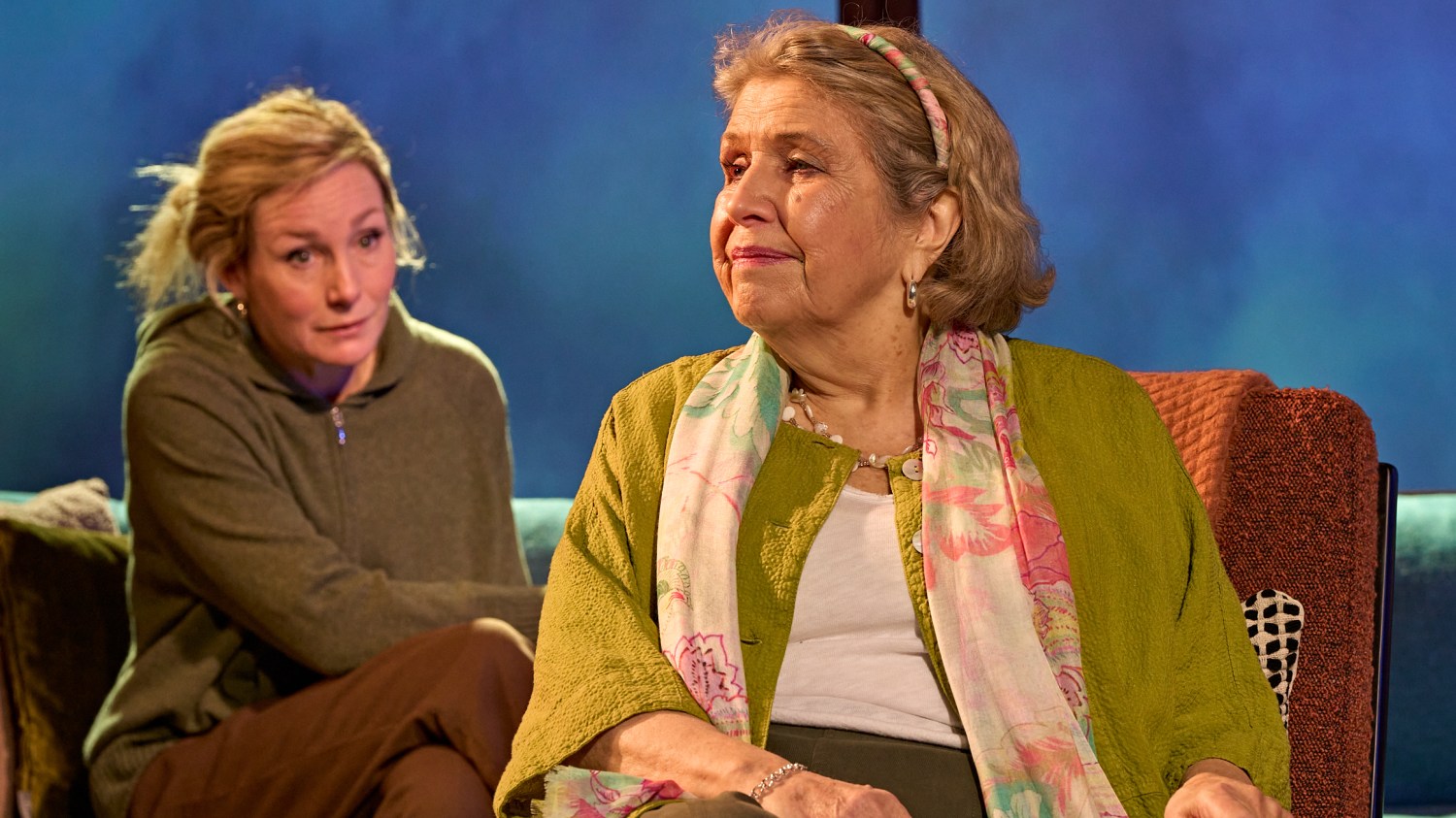


All in all, a pretty good year. One of our group, John Carr, kindly wrote a piece for our website identifying some of the highlights he and Judith have enjoyed with us over recent years. Mike and I would love it if several more of our group would let us know via the Comments page what your highlights were this year, and who you think gave the best performance. We look forward to hearing from you!
No review of our year is complete without a few Thank Yous. Mike and I enjoy good relations with the theatres and the agencies we deal with to get your tickets, though it has to be said that some are more co-operative than others. The box-office staff at the Gillian Lynne Theatre compensated for the obstacles created by LW Theatres to make bookings; please look into this, Sir Andrew L-W! Sophie at NIMAX, and Sheila at Sadler’s Wells are exceptionally helpful, and the team at Delfont Mackintosh (when I can get through to them on the phone) are reliable and well-informed. Several of the staff at the very busy ATG Groupline have taken a lot of time to assist with our bookings. As always, we have a great relationship with our friends at the Donmar: please note that the entire season of Macbeth sold out within 20 minutes, yet they ensured we still secured 60 tickets.
We rely very heavily on the expert drivers from Cook’s Coaches, and I am genuinely in awe of their skill and patience in navigating the increasingly difficult journeys into London.
Mike maintains that the most important people in the theatre are not the actors and the directors and the writers, but the audience. By extension, the most important people in our group are you, our patrons. It’s been a good year for us, and it’s been better for sharing it with you.
And even more, we look forward to seeing you again in 2024!
(You can see a list of all shows seen in 2023 in the Bookings section.)
01/01/24 Mike writes –
OOO23
The Shows we visited without you
If anyone ever asks what sort of ‘retired’ lives we lead, I tell them we take people to the theatre. You know that. But of course that’s not the only theatre we see as more frequently we are off at a show by ourselves or sometimes with friends – OnOurOwn, as we like to put it. We report back to you on our website, to both keep you abreast of what London theatres are offering and perhaps recommend shows you may like to visit on your own. These OOO shows make up the majority of our theatre visits.
Are we a dying breed? This becomes more and more likely as prices go through the roof. Theatregoing is generally becoming an elite event, a treat for special occasions or for fans of the stars. I began my regular theatregoing in 1961, up in the Gods with a bird’s eye view of the stage. As I earned more money and then joined with Fredo on his theatre visits, I moved downstairs to the Group’s better seats. When we venture out OnOurOwn, we are now usually back in the cheaper Gods. Or we frequently visit those OffWestEnd theatres where prices are still affordable. Senior discounts are welcome too, but only subsidised theatres run on a charity basis provide these.
This past year has been exceptional with many shows earning our four or five ★ ratings. We have also managed to see plays which we would love to offer to the Group but the seats were too expensive without a Group or Senior discount. Or perhaps their appeal was not wide enough to fill our coach, a necessity if we are not to be out-of-pocket.
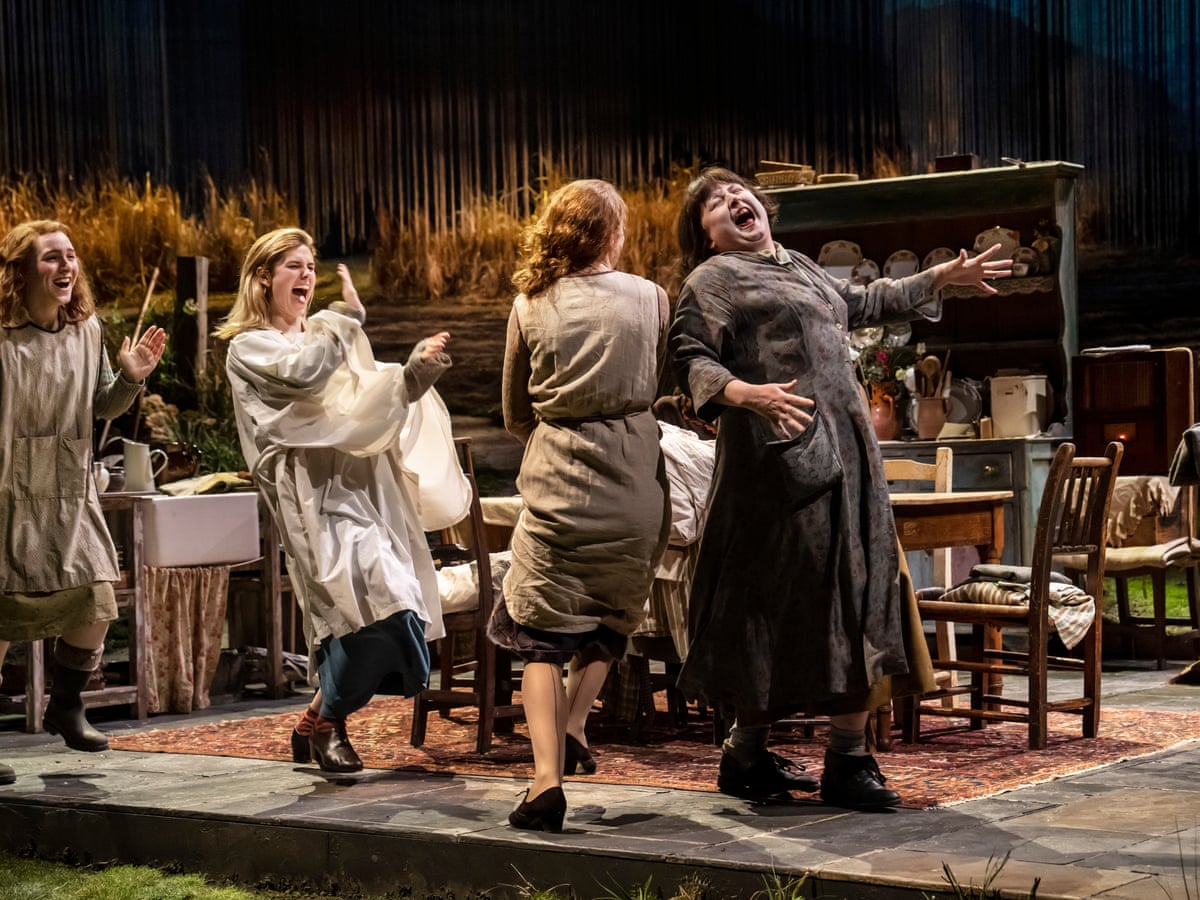
We saw one major musical at the National which we wanted to take our Group to see but there was no availability. Now it’s transferring to the West End and we have booked you in to see this epic and emotional Standing at the Sky’s Edge. I streamed my favourite song, the plaintive Open Up Your Door, repeatedly afterwards. Another 5 ★ production at the National was Brian Friel’s Dancing at Lughnasa – for both shows we sat in the front £20 seats (limited to 2 per booking) and basked in the emotional warmth of this atmospheric Irish masterpiece.
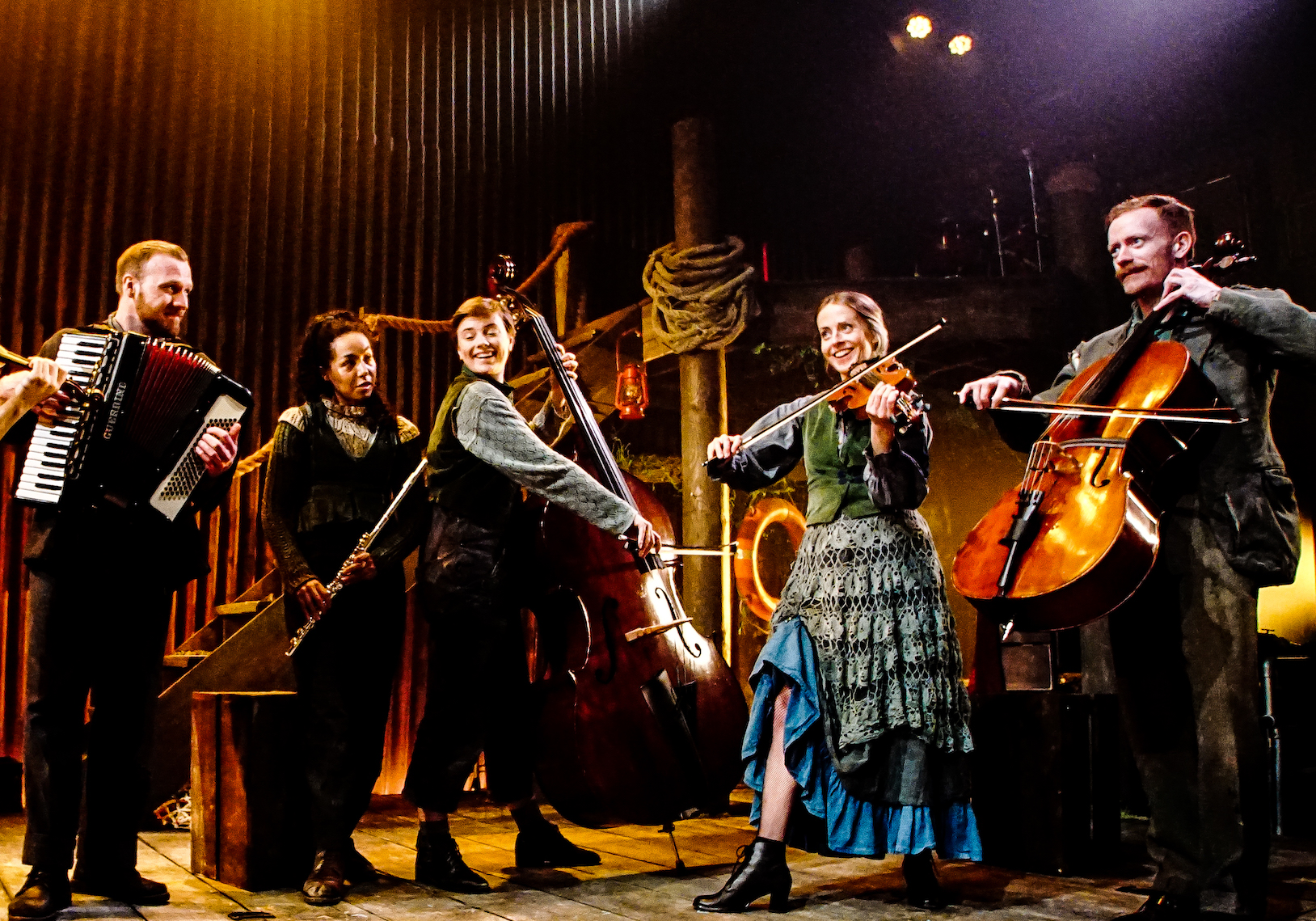
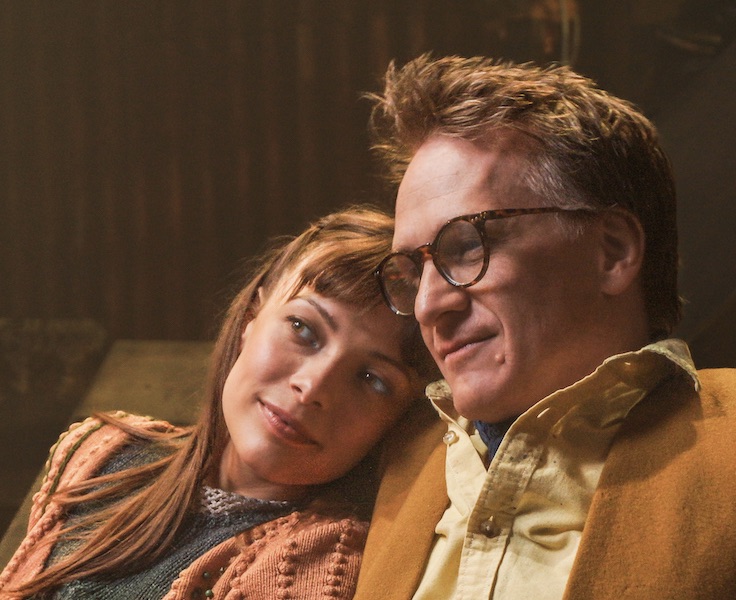
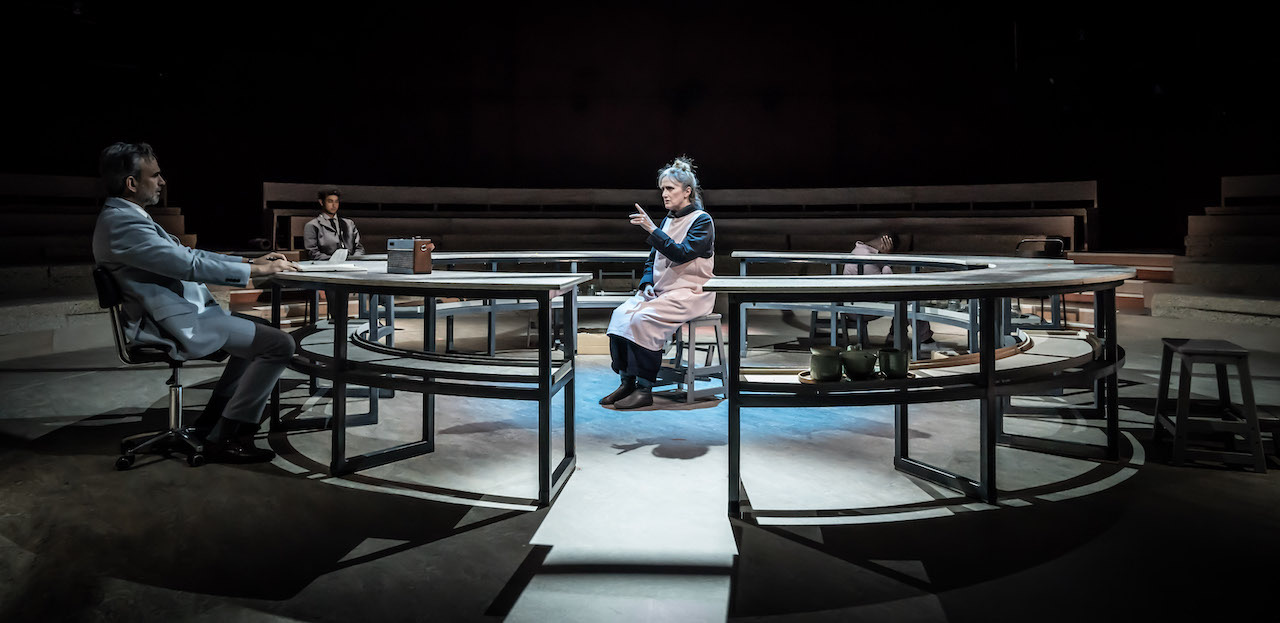
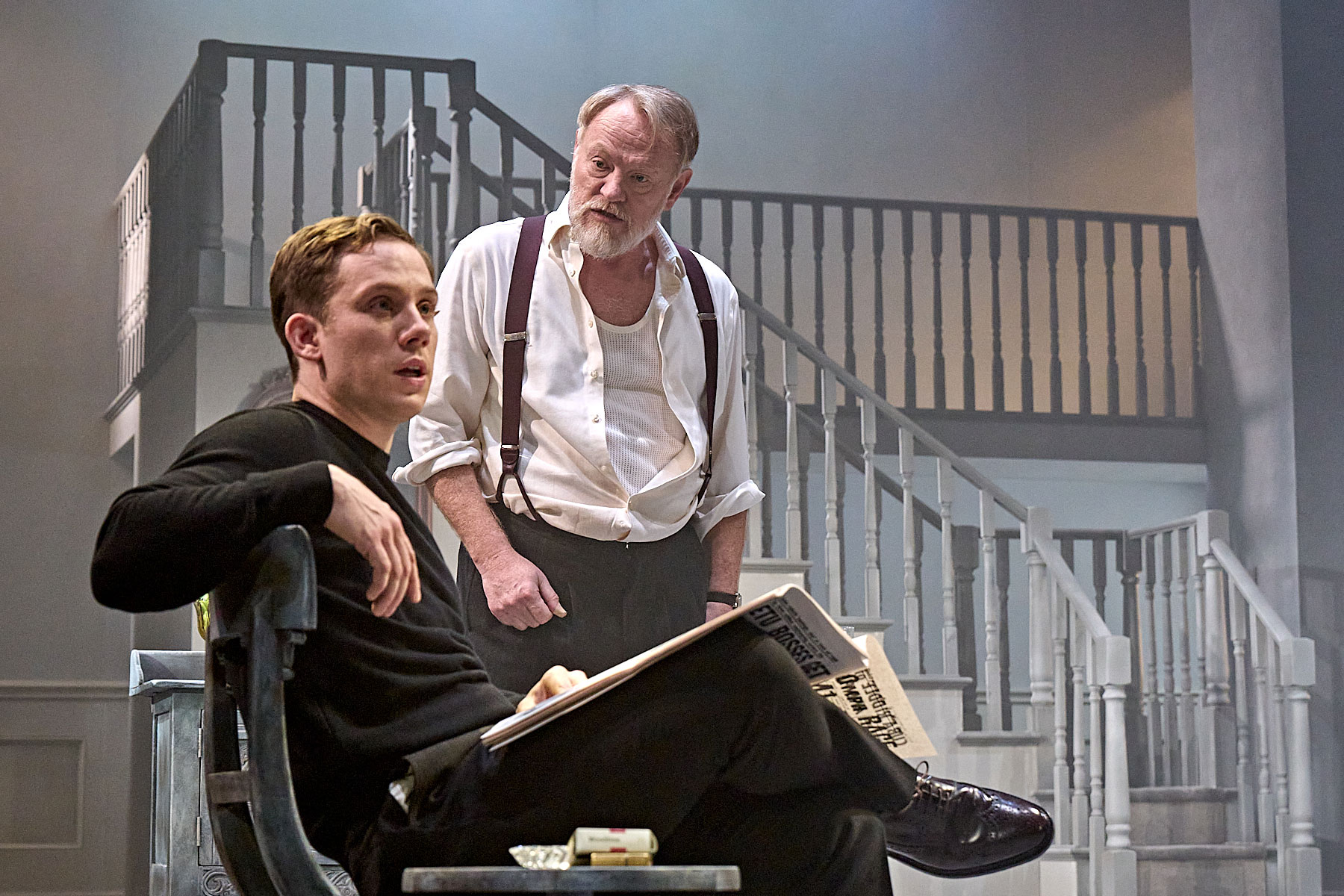
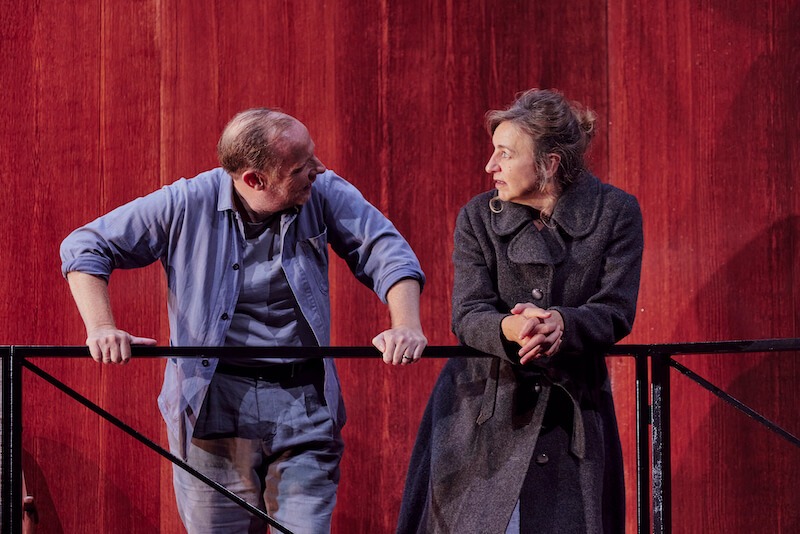
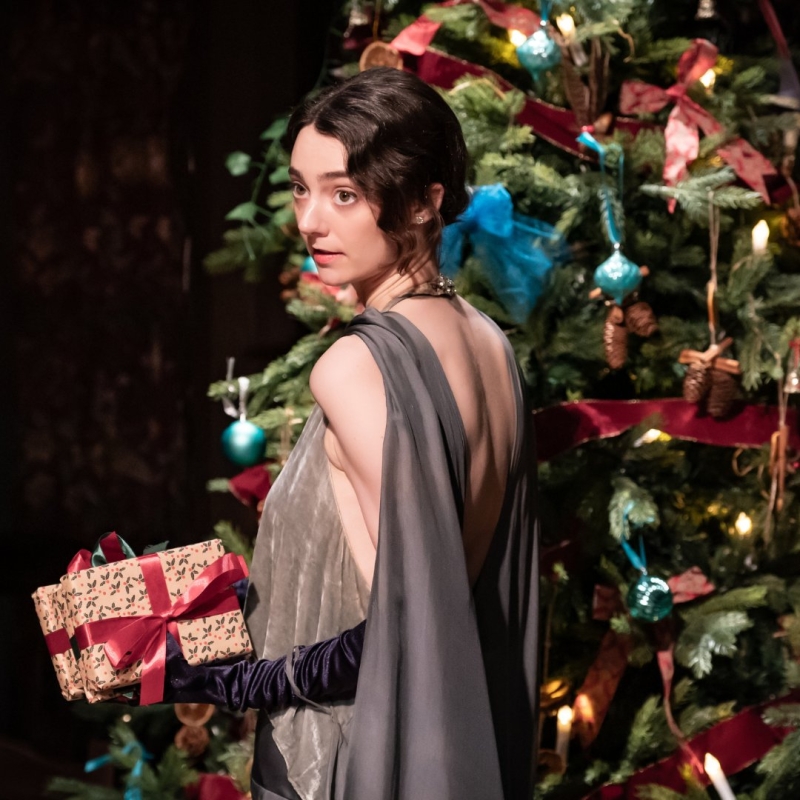
At the Southwark Playhouse we caught an unusual based-on-the-film musical with Jamie Parker as the titular lead in The Curious Case of Benjamin Button. This one deserved to transfer to the West End for a larger audience, but that all too rarely happens to shows from outside the West End. The Young Vic this year tempted us with two promising plays, Further than the Furthest Thing and Pinter’s The Homecoming. More locally, for me, we have visited Kingston’s Rose Theatre for Miller’s A View from the Bridge, and the tiny Orange Tree in Richmond for She Stoops to Conquer, set-in-the-round with the audience seated-in-the-set which was appropriately dressed for Christmas.
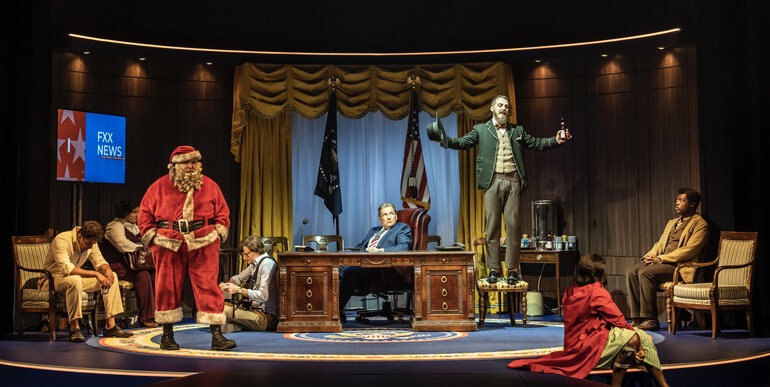
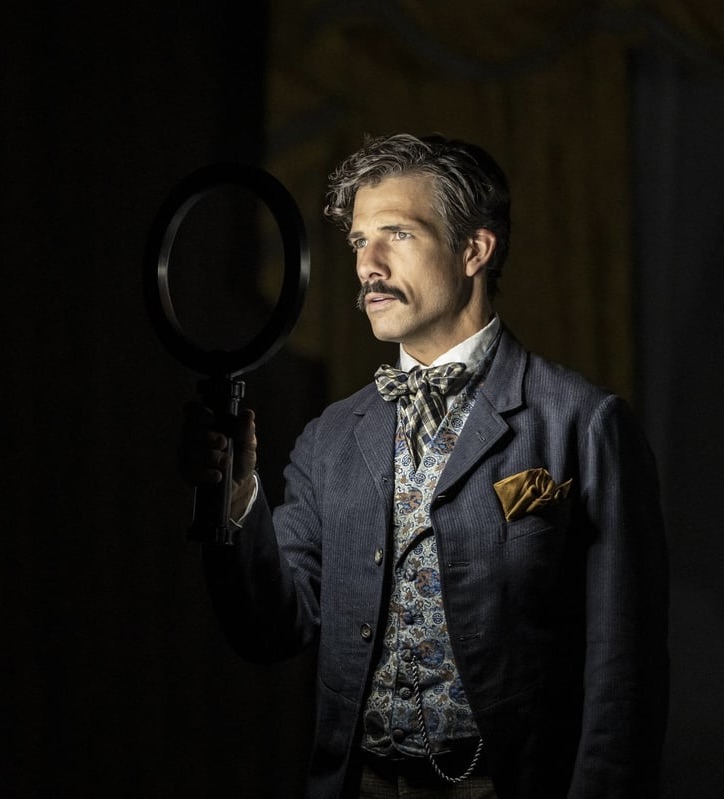

Sometimes we go further afield, and this year we took the train to Chichester for Assassins, with Danny Mac, in this not-to-be-missed Sondheim which earned a 5 ★ rating from me. We doubled that up while there with 4000 Miles starring the must-be-seen Eileen Atkins.
Musicals usually sell better than plays and yet so many plays, new or revivals, are too good to miss. Or maybe I should say too ‘interesting’ to miss, for specific reasons. I chose to see A Little Life for James Norton and the best selling book it’s based on, and also a revival of The Pillowman for its cast and the playwright Martin McDonagh’s reputation. Neither rted highly. An updated Phaedra attracted us but we doubted her appeal would fill our coach – the update went a step too far for some. A modern teenage Romeo & Julie was a delight, only loosely based on Shakespeare’s play, and the senior-centred Infinite Life with its detailed talk of pain and bodily functions raised some eyebrows – both were small scale critical hits at the National’s Dorfman Theatre. At the Almeida, we were impressed with Lulu Raczka’s first play Women, Beware the Devil, but less so with Cold War.


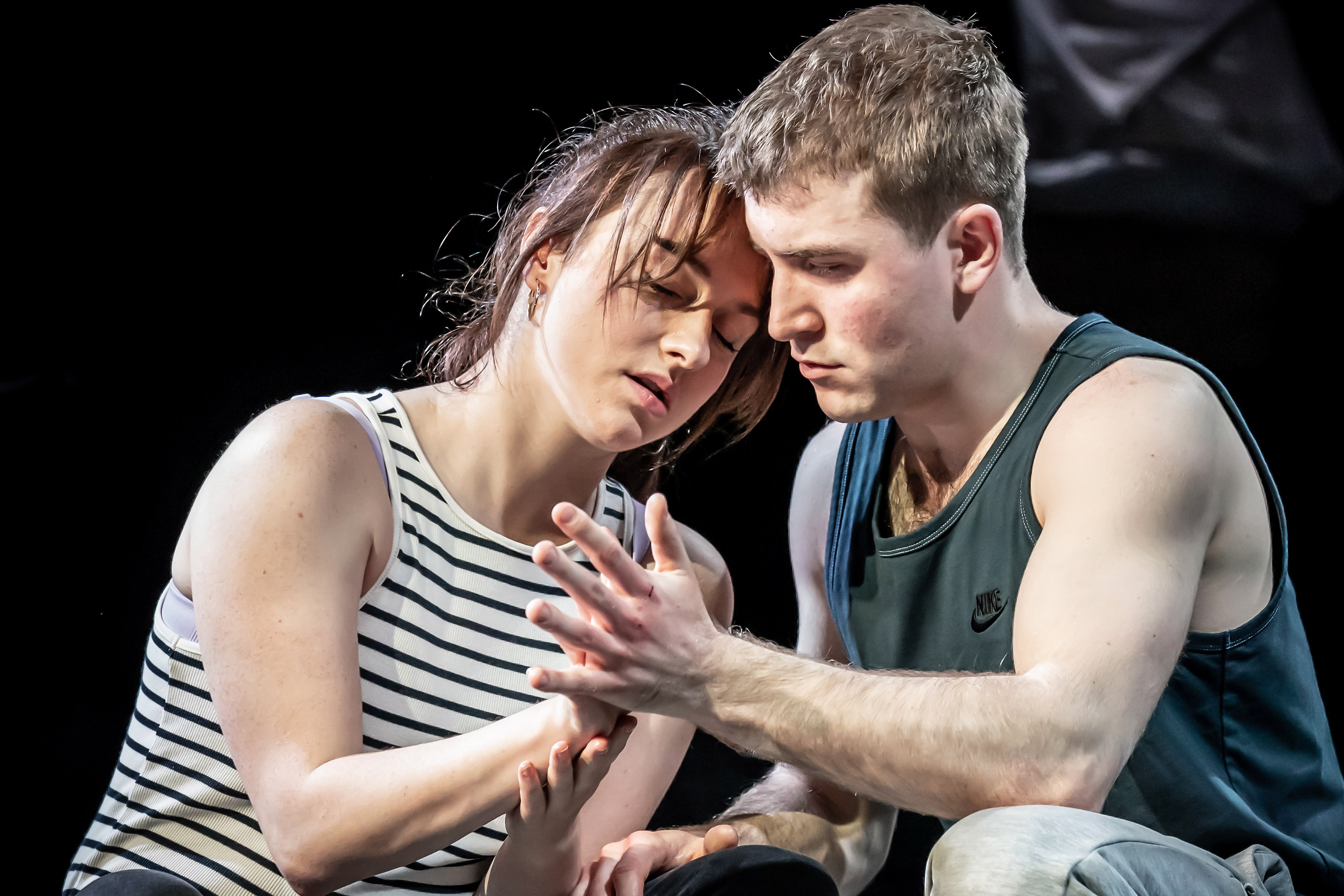

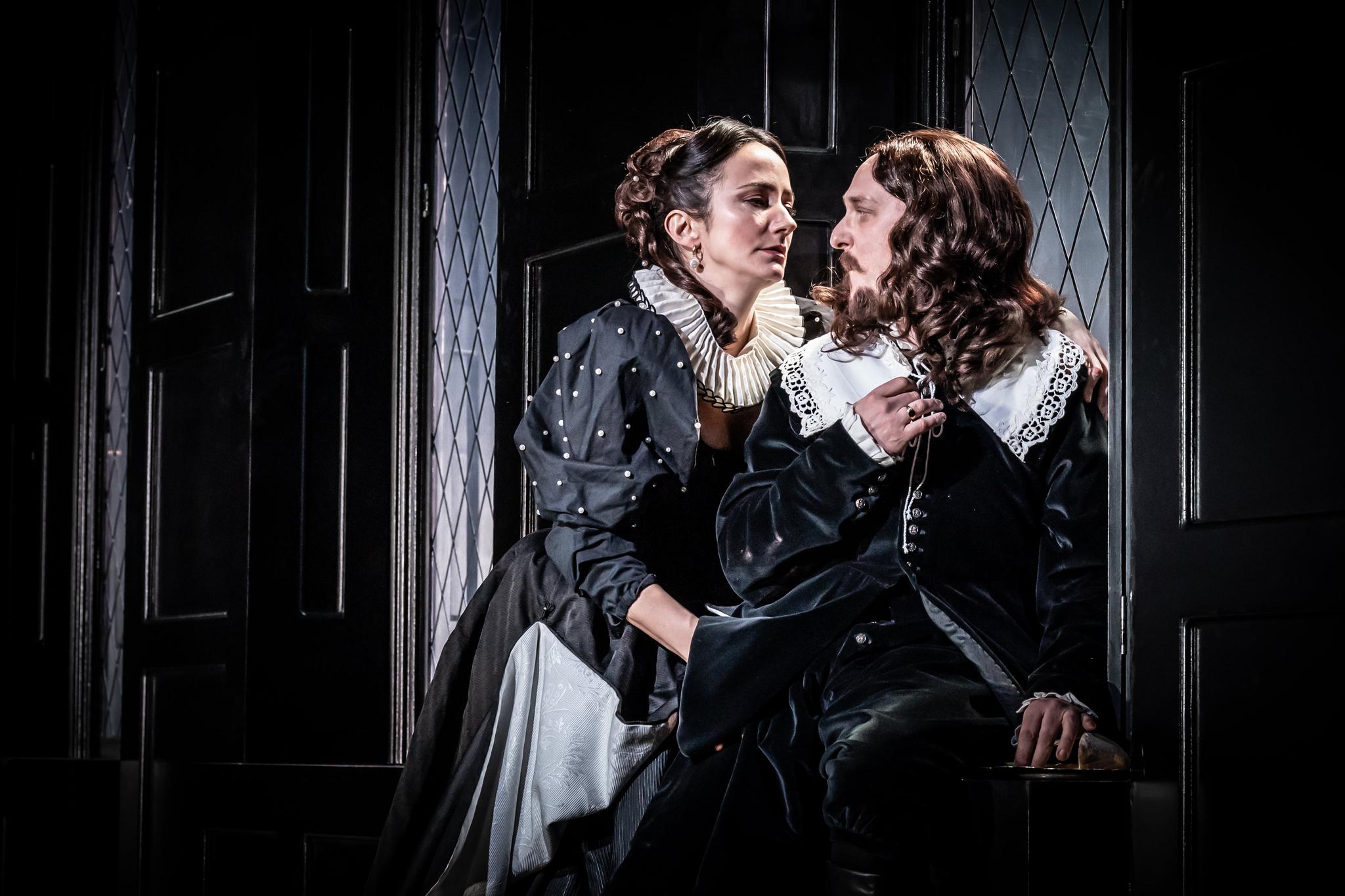
Operas sometimes feature in our schedule too, thanks to our friend Meryl who gets us cheap tickets for the ENO rehearsals. We have seen Wagner’s Rhinegold, the race-related Blue, The Dead City, and the strange Seven Deaths of Maria Callas. Also, I booked to see the powerful school-shooting opera Innocence at Covent Garden from the rear Amphitheatre, not an ideal view but an affecting opera worth catching.

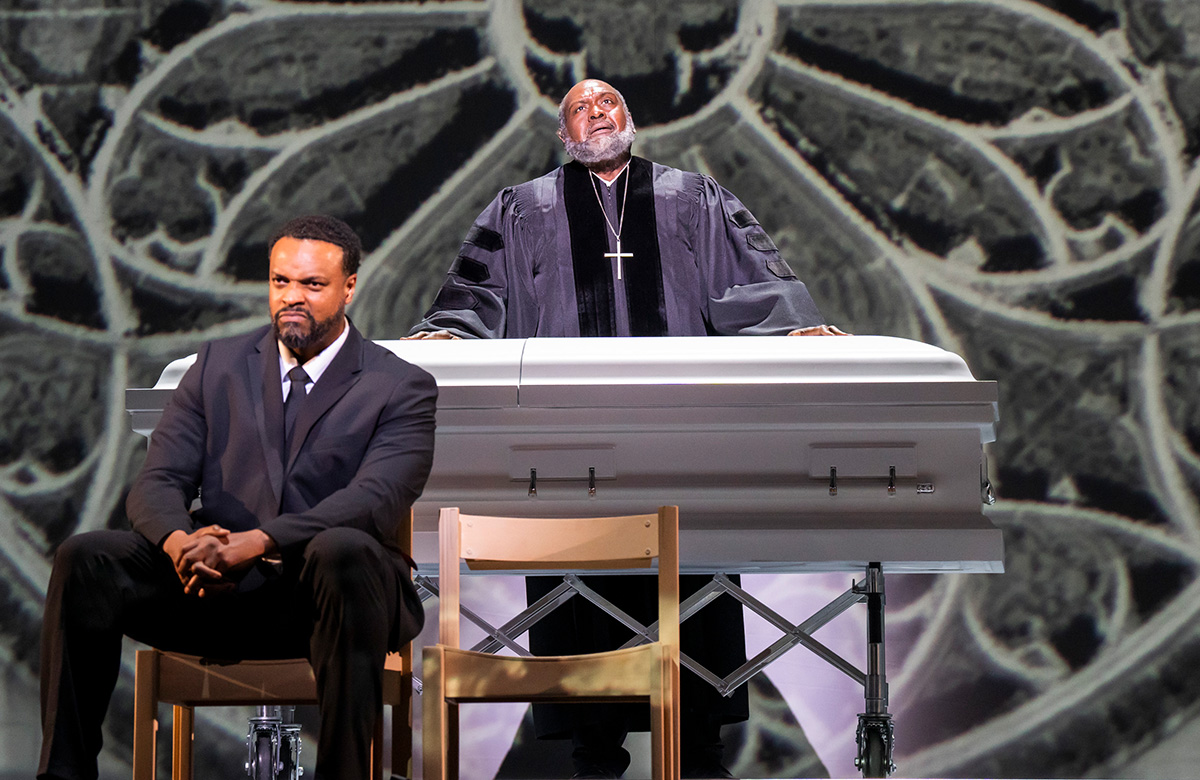

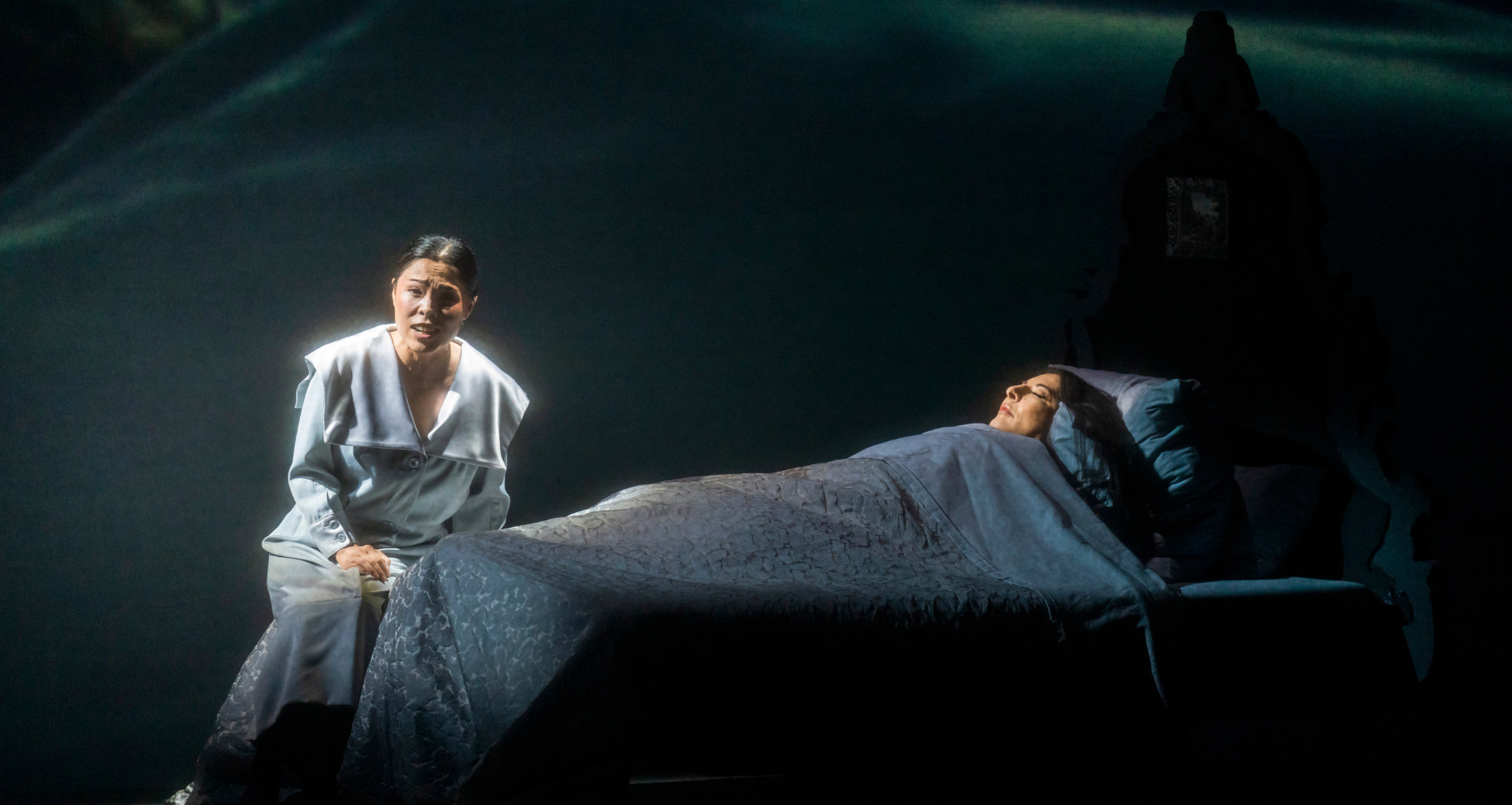
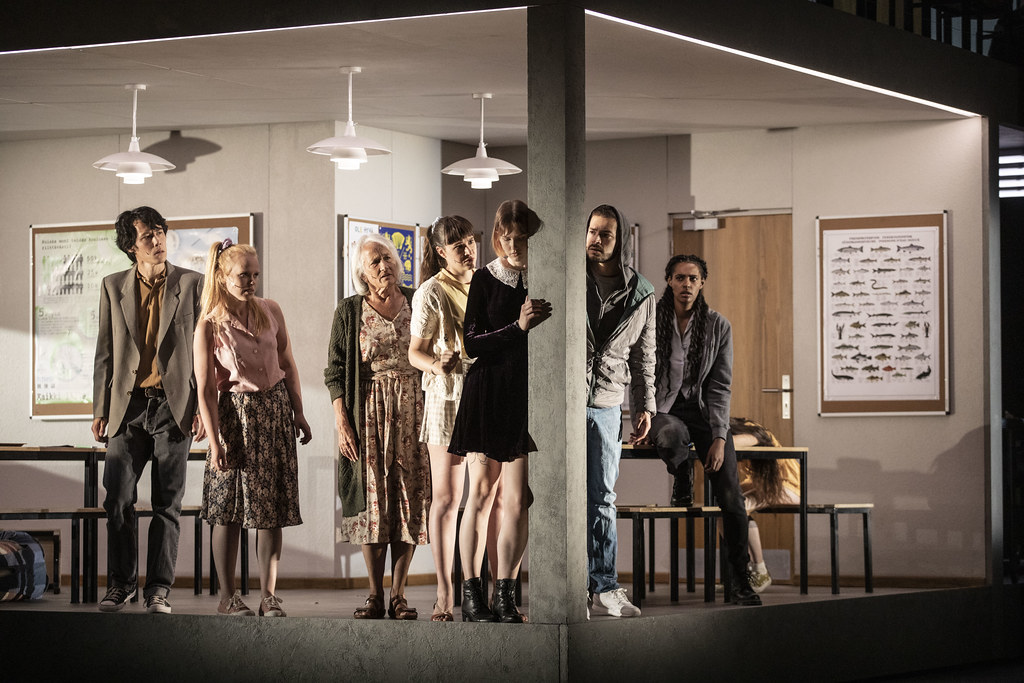
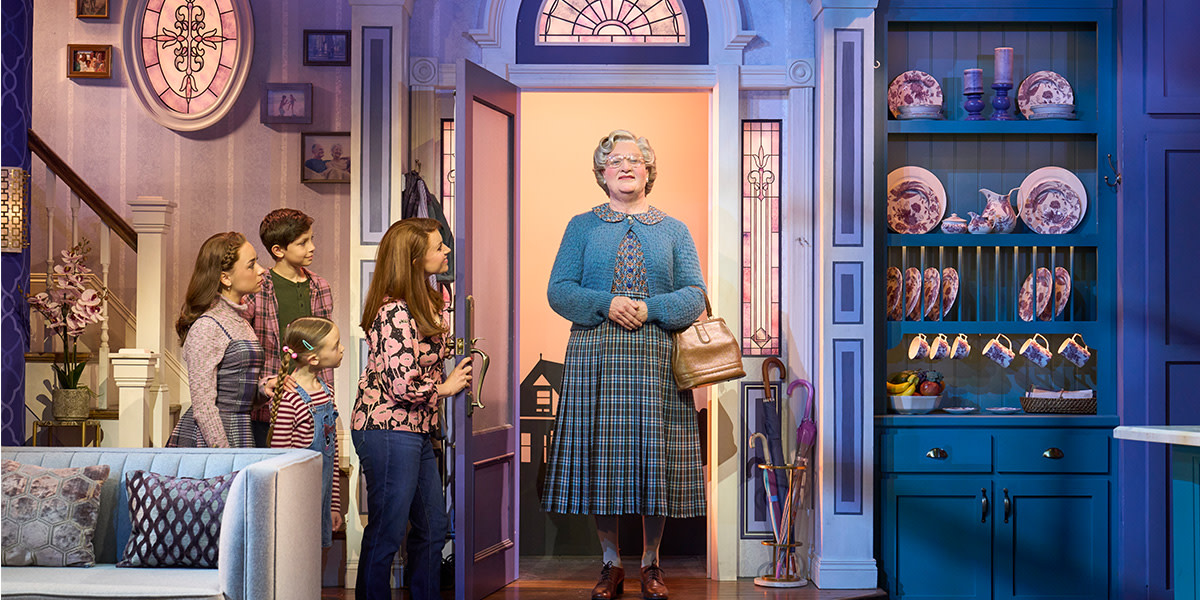
One of the perks of organising groups is that occasionally producers invite us to previews of their shows, and naturally we can never refuse a freebie or they may never ask us again. This last year we were invited to ten shows including the gleefully funny Backstairs Billy (my comedy of the year) which the Group subsequently enjoyed. Invitations also came for several of my lowest ★ ratings which I shall tactfully not mention (though you can check our OnOurOwn reports elsewhere). However, the musical-of-the-film Mrs Doubtfire was an unexpected fun freebie with the little known Gabriel Vick leading the cast (but not mentioned in the advertising) as the gender-swap dad.


Every year there are always high spots and missed opportunities. Fredo has mentioned many highlights we did see so it’s left to me to mention those we missed out on. We did not see Jamie Lloyd’s production of Sunset Boulevard because the prices were astronomical (and we were not invited!) – for some it was the show-of-the-year. Recently many critics have been impressed by the amazing staging of Stranger Things so I have booked myself a ticket at a great discount (a Boxing Day offer, thanks to london-theatreland.co.uk) for later this January. Happily, there are some upcoming biggies we have already booked the Group to see, at reasonable prices, so we won’t miss out and neither will you.

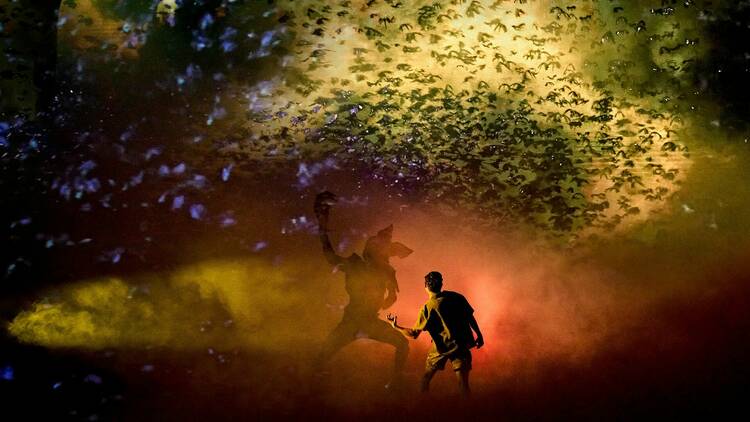
In 2023 we saw about 50 shows on our own in addition to our coach trips. We get about because some would say our enthusiasm knows no bounds. Or we have a theatre obsession. Perhaps it’s in our DNA. But we never forget how lucky we are to have London’s enormous cultural choices on our doorstep. We know you know that too.
Previous articles continued on next page
 theatreguys